
420 vs 304 Stainless Steel: Strength, Corrosion Resistance & Industrial Applications
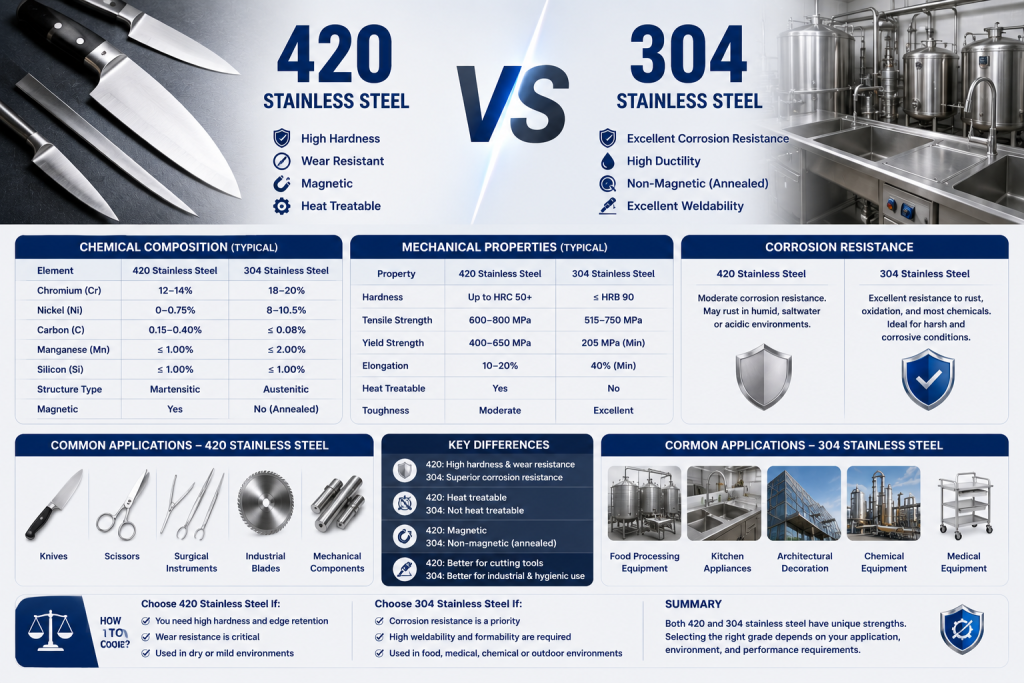
420 stainless steel and 304 stainless steel are two widely used stainless steel grades in global industrial manufacturing. Although both belong to the stainless steel family, they differ significantly in composition, hardness, corrosion resistance, heat treatment capability, and application focus.
304 stainless steel is globally recognized for its excellent corrosion resistance and versatile industrial performance, while 420 stainless steel is valued for its high hardness and wear resistance after heat treatment. Understanding the differences between these two materials is essential for selecting the right stainless steel for industrial, commercial, medical, and engineering applications.
This article provides a comprehensive comparison of 420 vs 304 stainless steel, including mechanical properties, corrosion resistance, processing performance, industrial uses, and long-term value considerations.
1. What Is 420 Stainless Steel?
420 stainless steel is a:
Martensitic stainless steel
that contains relatively high carbon content and moderate chromium levels.
Main Characteristics of 420 Stainless Steel
- High hardness after heat treatment
- Excellent wear resistance
- Good polishing capability
- Magnetic structure
- Moderate corrosion resistance
420 stainless steel is commonly used in applications requiring:
- Sharp edges
- Abrasion resistance
- Mechanical durability
Typical products include:
- Knives
- Surgical instruments
- Industrial blades
- Cutting tools
- Mechanical components
2. What Is 304 Stainless Steel?
304 stainless steel is an:
Austenitic stainless steel
containing high chromium and nickel content.
Main Characteristics of 304 Stainless Steel
- Excellent corrosion resistance
- Outstanding weldability
- Good formability
- Non-magnetic in annealed condition
- Excellent hygienic performance
304 stainless steel is one of the most commonly used stainless steel grades worldwide due to its balanced overall performance.
It is widely used in:
- Food processing equipment
- Kitchen appliances
- Architectural decoration
- Chemical equipment
- Industrial tanks and pipelines
3. Chemical Composition Comparison
| Element | 420 Stainless Steel | 304 Stainless Steel |
|---|---|---|
| Chromium (Cr) | 12–14% | 18–20% |
| Nickel (Ni) | Usually low or none | 8–10.5% |
| Carbon (C) | Higher | Lower |
| Structure Type | Martensitic | Austenitic |
| Magnetic | Yes | Mostly non-magnetic |
The higher nickel and chromium content in 304 stainless steel gives it significantly better corrosion resistance.
4. Hardness and Strength Comparison
420 Stainless Steel Hardness
420 stainless steel can achieve very high hardness after heat treatment.
Typical hardness range:
- Up to HRC 50+ depending on treatment
This makes it highly suitable for:
- Blades
- Cutting tools
- Wear-resistant parts
304 Stainless Steel Hardness
304 stainless steel cannot be hardened through conventional heat treatment.
However, it offers:
- Excellent toughness
- Good ductility
- Stable mechanical performance
In terms of wear resistance and edge retention, 420 stainless steel clearly outperforms 304.
5. Corrosion Resistance Comparison
304 Stainless Steel Corrosion Resistance
304 stainless steel provides excellent resistance to:
- Humidity
- Food acids
- Industrial environments
- General atmospheric corrosion
Its high chromium and nickel content creates a stable passive oxide layer that protects against corrosion.
420 Stainless Steel Corrosion Resistance
420 stainless steel offers only moderate corrosion resistance.
It may experience corrosion in:
- Saltwater exposure
- High humidity
- Acidic environments
Therefore, 304 stainless steel is generally preferred for corrosive or hygienic applications.
6. Heat Treatment Capability
| Property | 420 Stainless Steel | 304 Stainless Steel |
|---|---|---|
| Heat Treatable | Yes | No |
| Hardening Capability | Excellent | Limited |
| Wear Resistance | High | Moderate |
| Toughness | Moderate | Excellent |
420 stainless steel is specifically designed for applications requiring hardness and wear resistance through heat treatment.
7. Weldability and Fabrication
304 Stainless Steel
- Excellent weldability
- Easy forming and bending
- Ideal for large fabrication projects
420 Stainless Steel
- More difficult to weld
- Higher risk of cracking
- Requires controlled welding procedures
For fabrication-intensive projects, 304 stainless steel is generally the superior option.
8. Common Industrial Applications
420 Stainless Steel Applications
- Knife manufacturing
- Surgical tools
- Industrial blades
- Scissors
- Mechanical shafts
304 Stainless Steel Applications
- Food-grade equipment
- Kitchen sinks
- Architectural panels
- Chemical processing systems
- Medical equipment
9. Cost Comparison
Generally:
- 420 stainless steel is usually lower in cost
- 304 stainless steel is more expensive due to nickel content
However, lifecycle cost depends on:
- Environmental exposure
- Maintenance requirements
- Service lifespan
In corrosive environments, 304 stainless steel often provides better long-term value because of its superior durability.
10. Which Stainless Steel Should You Choose?
Choose 420 Stainless Steel If:
- You need high hardness
- Wear resistance is critical
- Cutting performance matters
- The environment is relatively dry
Choose 304 Stainless Steel If:
- Corrosion resistance is important
- You need excellent weldability
- The application requires hygiene
- Outdoor or humid conditions exist
11. Future Market Trends
As global industries continue upgrading manufacturing standards, demand for specialized stainless steel materials continues growing.
420 stainless steel remains important in:
- Precision cutting tools
- Medical instruments
- Industrial machinery
Meanwhile, 304 stainless steel continues dominating:
- Food-grade industries
- Construction projects
- Industrial fabrication
- Infrastructure development
Both grades maintain strong market demand because they serve different engineering priorities.
Frequently Asked Questions (FAQ)
Is 420 stainless steel stronger than 304?
420 stainless steel is harder and more wear-resistant after heat treatment, while 304 offers better toughness and corrosion resistance.
Which stainless steel is better for knives?
420 stainless steel is commonly preferred for knives because it can achieve high hardness and sharp edge retention.
Does 420 stainless steel rust?
420 stainless steel has moderate corrosion resistance but may rust in humid or salty environments if not properly maintained.
Why is 304 stainless steel more expensive?
304 contains higher nickel content, which improves corrosion resistance but increases material cost.
Can 304 stainless steel be heat treated?
304 stainless steel cannot be hardened using conventional heat treatment methods.
Conclusion: 420 stainless steel and 304 stainless steel are designed for different industrial purposes. 420 stainless steel excels in hardness, cutting performance, and wear resistance, making it ideal for blades and precision tools. In contrast, 304 stainless steel offers superior corrosion resistance, fabrication performance, and hygienic properties, making it one of the most versatile stainless steel grades in the global market. Selecting the right material depends on environmental conditions, mechanical requirements, maintenance expectations, and long-term operational goals.
