
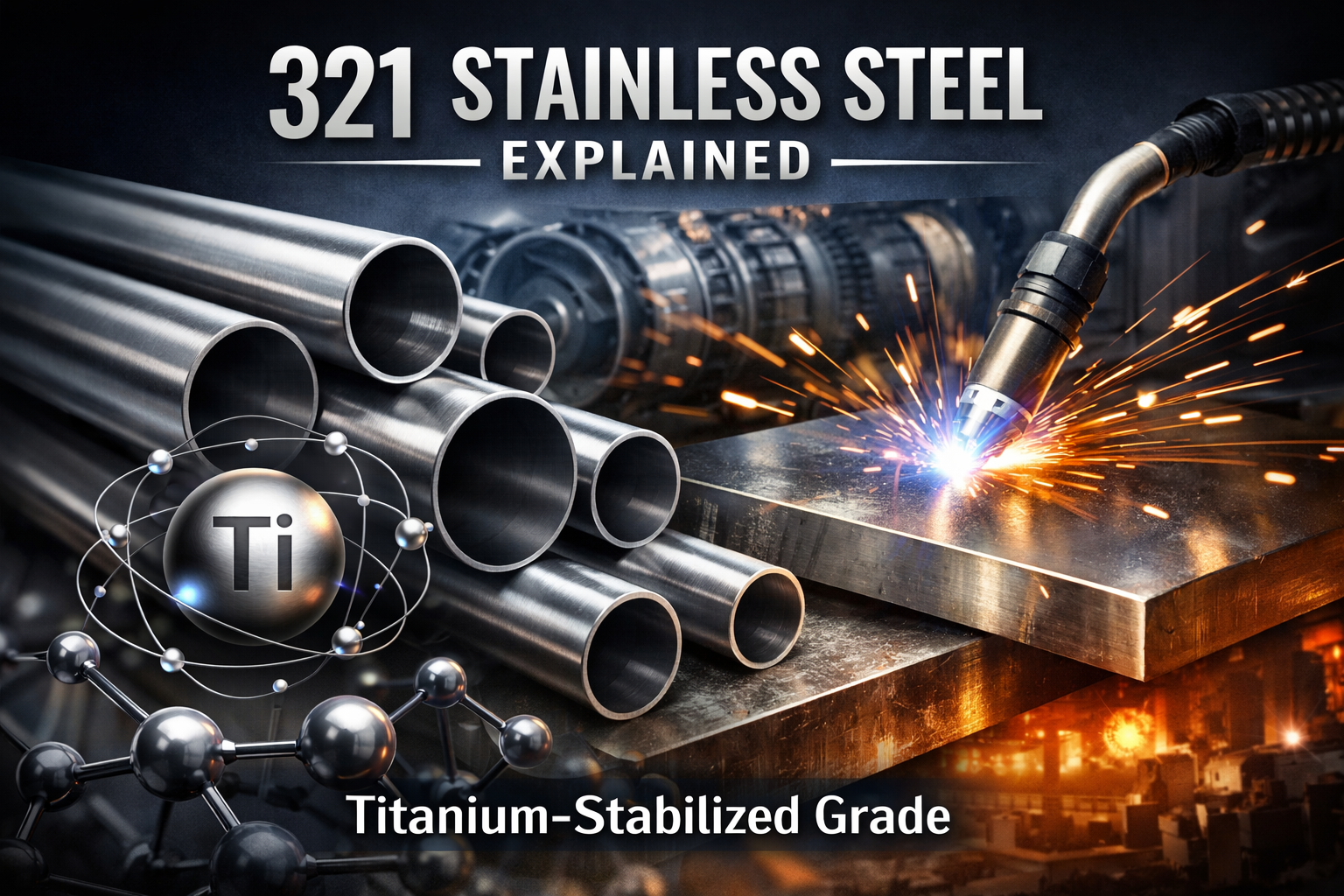
321 Stainless Steel Explained: Titanium-Stabilized Grade
321 stainless steel is a titanium-stabilized austenitic stainless steel designed to offer
enhanced resistance to intergranular corrosion, particularly after exposure to elevated
temperatures. As a modified version of 304 stainless steel, it provides improved performance
in high-temperature environments, making it a preferred material in aerospace, chemical,
and thermal processing industries.
1. What Is 321 Stainless Steel?
321 stainless steel (UNS S32100) is an austenitic chromium-nickel stainless steel stabilized
with titanium. The addition of titanium prevents the formation of chromium carbides at grain
boundaries, which can otherwise lead to intergranular corrosion during welding or prolonged
exposure to temperatures between 425°C and 850°C.
This stabilization makes 321 stainless steel particularly suitable for applications involving
repeated heating cycles or high-temperature service.
2. Chemical Composition of 321 Stainless Steel
| Element | Content (%) |
|---|---|
| Carbon (C) | ≤ 0.08 |
| Chromium (Cr) | 17.0 – 19.0 |
| Nickel (Ni) | 9.0 – 12.0 |
| Titanium (Ti) | ≥ 5 × C (typically 0.3 – 0.7) |
| Manganese (Mn) | ≤ 2.0 |
| Silicon (Si) | ≤ 1.0 |
| Phosphorus (P) | ≤ 0.045 |
| Sulfur (S) | ≤ 0.03 |
| Iron (Fe) | Balance |
3. Key Properties of 321 Stainless Steel
3.1 Resistance to Intergranular Corrosion
The titanium stabilization prevents chromium carbide precipitation, ensuring excellent resistance
to intergranular corrosion even after welding or prolonged exposure to high temperatures.
3.2 High-Temperature Performance
321 stainless steel performs well in temperatures up to approximately 870°C in continuous service
and higher in intermittent conditions, maintaining structural integrity and oxidation resistance.
3.3 Mechanical Properties
- Tensile Strength: ≥ 515 MPa
- Yield Strength: ≥ 205 MPa
- Elongation: ≥ 40%
3.4 Good Weldability
Unlike standard 304 stainless steel, 321 does not require post-weld annealing in most cases,
making it highly suitable for welded structures in high-temperature environments.
3.5 Oxidation Resistance
The chromium content provides good resistance to oxidation, especially in moderately aggressive
environments.
4. Applications of 321 Stainless Steel
4.1 Aerospace Industry
- Aircraft exhaust systems
- Jet engine components
- Thermal shielding systems
4.2 Petrochemical and Chemical Processing
- High-temperature pipelines
- Heat exchangers
- Refinery equipment
4.3 Thermal Processing Equipment
- Furnace parts
- Expansion joints
- Heat treatment equipment
4.4 Automotive Industry
- Exhaust manifolds
- Emission control systems
4.5 Power Generation
- Boiler components
- High-temperature piping systems
5. Advantages of 321 Stainless Steel
- Excellent resistance to intergranular corrosion
- Superior high-temperature stability
- Good weldability without post-treatment
- Reliable performance in cyclic heating environments
6. Limitations of 321 Stainless Steel
- Higher cost compared to 304 stainless steel
- Not as resistant to chloride corrosion as 316 grades
- Limited use in highly reducing environments
7. 321 vs 304 Stainless Steel
While both are austenitic stainless steels, 321 offers improved performance in high-temperature
applications due to titanium stabilization. 304 is more economical and suitable for general-purpose
use, whereas 321 is preferred for thermal and welded applications.
8. 321 vs 316 Stainless Steel
316 stainless steel provides better resistance to chloride corrosion due to the presence of molybdenum,
while 321 excels in high-temperature environments and resistance to intergranular corrosion.
FAQ
Q1: What is the main benefit of titanium in 321 stainless steel?
Titanium stabilizes the structure by preventing chromium carbide formation, improving resistance
to intergranular corrosion.
Q2: Is 321 stainless steel suitable for high-temperature applications?
Yes, it is specifically designed for elevated temperature environments and performs well under
thermal cycling conditions.
Q3: Can 321 stainless steel be welded easily?
Yes, it has excellent weldability and typically does not require post-weld heat treatment.
Q4: How does 321 compare to 316 stainless steel?
321 is better for high-temperature use, while 316 is better for corrosion resistance in chloride environments.
Q5: Where is 321 stainless steel commonly used?
It is commonly used in aerospace, petrochemical processing, power generation, and heat treatment equipment.
Conclusion
321 stainless steel stands out as a high-performance, titanium-stabilized material designed for
demanding thermal environments. Its excellent resistance to intergranular corrosion and superior
high-temperature stability make it an essential choice for industries requiring reliability under
extreme conditions.
