
What Is 316L Stainless Steel Used For?
316L stainless steel is a low-carbon version of 316 stainless steel, widely recognized for its
superior corrosion resistance, excellent weldability, and durability in harsh environments.
Due to these characteristics, it is extensively used in industries such as marine engineering,
chemical processing, medical equipment, and food production.
1. What Is 316L Stainless Steel?
316L stainless steel is an austenitic stainless steel containing chromium (Cr), nickel (Ni),
and molybdenum (Mo). The addition of molybdenum significantly improves its resistance to
pitting and crevice corrosion, especially in chloride-rich environments.
The “L” in 316L stands for “Low Carbon,” typically ≤0.03%, which minimizes carbide precipitation
during welding and reduces the risk of intergranular corrosion.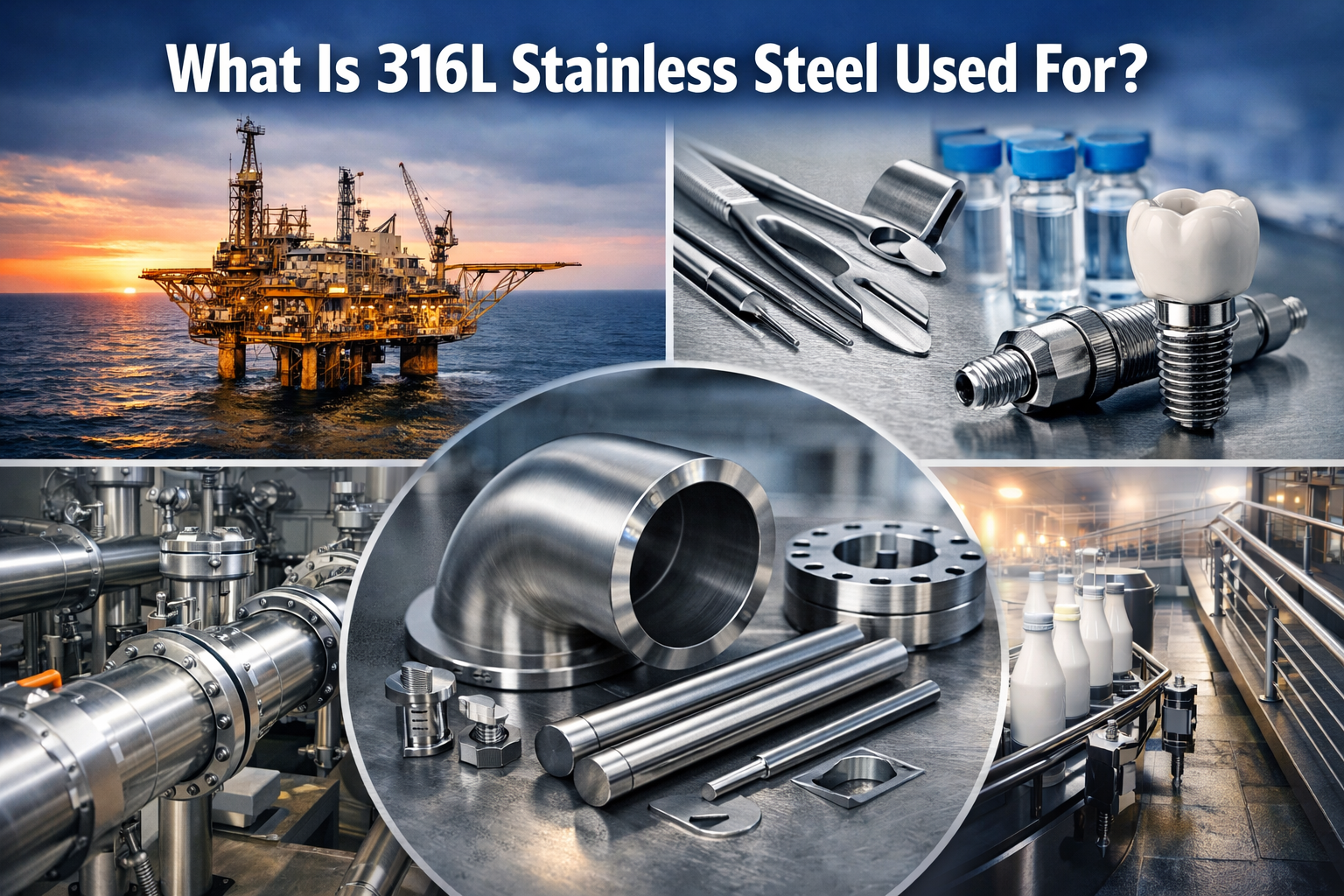
2. Chemical Composition of 316L Stainless Steel
| Element | Content (%) |
|---|---|
| Carbon (C) | ≤ 0.03 |
| Chromium (Cr) | 16.0 – 18.0 |
| Nickel (Ni) | 10.0 – 14.0 |
| Molybdenum (Mo) | 2.0 – 3.0 |
| Manganese (Mn) | ≤ 2.0 |
| Silicon (Si) | ≤ 1.0 |
| Phosphorus (P) | ≤ 0.045 |
| Sulfur (S) | ≤ 0.03 |
| Iron (Fe) | Balance |
3. Key Properties of 316L Stainless Steel
3.1 Superior Corrosion Resistance
316L stainless steel performs exceptionally well in chloride environments such as seawater
and chemical solutions. It offers better corrosion resistance than 304 stainless steel.
3.2 Excellent Weldability
The low carbon content reduces the risk of sensitization during welding, making 316L ideal
for welded structures without the need for post-weld annealing.
3.3 High Strength and Toughness
- Tensile Strength: ≥ 485 MPa
- Yield Strength: ≥ 170 MPa
- Elongation: ≥ 40%
3.4 Hygienic and Non-reactive
316L is non-toxic and easy to clean, making it suitable for sanitary applications such as
food processing and medical equipment.
4. Main Uses of 316L Stainless Steel
4.1 Marine Applications
Due to its excellent resistance to saltwater corrosion, 316L is widely used in:
- Ship components
- Marine hardware
- Offshore platforms
4.2 Chemical and Petrochemical Industry
316L stainless steel is commonly used in aggressive chemical environments:
- Chemical storage tanks
- Pipelines and valves
- Heat exchangers
4.3 Medical and Pharmaceutical Equipment
Its biocompatibility and corrosion resistance make it suitable for:
- Surgical instruments
- Implants
- Pharmaceutical processing equipment
4.4 Food Processing Industry
316L is widely used in hygienic environments:
- Food processing machinery
- Dairy equipment
- Brewery tanks
4.5 Architecture and Construction
In coastal or polluted environments, 316L is preferred over 304 due to its superior durability:
- Exterior cladding
- Railings and fittings
- Structural components
5. Advantages of 316L Stainless Steel
- Excellent resistance to corrosion and oxidation
- Superior performance in chloride environments
- Good weldability and formability
- Long service life
6. Limitations of 316L Stainless Steel
- Higher cost compared to 304 stainless steel
- Lower strength than some high-strength alloys
- May still corrode in extremely aggressive conditions
7. 316 vs 316L Stainless Steel
The primary difference between 316 and 316L is carbon content. 316L has lower carbon, which improves
weldability and reduces the risk of intergranular corrosion. For most welded applications, 316L is preferred.
FAQ
Q1: What is 316L stainless steel mainly used for?
It is mainly used in marine, chemical, medical, and food processing industries due to its excellent corrosion resistance.
Q2: Is 316L better than 304 stainless steel?
Yes, 316L offers better corrosion resistance, especially in chloride environments, but it is more expensive.
Q3: Can 316L stainless steel rust?
It is highly corrosion-resistant but not completely rust-proof under extreme conditions.
Q4: Is 316L safe for food and medical use?
Yes, it is widely used in food-grade and medical applications due to its non-reactive and hygienic properties.
Q5: Why is molybdenum added to 316L?
Molybdenum enhances resistance to pitting and crevice corrosion, especially in chloride-rich environments.
Conclusion
316L stainless steel is a premium-grade material known for its durability, corrosion resistance,
and versatility. Its widespread use across industries highlights its importance in modern engineering
and manufacturing applications.
