
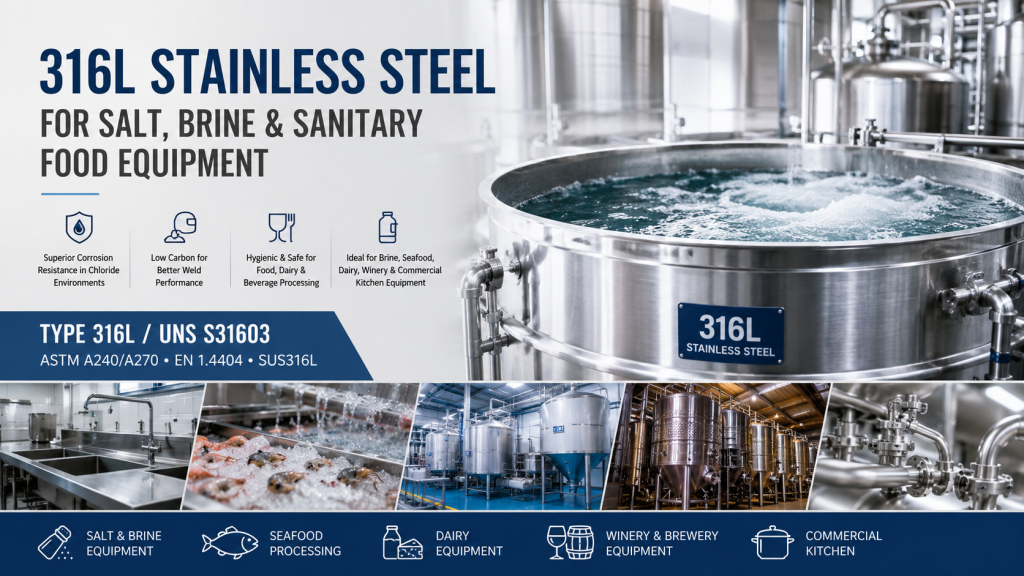
When Does Food & Beverage Equipment Need 316L Stainless Steel?
316L stainless steel becomes particularly valuable in food and beverage equipment when the corrosion environment is more demanding than ordinary kitchen or general food-processing service.
A standard restaurant worktable, a seafood-processing wash station and a brine-storage tank may all be described as food equipment, but they create very different corrosion risks.
Salt, chlorides, acidic food products, aggressive cleaning chemicals, repeated wash-down and welded fabrication can all increase the technical justification for Type 316L / UNS S31603.
The alloy contains molybdenum, which provides additional resistance to localized corrosion in many chloride-containing environments, while its low carbon content reduces the risk of sensitization associated with welding.
The practical purchasing question is therefore:
which food, dairy, winery and commercial-kitchen products actually justify 316L, and what raw-material form, standard and surface requirement should the buyer specify?
Quick Answer: Which Food Equipment Creates a Strong Case for 316L?
316L is particularly worth evaluating for equipment exposed to salt, brine, chlorides, acidic products, repeated chemical cleaning or other demanding hygienic-process conditions.
Potential applications include:
- brine storage tanks
- salt-mixing tanks
- seafood-processing equipment
- seafood wash stations
- salted-food processing vessels
- dairy process tanks
- CIP tanks and selected CIP-system components
- sanitary transfer lines
- selected winery and brewery tanks
- acidified-food process vessels
- sauce and condiment mixing tanks
- food-processing heat-transfer equipment
- coastal commercial-kitchen equipment
- heavy-duty sinks and wash stations
- selected food conveyors and product-contact components
This does not mean that every dairy tank, winery vessel or commercial-kitchen sink requires 316L.
Where 304 or 304L already provides adequate corrosion life, upgrading automatically to 316L may add material cost without creating a meaningful lifecycle benefit.
Why Do Molybdenum and Low Carbon Matter?
Type 316L / UNS S31603 is a low-carbon chromium-nickel-molybdenum austenitic stainless steel.
Two alloy features are particularly relevant to food-equipment manufacturers.
Molybdenum
316L contains approximately 2–3% molybdenum under the ASTM A240 S31603 specification.
Molybdenum improves resistance to localized corrosion, including pitting and crevice corrosion, in many chloride-containing environments compared with the 304 stainless steel family.
This is why 316L becomes particularly relevant when food-processing equipment is exposed to:
- salt
- brine
- seafood
- chloride-containing water
- road or coastal salt contamination
- repeated wet chloride exposure
Low Carbon
The maximum carbon content of Type 316L is lower than standard Type 316.
This reduces the risk of chromium-carbide precipitation associated with welding and thermal exposure and helps reduce susceptibility to intergranular corrosion in welded equipment.
Low carbon does not make 316L corrosion-proof.
It also does not eliminate the need for qualified welding procedures, post-weld cleaning and correct hygienic design.
For general grade information, see the
JUDE Steel 316L stainless steel material page.
316L Standards and Grade Designations
| System / Product | Designation | Procurement Note |
|---|---|---|
| Common grade | Type 316L | Low-carbon molybdenum-alloyed austenitic stainless steel |
| UNS | S31603 | Principal UNS designation |
| ES | 1.4404 / X2CrNiMo17-12-2 | Common European counterpart |
| JIS | SUS316L | Use with the applicable JIS product standard |
| Plate / sheet / strip | ASTM A240/A240M Type 316L / UNS S31603 | Flat products used for tanks, vessels, sinks and fabricated equipment |
| Sanitary dairy / food tubing | ASTM A270/A270M TP316L | Sanitary tubing for food and dairy service where specified |
| General-service tubing | ASTM A269/A269M TP316L | General tubing; not an automatic substitute for sanitary A270 tubing |
| General process pipe | ASTM A312/A312M TP316L | General corrosive-service piping rather than a dedicated sanitary-tube specification |
A professional RFQ should therefore identify both the stainless steel grade and the finished-product standard.
A brine tank fabricator may purchase ASTM A240 plate or sheet, while a sanitary dairy product-transfer line may require ASTM A270 tubing with separately specified internal surface requirements.
For ASTM flat-product scope, see
ASTM A240/A240M.
ASTM A240 Type 316L / UNS S31603 Chemical Composition
The following values are specification limits for ASTM A240 Type 316L flat products. They should not be described as a producer’s typical chemistry.
| Elemento | ASTM A240 S31603, wt.% |
|---|---|
| Carbon (C) | 0.030 max. |
| Manganese (Mn) | 2.00 max. |
| Silicon (Si) | 0.75 max. |
| Phosphorus (P) | 0.045 max. |
| Sulfur (S) | 0.030 max. |
| Chromium (Cr) | 16.0–18.0 |
| Nickel (Ni) | 10.0–14.0 |
| Molybdenum (Mo) | 2.0–3.0 |
| Nitrogen (N) | 0.10 max. |
Typical producer chemistry may fall near the middle of these ranges, but incoming material should be accepted against the actual product standard and mill test certificate.
JIS SUS316L has its own chemistry limits, including 12.0–15.0% nickel and 2.0–3.0% molybdenum.
International grade cross-reference tables are useful for screening, but ASTM S31603, EN 1.4404 and JIS SUS316L should still be ordered according to the governing product standard.
Which Food & Beverage Equipment Uses 316L?
1. Brine and Salt-Mixing Tanks
Brine processing is one of the clearest food-industry situations where 316L deserves evaluation over standard 304-series stainless steel.
Chloride ions can increase the risk of localized pitting and crevice corrosion.
Potential 316L components include:
- brine-storage tank shells
- salt-mixing vessels
- formed tank bottoms and heads
- internal baffles
- wetted covers
- nozzle and connection components
The actual chloride concentration and operating temperature should be included in the material-selection review.
316L is not immune to concentrated or hot chloride solutions.
2. Seafood Processing and Wash Equipment
Seafood-processing facilities combine food contact with repeated exposure to salt, chloride-containing water and frequent wash-down.
316L can therefore be evaluated for:
- seafood preparation tables
- wash stations
- sorting surfaces
- processing trays
- product-contact chutes
- equipment covers
- selected conveyor components
For sheet-metal equipment, cold-rolled 316L sheet may be specified according to thickness, surface, forming requirement and final hygienic finish.
3. Dairy Process and CIP Vessels
Dairy equipment does not automatically require 316L, but more demanding cleaning chemistry can create a stronger technical case for the grade.
316L may be considered for:
- milk-processing vessels
- ingredient tanks
- CIP chemical tanks
- mixing vessels
- product-contact process vessels
- selected heat-transfer equipment
The decision should consider both the dairy product and the sanitation process.
Cleaning agents, chloride content, concentration, temperature, contact time and rinsing practice can materially affect corrosion performance.
4. Winery and Brewery Equipment in Demanding Cleaning Environments
304 and 304L are widely used for wine and beverage tanks, so the presence of wine or beer alone does not automatically justify 316L.
The stronger case for 316L appears when the equipment is exposed to:
- higher chloride levels in process or cleaning water
- more aggressive sanitation chemistry
- coastal environments
- frequent chemical cleaning
- process conditions that have produced pitting concerns in 304-series equipment
Potential applications include:
- fermentation vessels
- storage tanks
- product-transfer systems
- CIP circuits
- selected valves and wetted components
Use actual process conditions rather than the generic label “winery equipment” when selecting the material.
5. Acidified Food, Sauce and Condiment Tanks
Food-processing vessels handling vinegar-containing products, sauces, marinades, condiments or acidic ingredients may require greater corrosion resistance depending on formulation and temperature.
316L may provide additional corrosion margin compared with 304 in selected environments.
However, the phrase “acidic food” is too broad to define a material.
The buyer should provide:
- actual food chemistry
- pH
- salt or chloride concentration
- temperature
- cleaning chemistry
Compatibility should be reviewed when the formulation contains strong acids, high salt or unusual ingredients.
6. Sanitary Product-Transfer Lines
Sanitary pipelines for dairy, beverage and liquid-food systems require careful control of both material and surface condition.
ASTM A270/A270M is specifically intended for sanitary tubing used in dairy and food-industry service.
A sanitary tube RFQ should identify:
- TP316L
- outside diameter
- wall thickness
- tube construction
- internal surface finish
- external surface finish
- maximum Ra where specified
- heat treatment
- testing
- certification
ASTM A269 general-service tubing or ASTM A312 process pipe should not automatically replace ASTM A270 when a sanitary tubing specification is required.
7. Food-Process Heat-Transfer Equipment
Food and dairy plants use heat exchangers for heating, cooling, pasteurization and process-temperature control.
316L may be selected for product-contact components where:
- chloride resistance is important
- cleaning chemistry is demanding
- sanitary fabrication is required
- product chemistry creates a greater corrosion risk
The exact equipment standard, plate thickness, finish and corrosion requirement should be provided with the inquiry.
8. Heavy-Duty Commercial Kitchen and Coastal Equipment
Standard 304 remains the normal economical material for many commercial-kitchen sinks, worktables, hoods and cabinets.
316L becomes more relevant when the equipment faces a more aggressive environment such as:
- coastal atmosphere
- seafood preparation
- high salt exposure
- frequent aggressive wash-down
- stronger cleaning chemicals
Possible components include:
- seafood preparation sinks
- heavy-duty wash stations
- coastal kitchen work surfaces
- salt-exposed food counters
- specialty catering-process vessels
Do not specify 316L for ordinary kitchen equipment only because it is perceived as a “premium grade.”
Equipment-to-Raw-Material Procurement Matrix
| Finished Equipment | Possible 316L Raw Material | Main Purchasing Requirement |
|---|---|---|
| Brine tank | Sheet / plate | Chloride level, thickness, weld and internal finish |
| Salt-mixing vessel | Sheet / plate | Salt concentration, temperature, fabrication |
| Seafood wash station | Cold-rolled sheet | Surface, thickness, forming and wash-down chemistry |
| Dairy process tank | Sheet / plate | Cleaning chemistry, weld quality and sanitary finish |
| CIP tank | Sheet / plate | Chemical concentration and temperature |
| Winery process vessel | Sheet / plate | Cleaning water, chlorides, surface and welds |
| Acidified-food tank | Sheet / plate | Food chemistry, pH, salt and temperature |
| Sanitary transfer line | Sanitary tube | ASTM A270, OD, wall, finish and Ra |
| Heat-transfer equipment | Thin sheet / plate / tube | Product chemistry and sanitary requirements |
| Coastal kitchen equipment | Cold-rolled sheet / coil | Salt exposure, surface, forming and appearance |
Why Do Chloride Concentration and Temperature Matter?
316L provides better chloride resistance than the 304 stainless steel family, but it does not have unlimited chloride tolerance.
Pitting and crevice-corrosion risk generally becomes more demanding as factors such as the following increase:
- chloride concentration
- temperature
- stagnation
- crevice severity
- surface contamination
- poor drainage
- residual deposits
This means that a food-processing line handling dilute salt solution at room temperature and a hot concentrated brine tank are not the same material-selection problem.
Critical RFQs should include actual chloride concentration and operating temperature rather than simply stating “salt service.”
ASTM A270 vs A269 vs A312
ASTM A270
ASTM A270 is specifically intended for sanitary tubing used in the dairy and food industry.
Purchasers can specify surface-finish and roughness requirements appropriate to hygienic product-contact service.
ASTM A269
ASTM A269 covers general-service austenitic stainless steel tubing.
It is not automatically equivalent to a sanitary A270 specification.
ASTM A312
ASTM A312 covers austenitic stainless steel pipe for general corrosive and process service.
It should not be confused with sanitary product-contact tubing simply because both specifications can include TP316L.
Procurement rule:
grade and product standard should be specified separately.
Surface Finish, Ra and Hygienic Design
Type 316L alone does not make a finished machine hygienic.
Food-contact suitability also depends on:
- surface roughness
- weld finishing
- crevice-free construction
- drainability
- cleanability
- inspectability
- surface contamination control
A buyer should therefore avoid vague RFQ phrases such as:
“316L food-grade finish.”
Instead, state:
- 2B, polished or project-specific starting finish
- maximum Ra where required
- internal and external finish separately
- weld-finish requirement
- pickling/passivation requirement where applicable
3-A Sanitary Standards address hygienic equipment materials, fabrication and cleanability; raw-material grade is only one part of the finished-equipment requirement.
Does 316L Resist Chlorine and Bleach?
This question requires caution.
316L has greater resistance to many chloride-containing environments than 304, but chlorine-based and hypochlorite cleaning chemicals can still cause pitting or crevice corrosion under unfavorable conditions.
Risk depends on:
- chemical concentration
- chloride level
- temperature
- contact time
- pH
- rinsing quality
- surface condition
A material should not be approved simply because the cleaner is described as “food-safe.”
Equipment manufacturers should obtain the actual cleaning-chemical concentration and sanitation procedure from the end user.
304 vs 304L vs 316L for Food Equipment
| Selection Factor | 304 | 304L | 316L |
|---|---|---|---|
| Main advantage | General-purpose cost/performance | Low carbon for welded fabrication | Mo + low carbon for higher corrosion demand and welding |
| General kitchen equipment | Common choice | Usually unnecessary unless welding specification requires it | Usually unnecessary unless environment is aggressive |
| Large welded food tanks | Can be suitable | Strong candidate | Strong candidate where chloride or cleaning risk is higher |
| Salt / brine | More limited chloride margin | Similar chloride family to 304 | Greater chloride corrosion margin |
| Seafood processing | Application dependent | Application dependent | Often worth evaluating |
| Aggressive cleaning | May be sufficient in mild service | Low carbon helps welding but not chloride resistance | Often provides additional corrosion margin |
| Primary reason to upgrade | — | Welding / sensitization | Chloride/localized corrosion + welding |
The upgrade path should therefore not be understood as:
304 < 304L < 316L in every property.
304L primarily changes carbon content, while 316L adds molybdenum and changes the corrosion-resistance profile.
For general food-grade selection context, see JUDE Steel’s
Food Grade Stainless Steel Selection Guide.
When Is 316L Not Enough?
316L should not be treated as the final answer for every severe food-processing environment.
A higher-alloy material may require evaluation when the equipment experiences:
- hot concentrated brine
- very high chloride concentration
- seawater immersion
- severe crevice conditions
- aggressive hypochlorite exposure
- process chemistry beyond the proven capability of 316L
- a customer specification requiring duplex or higher-alloy stainless steel
Possible alternatives may include duplex 2205, higher-molybdenum austenitic stainless steels or other corrosion-resistant alloys depending on the environment.
The correct material should be selected from actual corrosion conditions rather than by assuming that “marine-grade stainless steel” is universally sufficient.
What Should a 316L Food-Equipment RFQ Include?
- Finished equipment: brine tank, seafood table, dairy vessel, CIP tank, wine tank, sanitary line or kitchen equipment.
- Grade: Type 316L / UNS S31603.
- Standard: ASTM A240, ASTM A270, EN 10088, JIS or customer specification.
- Product form: sheet, plate, coil, strip or sanitary tubing.
- Thickness: nominal value and tolerance.
- Width and length: or coil dimensions.
- Surface finish: 2B, No.4, polished or sanitary finish.
- Maximum Ra: where a hygienic specification requires it.
- Food or beverage medium: actual product.
- Salt / chloride concentration: where relevant.
- pH or acidic process condition: where relevant.
- Operating temperature: normal and maximum.
- Cleaning chemical: product name or chemistry.
- Cleaning concentration: actual working concentration.
- Cleaning temperature: where applicable.
- Welding requirement: for fabricated equipment.
- Post-weld treatment: grinding, polishing, pickling or passivation where required.
- Processing: cutting, slitting, polishing or drawing-based blanks.
- Certification: MTC / EN 10204 or project documentation.
- Quantity: sheets, plates, coils or total tonnage.
- Destination: country, port and delivery requirement.
Example 316L Stainless Steel Brine-Tank RFQ
Material: Type 316L Stainless Steel
UNS: S31603
Specification: ASTM A240/A240M
Product: Cold-Rolled Sheet
Application: Food-Processing Brine Tank
Thickness: 2.50 mm
Width: 1500 mm
Length: 6000 mm
Surface: 2B starting finish
Internal Finish: Fabricator sanitary-polishing specification attached
Quantity: 12 MT
Process Medium: Sodium-chloride brine
Chloride / Salt Concentration: Project data sheet attached
Operating Temperature: Project data sheet attached
Cleaning: CIP procedure attached
Certificate: EN 10204 3.1 / Mill Test Certificate required
Processing: Cut-to-size sheets requested
Destination: Rotterdam, Netherlands
Providing the actual salt concentration and cleaning conditions is more useful than simply writing “food-grade brine tank.”
Incoming Inspection and Documentation
Depending on the equipment specification, incoming inspection may include:
- heat number
- mill test certificate
- UNS S31603 confirmation
- carbon content
- chromium, nickel and molybdenum content
- mechanical properties
- thickness
- width and length
- surface condition
- flatness
- surface roughness where specified
- protective film where required
- PMI where required
- traceability
For sanitary tubing, inspection should also verify the applicable ASTM A270 surface, dimensional and documentation requirements.
JUDE Steel’s available company and third-party certifications can be reviewed on the
Certification page.
How JUDE Steel Supports Food-Equipment Manufacturers
JUDE Steel supplies Type 316L stainless steel in multiple flat-product forms for international food-equipment and industrial manufacturers.
Published product categories include:
JUDE Steel also provides flat-product processing through its
Services & Capabilities,
including cutting, slitting, polishing, brushing, bending and drawing-based processing.
For components requiring precision blanks, buyers can review JUDE Steel’s
laser-cutting capability.
Specific 316L thickness, width, surface, polishing requirement, mill origin, certification and stock availability should be confirmed for each inquiry.
If sanitary tubing is required, identify ASTM A270 or the applicable sanitary-tube specification separately from the flat-product requirement.
Frequently Asked Questions
Why use 316L instead of 304 for brine equipment?
316L contains molybdenum, which provides additional resistance to localized corrosion in many chloride-containing environments. This makes it worth evaluating for brine, salt and seafood applications where 304 may not provide enough corrosion margin.
Does every dairy tank require 316L?
No. 304 or 304L can provide suitable performance in many dairy applications. 316L becomes more relevant when chloride exposure, cleaning chemistry or other process conditions create a stronger corrosion requirement.
Is 316L suitable for seawater?
316L is widely associated with marine environments, but it should not be treated as universally resistant to seawater immersion or severe stagnant seawater crevices. More corrosion-resistant alloys may be required depending on temperature and exposure conditions.
Does 316L resist bleach and hypochlorite cleaners?
316L can still suffer localized corrosion from chlorine- or hypochlorite-containing cleaners. Concentration, temperature, pH, contact time and rinsing procedure should be reviewed before approving the cleaning process.
Is ASTM A270 required for sanitary dairy or food tubing?
ASTM A270 is specifically intended for sanitary tubing used in dairy and food-industry applications. When the equipment specification requires A270, general ASTM A269 tubing or ASTM A312 pipe should not automatically be substituted.
Is No.4 finish automatically sanitary?
No. No.4 describes a mechanically finished surface but does not by itself define a hygienic roughness requirement. A sanitary specification should state the required surface condition or maximum Ra and include weld-finishing and cleanability requirements.
Should a winery use 304L or 316L?
304L is a strong choice when welded fabrication and sensitization risk are the main concerns. 316L becomes more attractive when chloride concentration, cleaning chemistry or another corrosion factor requires additional localized-corrosion resistance.
Can dual-certified 316/316L material be used?
It may be acceptable when the delivered heat actually meets the specified Type 316L chemistry and mechanical requirements and the project permits dual certification. Verify the mill test certificate rather than relying only on the commercial description.
What should a seafood-equipment manufacturer include in an RFQ?
Provide the component drawing, Type 316L / S31603 specification, dimensions, surface, forming requirements, salt or chloride exposure, cleaning chemistry, quantity, certification and destination.
Request a 316L Stainless Steel Quote
Manufacturing brine tanks, seafood-processing equipment, dairy vessels, sanitary food lines or corrosion-resistant commercial-kitchen equipment?
Send JUDE Steel your:
Equipment Drawing + Grade + Standard + Product Form + Thickness + Width + Surface + Quantity + Destination
For corrosion-critical food applications, also include:
Food Medium + Salt / Chloride Level + Temperature + Cleaning Chemistry + Maximum Ra + Welding Requirement
Technical note:
This article is intended for preliminary material selection and procurement guidance. Final food-contact suitability depends on the actual food chemistry, chloride concentration, cleaning process, temperature, stainless steel grade, surface finish, weld condition, hygienic design and applicable equipment or regulatory specification.
