
What Is Food Grade Stainless Steel? Grades, Safety, Applications & Selection Guide
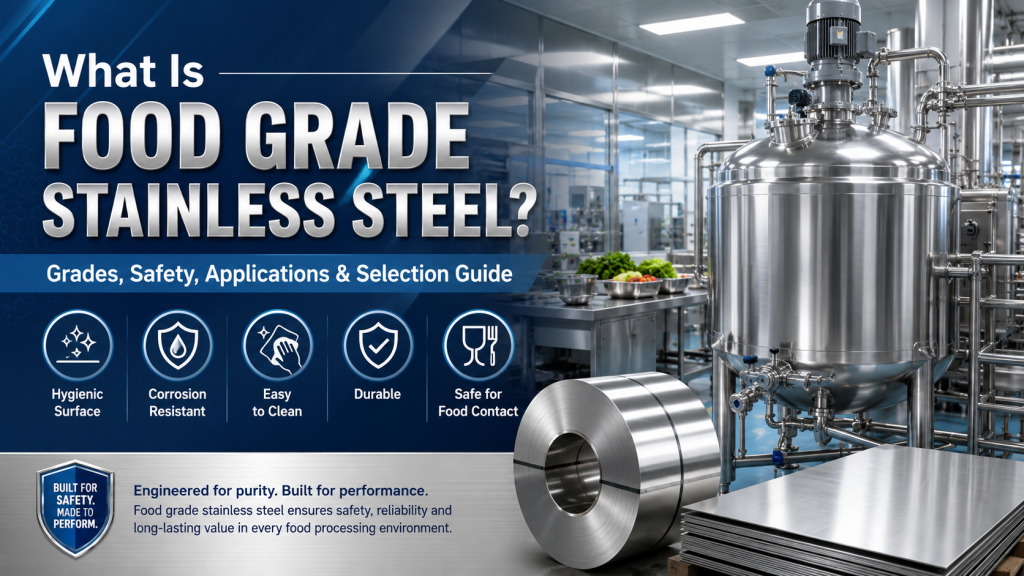
Food grade stainless steel refers to stainless steel that is suitable for food contact applications when the correct grade, surface finish, fabrication method, cleaning process and equipment design are used. It is widely used in commercial kitchens, cookware, food processing plants, dairy equipment, breweries, beverage tanks, pharmaceutical systems and restaurant equipment.
Not every stainless steel grade should automatically be considered food grade. The material must resist corrosion from water, salt, acids, sauces, dairy products, cleaning chemicals and repeated washing. It must also offer a smooth, cleanable surface that helps reduce contamination risk and supports hygienic production.
This guide explains what food grade stainless steel means, why 304 and 316L are widely used, how 430 and 201 compare, what 18/8 and 18/10 stainless steel mean, how surface finish affects hygiene, and how buyers can choose the right stainless steel for food equipment. For related products, visit 304 Stainless Steel, 316L Stainless Steel, Stainless Steel Sheet, Stainless Steel Coil and the Jude Steel Stainless Steel Grade Center.
Quick Answer: What Makes Stainless Steel Food Grade?
Food grade stainless steel is not only about the grade number. It is a combination of material chemistry, corrosion resistance, surface smoothness, cleaning ability, fabrication quality and correct application design.
| Requirement | Why It Matters | Typical Stainless Steel Direction |
|---|---|---|
| Corrosion resistance | Food products may contain salt, acids, sugars, moisture and cleaning chemicals | 304, 316L, duplex or higher alloy grade depending on environment |
| Hygienic surface | Smooth surfaces are easier to clean and reduce residue buildup | 2B, BA, polished or sanitary finish depending on equipment |
| Chemical stability | The material should not react with food or affect taste, odor or safety under normal use | 304 or 316L for most food equipment |
| Durability | Food equipment faces washing, steam, heat, abrasion and long service cycles | 304, 316L or higher corrosion-resistant stainless steel |
| Fabrication quality | Poor welding, rough seams or crevices can trap residues and bacteria | Low-carbon grades and hygienic weld design where needed |
| Cleaning compatibility | Frequent cleaning chemicals may accelerate corrosion if the wrong grade is selected | 316L is often safer for more aggressive cleaning environments |
1. Why Stainless Steel Is Used for Food Contact
Food equipment needs materials that are strong, cleanable, durable and resistant to corrosion. Stainless steel is widely used because it offers a strong combination of corrosion resistance, hygiene, mechanical strength and long service life.
Compared with carbon steel, stainless steel does not rust easily. Compared with many coated metals, stainless steel does not rely only on a surface coating that can peel off. Compared with aluminum, stainless steel is usually more durable and more resistant to cleaning chemicals in industrial food environments.
Main Advantages of Stainless Steel in Food Applications
- Good resistance to water, steam and food acids
- Smooth surface suitable for cleaning and sanitation
- High strength and long service life
- Good temperature resistance for cooking, washing and sterilizing processes
- Excellent fabrication options for tanks, tables, sinks, pipes and equipment
- Available in sheet, coil, plate, pipe, tube, bar and custom processed parts
- Attractive appearance for commercial kitchens and visible equipment
2. Common Food Grade Stainless Steel Grades
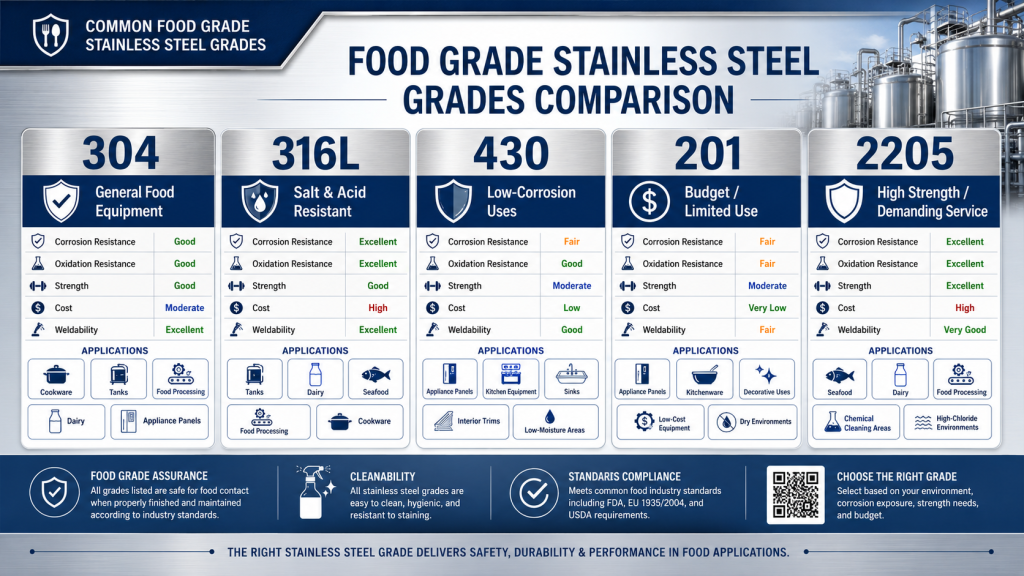
The most common food grade stainless steels are 304 and 316L. Some applications may also use 430 or other grades, but grade selection should always match the food type, cleaning process, surface finish and corrosion risk.
| Grado | Food Grade Suitability | Main Advantage | Typical Applications |
|---|---|---|---|
| 304 Stainless Steel | Excellent for general food contact | Balanced corrosion resistance, cleanability, formability and cost | Sinks, cookware, food tables, tanks, mixing vessels, kitchen equipment |
| 316L Stainless Steel | Excellent for more corrosive food environments | Better resistance to chlorides, salt and acidic cleaning conditions | Dairy, brewery, seafood, pharmaceutical, salt-rich food, chemical cleaning systems |
| 430 Stainless Steel | Suitable for limited low-corrosion applications | Lower cost and good appearance for dry or decorative uses | Appliance panels, dishwasher interiors, decorative kitchen components |
| 201 Stainless Steel | Limited and application-dependent | Lower cost | Low-corrosion indoor products, non-critical food-related parts |
| 2205 Duplex Stainless Steel | Used for demanding industrial conditions | Higher strength and better chloride resistance | Salt processing, chemical food systems, high-strength tanks and piping |
3. 304 Stainless Steel: The Most Common Food Grade Choice
304 stainless steel is the most widely used food grade stainless steel for general kitchen and food processing applications. It is often called 18/8 stainless steel because it contains approximately 18% chromium and 8% nickel.
304 offers a practical balance of corrosion resistance, formability, weldability, cleanability and cost. For most normal food contact environments, 304 is sufficient and economical.
Common 304 Food Grade Applications
- Commercial kitchen tables and counters
- Kitchen sinks
- Cookware and food containers
- Food processing equipment
- Mixing tanks and storage tanks
- Bakery equipment
- Restaurant preparation tables
- Food conveyor components
- Kitchen ventilation and appliance parts
Advantages of 304 Stainless Steel
- Excellent general corrosion resistance
- Good cleanability and hygiene performance
- Good forming and deep drawing ability
- Good weldability
- Widely available and cost-effective
- Suitable for many polished, brushed and 2B surface finishes
4. 316L Stainless Steel: Better for Salt, Acid and Harsh Cleaning
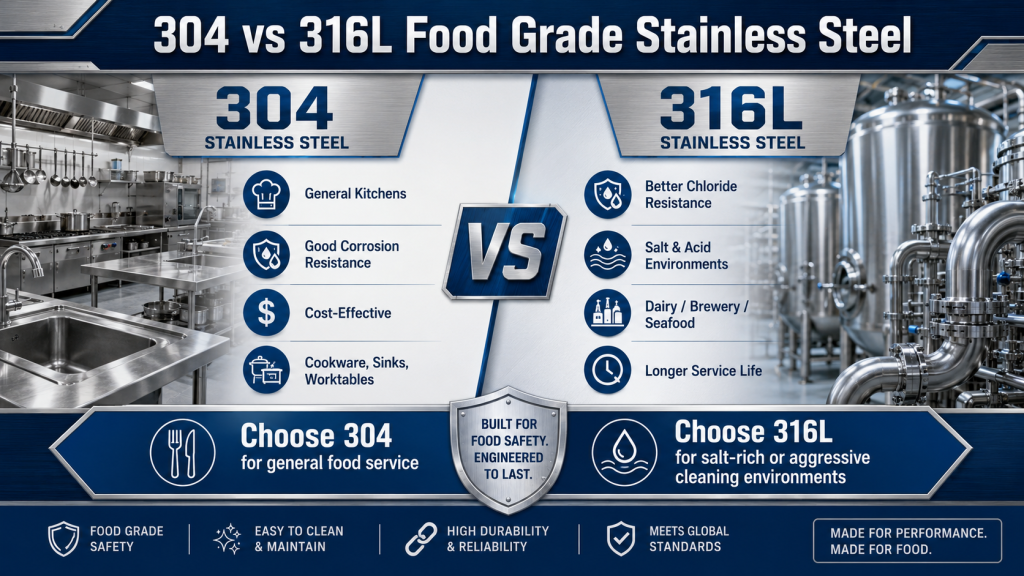
316L stainless steel contains molybdenum, which improves resistance to pitting, crevice corrosion and chloride attack. This makes 316L a better choice for food environments involving salt, seafood, brine, acidic products, frequent chemical cleaning or more aggressive sanitation conditions.
| Food Environment | Recommended Grade | Reason |
|---|---|---|
| General kitchen equipment | 304 | Good balance of corrosion resistance, cost and cleanability |
| Cookware and food containers | 304 | Suitable for many normal food contact applications |
| Dairy processing | 316L | Better resistance to cleaning chemicals and corrosive processing conditions |
| Brewery equipment | 316L | Better performance in acidic and cleaning environments |
| Seafood and salt-rich food | 316L | Improved chloride resistance |
| Pharmaceutical equipment | 316L | Better corrosion resistance and sanitary performance |
| Marine food processing | 316L or higher grade | Better resistance to chloride and coastal atmosphere |
Choose 316L Instead of 304 If:
- The food contains high salt or brine
- The equipment is used for seafood processing
- The process uses acidic products
- Cleaning chemicals are strong or frequent
- The environment is coastal or marine
- The equipment is used in dairy, brewery or pharmaceutical production
- Long service life is more important than the lowest purchase price
5. Is 430 Stainless Steel Food Grade?
430 stainless steel is a ferritic stainless steel that contains chromium but little or no nickel. It is magnetic, lower cost and often used in appliances, decorative panels and some kitchen-related components.
430 may be used in certain food-related applications, especially where corrosion exposure is low and the surface is not constantly exposed to salt, acid or aggressive cleaning chemicals. However, it has lower corrosion resistance than 304 and 316L.
| Factor | 430 Stainless Steel | 304 Stainless Steel |
|---|---|---|
| Structure | Ferritic | Austenitic |
| Nickel Content | Little or no nickel | Contains nickel |
| Magnetism | Magnetic | Usually non-magnetic in annealed condition |
| Corrosion Resistance | Moderate | Better |
| Food Contact Suitability | Limited and condition-dependent | Excellent for general food contact |
| Best Use | Appliance panels, decorative parts, low-corrosion kitchen components | Sinks, cookware, tables, tanks, processing equipment |
| Cost | Lower | Higher than 430 but more versatile |
6. What Do 18/8 and 18/10 Stainless Steel Mean?
In cookware and kitchenware, buyers often see labels such as 18/8 or 18/10 stainless steel. These numbers usually refer to chromium and nickel content.
| Label | Meaning | Common Grade Relationship | Typical Use |
|---|---|---|---|
| 18/8 Stainless Steel | Approximately 18% chromium and 8% nickel | Commonly associated with 304 stainless steel | Cookware, kitchenware, food containers, sinks |
| 18/10 Stainless Steel | Approximately 18% chromium and 10% nickel | Often used for higher-end cookware and kitchenware | Premium cookware, cutlery, food service equipment |
| 18/0 Stainless Steel | Approximately 18% chromium and little or no nickel | Often related to ferritic stainless steels such as 430 | Magnetic cookware bases, appliances, lower-cost kitchen products |
18/8 and 18/10 stainless steels are popular because they provide good corrosion resistance, bright appearance and good food contact performance. However, the exact grade, surface finish, manufacturing quality and cleaning method still matter.
7. Surface Finish and Hygiene Performance
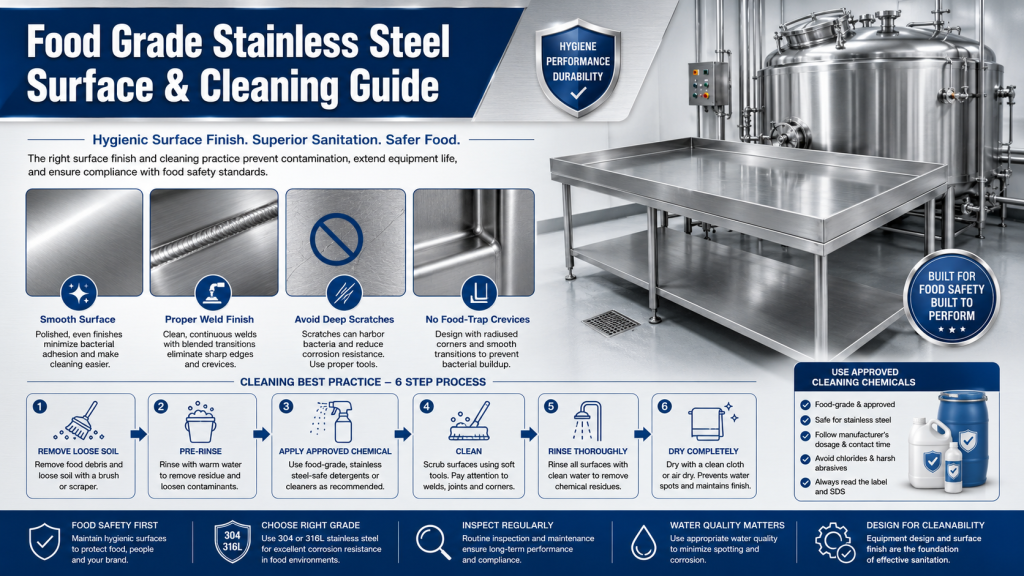
Food grade stainless steel must be easy to clean. A rough surface, deep scratch, poor weld seam or crevice can trap food residues and make sanitation difficult. This is why surface finish is a major part of food equipment design.
| Surface / Design Factor | Why It Matters | Recommended Practice |
|---|---|---|
| Smooth surface | Reduces residue buildup and improves cleanability | Use 2B, BA, polished or sanitary finish depending on application |
| Weld quality | Poor welds can trap food and cleaning chemicals | Use proper welding, grinding, polishing and passivation where required |
| No dead corners | Crevices can hold moisture and bacteria | Use hygienic equipment design with smooth transitions |
| Scratch control | Deep scratches can collect residues | Protect surfaces during fabrication, transport and installation |
| Cleaning compatibility | Wrong chemicals can damage stainless steel | Use approved cleaning procedures and rinse thoroughly |
| Drainability | Standing water can increase corrosion risk | Design tanks and surfaces to drain completely |
8. Food Products and Corrosion Risk
Different foods create different corrosion risks. Salt, acidic ingredients, vinegar, sauces, dairy products and cleaning chemicals can attack ordinary metals and may also challenge stainless steel if the wrong grade is selected.
| Food / Process Condition | Corrosion Risk | Recommended Grade Direction |
|---|---|---|
| Fresh water and normal kitchen use | Low to moderate | 304 |
| Salt and brine | High chloride risk | 316L or higher grade |
| Seafood processing | Salt and chloride exposure | 316L or higher grade |
| Tomato, vinegar and acidic sauces | Acid corrosion risk | 304 for mild service, 316L for more demanding use |
| Dairy processing | Cleaning chemicals and organic acids | 316L often preferred |
| Brewery and beverage tanks | Acidic products and sanitation chemicals | 304 or 316L depending on process and cleaning |
| High-temperature sterilization | Heat, steam and cleaning cycles | 304, 316L or application-specific grade |
| Pharmaceutical processing | High hygiene and corrosion control | 316L commonly preferred |
9. Food Grade Stainless Steel Product Forms
Food grade stainless steel can be supplied in many product forms depending on the final equipment design. The most common forms include sheet, coil, plate, pipe, tube, bar and custom fabricated parts.
| Product Form | Typical Grade | Food Industry Use |
|---|---|---|
| Chapa de acero inoxidable | 304, 316L, 430 | Worktables, cabinets, sinks, kitchen panels, equipment covers |
| Bobina de acero inoxidable | 304, 316L, 430 | Mass production, appliance parts, kitchenware, formed components |
| Stainless Steel Plate | 304, 316L, 2205 | Heavy tanks, pressure vessels, industrial food equipment |
| Stainless Steel Pipe / Tube | 304, 316L | Food pipelines, beverage lines, dairy systems, CIP systems |
| Fleje de acero inoxidable | 301, 304, 316L | Clamps, gaskets, small formed parts, food equipment components |
| Custom Fabricated Parts | 304, 316L | Tanks, hoppers, conveyors, mixing vessels, frames and brackets |
Jude Steel supplies stainless steel sheets, coils and strips with processing support such as laser cutting, bending, brushing and polishing.
10. How to Choose Food Grade Stainless Steel
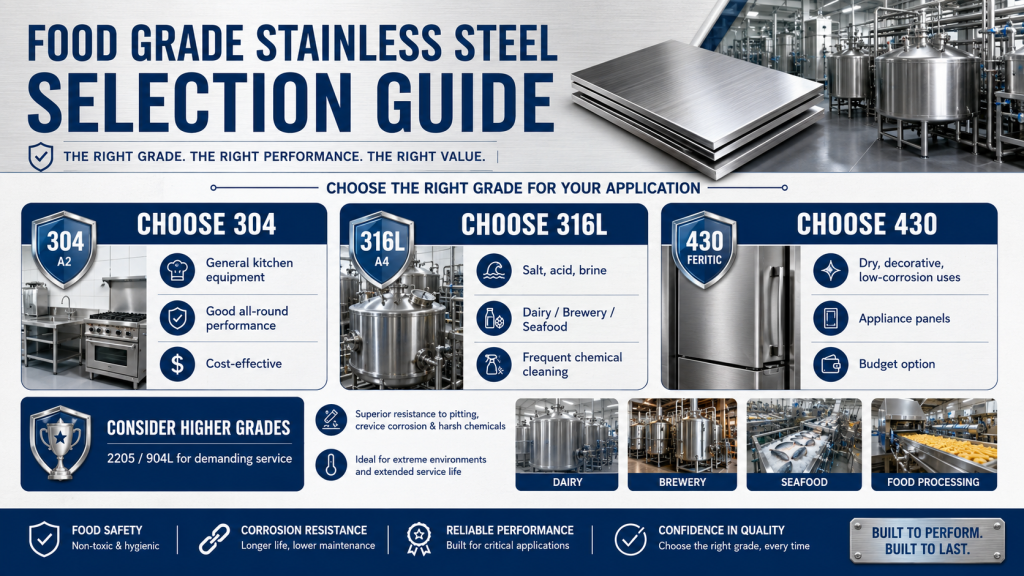
Choose 304 Stainless Steel If:
- The application is general kitchen equipment
- The environment is not highly salty or acidic
- You need good cleanability and corrosion resistance
- The product is a sink, worktable, cookware, container or food preparation surface
- Cost efficiency is important
- Welding and forming are required
- The cleaning process is moderate
Choose 316L Stainless Steel If:
- The food contains salt, brine or chlorides
- The application involves seafood, dairy, brewery or pharmaceutical production
- The equipment is cleaned frequently with stronger chemicals
- The environment is coastal or humid
- Long service life and corrosion resistance are critical
- The system includes tanks, pipes, valves or sanitary equipment
- You want a safer upgrade from 304 in demanding conditions
Choose 430 Stainless Steel If:
- The part is mainly decorative or non-critical
- The environment is dry and low-corrosion
- Cost control is the main priority
- Magnetic behavior is acceptable
- The application is an appliance panel, decorative kitchen component or dishwasher part
- The part is not exposed to salt, acid or aggressive cleaning chemicals
Consider Higher Grades If:
- 316L is not corrosion resistant enough
- The application involves severe chlorides or chemical cleaning
- High strength and corrosion resistance are required
- The equipment is used in harsh food processing, chemical food systems or marine service
- Duplex 2205, 2507, 904L or nickel alloys may be required
11. Common Buyer Mistakes to Avoid
- Assuming every stainless steel is food grade
- Choosing 201 or 430 only because they are cheaper
- Using 304 in high-salt or aggressive cleaning environments without evaluation
- Ignoring surface roughness and weld quality
- Ignoring crevices, dead corners and drainage design
- Using strong cleaning chemicals without checking stainless steel compatibility
- Not confirming actual grade, material certificate and surface finish
- Focusing only on material price instead of lifecycle cost
- Using scratched or contaminated stainless steel surfaces for food contact
- Not matching the grade to the real food product and cleaning process
Frequently Asked Questions
What is food grade stainless steel?
Food grade stainless steel refers to stainless steel that is suitable for direct or indirect food contact when the correct grade, surface finish, cleaning method and equipment design are used. It should resist corrosion, be easy to clean, be durable and not contaminate food under normal service conditions.
Is 304 stainless steel food grade?
Yes. 304 stainless steel is widely used for food contact applications because it provides good corrosion resistance, cleanability, formability and cost performance for most normal food processing and kitchen environments.
Is 316L stainless steel food grade?
Yes. 316L stainless steel is widely used in demanding food, beverage, dairy, brewery and pharmaceutical environments because it provides better resistance to chlorides, acids and cleaning chemicals than 304.
Is 430 stainless steel food grade?
430 stainless steel can be used in some low-corrosion food-related applications such as appliance panels, dishwasher interiors and decorative kitchen components. However, it has lower corrosion resistance than 304 and is not ideal for salt-rich, acidic or frequently washed food processing environments.
What is the difference between 18/8 and 18/10 stainless steel?
18/8 stainless steel usually means approximately 18% chromium and 8% nickel. 18/10 stainless steel usually means approximately 18% chromium and 10% nickel. Both are commonly associated with food-grade kitchenware and cookware.
Which is better for food equipment, 304 or 316L?
304 is suitable for most general food equipment. 316L is better when salt, brine, acids, chlorides, strong cleaning chemicals or coastal environments are involved.
Can food grade stainless steel rust?
Yes. Food grade stainless steel can still rust, stain or pit if the wrong grade is selected, the surface is damaged, cleaning chemicals are unsuitable, or salt and moisture remain on the surface for long periods.
Conclusión
Food grade stainless steel is selected because it offers corrosion resistance, hygiene, durability, cleanability and safe food contact performance. However, food grade stainless steel is not a single grade. The correct choice depends on the food type, cleaning method, surface finish, equipment design and corrosion environment.
304 stainless steel is the most widely used food grade stainless steel for general kitchens, cookware, sinks, worktables, food containers and many processing applications. 316L stainless steel is the better choice for salt-rich, acidic, dairy, brewery, seafood, pharmaceutical and chemical cleaning environments. 430 stainless steel can be economical for dry, decorative or low-corrosion food-related components, but it should not replace 304 or 316L in demanding food processing conditions.
Jude Steel supplies stainless steel sheets, coils, strips and customized processing services for global food equipment and industrial buyers. Explore more at Judesteel.com, or visit our product pages for stainless steel sheet, stainless steel coil, stainless steel strip, 304 stainless steel and 316L stainless steel.
