
Stainless Steel for Automotive Exhaust Heat Shields: 409L, 439 and 441 Sheet & Coil Selection
Industry Application | Automotive Exhaust and Thermal Management
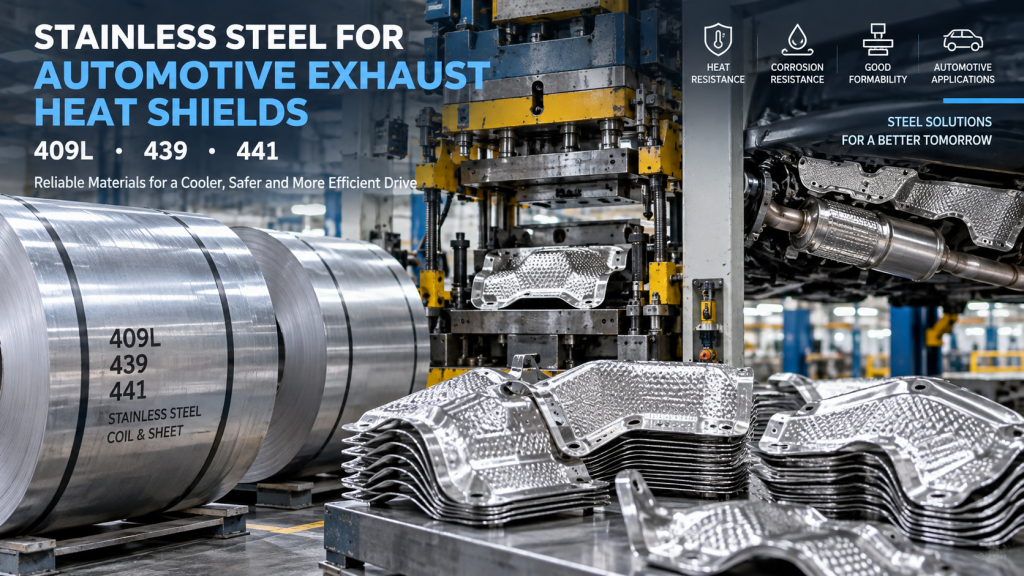
Automotive exhaust heat shields protect surrounding vehicle components from unwanted heat transfer. They can be installed around exhaust pipes, catalytic converters, mufflers and other high-temperature assemblies. While their shapes may appear simple, manufacturing a reliable stamped heat shield requires careful decisions about sheet metal grade, thickness, formability, corrosion exposure and mounting design.
For automotive component manufacturers purchasing stainless steel sheet or coil, 409L, 439 and 441 are three ferritic stainless steel material families worth evaluating when the engineering specification permits their use.
However, these grades are not interchangeable, and not every heat shield should be manufactured from stainless steel. Aluminum, aluminized steel and multilayer constructions are also used in automotive thermal-management systems.
Quick answer: 409L-type stainless steel may be considered for cost-sensitive stamped components where its corrosion and temperature capabilities are sufficient. Type 439 can be evaluated when a higher-chromium ferritic material is required, while Type 441 and related stabilized ferritic grades deserve consideration for more demanding thermal exposure. The final choice must satisfy the approved component drawing and durability requirements.
For buyers seeking flat-rolled raw materials, JUDE Steel publishes product information for stainless steel sheet, stainless steel coil and stainless steel strip.
Manufacturing a new exhaust heat shield? Send the required grade, thickness, coil or sheet dimensions, forming requirements and estimated quantity to JUDE Steel’s quotation team for a raw-material inquiry.
1. Which Automotive Components Can Be Produced From Heat Shield Sheet Metal?
An automotive heat shield is not necessarily a single flat metal cover. Different thermal-management assemblies may contain stamped shells, formed panels, reinforcement features and attachment elements.
For material purchasing, distinguishing these components is important because each may require different forming and mechanical properties.
| Candidate Component | Manufacturing Process | Key Material Requirements |
|---|---|---|
| Exhaust pipe heat shield | Blanking, stamping, bending and mounting-hole punching | Formability, vibration durability and resistance to the specified thermal environment |
| Catalytic converter outer heat shield | Stamping, embossing and assembly | Thermal cycling, oxidation resistance and dimensional stability |
| Muffler outer heat shield | Sheet forming, embossing and attachment | Corrosion resistance, forming behavior and component stiffness |
| Formed thermal-protection panel | Blanking, shallow drawing and flanging | Surface quality, formability and repeatable dimensions |
| Heat shield mounting tabs and brackets | Punching, bending and fastening | Mechanical strength, fatigue resistance and compatibility with the assembly |
Some heat shields contain multiple layers or insulating materials. The outer sheet, internal layer and mounting hardware may therefore require different material specifications.
The stainless steel grades discussed here are candidate materials for selected metallic components. Their inclusion does not establish that they are used in every vehicle model or exhaust-system design.
2. Why Stainless Steel Is Considered for Automotive Heat Shields
Automotive exhaust components experience repeated heating and cooling during vehicle operation.
Heat shields can also be affected by vibration, road water, de-icing salts, assembly stress and repeated mechanical movement.
Ferritic stainless steels provide several characteristics that may be useful in these conditions.
Thermal Expansion Behavior
Ferritic stainless steels generally have lower thermal expansion coefficients than conventional austenitic stainless steels.
This characteristic can be useful in assemblies subjected to repeated temperature changes, but it does not eliminate thermal stress.
The shield’s geometry, temperature gradients, mounting points and surrounding components still determine how much thermal movement occurs.
Oxidation and Corrosion Resistance
Chromium-containing stainless steels develop protective oxide films that contribute to their corrosion and oxidation resistance.
However, performance differs among 409L, 439 and 441, and it also depends on the actual environment.
External heat shields may be exposed to road salt and wet-dry cycles, while shields near hotter exhaust components can experience additional oxidation and thermal-fatigue demands.
Forming and Fabrication
Ferritic stainless steel sheet can be stamped, bent, embossed and joined using suitable manufacturing processes.
Nevertheless, a grade that performs well in a simple bend may not be appropriate for a complex stamped shield with narrow embossments and highly strained corners.
Production feasibility must be established using the specified sheet condition and actual tooling.
3. 409L vs 439 vs 441: Which Grade Fits a Heat Shield Project?
Material selection should start with the shield’s position, operating conditions and manufacturing method.
The following table presents preliminary engineering considerations rather than guaranteed application approvals.
| Material Family | General Characteristics | Potential Heat Shield Application | What to Verify |
|---|---|---|---|
| 409 / 409L-type | Lower-chromium, titanium-stabilized ferritic stainless steel family associated with automotive exhaust manufacturing. | Selected exhaust or muffler shields in suitable corrosion and thermal environments. | OEM grade approval, corrosion requirements, thermal exposure and stamping performance. |
| 439-type | Higher-chromium ferritic stainless steel family associated with useful forming and welding characteristics. | Selected formed shields where additional corrosion durability is required. | Specific UNS or EN grade, forming performance, oxidation exposure and material condition. |
| 441-type | Titanium- and niobium-stabilized ferritic stainless steel family used in demanding exhaust applications. | Selected shields and formed components exposed to more demanding temperature cycles. | Approved chemistry, high-temperature properties, thermal fatigue and stamping feasibility. |
409L: When Material Economy Is Important
The 409 family is widely associated with automotive exhaust manufacturing because it offers a useful combination of fabrication characteristics, oxidation resistance and alloy economy.
For selected heat shields in less demanding environments, a 409L-type product may be worth evaluating.
However, an automotive buyer should not assume that every product described as 409, 409L or EN 1.4512 is identical.
For detailed purchasing information, see JUDE’s 409L stainless steel grade page.
439: When Additional Corrosion Margin Is Needed
439-type stainless steel generally contains more chromium than the 409 family. Depending on the exact product specification and manufacturing condition, it may offer additional corrosion resistance.
For an external heat shield exposed to road contaminants and moisture, corrosion behavior can be an important part of material selection.
Type 439 is also relevant to formed and welded automotive exhaust components, but its use in a particular stamped heat shield must still be validated.
See JUDE’s 439 stainless steel product information.
441: When Thermal Performance Becomes More Demanding
Type 441 and related stabilized ferritic stainless steels are used in automotive exhaust applications where elevated-temperature performance can be important.
Titanium and niobium stabilization help support suitable metallurgical behavior during manufacturing and thermal exposure.
For a shield near a catalytic converter or another hot exhaust assembly, 441 can be considered alongside other approved heat-resistant materials.
But the shield’s actual metal temperature must be established before using elevated-temperature material data.
The maximum temperature of the exhaust gas is not necessarily the temperature experienced by the heat shield itself.
Likewise, a producer’s oxidation-test temperature must not be presented as a universal continuous service-temperature guarantee.
Learn more about the material family through JUDE’s 441 stainless steel grade page.
4. Material Standards: Avoid Incorrect Grade Substitutions
International automotive manufacturers may receive purchasing drawings that identify materials using ASTM, UNS, EN or JIS designations.
These systems must be handled carefully because commercial grade names and national standards are not always identical.
| Reference | What It Covers | Procurement Note |
|---|---|---|
| ASTM A240/A240M | Specified stainless steel plate, sheet and strip. | Confirm the exact Type or UNS designation and applicable requirements. |
| ASTM A480/A480M | General requirements for applicable flat-rolled stainless steel products. | Use alongside the applicable product specification. |
| EN 10088-2 | Technical delivery conditions for stainless steel flat products. | Confirm the EN grade, delivery condition and agreed product requirements. |
| JIS G 4305 | Cold-rolled stainless steel plate, sheet and strip. | Use the exact JIS designation where required by the drawing or purchase order. |
| OEM material specification | Customer-specific material and approval requirements. | May impose additional chemistry, property, inspection or qualification requirements. |
ASTM Type 409 is commonly associated with UNS S40900, and ASTM Type 439 is commonly associated with UNS S43035.
However, commercial 409L products and EN 1.4512 should not be substituted for ASTM Type 409 solely on the basis of naming similarity.
Similarly, products marketed as 441 may be associated with different UNS designations, including S43932 and S43940, depending on the precise specification.
EN 1.4509 is a relevant European designation in this family, but it must not be treated as an unconditional replacement for every material sold as Type 441.
For cold-rolled material orders, buyers should identify the exact governing standard, grade and delivery condition rather than requesting only “409L coil” or “441 sheet.”
5. Stamping and Embossing: The Manufacturing Issues That Matter
The material purchased from a steel supplier must perform reliably during the component manufacturer’s actual production process.
For stamped automotive heat shields, several forming-related issues deserve particular attention.
Embossing and Localized Deformation
Many metallic heat shields use raised patterns, ribs or formed channels to increase local stiffness or achieve the required shape.
Embossing changes the strain distribution in the sheet.
If the emboss depth, corner radius or material condition is unsuitable, localized thinning or cracking may occur.
A successful forming trial should evaluate the actual emboss geometry, rather than relying only on the material’s nominal elongation value.
Bending and Springback
After forming, sheet metal may undergo elastic recovery, commonly referred to as springback.
Springback depends on the material’s mechanical properties, thickness, bending method and tool geometry.
For heat shields installed within restricted spaces, excessive dimensional variation can create assembly difficulties.
Manufacturers should therefore verify the formed part against the drawing using the intended material and tooling.
Mounting Holes and Flanged Areas
Heat shields are frequently attached through mounting holes, formed tabs or brackets.
These features can experience local stress during assembly and vibration.
Critical design factors include hole position, edge distance, local reinforcement, material thickness and the method of attachment.
Increasing the raw material thickness alone will not necessarily resolve a fatigue or mounting failure.
Surface Condition and Handling
Surface defects, dents, edge damage and unsuitable coil handling can affect downstream forming and visual inspection.
For exposed or tightly formed components, the required finish and permissible surface conditions should be agreed before production.
A decorative mirror finish is not automatically required or technically advantageous for an exhaust heat shield.
6. Sheet, Coil or Strip: What Should a Heat Shield Manufacturer Purchase?
The best product form depends on the manufacturing line, blank layout, annual volume and available equipment.
Chapa de acero inoxidable
Sheet can be practical for prototype development, tooling trials, small batches and production processes using individual blanks.
Key purchasing parameters include:
- Exact material grade and standard.
- Sheet thickness and tolerance.
- Sheet width and length.
- Surface and flatness requirements.
- Edge condition and packaging.
JUDE publishes its stainless steel sheet product range for customer review.
Bobina de acero inoxidable
Coil can be suitable for high-volume production using continuous blanking or progressive tooling.
Coil-based operations require attention to consistent strip feeding, thickness, flatness and coil handling.
The buyer should confirm:
- Nominal thickness and permitted variation.
- Required coil width.
- Coil inside diameter and maximum outside diameter.
- Preferred coil weight.
- Applicable surface and edge requirements.
- Traceability and packaging needs.
For material inquiries, see JUDE’s stainless steel coil page.
Fleje de acero inoxidable
Narrow strip may be appropriate when the production line uses relatively small blanks or continuous narrow-width material.
In these applications, strip width tolerance, camber and edge quality can influence feeding accuracy and processing stability.
JUDE also publishes strip processing services and stainless steel strip products.
Published processing ranges do not confirm that every stainless steel grade is available in every thickness or width. Exact feasibility and availability should be established by quotation.
7. Does a Thicker Heat Shield Always Provide Better Thermal Protection?
No. Increasing sheet thickness changes the weight, stiffness, thermal mass and forming behavior of the component, but it does not automatically guarantee better thermal protection.
Actual heat-shield performance also depends on:
- Distance between the shield and the heat source.
- Air-gap geometry.
- Radiative surface characteristics.
- Airflow and ventilation.
- Number of layers and any insulating material.
- Mounting arrangement and thermal bridges.
- Operating temperature and exposure duration.
For example, a correctly designed multilayer assembly may control heat transfer differently from a thicker single-sheet component.
This means the heat shield designer should determine the required material thickness through engineering analysis and testing.
Material suppliers should provide the specified sheet or coil properties rather than claiming that a particular thickness guarantees the finished component’s thermal performance.
8. Quality Inspection Before Automotive Mass Production
For automotive component manufacturing, the quality-control process should connect incoming raw material with the actual forming and assembly requirements.
Incoming Raw Material Checks
The following items may be included in an inspection plan:
- Heat or batch identification.
- Exact grade and product standard.
- Applicable material certificate.
- Thickness and width measurements.
- Surface and edge inspection.
- Coil shape and handling condition.
- Required mechanical and chemical test results.
First-Article Stamping Validation
When a new grade, supplier or tooling arrangement is introduced, representative stamping trials can identify potential manufacturing problems before series production.
Inspection may include:
- Cracking or localized thinning.
- Dimensional accuracy after forming.
- Springback and flange geometry.
- Mounting-hole position.
- Edge condition and burr formation.
- Surface damage after forming.
These tests should be specified by the component manufacturer according to its approved design and quality requirements.
Automotive Customer Approval
Where required by the customer, a material change may need documented approval, production-part validation or PPAP-related submissions.
An ASTM-compliant steel certificate does not independently demonstrate that a finished heat shield is approved by an automotive OEM.
The raw-material supplier and component manufacturer have different responsibilities in the qualification process.
9. Sourcing Materials for Automotive Components in Tolyatti and Samara Oblast
Tolyatti in Russia’s Samara Oblast has an established automotive component manufacturing network.
An August 2026 industry report described automotive supplier-development activities and identified a local manufacturer involved in exhaust-system components.
The development provides relevant background for automotive raw-material sourcing, although it does not establish a purchase contract for any specific stainless steel grade.
For component manufacturers in Tolyatti, Samara and nearby industrial areas, the most useful approach is to begin with the approved component specification.
International sourcing inquiries should clearly identify whether the intended product is a stamped heat shield, exhaust tube, muffler shell or another part.
For heat shield manufacturers specifically, the raw-material purchasing decision should cover the grade, thickness, coil or sheet form, stamping requirements and inspection documentation.
Depending on the destination and end use, international transactions may also require checks of applicable sanctions, export-control requirements, payment arrangements and shipping restrictions.
Material availability, order acceptance and delivery feasibility should be confirmed before placing an order.
Regional industry reference: Samara Oblast automotive component supplier development, August 27, 2026.
10. Stainless Steel RFQ Checklist for Heat Shield Manufacturers
A precise request for quotation makes it easier to compare technically suitable raw-material offers.
For an automotive heat shield project, include the following information wherever available.
| RFQ Field | Information to Provide |
|---|---|
| Finished component | Exhaust pipe shield, converter shield, muffler shield or mounting part. |
| Material grade | OEM-approved 409L-type, 439-type, 441-type or exact specified material. |
| Governing specification | ASTM, UNS, EN, JIS or customer material standard. |
| Raw material form | Sheet, coil or slit strip. |
| Espesor | Nominal thickness and permitted tolerance. |
| Dimensions | Sheet size, coil width or strip width. |
| Coil configuration | Required inside diameter, outside diameter and coil weight where applicable. |
| Surface and edge | Required finish, surface condition, edge type and inspection limits. |
| Forming operation | Stamping, embossing, punching, bending or other forming process. |
| Service environment | Temperature exposure, corrosion conditions and relevant thermal cycles. |
| Documentation | Material certificate, traceability, testing and customer-specific requirements. |
| Commercial details | Trial quantity, annual quantity, destination and requested trade terms. |
Example Automotive Heat Shield Material Inquiry
The following template can be adapted for a real purchasing project. Bracketed fields must be replaced with the buyer’s actual requirements.
Subject: RFQ – Stainless Steel Sheet/Coil for Automotive Exhaust Heat Shield Production
Dear JUDE Steel Team,
We are evaluating stainless steel raw materials for automotive exhaust heat shield manufacturing.
Component: [Component name]
Required grade: [Exact approved grade]
Material standard: [ASTM / EN / JIS / OEM specification]
Product form: [Sheet / Coil / Strip]
Thickness: [Required mm and tolerance]
Width and dimensions: [Required dimensions]
Surface and edge: [Required condition]
Forming operation: [Stamping / Embossing / Bending]
Quantity: [Trial quantity / Annual demand]
Destination: [City / Country]
Required documents: [Inspection and traceability requirements]Please review the specification and advise on material availability, technical conformity, quotation and available processing options.
We can provide component drawings and additional technical requirements upon request.
If the material specification is not finalized, buyers should state which requirements are fixed by the customer and which alternatives may be evaluated.
Any proposed grade substitution must be approved through the appropriate engineering and customer process before production.
11. Common Material Purchasing Errors
Ordering a Grade Without the Governing Standard
The description “441 stainless steel” may be insufficient for a controlled automotive purchase.
The order should identify the actual required material specification and delivery condition.
Assuming Higher Chromium Solves Every Problem
Additional chromium can influence corrosion and oxidation resistance, but it does not automatically resolve stamping cracks, attachment fatigue or an unsuitable shield design.
Ignoring the Difference Between Material and Component Qualification
The material certificate confirms relevant raw-material information. It does not establish the thermal, fatigue or durability performance of the finished heat shield.
Comparing Prices Without Matching Specifications
Quotations for different grades, thickness tolerances, surface conditions, coil configurations or inspection requirements may not be directly comparable.
Purchasers should normalize these requirements before comparing offers.
12. Frequently Asked Questions
Can 409L stainless steel be used for stamped exhaust heat shields?
409L-type material can be evaluated for selected stamped heat shields when the approved specification and operating conditions permit. Formability, corrosion exposure, thermal requirements and customer approval should be checked before production.
What causes cracking during stainless steel heat shield stamping?
Possible causes include excessive localized strain, unsuitable radii, unfavorable material condition, poor tool geometry or inappropriate forming conditions. The root cause should be established through forming analysis and representative trials rather than assuming a higher-alloy grade will eliminate cracking.
Should heat shield manufacturers purchase stainless steel coil or sheet?
Sheet can suit prototype and small-batch operations, while coil may be more practical for continuous blanking and high-volume stamping. The best choice depends on production equipment, blank layout, available sizes and commercial requirements.
Does Type 441 guarantee better heat shield performance than Type 439?
No. Type 441 may provide advantages under certain demanding thermal conditions, but finished-shield performance also depends on geometry, thickness, mounting, airflow and the validated service environment. The approved OEM material specification remains decisive.
Can JUDE supply slit stainless steel strip for heat shield production?
JUDE publishes stainless steel strip and strip-processing services. Buyers should submit their exact grade, thickness, required slit width, edge condition, coil configuration and quantity so that processing feasibility and availability can be confirmed.
Can a supplier’s material certificate replace automotive part approval?
No. A material certificate and finished-component approval serve different purposes. Automotive production may require additional manufacturing validation, customer approval, testing and traceability according to the project requirements.
What is the most useful information to send for a first quotation?
The approved material grade, standard, thickness, dimensions, raw-material form, intended stamping operation, quantity and destination are the most useful starting points. A component drawing can clarify additional technical requirements.
13. Request Stainless Steel Sheet or Coil for Automotive Heat Shield Production
JUDE Steel supplies information about stainless steel flat products and related processing services for industrial material buyers.
For automotive component manufacturers evaluating 409L, 439 or 441 stainless steel sheet, coil or strip, the first step is to establish an accurate raw-material specification.
JUDE’s relevant material pages include:
- 409L Stainless Steel
- 439 Stainless Steel
- 441 Stainless Steel
- Chapa de acero inoxidable
- Bobina de acero inoxidable
- Stainless Steel Strip Processing
JUDE Steel’s role in this inquiry is the supply and processing of stainless steel raw materials. Finished heat shield design, stamping qualification and OEM product approval remain separate project requirements.
For a technical quotation review, send:
- The exact material standard and grade.
- Required thickness, width and surface condition.
- Sheet, coil or slit-strip requirements.
- Stamped-part drawing or forming details when available.
- Required inspection documentation.
- Trial quantity, annual demand and delivery destination.
Request a 409L, 439 or 441 Stainless Steel Material Quote
Submit Your Material RFQ to JUDE Steel
Email: support@jiscojude.com
WhatsApp / Phone: +86 15358013701
Include “Automotive Heat Shield Material RFQ” in your message subject to identify the intended application.
Technical References
- ASTM A240/A240M-26 – Stainless Steel Plate, Sheet and Strip.
- ASTM A480/A480M-25b – General Requirements for Flat-Rolled Stainless Steel Products.
- BS EN 10088-2:2024 – Stainless Steel Flat-Product Technical Delivery Conditions.
- JIS G 4305:2021 – Cold-Rolled Stainless Steel Plate, Sheet and Strip.
- Aperam – K39M / EN 1.4510 Ferritic Stainless Steel.
- Aperam – K41X / EN 1.4509 Automotive Exhaust Stainless Steel.
Technical disclaimer: This article provides material-selection and purchasing guidance. The use of a stainless steel grade in an automotive component must be approved against the applicable engineering drawing, product specification, manufacturing process and durability requirements. Published manufacturer data and typical applications do not establish universal performance guarantees, stock availability or OEM approval.
