
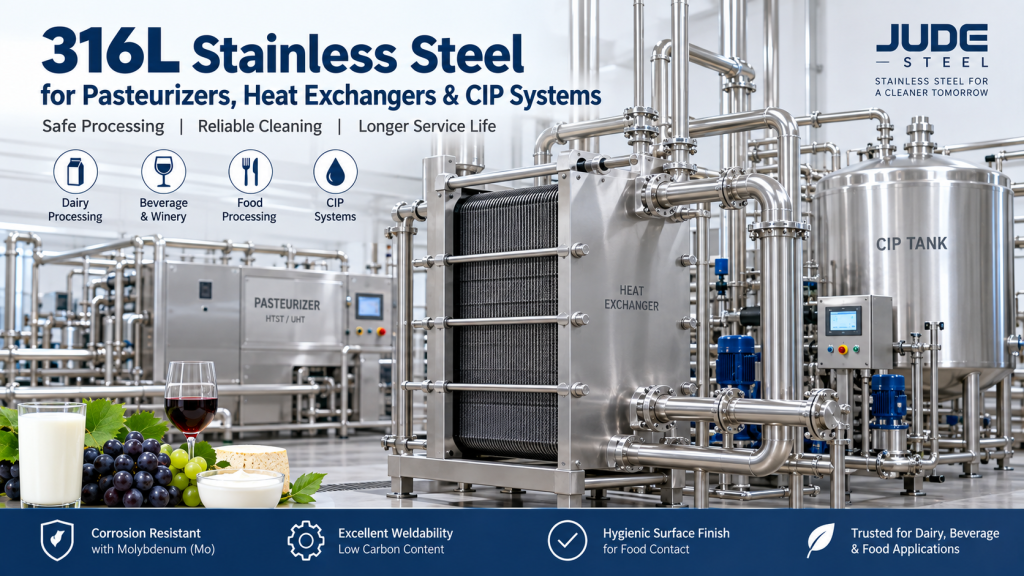
Which Pasteurizers, Heat Exchangers and CIP Systems Use 316L Stainless Steel?
316L stainless steel is widely associated with hygienic food-processing equipment, but its value becomes clearer when the finished machine combines product contact, welded fabrication, thermal cycling and repeated chemical cleaning.
A dairy pasteurizer, a winery cooler and a commercial-kitchen worktable may all contain stainless steel, but their hygienic and corrosion requirements are not the same.
Pasteurizers, sanitary heat exchangers and clean-in-place systems repeatedly expose stainless steel to product, hot water, cleaning chemicals, welds, gaskets, crevices and temperature changes.
For these systems, Type 316L / UNS S31603 may provide useful additional corrosion margin compared with the 304 stainless steel family, particularly where chlorides or more demanding cleaning conditions are present.
This guide connects:
finished hygienic equipment → 316L raw material → ASTM product specification → surface requirement → process conditions → RFQ.
Quick Answer: Where Does 316L Fit in Hygienic Processing Equipment?
Depending on the actual food product, cleaning chemistry and hygienic-equipment specification, 316L may be considered for:
- plate heat exchangers
- tubular heat exchangers
- milk pasteurizers
- cream and yogurt thermal-processing equipment
- juice and beverage pasteurizers
- winery heating and cooling systems
- brewery process coolers
- CIP supply tanks
- CIP return tanks
- sanitary product-transfer tubing
- sanitary manifolds
- dosing skids
- selected valve and pump wetted parts
- filling and product-transfer assemblies
316L is not automatically required for every food-processing system.
Where 304 or 304L already provides adequate corrosion performance, specifying 316L solely because it is perceived as a “higher grade” may add unnecessary material cost.
Why Is 316L Used in Hygienic Thermal-Processing Systems?
Type 316L is a low-carbon chromium-nickel-molybdenum austenitic stainless steel.
Two characteristics are particularly relevant to pasteurizers, heat exchangers and CIP systems.
Molybdenum for Additional Localized-Corrosion Resistance
ASTM A240 Type 316L contains 2.0–3.0% molybdenum.
Molybdenum improves resistance to pitting and crevice corrosion in many chloride-containing environments compared with the 304 stainless steel family.
This can matter in hygienic equipment because chloride exposure may come from:
- process water
- food ingredients
- salt-containing products
- cleaning chemicals
- rinse water
- coastal plant environments
The improvement is not unlimited. Chloride concentration, temperature, deposits, crevices and cleaning practices still determine actual corrosion risk.
Low Carbon for Welded Fabrication
The maximum carbon content of Type 316L is lower than standard Type 316.
This reduces the risk of chromium-carbide precipitation associated with sensitizing thermal exposure during welding.
That is particularly relevant to:
- welded sanitary pipelines
- fabricated CIP tanks
- heat-exchanger housings
- sanitary manifolds
- welded process skids
- large fabricated hygienic assemblies
Low carbon does not eliminate the need for qualified welding, heat-tint removal and correct post-weld surface treatment.
For basic alloy information, see the
JUDE Steel 316L Stainless Steel Grade Page.
316L Standards and Grade Designations
| System / Product | Designation | Procurement Note |
|---|---|---|
| Common grade | Type 316L | Low-carbon molybdenum-alloyed austenitic stainless steel |
| UNS | S31603 | Principal UNS designation |
| ES | 1.4404 / X2CrNiMo17-12-2 | Common European counterpart |
| JIS | SUS316L | Use with the applicable JIS product standard |
| Sheet / plate / strip | ASTM A240/A240M S31603 | Flat products for tanks, housings, plates and fabricated components |
| Sanitary tubing | ASTM A270/A270M TP316L | Sanitary tubing intended for dairy and food-industry service |
| General-service tubing | ASTM A269/A269M TP316L | General tubing; not automatically equivalent to sanitary A270 tubing |
| Welded exchanger tubing | ASTM A249/A249M TP316L | Relevant to welded heat-exchanger and condenser tubes where specified |
| Process piping | ASTM A312/A312M TP316L | General process-pipe specification rather than dedicated sanitary tubing |
A hygienic equipment manufacturer should therefore specify both the alloy and the product standard.
A plate heat exchanger may start from cold-rolled 316L sheet, while a hygienic product-transfer line may require ASTM A270 TP316L tubing.
ASTM A240 Type 316L / UNS S31603 Chemical Composition
The following values are ASTM A240 specification limits for Type 316L flat products. They are not producer-specific typical values.
| Elemento | ASTM A240 S31603, wt.% |
|---|---|
| Carbon (C) | 0.030 max. |
| Manganese (Mn) | 2.00 max. |
| Silicon (Si) | 0.75 max. |
| Phosphorus (P) | 0.045 max. |
| Sulfur (S) | 0.030 max. |
| Chromium (Cr) | 16.0–18.0 |
| Nickel (Ni) | 10.0–14.0 |
| Molybdenum (Mo) | 2.0–3.0 |
| Nitrogen (N) | 0.10 max. |
A producer may publish typical values near the middle of these ranges, but incoming material should be accepted against the governing product standard and mill test certificate.
Which Hygienic Processing Equipment Uses 316L?
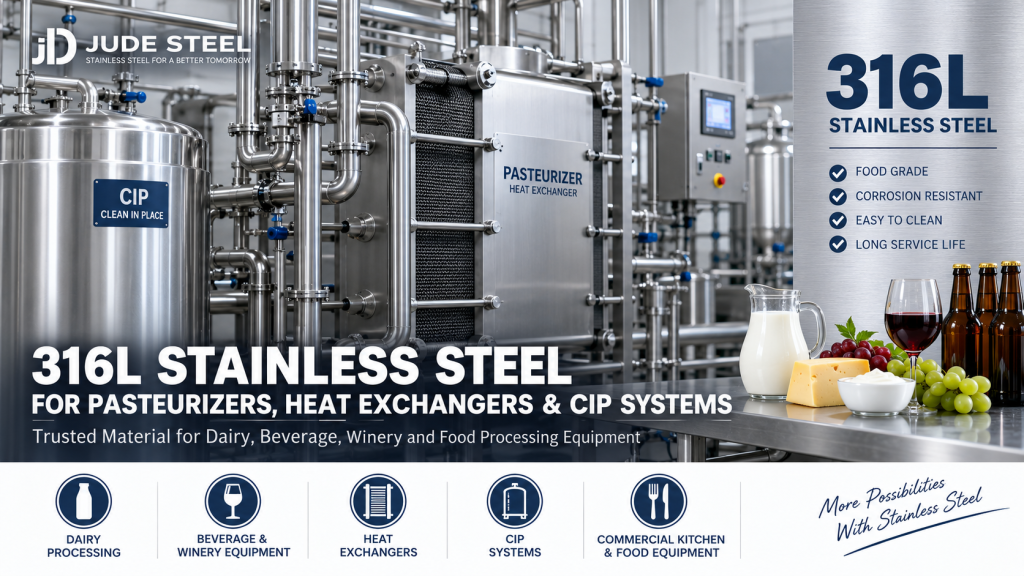 1. Plate Heat Exchangers
Plate heat exchangers are widely used in dairy, beverage and food processing for heating, cooling and heat recovery.
Possible applications include:
- milk heating and cooling
- pasteurization systems
- juice processing
- beverage cooling
- brewery process cooling
- winery temperature control
Thin cold-rolled 316L stainless steel can be used for selected heat-exchanger plates where the product chemistry, cleaning environment and equipment specification justify the grade.
Key raw-material requirements may include:
- tight thickness tolerance
- surface cleanliness
- consistent formability
- flatness
- controlled coil or sheet width
- material traceability
JUDE Steel supplies
316L stainless steel sheet
and
316L stainless steel coil
for industrial fabrication.
2. Tubular Heat Exchangers
Tubular heat exchangers are also common in food and dairy processing.
They may be selected where the product is viscous, contains particulates or requires a different flow path from a plate exchanger.
Depending on design, 316L can be used for:
- product-contact tubes
- shell sections
- manifolds
- connection components
- supporting fabricated parts
The correct tube specification depends on the equipment design.
ASTM A270 is particularly relevant when a sanitary food or dairy tubing specification is required.
ASTM A249 may apply to welded heat-exchanger tubing in applications where the equipment specification calls for that standard.
3. Dairy Pasteurizers
Pasteurization equipment combines temperature cycling, product contact, hygienic design and frequent cleaning.
316L may be evaluated for selected product-contact components where:
- cleaning chemistry is demanding
- chlorides are present
- the plant requires additional pitting-resistance margin
- welded fabrication is extensive
- the applicable equipment specification calls for 316L
Possible applications include:
- heat-transfer plates
- sanitary pipelines
- product manifolds
- holding-tube systems
- selected vessel and skid components
3-A Sanitary Standards maintain separate requirements for plate-type heat exchangers, tubular heat exchangers and pasteurization systems.
4. Juice and Beverage Pasteurizers
Juice and beverage equipment can handle products with organic acids, flavor ingredients, sugar and cleaning residues.
316L may provide additional corrosion margin where the product and cleaning system create a more demanding environment than general 304-series service.
The buyer should identify:
- actual beverage chemistry
- pH
- chloride level
- operating temperature
- cleaning chemicals
- cleaning concentration
The word “juice” or “beverage” alone is not enough for final alloy selection.
5. Winery Heating and Cooling Equipment
304L remains widely suitable for many wine tanks, so the presence of wine alone does not automatically justify 316L.
316L becomes more relevant in winery thermal-processing equipment when additional corrosion margin is required because of:
- cleaning-water chlorides
- sanitation chemistry
- frequent cleaning cycles
- coastal winery environments
- prior localized-corrosion concerns
Potential applications include:
- wine coolers
- must coolers
- heat-recovery units
- sanitary product lines
- CIP manifolds
6. CIP Supply and Return Systems
Clean-in-place systems repeatedly expose stainless steel surfaces to cleaning chemicals at controlled concentrations and temperatures.
A CIP system can include:
- supply piping
- return piping
- sanitary manifolds
- spray-system connections
- valves
- pumps
- chemical dosing equipment
316L may be selected where cleaning chemistry, chloride content and temperature justify more localized-corrosion resistance than a 304-series system provides.
The material should not be chosen from the acronym “CIP” alone.
7. CIP Chemical Tanks
CIP systems can use separate tanks for water, caustic solutions, acid solutions and recovery fluids.
316L sheet or plate may be suitable for selected CIP tanks, but compatibility must be checked against:
- chemical identity
- concentration
- temperature
- chloride contamination
- storage duration
- mixing conditions
The same alloy should not automatically be specified for every tank in a CIP skid if the chemical environments are different.
8. Sanitary Manifolds, Valves and Dosing Skids
Food and beverage process skids often combine tubing, valves, pumps, instruments and small fabricated vessels.
316L is widely relevant to product-contact and cleaning-fluid components when the project specification requires its corrosion performance.
A skid manufacturer should control:
- material traceability
- tube surface finish
- weld quality
- dead-leg control
- drainability
- cleanability
- component documentation
Raw-material grade is only one part of hygienic skid design.
Equipment-to-Raw-Material Procurement Matrix
| Equipment | Possible 316L Raw Material | Main Procurement Requirement |
|---|---|---|
| Plate heat exchanger | Thin cold-rolled sheet / coil | Thickness tolerance, formability, surface and traceability |
| Tubular heat exchanger | Tube / sheet / plate | Tube standard, OD, wall, finish and fluid chemistry |
| Dairy pasteurizer | Sheet + sanitary tube | Surface, welds, product chemistry and cleaning cycle |
| Beverage pasteurizer | Sheet + sanitary tube | pH, temperature, finish and sanitation chemistry |
| Winery cooler | Sheet / tube | Cleaning water, chlorides and surface |
| CIP supply line | Sanitary tube | ASTM A270, OD, wall, internal finish and Ra |
| CIP chemical tank | Sheet / plate | Chemical concentration, temperature and welding |
| Sanitary manifold | Tube + fabricated components | Surface, weld quality and cleanability |
| Dosing skid | Sheet / tube / strip | Chemical compatibility and drawing requirements |
ASTM A270 vs A269 vs A249: Which Tube Standard Should Be Used?
ASTM A270
ASTM A270/A270M covers seamless, welded and heavily cold-worked stainless steel sanitary tubing intended for dairy and food-industry use.
It also allows the purchaser to specify special internal and external surface finishes and maximum roughness-average requirements.
This makes A270 especially relevant to hygienic product-transfer and CIP piping.
ASTM A269
ASTM A269 covers seamless and welded austenitic stainless tubing for general corrosion-resistant and temperature service.
It is not automatically equivalent to an A270 sanitary-tube specification.
ASTM A249
ASTM A249 covers welded austenitic tubes intended for boiler, heat-exchanger and condenser service.
It can be relevant to selected tubular heat exchangers but should not automatically be substituted for sanitary A270 tubing in a hygienic product-transfer line.
Purchasing rule:
specify the tube standard according to the function of the finished tube, not merely because all three specifications can include TP316L.
Why Do Surface Roughness and Weld Finish Matter?
316L chemistry alone does not create a hygienic product-contact surface.
A sanitary-equipment specification may also control:
- surface roughness
- grinding direction
- mechanical polishing
- electropolishing where required
- weld profile
- heat-tint removal
- crevice elimination
- drainability
- cleanability
ASTM A270 provides multiple sanitary-tube surface options and allows maximum roughness-average requirements to be specified.
Do not write only:
“316L sanitary finish.”
Instead, provide the actual internal and external surface requirement and maximum Ra where the equipment specification requires it.
What Do 3-A Sanitary Standards Actually Mean?
3-A Sanitary Standards address hygienic equipment design and fabrication, not simply stainless steel grade selection.
Relevant standards and accepted practices exist for equipment including:
- plate-type heat exchangers
- tubular heat exchangers
- pasteurizers
- metal tubing
- hygienic pipelines
- CIP installation and operation
This means that a component manufactured from 316L does not automatically become “3-A compliant.”
The completed machine or system must satisfy the applicable sanitary design, fabrication and cleanability requirements.
For current sanitary-equipment standards, see
3-A Sanitary Standards.
Does a CIP System Automatically Require 316L?
No.
304L can perform well in many compatible CIP systems.
316L becomes more attractive when:
- chloride levels are higher
- cleaning temperatures are elevated
- aggressive sanitation chemicals are used
- localized corrosion has previously occurred
- the customer specification requires additional corrosion margin
Material selection should therefore be based on the actual cleaning recipe rather than the generic term “CIP.”
Chlorides, Caustic and Hypochlorite Cleaning
Cleaning chemistry is often more aggressive to stainless steel than the food product itself.
Important variables include:
- cleaner chemistry
- concentration
- temperature
- chloride contamination
- pH
- contact time
- rinsing practice
- stagnant crevices
316L can still suffer localized corrosion under unfavorable chlorine- or hypochlorite-containing cleaning conditions.
It should not be marketed as resistant to every bleach or chlorine-based sanitation process.
304L vs 316L for Pasteurizers and CIP Systems
| Selection Factor | 304L | 316L |
|---|---|---|
| Low-carbon weldability | Yes | Yes |
| Molybdenum | No deliberate Mo addition | 2.0–3.0% under ASTM A240 |
| General mild food service | Often sufficient | May be unnecessary |
| Higher chloride exposure | Lower corrosion margin | Greater localized-corrosion margin |
| Demanding CIP chemistry | Application dependent | Often worth evaluating |
| Sanitary tubing | Available under applicable standards | Available under applicable standards |
| Main reason to upgrade | — | Additional corrosion margin, especially against localized corrosion |
The difference should not be presented as “316L is always better.”
If 304L already provides the required service life, 316L may not provide an economic benefit.
For environments where salt and chloride exposure are the primary selection factor, see JUDE Steel’s
316L Stainless Steel for Salt & Sanitary Food Equipment.
When Is 316L Not Enough?
316L is not the highest-corrosion-resistant stainless steel available.
Another material may need evaluation when hygienic equipment experiences:
- very high chloride concentration
- hot concentrated salt solutions
- severe hypochlorite exposure
- persistent crevices
- process chemistry outside the proven range of 316L
- a customer specification requiring duplex or higher-alloy stainless steel
Possible alternatives may include duplex 2205 or more highly alloyed stainless steels depending on the actual corrosion mechanism.
What Should a 316L Hygienic-Equipment RFQ Include?
- Finished equipment: plate exchanger, tubular exchanger, pasteurizer, CIP skid or sanitary manifold.
- Grade: Type 316L / UNS S31603.
- Product standard: ASTM A240, A270, A249, A269 or customer specification.
- Product form: sheet, plate, coil, strip or tubing.
- Dimensions: thickness, width, length, OD or wall thickness.
- Product medium: milk, wine, juice, beer, syrup, food ingredient or other fluid.
- pH: where relevant.
- Salt / chloride level: where known.
- Operating temperature: normal and maximum.
- Cleaning chemistry: caustic, acid, hypochlorite or other sanitation chemistry.
- Cleaning concentration: actual working concentration.
- Cleaning temperature: where relevant.
- Surface finish: raw material starting finish or sanitary finish.
- Maximum Ra: where required.
- Welding requirement: if the component will be welded.
- Post-weld treatment: polishing, pickling, passivation or project requirement.
- Quantity: sheets, coils, tube length or total tonnage.
- Certification: MTC / EN 10204 or customer requirement.
- Drawing: provide drawings for cut or fabricated parts.
- Destination: country, port and delivery requirement.
Example 316L Pasteurizer Material RFQ
Application: Dairy HTST Pasteurizer Skid
Material: Type 316L Stainless Steel
UNS: S31603
Flat Product Specification: ASTM A240/A240M
Sanitary Tubing Specification: ASTM A270/A270M TP316L
Sheet Thickness: 1.50 mm and 2.00 mm
Tube Sizes: Drawing attached
Product Medium: Milk
Operating Temperature: Process data sheet attached
CIP Chemistry: Cleaning schedule attached
Internal Tube Finish: Sanitary finish and maximum Ra per project specification
Fabrication: Welded sanitary skid
Certificate: Mill Test Certificate required
Quantity: BOM attached
Destination: Wisconsin, USA
For a useful quotation, provide both the material requirement and the hygienic process conditions rather than requesting only “316L food-grade stainless steel.”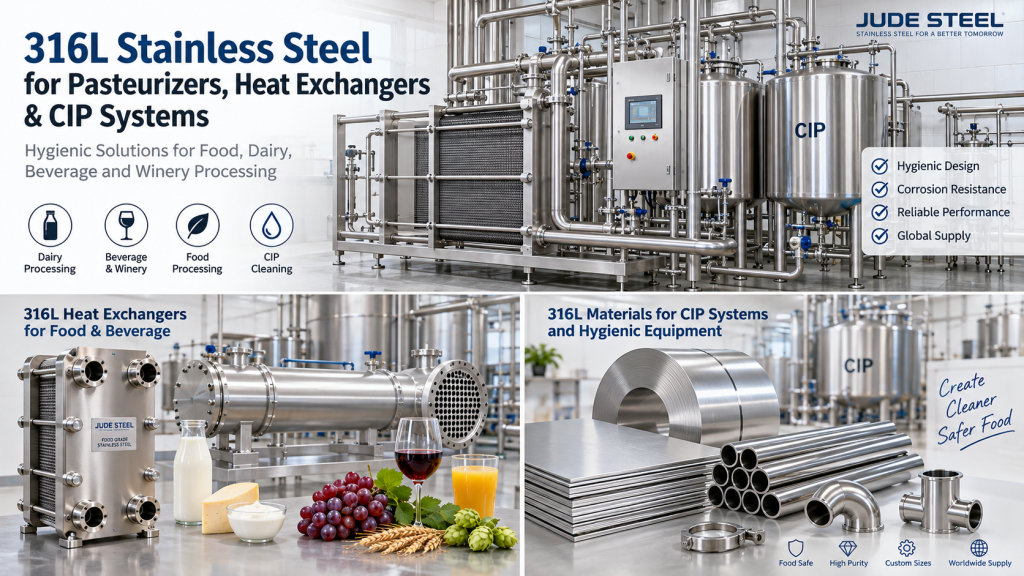
Incoming Inspection and Documentation
Depending on the project specification, incoming inspection may include:
- heat number
- mill test certificate
- UNS S31603 confirmation
- chemical composition
- molybdenum content
- carbon content
- mechanical properties
- thickness / OD / wall thickness
- surface finish
- surface roughness where specified
- tube weld condition
- protective film
- traceability
For sanitary tubing, verify the actual ASTM A270 requirements identified in the purchase order rather than relying only on a generic “sanitary tube” label.
JUDE Steel’s available company and third-party certificates can be reviewed on the
Certification Page.
How JUDE Steel Supports Hygienic Equipment Manufacturers
JUDE Steel supplies Type 316L stainless steel sheet, plate, coil and strip for international food-equipment and process-equipment manufacturers.
Published product categories include:
JUDE Steel also provides processing services for manufacturers requiring cut-to-size flat products and drawing-based preparation.
Available processing capabilities can be reviewed on the
Services & Capabilities Page.
For precision sheet blanks, buyers can review JUDE Steel’s
Laser Cutting Service.
Specific 316L dimensions, surface, finish, certification, processing and stock availability should be confirmed for each inquiry.
Where sanitary tubing is required, provide the exact ASTM A270 or project tubing specification so availability can be reviewed separately from flat-product supply.
Frequently Asked Questions
Is 316L required for every dairy pasteurizer?
No. 304L can be suitable for many food and dairy systems. 316L becomes more attractive when chloride levels, cleaning chemistry or the equipment specification require additional localized-corrosion resistance.
Should sanitary piping use ASTM A270 or ASTM A269?
ASTM A270 is specifically intended for sanitary tubing used in dairy and food-industry service. ASTM A269 is a general-service tubing specification and should not automatically replace A270 where a sanitary specification is required.
Should a tubular heat exchanger use ASTM A270 or ASTM A249?
The correct specification depends on the equipment design and project requirements. ASTM A249 is specifically intended for welded heat-exchanger and condenser tubes, while ASTM A270 is intended for sanitary tubing used in food and dairy service. Follow the equipment drawing and purchase specification rather than selecting from grade alone.
Is a 2B surface automatically sanitary?
No. 2B is a cold-rolled mill finish. Hygienic equipment may require separately defined roughness, polishing, weld finishing and cleanability requirements.
Does every CIP system require 316L?
No. Material selection depends on cleaning chemistry, concentration, temperature, chlorides and equipment design. 304L can be adequate in compatible systems.
Can 316L resist hypochlorite CIP chemicals?
316L can still suffer localized corrosion under unfavorable hypochlorite or chlorine-containing conditions. Chemical concentration, temperature, pH, contact time and rinsing practice should be reviewed.
What does maximum Ra mean in a sanitary tubing RFQ?
Ra is an arithmetic-average surface-roughness parameter. When hygienic equipment specifications impose a maximum Ra, the purchaser should state the actual value and whether it applies to the internal surface, external surface or both.
When should a winery use 316L rather than 304L?
316L becomes more attractive when cleaning-water chlorides, sanitation chemistry or another corrosion factor requires more localized-corrosion resistance than the 304L family provides.
What should I send JUDE Steel for a pasteurizer or CIP-system quotation?
Send the equipment drawing, grade, applicable ASTM standard, dimensions, product medium, operating temperature, cleaning chemistry, chloride level where relevant, surface / Ra requirement, welding requirement, quantity, certification and destination.
Request 316L Material for Hygienic Processing Equipment
Manufacturing pasteurizers, sanitary heat exchangers, winery cooling equipment or CIP systems?
Send JUDE Steel your:
Equipment Drawing + Grade + ASTM Standard + Dimensions + Surface / Ra + Quantity + Destination
For product-contact equipment, also include:
Food / Beverage Medium + Chloride Level + Process Temperature + CIP Chemistry + Cleaning Temperature + Welding Requirement
Technical note:
This article is intended for preliminary material screening and procurement guidance. Final food-contact suitability depends on the actual product chemistry, chloride concentration, temperature, cleaning process, surface finish, welding condition, hygienic design and applicable equipment specification.
