
304L vs 304H Stainless Steel: Weldability, High-Temperature Strength and Applications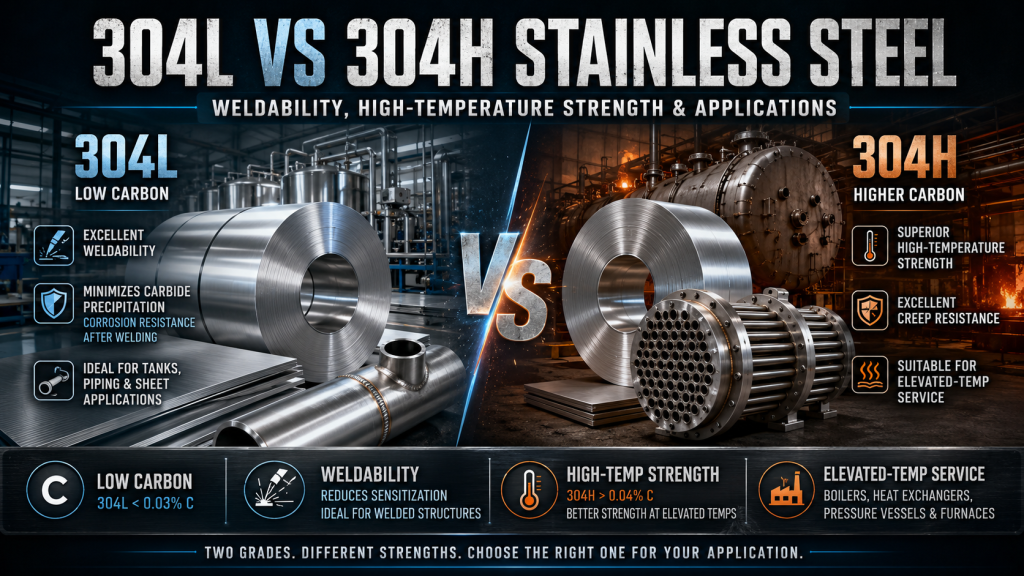
When comparing 304L vs 304H stainless steel, the real question is not which grade is universally better. The right question is: do you need better weldability and corrosion resistance after welding, or do you need better high-temperature strength and creep resistance?
Both 304L and 304H belong to the 304 austenitic stainless steel family. They have similar chromium-nickel chemistry, similar general corrosion resistance and similar appearance. However, their carbon content is intentionally different, and that small difference changes how each grade behaves in welding, high-temperature service and long-term industrial operation.
This guide explains the difference between 304L and 304H stainless steel from the perspective of chemical composition, weldability, sensitization risk, corrosion resistance, mechanical properties, high-temperature strength, applications and procurement selection. For related grade information, you may also visit 304 stainless steel, 304L stainless steel and the 304 vs 304L stainless steel guide.
Quick Answer: 304L vs 304H Stainless Steel
| Comparison Item | 304L Stainless Steel | 304H Stainless Steel |
|---|---|---|
| Grade Meaning | Low-carbon 304 stainless steel | High-carbon 304 stainless steel |
| Typical Carbon Content | Usually ≤ 0.03% | Usually 0.04%–0.10% |
| Main Advantage | Excellent weldability and lower sensitization risk | Better high-temperature strength and creep resistance |
| Welding Performance | Excellent; often used without post-weld annealing | Weldable, but requires more careful procedure control |
| High-Temperature Strength | Lower than 304H | Higher than 304L |
| Intergranular Corrosion Risk | Lower, especially after welding | Higher if welding or heat exposure is not properly controlled |
| Best For | Welded tanks, piping, food equipment, chemical equipment, heavy gauge fabrication | Boilers, heat exchangers, pressure vessels, refinery equipment, high-temperature piping |
| Simple Selection Rule | Choose 304L for welding and corrosion resistance after welding | Choose 304H for elevated-temperature strength and creep resistance |
1. What Is 304L Stainless Steel?
304L stainless steel is the low-carbon version of 304 stainless steel. The “L” stands for low carbon. By reducing carbon content, 304L minimizes chromium carbide precipitation during welding and high-temperature exposure. This helps preserve corrosion resistance in the heat-affected zone and reduces the risk of intergranular corrosion.
Because of this, 304L is widely used in welded structures, tanks, piping systems, food processing equipment, chemical equipment and heavy gauge components where post-weld heat treatment may be difficult or uneconomical.
Main Features of 304L Stainless Steel
- Low carbon content for improved weldability
- Lower risk of sensitization after welding
- Good resistance to intergranular corrosion
- Excellent formability and fabrication performance
- Suitable for sheet, plate, coil, strip, pipe and fabricated products
- Commonly used when welding quality and corrosion durability are important
Jude Steel supplies stainless steel products such as stainless steel sheet, stainless steel coil, stainless steel strip and stainless steel sheet metal for industrial buyers.
2. What Is 304H Stainless Steel?
304H stainless steel is the high-carbon version of 304 stainless steel. The “H” stands for high carbon. Compared with 304L, 304H has a controlled higher carbon range, which improves strength retention, creep resistance and stress rupture performance at elevated temperatures.
304H is commonly selected for boilers, pressure vessels, heat exchangers, refinery units, furnace components, thermal processing equipment and high-temperature piping systems. It is not normally chosen just for corrosion resistance; it is chosen when the equipment must carry load or pressure while exposed to heat for long service periods.
Main Features of 304H Stainless Steel
- Higher carbon content than 304L
- Better high-temperature strength
- Improved creep resistance under sustained load and heat
- Good oxidation resistance in suitable environments
- Suitable for elevated-temperature industrial equipment
- Requires careful welding and corrosion-risk evaluation
3. Chemical Composition Comparison
304L and 304H have similar chromium and nickel ranges because both belong to the 304 austenitic stainless steel family. The most important difference is carbon content. 304L intentionally limits carbon to improve weldability and resistance to intergranular corrosion, while 304H uses a higher controlled carbon range to improve high-temperature mechanical performance.
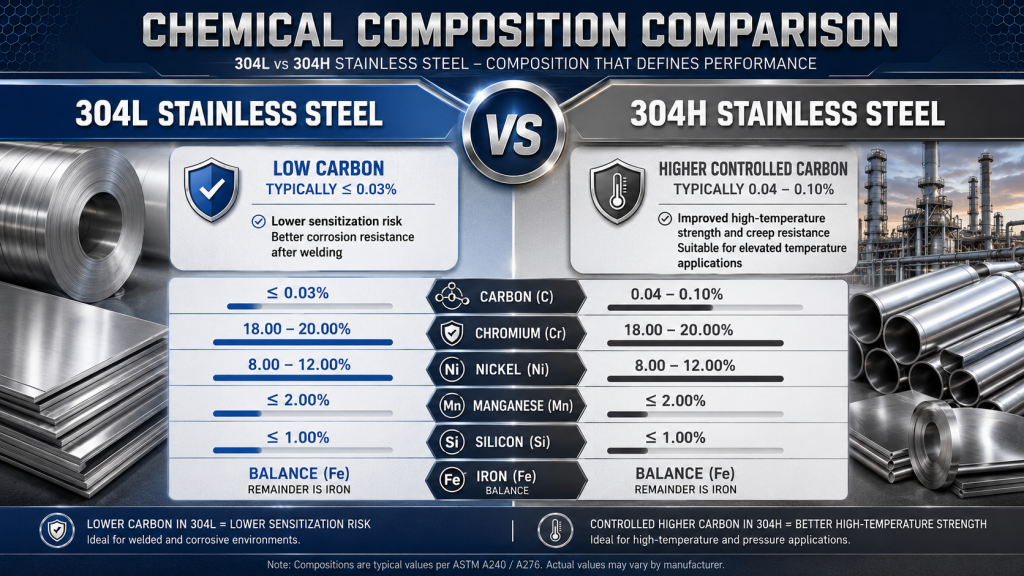
| Elemento | 304L Stainless Steel | 304H Stainless Steel | Performance Meaning |
|---|---|---|---|
| Carbon (C) | Low, usually ≤ 0.03% | Higher, usually 0.04%–0.10% | Controls weldability, sensitization risk and high-temperature strength |
| Chromium (Cr) | Typically around 18%–20% | Typically around 18%–20% | Provides passive film formation and oxidation resistance |
| Nickel (Ni) | Typically around 8%–12% | Typically around 8%–10.5% | Stabilizes the austenitic structure and improves toughness |
| Manganese (Mn) | Usually limited to about 2% maximum | Usually limited to about 2% maximum | Supports deoxidation and processing behavior |
| Silicon (Si) | Usually limited | Usually limited | Can contribute to oxidation resistance and steelmaking control |
| Iron (Fe) | Balance | Balance | Base metal of stainless steel |
Why Carbon Content Matters
Carbon is a small element with a large impact. In welded stainless steel, excessive carbon can combine with chromium and form chromium carbides at grain boundaries. This can reduce chromium availability near the grain boundaries and increase the risk of intergranular corrosion. By lowering carbon, 304L reduces that risk.
In high-temperature service, however, controlled carbon can help improve strength retention and creep resistance. This is why 304H is preferred in thermal equipment where mechanical stability at elevated temperature matters more than simple weldability.
4. Weldability and Sensitization Risk
Weldability is one of the strongest reasons to choose 304L instead of 304H. 304L is designed to minimize carbide precipitation during welding, making it suitable for welded structures that must maintain corrosion resistance without post-weld solution annealing.
304H can be welded, but the higher carbon content means welding procedures must be more carefully controlled. In corrosive service, engineers should pay attention to heat input, interpass temperature, filler selection, post-weld cleaning and whether heat treatment is required.
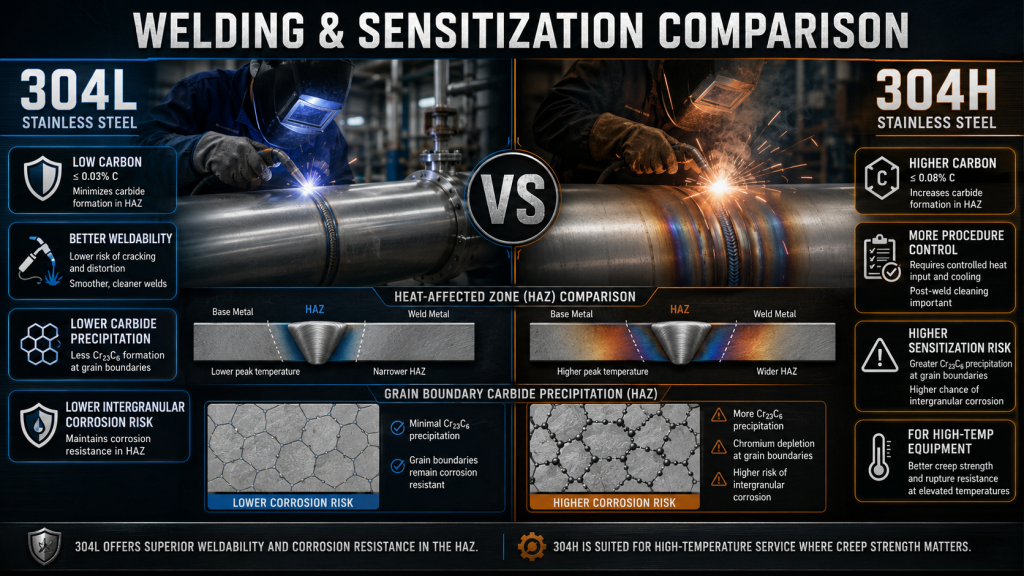
| Welding Factor | 304L Stainless Steel | 304H Stainless Steel |
|---|---|---|
| Weldability | Excelente | Good, but more procedure-sensitive |
| Carbon Level | Low | Higher |
| Carbide Precipitation Risk | Low | Higher if heat exposure is not controlled |
| Post-Weld Heat Treatment | Often not required for many applications | May be considered depending on service conditions and specification |
| Best Welding Use | Tanks, vessels, piping, food equipment and chemical equipment | High-temperature welded equipment where strength is required |
5. High-Temperature Strength and Creep Resistance
High-temperature performance is where 304H becomes more valuable. At elevated temperatures, stainless steel components may lose strength over time. If the component is also carrying pressure, load or thermal stress, creep deformation can become a serious design issue.
304H is designed to provide better strength retention and creep resistance than 304L in elevated-temperature service. This makes it more suitable for boilers, superheater tubes, heat exchangers, furnace components and refinery equipment.
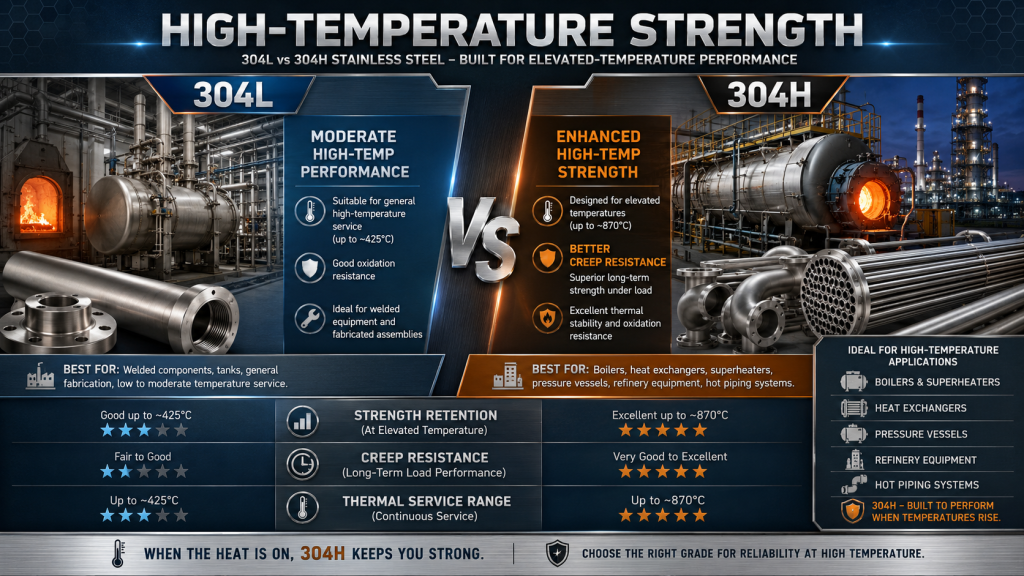
| High-Temperature Factor | 304L Stainless Steel | 304H Stainless Steel |
|---|---|---|
| Elevated-Temperature Strength | Lower than 304H | Higher than 304L |
| Creep Resistance | Limited for long-term high-temperature load | Better for sustained thermal stress |
| Thermal Stability | Suitable for many moderate-temperature uses | Better for high-temperature equipment |
| Typical Equipment | Welded tanks, piping, food and chemical equipment | Boilers, heat exchangers, refinery systems and pressure vessels |
| Selection Priority | Weldability and corrosion resistance after welding | Strength retention under heat |
When Temperature Changes the Material Decision
At normal or moderate temperatures, 304L is often preferred for welded stainless steel fabrication. When the equipment works under sustained high temperature and mechanical load, 304H becomes more appropriate because it is designed for high-temperature strength rather than purely welding convenience.
6. Corrosion Resistance: Which Grade Performs Better?
In many general environments, 304L and 304H have similar baseline corrosion resistance because their chromium-nickel alloy system is similar. The practical difference appears after welding or long heat exposure.
304L has an advantage in welded corrosive environments because its low carbon content reduces carbide precipitation and helps protect the heat-affected zone from intergranular corrosion. 304H still offers good general corrosion resistance, but its higher carbon content requires more careful evaluation when welding and corrosive media are both involved.
| Environment / Condition | Better Choice | Reason |
|---|---|---|
| Welded tank in food processing | 304L | Excellent weldability and lower sensitization risk |
| Welded chemical equipment | 304L or 316L depending on chemicals | Low carbon helps preserve corrosion resistance after welding |
| High-temperature boiler component | 304H | Better strength retention and creep resistance |
| General indoor decorative application | 304L or 304 | 304H is usually unnecessary |
| High-temperature refinery equipment | 304H or heat-resistant stainless grade | Elevated-temperature strength is critical |
| Chloride-rich marine environment | 316L, duplex 2205 or higher alloy may be needed | 304 family grades are not the first choice for severe chloride exposure |
For environments with chlorides, acids or aggressive chemicals, buyers should not compare only 304L and 304H. In many cases, 316L stainless steel sheet, duplex stainless steel or higher alloy materials may offer a better corrosion-performance solution.
7. Mechanical Properties: Strength, Ductility and Fabrication
304L generally provides excellent ductility, formability and weldability. Its lower carbon level may slightly reduce strength compared with standard 304 or 304H, but this trade-off is usually acceptable in welded fabrication where corrosion resistance and processing reliability are more important.
304H provides higher strength at elevated temperature. It is often specified where the material must resist deformation under heat, pressure or sustained stress.
| Mechanical Factor | 304L Stainless Steel | 304H Stainless Steel |
|---|---|---|
| Room-Temperature Strength | Good | Good to higher |
| Ductility | Excelente | Good |
| Formability | Excelente | Good, but grade and process dependent |
| High-Temperature Strength | Lower | Higher |
| Creep Resistance | Lower | Higher |
| Best Mechanical Advantage | Fabrication and welding reliability | Strength retention at elevated temperature |
8. 304L vs 304H vs Standard 304 Stainless Steel
Standard 304, 304L and 304H are closely related, but they are optimized for different priorities. 304 is a general-purpose grade, 304L is welding-optimized, and 304H is high-temperature-strength-optimized.
| Grado | Carbon Design | Key Advantage | Typical Use |
|---|---|---|---|
| 304 Stainless Steel | Standard carbon level | Balanced corrosion resistance, strength and cost | General equipment, kitchen products, architectural panels, industrial parts |
| 304L Stainless Steel | Low carbon | Weldability and lower intergranular corrosion risk | Welded tanks, vessels, piping and chemical equipment |
| 304H Stainless Steel | High controlled carbon | High-temperature strength and creep resistance | Boilers, heat exchangers, pressure vessels and refinery systems |
9. Typical Applications of 304L Stainless Steel
304L is widely used where welding is frequent and corrosion resistance after welding is important. It is a practical choice for fabricators who need reliable forming, cutting, welding and long-term corrosion performance.
Common 304L Applications
- Welded storage tanks
- Food processing equipment
- Beverage and dairy equipment
- Chemical processing equipment
- Pharmaceutical equipment
- Heat exchangers in moderate conditions
- Welded piping and tubing systems
- Architectural and structural components
- Heavy gauge welded stainless steel parts
10. Typical Applications of 304H Stainless Steel
304H is selected when the application involves elevated temperature and the component must maintain mechanical strength over time. It is especially relevant in thermal processing, petrochemical, power generation and pressure-related systems.
Common 304H Applications
- Industrial boilers
- Superheater components
- Pressure vessels
- Heat exchangers
- High-temperature piping systems
- Refinery process equipment
- Furnace parts
- Thermal processing equipment
- Power generation equipment
11. Fabrication and Processing Considerations
Both 304L and 304H can be supplied as stainless steel sheet, plate, coil, strip, pipe or custom fabricated products. However, their processing priorities are different.
304L is easier to use in welded fabrication because it reduces post-weld corrosion concerns. 304H requires more careful welding control when the finished component will be exposed to corrosive media or thermal cycling.
Recommended Procurement Checks
- Confirm the exact grade: 304L, 304H or dual-certified material
- Check carbon content on the mill test certificate
- Confirm applicable standard such as ASTM, EN, JIS or GB
- Check thickness, width, length and tolerance requirements
- Confirm whether the product will be welded, formed or heat exposed
- Specify surface finish such as No.1, 2B, BA, No.4, brushed or polished
- Confirm whether corrosion environment includes chlorides or acids
- Ask whether post-weld treatment or pickling/passivation is required
- Confirm packaging requirements for long-distance sea shipment
For custom fabrication, Jude Steel provides stainless steel processing solutions such as cutting, surface processing, bending, polishing and sheet metal fabrication. You can learn more from Jude Steel stainless steel supplier capabilities.
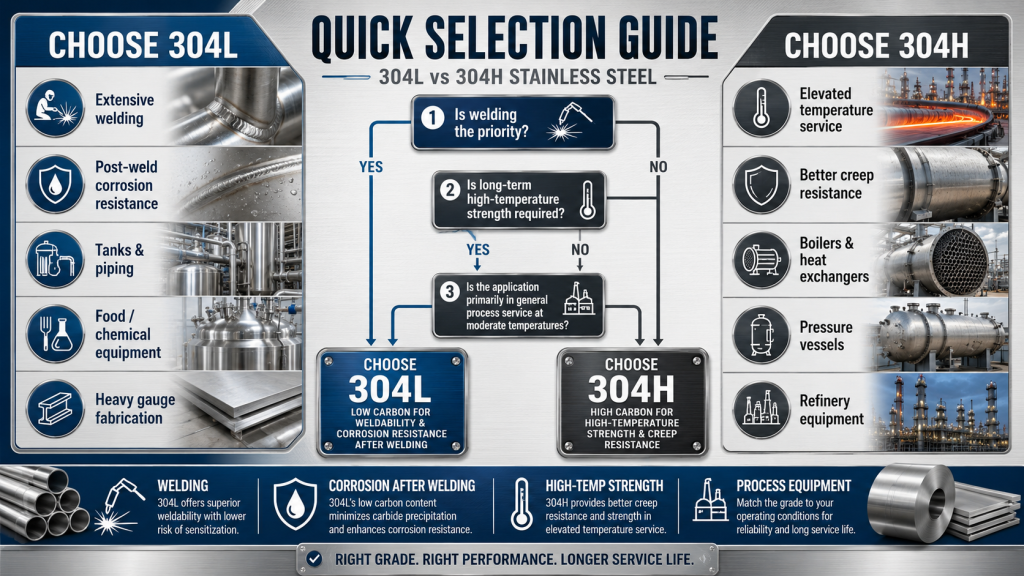
12. How to Choose Between 304L and 304H
| Project Requirement | Recommended Grade | Reason |
|---|---|---|
| Heavy welding without post-weld heat treatment | 304L | Low carbon reduces carbide precipitation risk |
| Food or beverage welded equipment | 304L | Good corrosion resistance and hygienic fabrication |
| Chemical tank with welded seams | 304L or 316L depending on media | 304L is better than 304H for welded corrosion resistance, but chemical severity may require 316L |
| Boiler or superheater component | 304H | Better high-temperature strength and creep resistance |
| Refinery equipment at elevated temperature | 304H or heat-resistant stainless grade | Strength retention under heat is important |
| Decorative indoor stainless steel sheet | 304 or 304L | 304H is usually unnecessary |
| Chloride-rich marine service | 316L, 2205 or higher alloy | 304L and 304H may not provide enough chloride resistance |
| General stainless steel fabrication | 304L or 304 | Better availability, weldability and cost efficiency |
13. Common Buyer Mistakes to Avoid
- Choosing 304H only because it sounds stronger, even when the project only needs welded corrosion resistance.
- Choosing 304L for high-temperature pressure equipment where creep strength is critical.
- Ignoring the carbon content shown on the mill test certificate.
- Assuming all 304-family stainless steels perform the same after welding.
- Using 304L or 304H in chloride-rich environments without evaluating 316L, 2205 or higher alloy grades.
- Not confirming surface finish, thickness tolerance and edge condition before ordering.
- Ignoring post-weld cleaning, pickling or passivation requirements.
- Ordering only by price without confirming standard, certification and application conditions.
14. Related Stainless Steel Grades to Consider
Sometimes neither 304L nor 304H is the best final choice. If the environment contains chlorides, acids, extreme oxidation or severe thermal cycling, buyers should compare alternative stainless steel grades.
| Alternative Grade | When to Consider It | Why |
|---|---|---|
| 304 Stainless Steel | General-purpose, non-critical welding applications | Balanced corrosion resistance, availability and cost |
| 316L Stainless Steel | Marine, chloride or chemical environments | Molybdenum improves pitting and crevice corrosion resistance |
| 321 Stainless Steel | Welded high-temperature service | Titanium stabilization improves resistance to carbide precipitation |
| 347 Stainless Steel | High-temperature welded equipment | Niobium stabilization improves intergranular corrosion resistance after heat exposure |
| 310S Stainless Steel | Severe oxidation and furnace service | Higher chromium and nickel content improves heat resistance |
| 2205 Duplex Stainless Steel | High-strength chloride environments | Higher strength and better chloride stress corrosion resistance than standard austenitic grades |
For broader grade comparison, you can also read What Is 304 Stainless Steel?, 304 vs 304L Stainless Steel and AISI 441 vs 304 Stainless Steel.
Frequently Asked Questions
What is the main difference between 304L and 304H stainless steel?
The main difference is carbon content. 304L is a low-carbon grade designed for welding and resistance to intergranular corrosion after welding. 304H is a high-carbon grade designed for better elevated-temperature strength and creep resistance.
Is 304L better than 304H?
304L is better for welded structures, tanks, piping and corrosive service after welding. 304H is better for high-temperature equipment such as boilers, heat exchangers, pressure vessels and refinery systems. The better grade depends on the operating condition.
Can 304H stainless steel be welded?
Yes. 304H can be welded, but welding procedures should be controlled carefully. Because 304H has higher carbon, it has a higher risk of sensitization and intergranular corrosion if the heat-affected zone is not properly managed.
Why does 304L have lower carbon?
304L has lower carbon to reduce chromium carbide precipitation during welding. This helps maintain corrosion resistance near welded areas and often reduces the need for post-weld solution annealing.
Why does 304H have higher carbon?
304H uses higher controlled carbon to improve high-temperature strength, creep resistance and stress rupture performance. This makes it suitable for thermal equipment that operates under heat and load.
Does 304L resist corrosion better than 304H?
In many general environments, their basic corrosion resistance is similar. However, after welding or heat exposure, 304L usually has better resistance to intergranular corrosion because of its lower carbon content.
Can I replace 304H with 304L?
Only when high-temperature strength and creep resistance are not required. If the equipment operates at elevated temperature under pressure or stress, replacing 304H with 304L may reduce safety and service life.
Can I replace 304L with 304H?
Only if the welding, corrosion and fabrication requirements allow it. For welded tanks, piping and chemical equipment where corrosion after welding is important, 304L is usually the safer choice.
Which grade is better for food processing equipment?
304L is usually preferred for welded food processing equipment because it offers good corrosion resistance and excellent weldability. For more aggressive cleaning chemicals or chloride exposure, 316L may be considered.
Which grade is better for boilers and heat exchangers?
304H is often better for boilers, superheaters, heat exchangers and pressure equipment operating at elevated temperature because it provides better high-temperature strength and creep resistance than 304L.
Conclusión
304L and 304H stainless steel are both important members of the 304 austenitic stainless steel family, but they are engineered for different priorities. 304L is optimized for low carbon, weldability and resistance to intergranular corrosion after welding. 304H is optimized for high-temperature strength, creep resistance and long-term service under thermal stress.
For welded tanks, pipelines, food equipment, chemical equipment and heavy gauge fabrication, 304L is usually the more practical and reliable choice. For boilers, heat exchangers, refinery equipment, pressure vessels and high-temperature piping, 304H may provide the necessary strength retention and creep resistance.
The best choice depends on welding conditions, operating temperature, corrosion environment, stress level, design life and inspection requirements. Jude Steel supplies stainless steel sheet, coil, strip, plate and custom processed stainless steel products for global industrial buyers. Explore more at Judesteel.com, or visit our pages for stainless steel sheet, stainless steel coil, stainless steel strip and stainless steel sheet metal processing.
