
What Is 304 Stainless Steel? Composition, Properties & Uses
304 stainless steel is one of the most widely used stainless steel grades in the world. Known for its excellent corrosion resistance, good formability, and balanced mechanical properties, it belongs to the austenitic stainless steel family. Due to its versatility and cost-effectiveness, 304 stainless steel is extensively used across industries such as construction, food processing, chemical equipment, and household applications.
1. What Is 304 Stainless Steel?
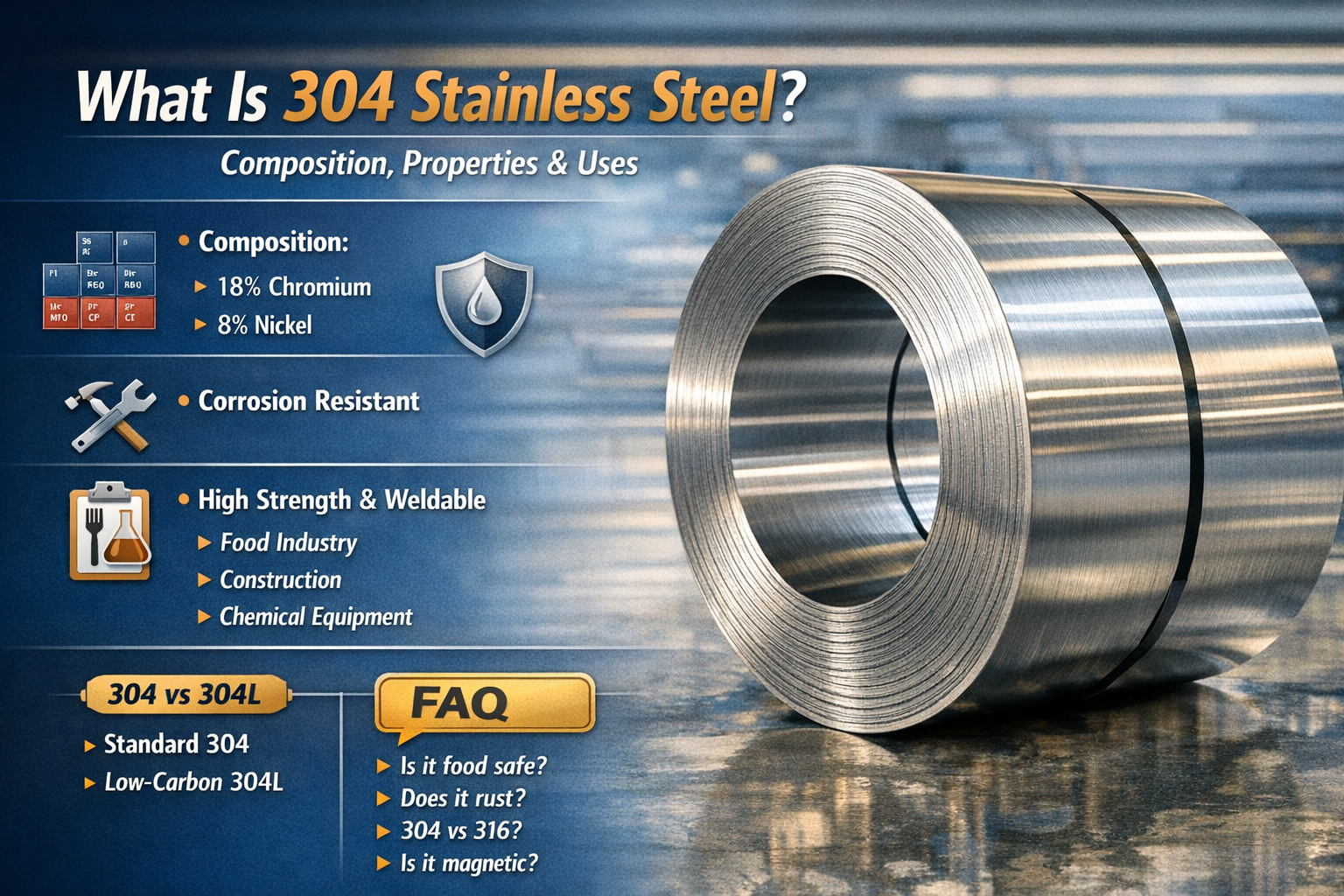
304 stainless steel, also known as UNS S30400, is an austenitic chromium-nickel stainless steel. It typically contains around 18% chromium and 8% nickel, which is why it is often referred to as “18/8 stainless steel.” The presence of chromium provides corrosion resistance, while nickel enhances toughness and ductility.
This grade is non-magnetic in the annealed condition and cannot be hardened by heat treatment. However, it can be strengthened through cold working processes.
2. Chemical Composition of 304 Stainless Steel
| Elemento | Content (%) |
|---|---|
| Carbon (C) | ≤ 0.08 |
| Chromium (Cr) | 18.0 – 20.0 |
| Nickel (Ni) | 8.0 – 10.5 |
| Manganese (Mn) | ≤ 2.0 |
| Silicon (Si) | ≤ 1.0 |
| Phosphorus (P) | ≤ 0.045 |
| Sulfur (S) | ≤ 0.03 |
| Iron (Fe) | Balance |
3. Key Properties of 304 Stainless Steel
3.1 Corrosion Resistance
304 stainless steel offers excellent resistance to corrosion in most atmospheric environments and many chemicals. It performs well in oxidizing environments but may be susceptible to pitting in chloride-rich conditions.
3.2 Mechanical Properties
- Tensile Strength: ≥ 515 MPa
- Yield Strength: ≥ 205 MPa
- Elongation: ≥ 40%
- Hardness: ≤ 201 HB
3.3 Heat Resistance
304 stainless steel can withstand temperatures up to 870°C in intermittent service and up to 925°C in continuous service. However, continuous exposure between 425°C and 860°C may lead to carbide precipitation and reduced corrosion resistance.
3.4 Formability and Weldability
This grade has excellent forming and welding characteristics. It can be easily fabricated using standard industrial methods, including bending, stamping, and deep drawing.
3.5 Hygienic Properties
Due to its smooth surface and resistance to contamination, 304 stainless steel is widely used in food processing and medical equipment.
4. Common Applications of 304 Stainless Steel
4.1 Food and Beverage Industry
- Kitchen equipment and utensils
- Food processing machinery
- Storage tanks and pipelines
4.2 Construction and Architecture
- Handrails and balustrades
- Decorative panels
- Structural components
4.3 Chemical and Industrial Equipment
- Heat exchangers
- Chemical containers
- Pressure vessels
4.4 Household and Consumer Products
- Sinks and cookware
- Appliances
- Water heaters
5. Advantages of 304 Stainless Steel
- Excellent corrosion resistance
- Good mechanical strength
- Easy to fabricate and weld
- Attractive surface finish
- Wide availability and cost-effective
6. Limitations of 304 Stainless Steel
- Not ideal for high-chloride environments (risk of pitting corrosion)
- Lower strength compared to some alloy steels
- Cannot be hardened by heat treatment
7. 304 vs 304L Stainless Steel
304L is a low-carbon version of 304 stainless steel (≤ 0.03% carbon). It is preferred for welding applications where carbide precipitation may occur. The lower carbon content reduces the risk of intergranular corrosion.
8. FAQ
Q1: Is 304 stainless steel food safe?
Yes, 304 stainless steel is widely considered food-safe due to its corrosion resistance, non-reactivity, and ease of cleaning.
Q2: Is 304 stainless steel rust-proof?
It is highly corrosion-resistant but not completely rust-proof. In harsh environments, especially those with high chloride content, it may corrode.
Q3: Can 304 stainless steel be magnetic?
In its annealed state, it is non-magnetic. However, cold working can induce slight magnetism.
Q4: What is the difference between 304 and 316 stainless steel?
316 stainless steel contains molybdenum, which provides better resistance to corrosion in chloride environments compared to 304.
Q5: Is 304 stainless steel suitable for outdoor use?
Yes, it performs well outdoors in most environments, but in coastal or marine environments, 316 stainless steel is often preferred.
Conclusión
