
Zinc vs Stainless Steel: Corrosion Resistance & Long-Term Performance Compared
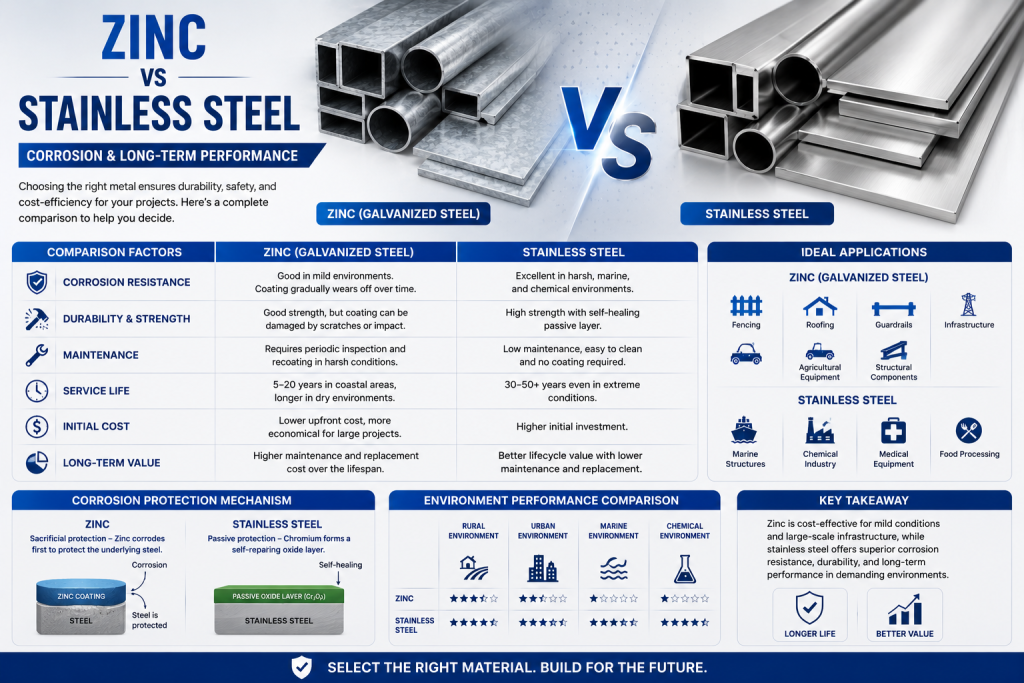
Selecting the right metal is critical for achieving long service life, reducing maintenance costs, and ensuring structural reliability. Among the most commonly used corrosion-resistant materials are zinc and stainless steel. While both materials offer protection against environmental degradation, their corrosion mechanisms, durability, and long-term performance differ significantly.
Understanding these differences helps engineers, contractors, manufacturers, and procurement professionals choose the most cost-effective solution for construction, infrastructure, marine projects, industrial equipment, and architectural applications.
What Is Zinc?
Zinc is a metallic element widely used as a protective coating for steel through a process known as galvanizing. The primary purpose of zinc coatings is to prevent rust and extend the service life of carbon steel products.
Zinc protects steel through two mechanisms:
- Physical barrier protection
- Sacrificial corrosion protection
Even when the coating is scratched, zinc continues protecting the underlying steel by corroding before the steel substrate.
What Is Stainless Steel?
Stainless steel is an iron-based alloy containing at least 10.5% chromium. The chromium reacts with oxygen to form a thin passive oxide layer that continuously protects the material from corrosion.
Unlike zinc-coated steel, stainless steel does not rely on a surface coating. Corrosion resistance is built directly into the alloy structure.
Common stainless steel grades include:
- 304 Stainless Steel
- 316 Stainless Steel
- 430 Stainless Steel
- 2205 Duplex Stainless Steel
Zinc vs Stainless Steel: Chemical Protection Mechanisms
| Property | Zinc | Stainless Steel |
|---|---|---|
| Protection Method | Sacrificial coating | Passive chromium oxide layer |
| Surface Damage Resistance | Limited | Self-healing passive film |
| Coating Dependency | Yes | No |
| Long-Term Stability | Moderate | Excelente |
The self-repairing passive layer of stainless steel gives it a major advantage in aggressive environments and long-term service conditions.
Corrosion Resistance Comparison
Atmospheric Exposure
Galvanized zinc performs well in ordinary urban and rural environments. However, over time the zinc layer gradually wears away.
Stainless steel offers significantly greater resistance and can maintain its appearance and structural integrity for decades with minimal degradation.
Marine Environments
Saltwater and chloride-rich environments accelerate zinc consumption.
316 stainless steel is typically preferred for:
- Coastal structures
- Marine hardware
- Offshore platforms
- Shipbuilding applications
Chemical Processing Facilities
Industrial chemicals can rapidly attack zinc coatings. Stainless steel grades such as 316, 317, and duplex stainless steel provide far superior resistance in chemical processing environments.
Mechanical Strength and Durability
| Performance Factor | Zinc-Coated Steel | Stainless Steel |
|---|---|---|
| Impact Resistance | Good | Excelente |
| Wear Resistance | Moderate | High |
| Structural Strength | Depends on base steel | Excelente |
| Fatigue Resistance | Moderate | High |
| Long-Term Durability | Good | Excelente |
For projects requiring decades of service life, stainless steel generally delivers superior mechanical reliability.
Maintenance Requirements
Maintenance costs often determine the true lifetime value of a material.
Zinc-Coated Steel
- Periodic inspection required
- Coating degradation must be monitored
- Repairs may be necessary in damaged areas
- Recoating may be required after years of service
Stainless Steel
- Minimal maintenance
- Easy cleaning
- No recoating required
- Excellent appearance retention
Although stainless steel typically has a higher initial cost, lower maintenance expenses often result in lower total lifecycle costs.
Expected Service Life
| Environment | Galvanized Zinc | Stainless Steel |
|---|---|---|
| Indoor Dry Conditions | 20-50 years | 50+ years |
| Urban Outdoor Environment | 15-40 years | 50+ years |
| Coastal Environment | 5-20 years | 30-50+ years |
| Industrial Chemical Environment | Limited | Excelente |
Actual lifespan depends on environmental conditions, maintenance practices, and material specifications.
Applications of Zinc-Coated Steel
- Utility poles
- Guardrails
- Fencing systems
- Roofing structures
- Agricultural equipment
- Structural steel components
Galvanized steel offers a cost-effective solution for large-scale infrastructure projects where budget is a major consideration.
Applications of Stainless Steel
- Food processing equipment
- Medical devices
- Marine structures
- Chemical processing systems
- Architectural facades
- Water treatment facilities
- Pharmaceutical production equipment
Its superior corrosion resistance and clean appearance make stainless steel the preferred material in demanding industries.
Cost vs Long-Term Value
Zinc-coated steel generally has a lower upfront cost. For short-term projects or moderately corrosive environments, it can provide excellent economic value.
Stainless steel requires a higher initial investment but often delivers:
- Longer service life
- Lower maintenance costs
- Reduced replacement frequency
- Improved appearance retention
- Higher long-term return on investment
For mission-critical infrastructure and corrosive environments, stainless steel frequently becomes the more economical option over the full project lifecycle.
Which Material Should You Choose?
Choose Zinc-Coated Steel If:
- Initial budget is limited
- Environmental exposure is moderate
- Large-scale infrastructure is involved
- Periodic maintenance is acceptable
Choose Stainless Steel If:
- Maximum corrosion resistance is required
- Long service life is critical
- Maintenance access is limited
- Marine or chemical exposure is present
- Premium appearance matters
Frequently Asked Questions (FAQ)
Is stainless steel more corrosion resistant than zinc?
Yes. Stainless steel generally offers significantly better long-term corrosion resistance, particularly in marine, industrial, and chemical environments.
Does zinc rust?
Zinc does not rust like iron, but it gradually corrodes and sacrifices itself to protect the underlying steel.
Can galvanized steel last as long as stainless steel?
In mild environments galvanized steel can provide decades of service, but stainless steel typically achieves a much longer lifespan with less maintenance.
Which material is better for coastal areas?
316 stainless steel is usually the preferred choice for coastal and marine environments due to its superior resistance to chloride corrosion.
Is stainless steel worth the higher cost?
For projects requiring long-term durability, reduced maintenance, and maximum corrosion protection, stainless steel often provides better lifecycle value despite the higher initial investment.
Conclusión
Both zinc and stainless steel play important roles in modern engineering and construction. Zinc-coated steel offers an economical solution for many structural applications, while stainless steel provides unmatched corrosion resistance, durability, and long-term performance. The optimal choice depends on environmental conditions, maintenance expectations, project lifespan, and total ownership cost. By evaluating these factors carefully, organizations can maximize reliability and return on investment for decades to come.
