
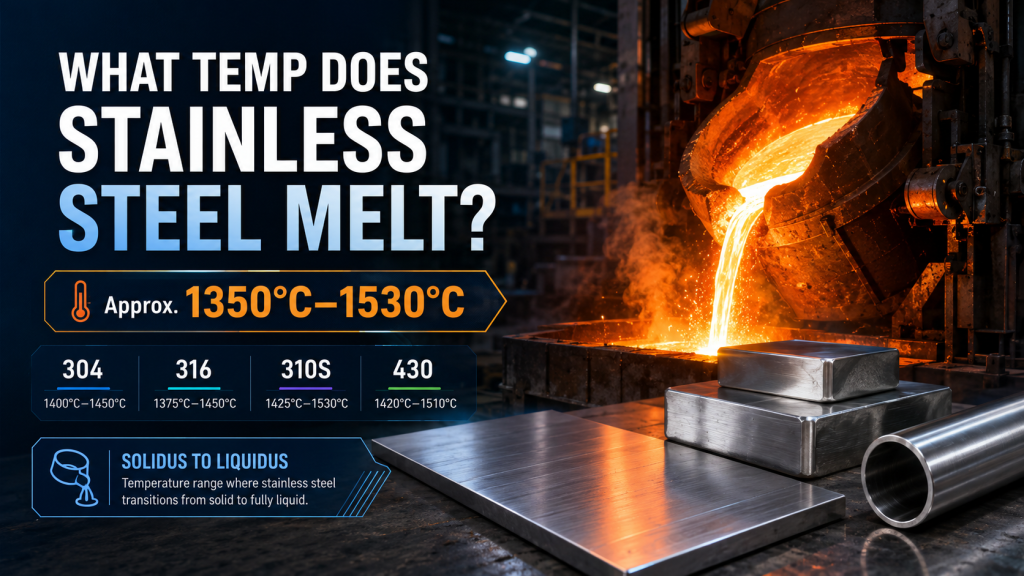
 What temp does stainless steel melt? Most commonly used stainless steel grades melt over an approximate range of about 1,350°C to 1,530°C, or 2,460°F to 2,790°F. Grade 304 typically melts at approximately 1,400–1,450°C, while 316 and 316L generally melt at approximately 1,375–1,400°C.
Stainless steel does not normally have one exact melting point because it is an alloy rather than a pure element. It begins to form liquid at its solidus temperature and becomes completely liquid only after reaching its liquidus temperature.
The exact range depends on the grade, chemical composition and individual production heat. More importantly, stainless steel loses useful strength and dimensional stability long before it reaches its melting range. Engineers should therefore select stainless steel according to operating temperature, load, atmosphere, oxidation resistance, thermal cycling and required service life—not melting point alone.
Quick Answer: At What Temperature Does Stainless Steel Melt?
- Common stainless steel grades:
approximately 1,350–1,530°C, or 2,460–2,790°F. - 304 / 304L stainless steel:
approximately 1,400–1,450°C, or 2,550–2,640°F. - 316 / 316L stainless steel:
approximately 1,375–1,400°C, or 2,507–2,552°F. - 310 / 310S stainless steel:
approximately 1,400–1,455°C, or 2,550–2,650°F. - 430 stainless steel:
approximately 1,425–1,510°C, or 2,600–2,750°F. - 2205 duplex stainless steel:
approximately 1,385–1,440°C, or 2,525–2,625°F.
These ranges are engineering reference values. They should not be used as guaranteed batch-specific acceptance criteria unless the requirement has been agreed with the manufacturer and supported by appropriate technical data.
Stainless Steel Melting Temperature Table
| Grado | Common UNS Designation | Approximate Melting Range °C | Approximate Melting Range °F | Typical Material Role |
|---|---|---|---|---|
| 304 / 304L | S30400 / S30403 | 1,400–1,450°C | 2,550–2,640°F | General-purpose austenitic stainless steel |
| 316 / 316L | S31600 / S31603 | 1,375–1,400°C | 2,507–2,552°F | Molybdenum-bearing corrosion-resistant grade |
| 310 / 310S | S31000 / S31008 | 1,400–1,455°C | 2,550–2,650°F | High-temperature oxidation-resistant grade |
| 321 | S32100 | 1,400–1,450°C | 2,550–2,640°F | Titanium-stabilized austenitic grade |
| 430 | S43000 | 1,425–1,510°C | 2,600–2,750°F | General-purpose ferritic stainless steel |
| 410 | S41000 | 1,480–1,530°C | 2,696–2,786°F | Hardenable martensitic stainless steel |
| 2205 Duplex | S32205 / S31803 | 1,385–1,440°C | 2,525–2,625°F | High-strength duplex stainless steel |
| 2507 Super Duplex | S32750 | 1,350–1,390°C | 2,462–2,534°F | Highly alloyed super duplex stainless steel |
The values in this table are approximate published reference ranges. Product form, chemical composition and individual heat analysis can shift the actual solidus and liquidus temperatures.
Why Does Stainless Steel Melt Over a Temperature Range?
Pure metals can be described by a single melting temperature under defined pressure conditions. Pure iron, for example, melts at approximately 1,538°C.
Stainless steel is different because it contains several alloying elements, including:
- Iron
- Chromium
- Nickel
- Molybdenum
- Carbon
- Manganese
- Silicon
- Nitrogen
- Grade-specific stabilizing or strengthening elements
These elements do not all transform from solid to liquid at exactly the same temperature. As a result, stainless steel passes through a partially molten condition.
What Is the Solidus Temperature?
The solidus is the temperature below which the alloy remains fully solid. When the steel reaches the solidus, the first liquid phase begins to form.
What Is the Liquidus Temperature?
The liquidus is the temperature above which the material is fully liquid. Between the solidus and liquidus, the alloy contains both solid and liquid phases.
This distinction is important in welding, casting, remelting, brazing, heat treatment and failure analysis.
Why Do Stainless Steel Grades Have Different Melting Ranges?
Composición química
Chromium, nickel, molybdenum, manganese, carbon and nitrogen alter the thermodynamic and solidification behavior of the alloy.
A grade with more alloying elements does not necessarily have a higher melting range. Highly alloyed grades can begin melting at lower temperatures than simpler grades.
Carbon Content
Carbon affects solidification behavior, carbide formation and the relationship between the solidus and liquidus temperatures.
Low-carbon grades such as 304L and 316L are selected mainly to reduce sensitization risk during welding. Their melting behavior remains broadly similar to the standard-carbon versions, but the exact heat chemistry can create small differences.
Ferritic, Austenitic, Martensitic and Duplex Structures
Different stainless steel families contain different combinations of chromium, nickel, molybdenum, carbon and nitrogen.
- Austenitic grades usually contain nickel and often have melting ranges lower than some ferritic and martensitic grades.
- Ferritic grades contain little or no nickel and may have relatively high liquidus temperatures.
- Martensitic grades contain more carbon than many austenitic or ferritic grades and can often be hardened by heat treatment.
- Duplex and super duplex grades contain high chromium, molybdenum and nitrogen, which influence their solidification and phase balance.
Melting Temperatures of Common Stainless Steel Grades
304 and 304L Stainless Steel
304 stainless steel
and
304L stainless steel
typically melt over a range of approximately 1,400–1,450°C.
These grades are widely used for food equipment, tanks, architectural products, kitchen equipment and general fabrication.
Their relatively high melting range does not mean that fabricated equipment can safely operate close to 1,400°C. Oxidation, scaling, creep and loss of strength become important much earlier.
316 and 316L Stainless Steel
316 and
316L stainless steel
typically melt over a range of approximately 1,375–1,400°C.
The grades contain molybdenum and are selected primarily for corrosion resistance in many chloride-bearing, chemical, food-processing and pharmaceutical environments.
Their lower reference melting range compared with 304 does not mean they are inferior materials. Melting range and corrosion performance describe different material behaviors.
310 and 310S Stainless Steel
310 and 310S typically melt over a range of approximately 1,400–1,455°C, which is similar to the range for 304.
However, 310S has considerably higher chromium and nickel content and is designed for improved oxidation resistance and elevated-temperature service.
This comparison demonstrates why melting point alone is not a useful way to rank heat-resistant stainless steel grades.
For a more detailed high-temperature comparison, review
310S vs 309 stainless steel
.
430 Stainless Steel
430 stainless steel
is a ferritic grade with an approximate reference melting range of 1,425–1,510°C.
Although its liquidus temperature can be higher than that of some austenitic grades, 430 is not automatically the best option for every high-temperature application. Oxidation resistance, embrittlement, thermal expansion, welding and mechanical loading must still be reviewed.
2205 Duplex Stainless Steel
2205 duplex stainless steel
typically melts over an approximate range of 1,385–1,440°C.
2205 is mainly selected for its high strength, chloride stress-corrosion-cracking resistance and localized-corrosion resistance—not for continuous furnace service.
2507 Super Duplex Stainless Steel
2507 super duplex stainless steel
has an approximate reference melting range of 1,350–1,390°C.
Its comparatively lower melting range does not reduce its value in offshore, desalination, oil-and-gas and chloride-bearing process applications. Its main advantages are strength and corrosion resistance.
Is Melting Point the Same as Maximum Service Temperature?
No. Melting point and maximum service temperature describe very different limitations.
The melting range indicates when the alloy changes from solid to liquid. The allowable service temperature indicates whether a component can maintain acceptable:
- Yield and tensile strength
- Creep resistance
- Oxidation resistance
- Dimensional stability
- Fatigue resistance
- Surface condition
- Metallurgical stability
- Corrosion resistance
A component can lose load-bearing capacity, distort, creep, oxidize or experience metallurgical damage while remaining completely solid.
Engineering principle:
A material with a melting range above the operating temperature is not automatically suitable for that operating temperature.
304 vs 310S: Similar Melting Range, Different Performance
304 and 310S both melt at approximately 1,400–1,450°C, yet 310S normally performs better in sustained high-temperature oxidizing environments.
The reason is not a significantly higher melting point. It is the higher chromium and nickel content, which improves oxidation resistance and high-temperature metallurgical stability.
What Happens to Stainless Steel Before It Melts?
Loss of Mechanical Strength
As temperature increases, yield strength, tensile strength and elastic modulus generally decrease. The rate of reduction depends on the grade, product condition and exposure time.
A load-bearing component can deform or fail well below the solidus temperature.
Creep
Creep is time-dependent deformation under sustained load at elevated temperature.
For equipment operating at high temperature for months or years, creep strength can control material selection even when the operating temperature is hundreds of degrees below the melting range.
Oxidation and Scaling
Oxygen reacts with the hot stainless steel surface and forms oxide scale. Chromium-rich grades usually provide better oxidation resistance, but performance also depends on:
- Temperature
- Exposure time
- Gas composition
- Thermal cycling
- Surface contamination
- Scale adhesion
Thermal Expansion and Distortion
Stainless steel expands when heated. Uneven heating, restrained joints and repeated heating and cooling can produce distortion, thermal fatigue and cracking.
Microstructural Change
Prolonged exposure in certain temperature ranges may cause carbide precipitation, sigma-phase formation, embrittlement or changes in corrosion resistance.
Can Stainless Steel Melt in a Fire?
Stainless steel may remain solid during many fire events because common stainless steel melting ranges are above the temperatures reached in many building and equipment fires.
However, remaining solid does not mean remaining structurally safe.
Fire exposure can cause:
- Severe reduction in strength
- Loss of stiffness
- Permanent deformation
- Weld and connection damage
- Oxidation and scale formation
- Changes in surface condition
Fire-damaged stainless steel structures and equipment should be assessed using applicable engineering codes, grade-specific elevated-temperature data and professional inspection.
Does Stainless Steel Melt During Welding?
Yes. Fusion welding creates a small localized molten pool in the base metal and filler metal.
The welding arc or heat source operates at a temperature far above the stainless steel melting range, but heat is concentrated in a limited area.
Welding performance depends on:
- Base-metal grade
- Filler-metal selection
- Heat input
- Joint design
- Shielding gas
- Solidification mode
- Cooling rate
- Interpass temperature
- Post-weld cleaning
Improper control can result in hot cracking, excessive ferrite or austenite imbalance, oxidation, sensitization, distortion and reduced corrosion resistance.
Stainless Steel Melting in Casting and Remelting
In casting and stainless steel production, the furnace must heat the metal above the liquidus temperature so that the charge becomes fully molten and can flow, refine and fill the mold.
The required superheat above the liquidus depends on:
- Alloy grade
- Furnace type
- Ladle and transfer time
- Section thickness
- Mold design
- Fluidity requirement
- Expected temperature loss
Excessive superheat can increase oxidation, refractory attack, alloy loss, gas pickup and energy consumption. Insufficient temperature can lead to poor flow, incomplete filling and casting defects.
Stainless Steel vs Other Metals: Melting Temperature
| Material | Approximate Melting Temperature or Range | Important Note |
|---|---|---|
| Aluminum | Approximately 660°C | Melts substantially below stainless steel |
| Brass | Approximately 900–940°C | Varies significantly with copper-zinc composition |
| Bronze | Approximately 950–1,050°C | Depends on the bronze alloy system |
| Cast Iron | Approximately 1,150–1,200°C | Carbon and silicon lower the melting range |
| Stainless Steel | Approximately 1,350–1,530°C | Depends strongly on grade and chemistry |
| Pure Iron | Approximately 1,538°C | Pure element with a defined melting temperature |
| Titanium | Approximately 1,668°C | Higher melting temperature does not define every service advantage |
Which Stainless Steel Is Best for High-Temperature Equipment?
The correct grade cannot be selected from melting range alone.
Engineers and buyers should define:
Operating Temperature
- Normal operating temperature
- Maximum upset temperature
- Continuous or intermittent exposure
- Heating and cooling rate
Atmosphere
- Air or oxygen-rich gas
- Reducing gas
- Sulfur-bearing gas
- Carburizing atmosphere
- Nitriding atmosphere
- Combustion products
- Molten salts or process deposits
Mechanical Requirements
- Static load
- Pressure
- Vibration
- Creep life
- Dimensional stability
- Thermal-fatigue resistance
Fabrication Requirements
- Welding
- Doblar
- Forming
- Machining
- Heat treatment
- Surface restoration
For moderate-temperature general fabrication, 304 or 316 may be suitable after engineering review.
For high-temperature oxidation service, grades such as 309S, 310S or 253MA may provide more appropriate performance.
For corrosive environments at moderate temperatures, 316L, 2205, 2507 or another corrosion-resistant grade may be more suitable.
Common Purchasing Mistakes
1. Asking Only for the Melting Point
The melting range does not show whether the component will retain strength, resist oxidation or maintain dimensional stability during service.
2. Choosing the Grade With the Highest Liquidus Temperature
A higher liquidus temperature does not automatically provide better creep strength, thermal-fatigue resistance or corrosion performance.
3. Treating a Reference Value as a Guaranteed Property
Published melting ranges are normally typical physical-property references. Actual heat chemistry can shift the solidus and liquidus.
4. Ignoring the Operating Atmosphere
A grade that performs well in clean air may behave differently in sulfur-bearing, carburizing, reducing or low-oxygen gases.
5. Ignoring Mechanical Loading
An unloaded test coupon and a heavily loaded furnace component can have very different usable temperature limits.
6. Ordering Only by the Name “Stainless Steel”
The purchase order should identify the exact grade, UNS designation, product standard, dimensions, surface condition and required documents.
Material Certificates and Inspection
A standard mill test certificate normally focuses on:
- Manufacturer and customer information
- Product standard
- Grado
- Heat number
- Chemical composition
- Mechanical properties
- Heat-treatment condition
- Dimensions
- Inspector authorization
The melting range is normally treated as a reference physical property rather than a routine batch acceptance result.
For critical projects, buyers may also request:
- Positive material identification
- Heat-number traceability
- Dimensional inspection
- Surface inspection
- Third-party inspection
- Welding documentation
- High-temperature property data
Review selected JUDE
stainless steel inspection reports
for examples of material and quality documentation.
High-Temperature Stainless Steel RFQ Checklist
Send the following information when requesting stainless steel for a high-temperature application:
- Exact grade:
304, 304L, 309S, 310S, 316L, 321, 430 or another specified grade. - UNS or EN designation:
Include the required material designation where applicable. - Product standard:
ASTM A240/A240M, EN 10088-2 or another applicable product standard. - Product form:
Sheet, plate, coil, strip or fabricated component. - Dimensions:
Thickness, width, length and tolerances. - Operating temperature:
Normal, maximum and upset temperatures. - Exposure duration:
Continuous, intermittent or cyclic service. - Atmosphere:
Air, combustion gas, reducing gas, sulfur-bearing gas or another environment. - Mechanical loading:
Pressure, weight, vibration, creep life and dimensional requirements. - Thermal cycling:
Heating and cooling frequency and rate. - Processing:
Cutting, bending, forming, welding, machining or heat treatment. - Surface condition:
No.1, 2B, BA, No.4 or another specified finish. - Inspection documents:
MTC, heat number, PMI, dimensional report or third-party inspection. - Quantity:
Number of pieces, total weight or coil quantity. - Delivery:
Packaging, destination port, Incoterm and required date.
JUDE Stainless Steel Product Options
JUDE supplies stainless steel materials in several product forms for general industrial, corrosion-resistant and high-temperature applications.
Stainless steel sheet and plate
for furnace panels, heat shields, equipment housings, tanks and fabricated components.
Stainless steel coil
for continuous processing, roll forming and cut-to-length production.
Stainless steel strip
for narrow components, clips, shields, gaskets and formed parts.
Frequently Asked Questions
At what temperature does stainless steel melt?
Most commonly used stainless steels melt over approximate ranges between 1,350°C and 1,530°C, depending on the grade and chemical composition.
What is the melting point of 304 stainless steel?
304 and 304L stainless steel typically melt over an approximate range of 1,400–1,450°C, or about 2,550–2,640°F.
What is the melting point of 316 stainless steel?
316 and 316L stainless steel typically melt over an approximate range of 1,375–1,400°C, or about 2,507–2,552°F.
Why does stainless steel have a melting range instead of one melting point?
Stainless steel contains several alloying elements. It begins melting at the solidus temperature and becomes fully liquid only after reaching the liquidus temperature.
Does stainless steel lose strength before it melts?
Yes. Strength, stiffness and dimensional stability can decrease significantly hundreds of degrees below the melting range.
Does a higher melting point mean better heat resistance?
No. Heat resistance also depends on oxidation, creep strength, thermal cycling, atmosphere, metallurgical stability and mechanical loading.
Can stainless steel melt during welding?
Yes. Fusion welding creates a localized molten pool in the base metal and filler metal while most of the surrounding component remains solid.
Which stainless steel is best for furnace applications?
Grades such as 309S, 310S and 253MA are commonly evaluated for furnace service, but the correct choice depends on temperature, atmosphere, load, thermal cycling and required life.
Conclusión
So, what temp does stainless steel melt? Most common grades melt over approximate ranges from about 1,350°C to 1,530°C.
304 typically melts at approximately 1,400–1,450°C, while 316 generally melts at approximately 1,375–1,400°C. Ferritic 430 and martensitic 410 can have higher liquidus temperatures, while highly alloyed duplex grades may begin melting at lower temperatures.
Melting point should never be used as the only high-temperature selection criterion. Stainless steel can lose strength, creep, oxidize, distort or experience metallurgical damage long before it becomes liquid.
For reliable material selection, define the operating temperature, atmosphere, load, thermal cycling, fabrication method and required service life.
Request a Stainless Steel Material Review
JUDE supplies stainless steel sheet, plate, coil, strip and processed components for general industrial and high-temperature applications.
Send the grade, standard, dimensions, operating temperature, atmosphere, mechanical load, processing requirements, inspection documents, quantity and destination.
Contact JUDE Steel for material selection support and a quotation.
