
Martensitic Stainless Steel: Grades, Properties & Uses
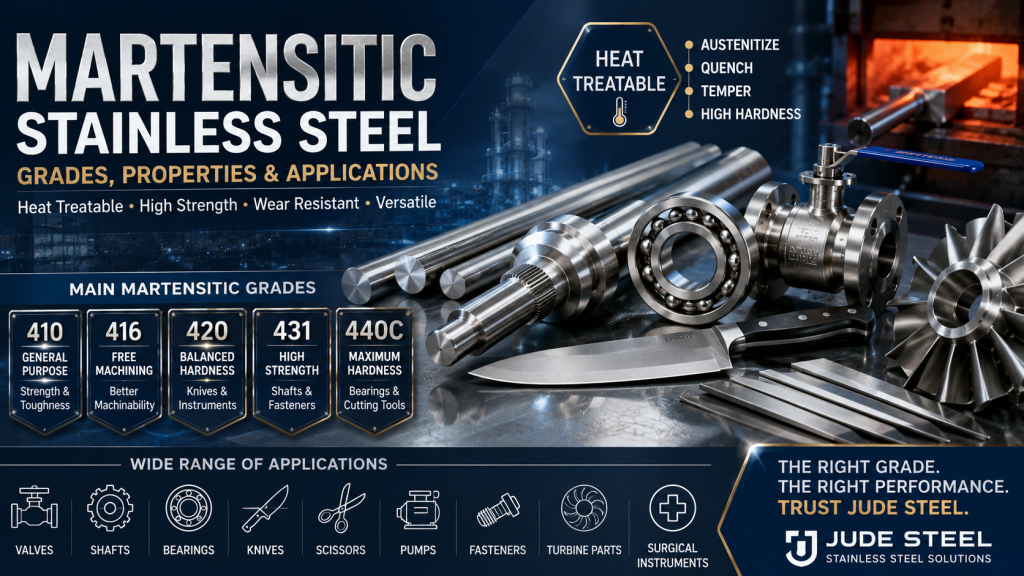 Martensitic stainless steel is a family of chromium-containing stainless steels that can be hardened through controlled heat treatment. Unlike conventional austenitic and ferritic stainless steels, martensitic grades can develop a hard, strong microstructure after austenitizing, quenching and tempering.
The correct grade cannot be selected from hardness alone. Engineers and buyers must balance corrosion resistance, toughness, wear resistance, welding, machining, heat-treatment capability, dimensional stability and final inspection requirements.
Quick Answer: What Is Martensitic Stainless Steel?
Martensitic stainless steel is normally an iron-chromium-carbon alloy designed to transform into a strong and hard martensitic microstructure after heat treatment.
- It can be hardened by austenitizing and quenching.
- It is normally tempered after hardening to reduce excessive brittleness.
- It is generally magnetic in annealed and hardened conditions.
- Its corrosion resistance is normally lower than that of 304 or 316L.
- Its hardness and wear resistance can be much higher than conventional annealed austenitic stainless steel.
- Its properties depend strongly on carbon content and heat treatment.
Common grades include 403, 410, 416, 420, 431, 440A, 440B and 440C. Related European grades include EN 1.4021, 1.4028, 1.4034, 1.4057, 1.4116 and 1.4122.
What Is Martensitic Stainless Steel?
Martensitic stainless steels are chromium-containing alloys designed to combine moderate corrosion resistance with high mechanical strength, hardness and wear resistance.
The family typically contains enough chromium to form a passive stainless surface, while carbon and other alloying elements provide the ability to form hard martensite during heat treatment.
Typical characteristics include:
- Heat-treatable strength and hardness
- Magnetic behavior
- Moderate corrosion resistance
- Good wear resistance in hardened conditions
- Lower ductility than annealed austenitic stainless steel
- Grade-dependent machining and welding behavior
- Wide use in blades, tools, valves, shafts, pumps and turbine components
Precipitation-hardening grades such as 17-4PH and 15-5PH may develop a martensitic matrix, but they are normally classified as precipitation-hardening stainless steels rather than conventional martensitic grades.
How Does the Martensitic Microstructure Form?
Martensite is produced by heating a suitable stainless steel into an austenitic temperature range and then cooling it rapidly enough to suppress slower equilibrium transformations.
The resulting microstructure is hard and strong, but it may contain high residual stress and limited toughness. Tempering is therefore normally required after quenching.
1. Annealed or Softened Condition
The material is supplied in a softer condition for machining, forming, cutting or fabrication.
2. Austenitizing
The component is heated into the grade-specific hardening range so that the required high-temperature microstructure develops.
3. Quenching
Controlled cooling transforms the material into martensite and develops high hardness.
4. Tempering
Reheating to a controlled temperature reduces brittleness, relieves residual stress and establishes the required balance of hardness and toughness.
Exact temperatures, holding times, quench media and tempering conditions depend on the grade, product thickness, component geometry and required final properties.
How Alloying Elements Control Performance
| Alloying Element | Main Function | Practical Effect |
|---|---|---|
| Chromium | Supports formation of the passive surface film | Improves general corrosion and oxidation resistance |
| Carbon | Increases hardenability and carbide formation | Raises potential hardness and wear resistance but can reduce toughness and corrosion resistance |
| Nickel | Improves hardenability and toughness | Used in grades such as 431 and low-carbon turbine grades |
| Molybdenum | Supports corrosion resistance and hardenability | Used in selected tool, turbine and higher-performance martensitic grades |
| Sulfur | Improves chip breaking | Enhances machinability in 416 but can reduce corrosion resistance and weldability |
| Vanadium | Forms hard carbides and refines microstructure | Can improve wear resistance and edge stability in selected knife grades |
| Nitrogen | Supports strength and corrosion performance | Used in modern specialized martensitic knife and tool steels |
A higher alloy content does not automatically produce a better grade. The selected chemistry must match the required heat treatment, manufacturing route and service environment.
Martensitic Stainless Steel Grade Map
| Grade or Family | Common Designation | Primary Property | Typical Applications | Important Limitation |
|---|---|---|---|---|
| 403 | UNS S40300 | Strength and steam-service performance | Turbine blades and compressor components | Limited corrosion resistance compared with higher-alloy grades |
| 410 | UNS S41000 / EN 1.4006 / SUS410 | General balance of strength, toughness and corrosion resistance | Valves, shafts, fasteners, pumps and mechanical components | Not intended for aggressive chloride service |
| 410S | UNS S41008 / EN 1.4000 / SUS410S | Low-carbon formability and limited hardening | Thermal equipment, press plates and fabricated components | Not a substitute for hardenable 410 |
| 416 | UNS S41600 / EN 1.4005 / SUS416 | Free-machining performance | Fasteners, fittings, shafts and precision machined parts | Reduced corrosion and welding performance |
| 420J1 / lower-carbon 420 | UNS S42000 family / EN 1.4021 / SUS420J1 | Balanced hardness, forming and toughness | Tableware, instruments and mechanical parts | Lower maximum hardness than higher-carbon variants |
| 420J2 / medium-carbon 420 | UNS S42000 family / EN 1.4028 / SUS420J2 | Higher hardness and wear resistance | Knives, scissors and cutting tools | Lower toughness and more difficult welding |
| High-carbon 420 type | EN 1.4034 / X46Cr13 | High blade hardness and polishability | Professional knives and cutting instruments | Heat treatment and edge geometry are critical |
| 431 | UNS S43100 / EN 1.4057 / SUS431 | High strength with improved toughness and corrosion resistance | Shafts, bolts, marine hardware and high-load components | Still not equivalent to austenitic or duplex stainless steel in chlorides |
| 440A | UNS S44002 | High hardness with a better corrosion balance than higher-carbon 440 grades | Knives, instruments and wear parts | Lower maximum hardness than 440C |
| 440B | UNS S44003 | Intermediate hardness and wear resistance | Cutting tools, dies and precision components | Availability may be more limited than 440A or 440C |
| 440C | UNS S44004 / EN 1.4125 / SUS440C | Very high hardness and wear resistance | Bearings, valve seats, knives and wear components | High carbide content reduces toughness and can limit corrosion performance |
| Low-carbon Ni-Mo martensitic | UNS S41500 / EN 1.4313 and related grades | High toughness, strength and improved corrosion resistance | Hydraulic turbines, pump components and energy equipment | Requires specialized heat treatment and specification control |
ASTM, EN and JIS grades can have different chemical, mechanical and delivery requirements. Confirm the exact governing standard before ordering.
410 and 410S Stainless Steel
410 Stainless Steel
410 is one of the most widely recognized general-purpose martensitic stainless steel grades. It can be hardened and tempered to provide useful strength and moderate wear resistance.
Typical applications include:
- Valve stems and components
- Pump shafts
- Fasteners
- Axles
- Steam-system components
- General mechanical hardware
410S Stainless Steel
410S stainless steel
is a low-carbon modification designed to minimize hardening during cooling and welding.
It provides better fabrication flexibility than standard hardenable 410, but it cannot provide the same final hardness after heat treatment.
410S is often grouped commercially with 410-family products, but its low-carbon design normally produces a predominantly ferritic, substantially non-hardening material rather than a conventional hardened martensitic structure.
416 Free-Machining Stainless Steel
416 is a free-machining modification of 410. Sulfur or another machinability addition helps break chips and improve cutting speed during high-volume machining.
It is commonly used for:
- Threaded components
- Fasteners
- Fittings
- Shafts
- Valve parts
- Precision-turned components
The machinability advantage involves trade-offs. Sulfur-containing inclusions can reduce transverse toughness, corrosion resistance and weldability.
416 should therefore be selected because the machining advantage is commercially important—not simply because it is easier to cut.
420, 420J1 and 420J2 Stainless Steel
The name “420 stainless steel” covers a broad range of martensitic grades. The main performance difference within this family is normally carbon content.
420J1
420J1 stainless steel
provides a practical balance of forming, toughness, hardenability and polishability.
It is commonly considered for:
- Table knives
- Kitchen utensils
- Lower-to-medium hardness instruments
- Press plates
- General mechanical components
420J2
420J2 stainless steel
contains more carbon and can achieve greater hardness and edge retention after appropriate heat treatment.
Common uses include:
- Kitchen knives
- Scissors
- Cutting instruments
- Wear-resistant parts
- Measuring tools
Higher hardness generally increases wear resistance but reduces forming capability, welding flexibility and impact toughness.
431 Stainless Steel
431 is a nickel-containing martensitic stainless steel developed for high strength, toughness and improved corrosion resistance compared with basic 12% chromium grades.
It is often considered for:
- High-strength shafts
- Bolts and fasteners
- Pump components
- Aircraft fittings
- Marine and water-service hardware
- Highly loaded mechanical components
The nickel addition supports toughness and hardenability, particularly in larger sections. However, 431 should not be described as universally seawater resistant.
440A, 440B and 440C Stainless Steel
The 440 family combines higher chromium with progressively greater carbon content.
| Grado | Relative Carbon Level | Performance Focus | Typical Selection |
|---|---|---|---|
| 440A | Lowest of the three | Balanced corrosion resistance, hardness and toughness | Knives, instruments and polished components |
| 440B | Intermediate | Higher hardness and wear resistance | Cutting tools, dies and wear parts |
| 440C | Highest of the three | Maximum hardness and carbide-related wear resistance | Bearings, valve seats, knives and precision wear components |
440C is often described as the hardest conventional stainless steel, but the best material for a specific component may be a lower-carbon grade with better toughness, corrosion resistance or processing consistency.
European Knife and Tool Grades
European standards include several martensitic stainless grades designed for knives, cutting tools, food-processing blades and precision strip.
Common examples include:
- EN 1.4021: lower-carbon, balanced general-purpose grade
- EN 1.4028: medium-carbon grade with higher hardness
- EN 1.4034: high-carbon knife and cutting-tool grade
- EN 1.4116: molybdenum- and vanadium-alloyed knife steel
- EN 1.4110: high-hardness martensitic grade with enhanced wear performance
- EN 1.4122: higher-chromium, molybdenum-containing corrosion-resistant martensitic grade
These grades should not be assigned an approximate ASTM equivalent without reviewing the complete chemistry, mechanical requirements and final heat-treatment condition.
Low-Carbon Nickel-Molybdenum Martensitic Grades
Some modern martensitic stainless steels use low carbon together with nickel and molybdenum to provide strength, toughness and improved corrosion resistance.
Grades such as EN 1.4313 and related 13Cr-4Ni materials are used for:
- Hydroelectric turbine runners
- Pump casings and impellers
- Compressor components
- Energy equipment
- Large cast or forged parts
These materials should not be evaluated using the same hardness logic as high-carbon blade grades. Toughness, weldability, section thickness and resistance to water-service corrosion are often more important.
Martensitic Stainless Steel Heat Treatment
Heat treatment is the most important factor controlling the final performance of martensitic stainless steel.
Annealing
Annealing or softening reduces hardness and prepares the material for machining, forming or further processing.
Austenitizing
The material is heated into a grade-specific temperature range. Carbon and alloying elements enter solution to the extent required for subsequent hardening.
Quenching
Rapid cooling creates the martensitic structure. Cooling rate must be sufficient for hardening but controlled to reduce cracking and distortion.
Tempering
Tempering adjusts the final balance between hardness, strength, toughness and residual stress.
Low-temperature tempering can preserve greater hardness, while higher-temperature tempering normally provides more toughness. Certain tempering ranges may reduce corrosion resistance or toughness in particular grades and should be avoided unless specified by the material producer.
Sub-Zero Treatment
Selected high-carbon grades may use sub-zero or cryogenic treatment to reduce retained austenite and improve dimensional stability.
This should be performed only as part of a validated heat-treatment procedure because it can also increase stress and cracking risk.
The same 420 or 440C material can produce substantially different results after different austenitizing, quenching and tempering procedures.
Hardness, Toughness and Wear Resistance
The property balance of martensitic stainless steel is controlled mainly by carbon content, alloy composition and heat treatment.
| Design Requirement | Typical Starting Grades | Main Trade-Off |
|---|---|---|
| General strength and toughness | 410 or 431 | Lower maximum hardness than high-carbon grades |
| Easy high-volume machining | 416 | Reduced corrosion, toughness and welding performance |
| Balanced blade performance | 420J1, 420J2 or EN 1.4034 | Higher hardness reduces forming and impact tolerance |
| Maximum conventional hardness | 440C | Lower toughness and more difficult heat treatment |
| High-strength shaft performance | 431 | Higher alloy cost and specialized heat treatment |
| Large energy or turbine components | Low-carbon Ni-Mo martensitic grades | Complex specification and welding control |
Corrosion Resistance
Martensitic stainless steels provide moderate corrosion resistance, but their performance varies widely.
The main controlling factors include:
- Chromium content
- Carbon content
- Molybdenum and nickel additions
- Carbide distribution
- Heat-treatment condition
- Surface roughness
- Grinding and polishing
- Passivation and cleanliness
- Chloride concentration
- Crevices and deposits
Higher carbon can tie up more chromium in carbides, reducing the chromium available in the surrounding matrix. This is one reason maximum hardness and maximum corrosion resistance are not always achieved under the same heat-treatment condition.
Proper hardening, tempering, polishing and passivation can improve practical corrosion performance, but martensitic grades should not automatically replace 304, 316L or duplex stainless steel in aggressive environments.
Can Martensitic Stainless Steel Be Used in Seawater?
Conventional 410, 416, 420 and 440 grades are generally not preferred for continuous seawater immersion or severe chloride exposure.
Selected nickel- and molybdenum-containing martensitic grades may perform better, but the final choice should consider pitting, crevice corrosion, stress corrosion, mechanical loading and maintenance.
Welding Martensitic Stainless Steel
Welding can create hard, brittle heat-affected zones and residual stress. Weldability generally becomes more difficult as carbon and hardenability increase.
A qualified welding procedure may require:
- Preheating
- Controlled heat input
- Suitable filler metal
- Interpass-temperature control
- Slow cooling
- Post-weld tempering
- Hardness testing
- Crack inspection
Lower-carbon grades and nickel-containing martensitic grades normally offer better welding flexibility than high-carbon 420 or 440C.
High-carbon knife and bearing grades should not be selected for welded structures without a specialized procedure and detailed engineering review.
Machining, Forming and Grinding
Machining
Most martensitic grades are machined in an annealed or softened condition before final heat treatment.
416 provides the best conventional machinability within the common martensitic family, while high-carbon grades become more difficult as hardness and carbide volume increase.
Forming
Bending, stamping and drawing should normally be completed before hardening.
Lower-carbon grades such as 410S and 420J1 provide more forming flexibility than 420J2, 440C or other high-carbon grades.
Grinding and Sharpening
Grinding after hardening controls final dimensions, edge geometry and surface finish.
Excessive grinding temperature can cause:
- Surface tempering
- Grinding burns
- Residual tensile stress
- Cracking
- Loss of hardness
- Dimensional distortion
Martensitic Stainless Steel Applications
| Application | Recommended Starting Grade | Selection Reason |
|---|---|---|
| Valve stem | 410 or 431 | Strength, toughness and moderate corrosion resistance |
| Pump shaft | 410, 431 or low-carbon Ni-Mo grade | Mechanical loading and water-service requirements |
| High-volume machined fitting | 416 | Improved chip breaking and machining productivity |
| Table knife | 420J1 | Balanced forming, polishability and moderate hardness |
| Kitchen knife | 420J2, EN 1.4034 or 1.4116 | Hardness, edge retention and polishability |
| Scissors | 420J2 or another medium/high-carbon martensitic grade | Cutting-edge wear resistance |
| Bearing component | 440C or specialized bearing grade | High hardness and contact-wear resistance |
| High-strength bolt or shaft | 431 | High strength with useful toughness |
| Hydroelectric turbine part | Low-carbon Ni-Mo martensitic grade | Toughness, cavitation resistance and weldability |
| Surgical cutting instrument | Application-specific 420 or higher-alloy martensitic grade | Validated hardness, polishability and corrosion performance |
Food, medical and surgical suitability applies to the completed component, not simply to the alloy name. Final heat treatment, surface finish, cleaning, sterilization and regulatory validation must also be controlled.
Martensitic vs Austenitic, Ferritic and Duplex Stainless Steel
| Property | Martensitic | Austenitic | Ferritic | Dúplex |
|---|---|---|---|---|
| Heat treatable to high hardness | Yes | No, except by cold work for strength | No conventional quench hardening | No conventional quench hardening |
| Magnetic | Normally yes | Low response when annealed | Yes | Yes |
| General corrosion resistance | Moderate and grade dependent | Good to very high | Moderate to high | High, especially in chlorides |
| Maximum hardness | High to very high | Moderate unless cold worked | Moderate | Moderate to high strength, not blade hardness |
| Formability | Limited to moderate | Generally excellent | Moderate | Moderate |
| Typical applications | Knives, tools, shafts and wear parts | Tanks, food equipment and chemical systems | Appliances, exhausts and heat exchangers | Oil and gas, desalination and chemical systems |
Product Forms and JUDE Supply Options
JUDE supplies selected martensitic and related 400-series stainless steel products subject to grade, standard, dimensions, condition and availability.
Stainless steel sheet and plate
for press plates, tooling blanks, valve components and fabricated parts.
Stainless steel coil
for continuous blanking, stamping and high-volume manufacturing.
Stainless steel strip
for knives, scissors, blades, clips and precision components.
Stainless steel strip processing
for slitting, leveling, edge treatment and customized widths.
Special stainless steel sourcing
for additional martensitic grades subject to technical and commercial review.
Inspection and Quality Control
Grade chemistry alone does not guarantee final martensitic stainless steel performance. Heat treatment and surface processing must also be inspected.
A complete inspection plan may include:
- Grade and product-standard verification
- Mill test certificate review
- Heat-number traceability
- PMI or laboratory chemical analysis
- Carbon-sensitive OES testing
- Hardness testing
- Microstructure examination
- Retained-austenite measurement where required
- Decarburization inspection
- Dimensional inspection
- Flatness and straightness inspection
- Surface-finish inspection
- Crack or nondestructive testing
- Packaging and marking review
Handheld XRF can identify chromium, nickel and molybdenum but may not reliably separate grades whose main difference is carbon. OES or another carbon-sensitive analytical method may be required.
Review selected JUDE
stainless steel inspection reports
when defining material documentation and traceability.
Common Purchasing Mistakes
The family includes soft fabricating grades, free-machining grades, blade grades, high-strength shaft grades and high-carbon bearing grades.
420J1, 420J2, EN 1.4021, 1.4028 and 1.4034 can provide significantly different hardness and forming behavior.
Sheet, coil or strip may be delivered annealed. The component manufacturer may remain responsible for final heat treatment.
Higher hardness may increase chipping, cracking, heat-treatment distortion and grinding difficulty.
Many handheld XRF instruments cannot accurately measure carbon.
Conventional martensitic grades are not normally preferred for continuous seawater or aggressive chloride exposure.
Martensitic Stainless Steel RFQ Checklist
- Exact grade:
403, 410, 410S, 416, 420J1, 420J2, 431, 440A, 440B, 440C or another specified grade. - Standard designation:
State the required UNS, EN, JIS or GB designation. - Product standard:
ASTM A240/A240M-26, ASTM A276/A276M-25, ASTM A580/A580M-23, EN 10088-2, JIS G 4304, JIS G 4305 or another applicable standard. - Product form:
Sheet, plate, coil, strip, bar, wire, blank or finished component. - Delivery condition:
Annealed, softened, hardened, hardened and tempered, or precision temper. - Required hardness:
State the range, scale, test method and test location. - Heat-treatment responsibility:
Confirm whether heat treatment is performed by the material supplier, component manufacturer or approved third party. - Dimensions:
Thickness, width, length, diameter and tolerances. - Flatness and straightness:
Define limits for blades, shafts, press plates and precision strip. - Surface finish:
No.1, 2B, BA, ground, polished, mirror or approved sample. - Edge condition:
Mill edge, slit edge, deburred, rounded, precision ground or sharpened. - Fabrication:
Cutting, blanking, slitting, bending, machining, welding, grinding, polishing or sharpening. - Service environment:
Moisture, steam, chemicals, chlorides, operating temperature and mechanical loading. - Inspection:
MTC, heat number, OES analysis, hardness report, microstructure, dimensional report or third-party inspection. - Quantity and delivery:
Pieces, weight, coil size, packaging, destination and required delivery date.
Frequently Asked Questions
What are the main martensitic stainless steel grades?
Common grades include 403, 410, 416, 420, 431, 440A, 440B and 440C. EN systems also include grades such as 1.4021, 1.4028, 1.4034, 1.4116 and 1.4122.
Can all martensitic stainless steels be hardened?
Most conventional martensitic grades can be hardened by heat treatment. Related low-carbon grades such as 410S are designed to restrict hardening and should not be treated as equivalent to standard 410.
Is martensitic stainless steel magnetic?
Yes. Conventional martensitic stainless steels are normally magnetic in annealed and hardened conditions.
Which martensitic stainless steel is the hardest?
440C is one of the highest-hardness conventional stainless grades. Specialized modern knife, tool and bearing grades may provide different combinations of hardness, toughness and corrosion resistance.
What is the difference between 420 and 440C?
440C generally contains more carbon and chromium and can achieve greater hardness and wear resistance. 420 variants normally provide better forming flexibility and toughness.
Is martensitic stainless steel corrosion resistant?
It provides moderate, grade-dependent corrosion resistance. Performance depends on chromium, carbon, molybdenum, heat treatment, surface finish and exposure.
Can martensitic stainless steel be welded?
It can be welded using qualified procedures, but preheating, controlled heat input and post-weld tempering may be required. Higher-carbon grades are more difficult to weld.
Is martensitic stainless steel suitable for seawater?
Conventional 410, 416, 420 and 440 grades are generally not preferred for continuous seawater immersion. More highly alloyed martensitic, duplex or super duplex grades may be required.
Should martensitic steel be purchased annealed or hardened?
Annealed material is easier to machine and form. Hardened and tempered material may be preferred when the buyer requires finished mechanical properties. The manufacturing route should be defined before ordering.
How can buyers verify the exact grade?
Review the MTC and heat-number markings. Use PMI for major alloying elements and carbon-sensitive OES or laboratory analysis when separating similar carbon-controlled grades.
Conclusión
Martensitic stainless steel combines stainless corrosion resistance with the ability to develop high strength, hardness and wear resistance through heat treatment.
410 provides a general engineering balance. 416 improves machining productivity. 420 grades serve tableware, knives and cutting tools. 431 supports high-strength shafts and fasteners, while 440C is used where very high hardness and wear resistance are required.
The best grade is not necessarily the hardest grade. Reliable selection requires balancing carbon content, corrosion resistance, toughness, heat treatment, machining, welding, dimensional stability and final inspection.
For international purchasing, specify the exact grade, governing standard, delivery condition, hardness, heat-treatment responsibility, dimensions, finish and required quality documents before production begins.
Request a Martensitic Stainless Steel Quotation
Send JUDE the exact grade, standard, product form, dimensions, delivery condition, required hardness, heat treatment, surface finish, edge condition, inspection documents, quantity and destination.
For blade, shaft, bearing or precision-strip projects, also provide the final application, flatness, straightness, hardness test method and required manufacturing route.
Technical References
ASTM A240/A240M-26 — Stainless Steel Plate, Sheet and Strip
ASTM A276/A276M-25 — Stainless Steel Bars and Shapes
ASTM A580/A580M-23 — Stainless Steel Wire
Outokumpu — Martensitic and Precipitation-Hardening Stainless Steels
Outokumpu Dura — Heat-Treatable Stainless Steel Grades
worldstainless — Stainless Steel Categories and Grades
