
Low Alloy Steel vs Stainless Steel: Strength, Corrosion & Full Cost Comparison (2026 Expert Guide)
Material selection between low alloy steel and stainless steel directly defines project lifespan, structural safety, long-term maintenance expenditure and overall profitability for global manufacturers, construction contractors, mechanical engineering and process plant operators. As a leading China-based stainless steel manufacturer with 50,000 tons year-round stainless sheet & coil inventory and full ISO9001-2015 certified processing capacity at Wuxi warehouse, JUDE STEEL elaborates core differences covering mechanical strength performance, inherent corrosion capability, upfront raw material pricing and total lifecycle ownership cost to help buyers make data-driven procurement decisions.
This comprehensive comparison breaks down grade-specific mechanical parameters, environmental adaptability and real-world cost calculation rules for 200/300/400 series stainless steel vs mainstream low alloy steel grades including HSLA A572, 4130 chromoly and ASTM A514 quenched steel.
1. Core Chemical Composition Definition: The Fundamental Dividing Line
What Is Low Alloy Steel?
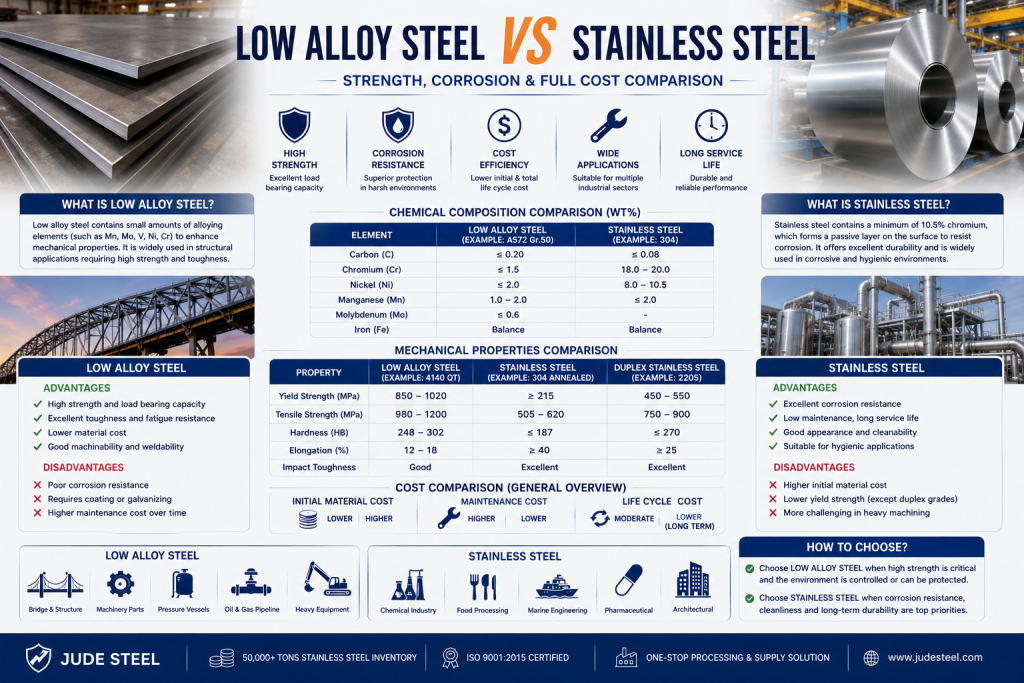
Low alloy steel is iron-carbon base metal blended with total alloy element content below 8wt%, common additives include manganese, molybdenum, vanadium, tiny chromium and nickel to boost mechanical properties without reaching stainless steel’s high chromium threshold (≥10.5% Cr). Alloy formulas are customized primarily for elevated tensile strength, high-temperature toughness and anti-fatigue performance rather than rust prevention, represented by HSLA structural steel (ASTM A572), 4130 chromoly alloy and quenched & tempered A514 plate widely used for heavy load components.
What Is Stainless Steel?
Defined by minimum 10.5% chromium by weight plus optional nickel, molybdenum, nitrogen or copper; chromium forms a self-healing passive chromium oxide film naturally when contacting oxygen, blocking electrochemical rust and corrosion inherently without external coating protection. JUDE’s mainstream stocked stainless grades cover austenitic (304/304L,316/316L), ferritic (430), martensitic (410S,420J2) and duplex high-performance stainless (2205,2507,904L) for diversified industrial scenarios.
2. Mechanical Strength Comparison: Tensile, Yield & Hardness Performance
Strength gap varies drastically based on heat treatment and material family; low alloy steel dominates high-load design after quenching & tempering while special duplex stainless steel matches alloy-level mechanical indicators for corrosion-critical heavy-duty projects.
| Performance Index | Typical Low Alloy Steel (4140/A572) | Conventional Austenitic SS (304 Annealed) | Duplex Stainless Steel (2205) |
|---|---|---|---|
| Yield Strength (MPa) | 850–1020 (QT state) | ~215 | 450–550 |
| Tensile Strength (MPa) | 980–1200 | 505–620 | 750–900 |
| Low-Temperature Toughness | Good after normalized heat treatment | Excellent (non-brittle under cryogenic environment) | Superior balance of toughness & tensile |
| High-Temp Strength | Decreases rapidly over 450℃ | Stable up to 600℃+ | Retain strength up to 550℃ |
Key Takeaway from Jude Steel Technical Team: Standard low alloy steel delivers 3~4x higher yield strength than annealed 304 stainless for crane shafts, heavy machinery frames and pressure vessel shells; select duplex grades (2205/2507) when both high mechanical load and anti-corrosion are mandatory requirements.
3. Corrosion Resistance: Built-in Protection vs Additional Surface Treatment
Corrosion performance becomes the top selection factor for outdoor, marine, chemical and food-grade operating environments, forming the most prominent difference between the two steel categories.
Low Alloy Steel Corrosion Feature
No native anti-rust property; prone to uniform rust, pitting and atmospheric oxidation once exposed to moisture, salt spray or acidic vapor. All low alloy finished parts need mandatory anti-corrosion solutions: hot-dip galvanizing, epoxy paint coating, polyurethane cladding or oil sealing, and periodic re-coating every 2–5 years based on service environment to avoid premature component failure.
Stainless Steel Corrosion Feature
Self-repairing chromium passive film automatically regenerates upon minor surface scratch damage in oxygen-rich surroundings, eliminating routine coating maintenance entirely:
- 304/304L: Resist fresh water & normal atmospheric corrosion for indoor/outdoor general industry
- 316/316L: Molybdenum-alloyed to resist chloride corrosion for coastal marine, brine and weak acid processing equipment
- Ferritic 430: Cost-effective anti-rust for household appliance and dry indoor structural components
- Duplex 2205/2507: Dual-phase structure withstand severe saltwater & chemical medium corrosion with high mechanical strength simultaneously
4. Cost Analysis: Upfront Raw Price vs Full Lifecycle Total Cost of Ownership (TCO)
Most buyers only compare spot material unit price and ignore long-term maintenance & replacement expense; Jude Steel divides cost into two core dimensions for accurate budget planning.
4.1 Upfront Purchase Cost
Low alloy steel raw material price is generally 35%~60% cheaper per metric ton than standard 304 stainless steel due to zero high-cost chromium/nickel input; martensitic stainless grades (410S,420J2) sit in mid-price tier between low alloy and austenitic stainless; duplex stainless ranks highest on initial material cost for premium application.
4.2 Full Lifecycle Ownership Cost (Critical for Long-Service Assets)
- Dry indoor enclosed environment: Low alloy wins total cost after adding one-time coating fee; ideal for sealed mechanical parts inside factory workshops
- Outdoor/coastal/humid/chemical exposure: Stainless steel’s higher initial investment is offset within 3–8 years by saving repeated painting, rust repair, downtime loss and component replacement cost, achieving drastically lower long-term total expenditure
Jude Steel’s global client data shows food & marine project owners cut over 40% average 15-year lifecycle cost by switching from coated low alloy to proper stainless steel grades for corrosive operating conditions.
5. Typical Industry Application Scenarios for Each Steel Type
Best Fit for Low Alloy Steel
Indoor heavy structural beams, construction bridge frames, hydraulic cylinder parts, automotive chassis, dry-environment pressure vessels, gear & axle components where full anti-corrosion coating can be regularly maintained with convenient access for rework.
Best Fit for Stainless Steel (JUDE Supplied Main Fields)
Food & beverage processing equipment, pharmaceutical sanitary piping, coastal marine piping & ship fittings, chemical reactor liners, outdoor architectural cladding, heat exchanger tubes, household kitchenware, medical precision components and washdown industrial production lines requiring hygiene & zero regular anti-rust maintenance.
6. Frequently Asked Questions (FAQ | Google Rich Snippet Optimized)
Q1: Is stainless steel always stronger than low alloy steel?
A1: No. Conventional annealed austenitic stainless (304/316) has much lower yield strength than heat-treated low alloy steel like 4140 QT; only duplex stainless grades (2205,2507) reach equivalent or superior mechanical performance vs standard low alloy steel at higher raw cost.
Q2: Can low alloy steel be used for outdoor open-air projects?
A2: Yes but requires mandatory full anti-corrosion coating system plus periodic re-coating maintenance; coastal salt-rich outdoor projects usually end up with higher total long-run cost vs stainless steel even with cheaper initial purchase price.
Q3: Which grade is most cost-efficient for general anti-rust indoor projects?
A3: Ferritic stainless steel grade 430 balances moderate anti-corrosion performance and lower raw cost than 304; Jude Steel keeps full-size 430 stainless sheet/strip in permanent warehouse stock for fast global delivery.
Q4: What stainless grade is suitable for chloride-rich seawater/marine environment?
A4: Select 316L for regular marine fresh-salt mixing water; duplex 2507 is preferred for concentrated brine and deep-sea equipment with high mechanical load requirement, both readily available from Jude Steel’s Wuxi inventory.
Q5: How to get customized stainless steel cutting/bending/heat treatment service from Jude Steel?
A5: JUDE STEEL owns complete full-process stainless processing workshop supporting CNC cutting, surface polishing, bending, welding and heat treatment for all 200/300/400 series & special stainless grades, send your technical drawing via official website judesteel.com for customized quotation within 24 working hours.
Final Material Selection Guidance from Jude Steel Expert Team
Pick low alloy steel when your project runs under dry enclosed conditions with regular coating maintenance access and top priority is minimizing upfront raw material budget; opt for stainless steel if components work in humid, coastal, chemical or sanitary environments where corrosion failure risk and long maintenance expense cannot be tolerated, with flexible grade selection from cost-effective 430 to high-end duplex stainless as per actual working medium.
With over 18 years stainless steel manufacturing experience since 2007 and ISO9001 certified quality control, JUDE STEEL supplies full-range stainless sheet, coil, strip and custom fabricated metal parts with globally competitive pricing and fast shipment from Wuxi China warehouse; contact our sales team via official website to confirm grade matching and bulk order pricing for your upcoming industrial project.
