
How to Import Stainless Steel from China: A Complete Guide for Global Buyers
China is the world’s largest producer and exporter of stainless steel, offering a wide range of products,competitive pricing, and advanced manufacturing capabilities. For global buyers, importing stainless steel from China can provide significant cost advantages—provided the process is managed correctly.
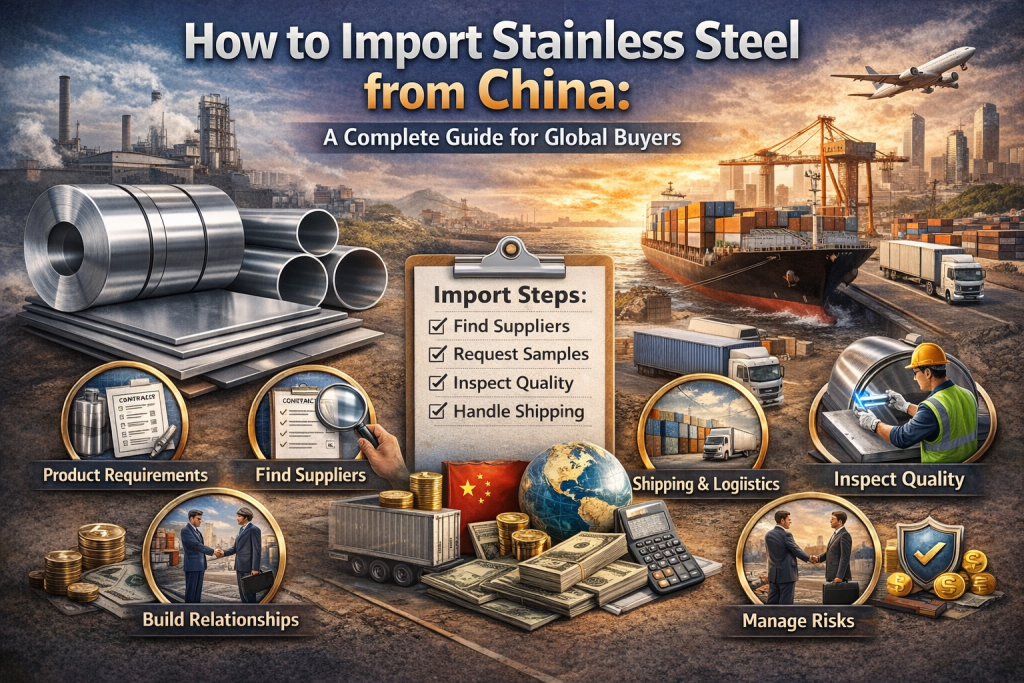
This guide outlines the key steps, risks, and best practices for successfully importing stainless steel from China, ensuring quality, compliance, and smooth logistics.
1. Understand Your Product Requirements
Before sourcing suppliers, clearly define your specifications:
- Grade (e.g., 304, 316, duplex)
- Product type (sheet, plate, coil, pipe, bar)
- Dimensions, thickness, and tolerances
- Surface finish (2B, BA, No.4, mirror)
- Applicable standards (ASTM, EN, JIS)
Precise requirements reduce misunderstandings and ensure accurate quotations.
2. Find Reliable Suppliers
Selecting the right supplier is critical to the success of your import process.
- Check company background and export experience
- Verify certifications (ISO 9001, Mill Test Certificates)
- Review customer references and case studies
- Evaluate production capacity and quality control systems
Working with established exporters reduces risks and ensures consistent supply.
3. Request Samples and Technical Documents
Always request samples or detailed documentation before placing bulk orders:
- Mill Test Certificates (MTC)
- Chemical composition reports
- Mechanical property data
- Third-party inspection reports (SGS, BV)
This step verifies product quality and compliance with specifications.
4. Negotiate Pricing and Terms
Pricing depends on grade, quantity, and market conditions. Key considerations include:
- FOB, CIF, or EXW pricing terms (Incoterms)
- Minimum order quantity (MOQ)
- Payment terms (T/T, L/C)
Clear agreements help avoid disputes and unexpected costs.
5. Conduct Quality Inspection
Quality inspection is essential before shipment:
- Pre-production inspection
- In-process inspection
- Final inspection before shipment
Third-party inspection agencies can provide unbiased verification of product quality.
6. Arrange Shipping and Logistics
Efficient logistics ensure timely delivery:
- Choose reliable freight forwarders
- Select appropriate shipping method (sea freight for bulk orders)
- Ensure proper packaging to prevent damage
Accurate planning reduces delays and minimizes risks during transit.
7. Handle Customs Clearance
Customs procedures vary by country but typically require:
- Commercial invoice
- Packing list
- Bill of lading
- Certificate of origin
Ensure compliance with import regulations, tariffs, and local standards.
8. Manage Risks and Compliance
Importing stainless steel involves several potential risks:
- Quality inconsistency
- Delayed shipments
- Currency fluctuations
- Trade policy changes
Mitigation strategies include working with trusted suppliers, using contracts, and purchasing insurance.
9. Build Long-Term Supplier Relationships
Developing long-term partnerships can improve pricing, priority production, and service quality.
- Maintain clear communication
- Provide consistent order volumes
- Establish mutual trust
FAQ
Q1: Is it safe to import stainless steel from China?
Yes, provided you work with reliable suppliers, verify certifications, and conduct inspections.
Q2: What is the best payment method?
Common methods include T/T (bank transfer) and L/C (letter of credit) for larger transactions.
Q3: How long does shipping take?
Sea freight typically takes 20–40 days depending on destination and shipping route.
Q4: What documents are required for import?
Commercial invoice, packing list, bill of lading, and certificate of origin are essential.
Q5: How can I ensure product quality?
Request samples, review MTCs, and use third-party inspections before shipment.
Conclusión
Importing stainless steel from China offers significant advantages in terms of cost, variety,and manufacturing capability.
By following a structured approach—defining requirements, selecting
reliable suppliers, ensuring quality control, and managing logistics—buyers can achieve successful and efficient international sourcing.
