⚖️Duplex vs Austenitic Stainless Steel: Key Differences
In the world of corrosion-resistant alloys, understanding the difference between duplex vs austenitic stainless steel is crucial for engineers, fabricators, and material specifiers. Both families offer excellent corrosion resistance, but their microstructures and mechanical properties vary significantly, making each better suited for specific environments and applications.
⚠️What Is Austenitic Stainless Steel?
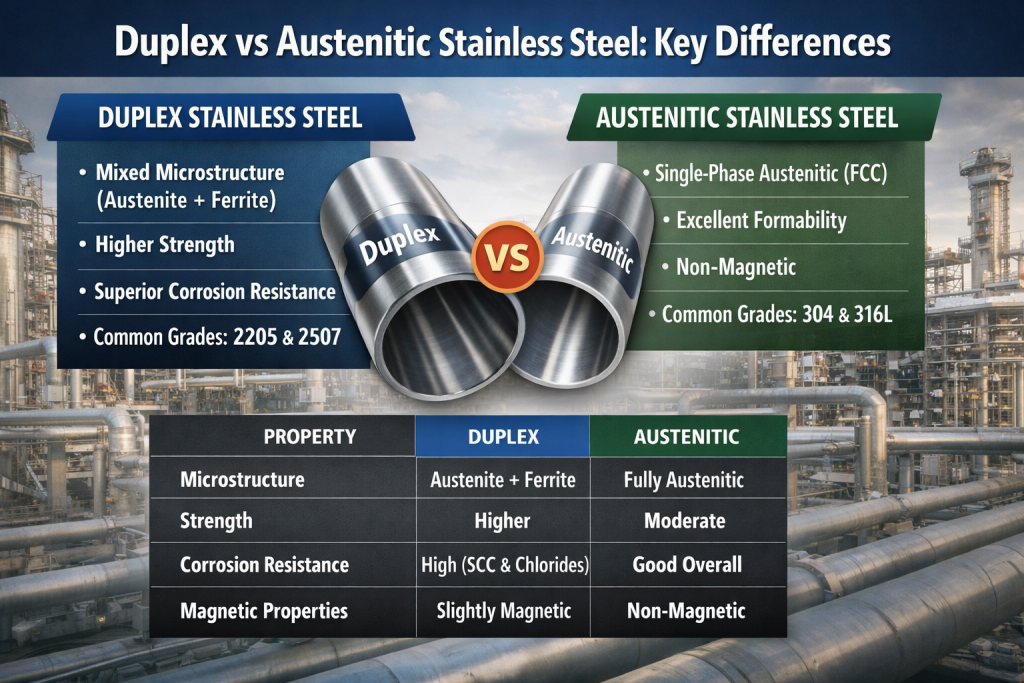
Austenitic stainless steels are the most widely used stainless steel family, characterized by a single-phase, face-centered cubic (FCC) microstructure. Typical grades include 304, 316, and 316L, all known for superior ductility, formability, weldability, and excellent general corrosion resistance.
- Excellent overall corrosion resistance
- Highly ductile and tough, even at low temperatures
- Non-magnetic in the annealed state
- Ideal for food, medical, architectural, and general industrial applications
⚠️What Is Duplex Stainless Steel?
Duplex stainless steel combines roughly equal parts of austenite and ferrite phases in its microstructure. This dual-phase structure provides a balanced combination of mechanical strength and corrosion resistance superior to many austenitic grades.
- Balanced microstructure (~50% austenite + 50% ferrite)
- Higher strength compared with typical austenitic grades
- Enhanced resistance to stress corrosion cracking (SCC) and chloride corrosion
- Common duplex grades include 2205 and 2507
⚖️Duplex vs Austenitic: Key Differences
| Property | Austenitic Stainless Steel | Duplex Stainless Steel |
|---|---|---|
| Microstructure | Single-phase austenitic (FCC) | Dual-phase (austenite + ferrite) |
| Chromium Content | ~16–18% | ~20–28% (higher) |
| Nickel Content | Higher (~8–10%) | Lower (~4–6%) |
| Corrosion Resistance | Excellent overall | Superior in chloride & SCC environments |
| Mechanical Strength | Moderate | High (often ~2× austenitic) |
| Weldability | Good and easy | Requires more control |
| Applications | Food, pharma, architectural | Oil & gas, chemical, marine |
This comparison clearly shows how the microstructure of duplex steels provides both high strength and excellent localized corrosion resistance, traits that make them attractive for harsher chemical and marine environments.
🧲Mechanical Property Differences
Duplex stainless steel generally exhibits higher yield and tensile strength than austenitic grades, often enabling the use of thinner sections without compromising structural integrity. For example, duplex grades like 2205 typically exceed 550 MPa yield strength — significantly higher than traditional austenitic equivalents.
- Yield Strength: Duplex >> Austenitic
- Tensile Strength: Duplex often > Austenitic
- Fatigue Resistance: Better in Duplex
- Ductility & Formability: Better in Austenitic
📌Corrosion Resistance: Localized vs General
While both families provide excellent general corrosion resistance, duplex stainless steels often outperform austenitic grades in chloride-rich environments and stress corrosion cracking scenarios due to their alloying elements (higher Cr, Mo, N) and dual-phase microstructure.
⚙️Typical Uses of Duplex and Austenitic Stainless Steels
Austenitic stainless steel finds broad use in:
- Kitchen equipment and food processing
- Medical devices and pharmaceutical systems
- Architectural structures
- General industrial components
Duplex stainless steel, especially grades like 2205 and 2507, is typically applied in:
- Pipelines and pressure vessels for oil & gas
- Chemical processing equipment
- Marine and offshore installations
- Heat exchangers in aggressive environments
🧠Conclusion
Choosing between duplex vs austenitic stainless steel depends largely on your project’s environmental conditions and mechanical requirements. If high strength and superior resistance to localized corrosion are critical, duplex grades such as 2205 and 2507 are excellent choices. However, if ease of forming, weldability, and general corrosion resistance are priorities, austenitic stainless steels remain an industry staple.
For detailed comparisons of specific alloys like 2205 or super duplex 2507, check out our linked pages above!
Duplex vs Austenitic Stainless Steel: Key Differences
In the world of corrosion-resistant alloys, understanding the difference between duplex vs austenitic stainless steel is crucial for engineers, fabricators, and material specifiers. Both families offer excellent corrosion resistance, but their microstructures and mechanical properties vary significantly, making each better suited for specific environments and applications. :contentReference.
What Is Austenitic Stainless Steel?
Austenitic stainless steels are the most widely used stainless steel family, characterized by a single-phase, face-centered cubic (FCC) microstructure. Typical grades include 304, 316, and 316L, all known for superior ductility, formability, weldability, and excellent general corrosion resistance. :contentReference.
- Excellent overall corrosion resistance
- Highly ductile and tough, even at low temperatures
- Non-magnetic in the annealed state
- Ideal for food, medical, architectural, and general industrial applications
What Is Duplex Stainless Steel?
Duplex stainless steel combines roughly equal parts of austenite and ferrite phases in its microstructure. This dual-phase structure provides a balanced combination of mechanical strength and corrosion resistance superior to many austenitic grades. :contentReference.
- Balanced microstructure (~50% austenite + 50% ferrite)
- Higher strength compared with typical austenitic grades
- Enhanced resistance to stress corrosion cracking (SCC) and chloride corrosion
- Common duplex grades include 2205 and 2507
Duplex vs Austenitic: Key Differences
| Property | Austenitic Stainless Steel | Duplex Stainless Steel |
|---|---|---|
| Microstructure | Single-phase austenitic (FCC) | Dual-phase (austenite + ferrite) |
| Chromium Content | ~16–18% | ~20–28% (higher) |
| Nickel Content | Higher (~8–10%) | Lower (~4–6%) |
| Corrosion Resistance | Excellent overall | Superior in chloride & SCC environments |
| Mechanical Strength | Moderate | High (often ~2× austenitic) |
| Weldability | Good and easy | Requires more control |
| Applications | Food, pharma, architectural | Oil & gas, chemical, marine |
This comparison clearly shows how the microstructure of duplex steels provides both high strength and excellent localized corrosion resistance, traits that make them attractive for harsher chemical and marine environments. :contentReference.
Mechanical Property Differences
Duplex stainless steel generally exhibits higher yield and tensile strength than austenitic grades, often enabling the use of thinner sections without compromising structural integrity. For example, duplex grades like 2205 typically exceed 550 MPa yield strength — significantly higher than traditional austenitic equivalents. :contentReference.
- Yield Strength: Duplex >> Austenitic
- Tensile Strength: Duplex often > Austenitic
- Fatigue Resistance: Better in Duplex
- Ductility & Formability: Better in Austenitic
Corrosion Resistance: Localized vs General
While both families provide excellent general corrosion resistance, duplex stainless steels often outperform austenitic grades in chloride-rich environments and stress corrosion cracking scenarios due to their alloying elements (higher Cr, Mo, N) and dual-phase microstructure. :contentReference.
Typical Uses of Duplex and Austenitic Stainless Steels
Austenitic stainless steel finds broad use in:
- Kitchen equipment and food processing
- Medical devices and pharmaceutical systems
- Architectural structures
- General industrial components
Duplex stainless steel, especially grades like 2205 and 2507, is typically applied in:
- Pipelines and pressure vessels for oil & gas
- Chemical processing equipment
- Marine and offshore installations
- Heat exchangers in aggressive environments
Conclusión
Choosing between duplex vs austenitic stainless steel depends largely on your project’s environmental conditions and mechanical requirements. If high strength and superior resistance to localized corrosion are critical, duplex grades such as 2205 and 2507 are excellent choices. However, if ease of forming, weldability, and general corrosion resistance are priorities, austenitic stainless steels remain an industry staple. :contentReference.
For detailed comparisons of specific alloys like 2205 or super duplex 2507, check out our linked pages above!
❓FAQ:
1. What is the main difference between duplex and austenitic stainless steel?
The main difference lies in their microstructure.
Austenitic stainless steel has a single-phase austenitic (FCC) structure, while duplex stainless steel has a dual-phase structure consisting of roughly equal parts austenite and ferrite, resulting in higher strength and improved resistance to stress corrosion cracking.
2. Which stainless steel is stronger, duplex or austenitic?
Duplex stainless steel is significantly stronger than austenitic stainless steel.
Duplex grades such as 2205 typically have nearly twice the yield strength of common austenitic grades like 304 or 316.
3. Is duplex stainless steel more corrosion resistant than austenitic?
Both offer excellent general corrosion resistance, but duplex stainless steel provides superior resistance to localized corrosion, chloride-induced corrosion, and stress corrosion cracking, especially in harsh chemical and marine environments.
4. Why does duplex stainless steel perform better in chloride environments?
Duplex stainless steel contains higher levels of chromium, molybdenum, and nitrogen, combined with its dual-phase microstructure. This composition significantly enhances resistance to pitting, crevice corrosion, and stress corrosion cracking in chloride-rich environments.
5. Are austenitic stainless steels easier to weld than duplex steels?
Yes. Austenitic stainless steels are generally easier to weld and fabricate.
Duplex stainless steels require more controlled welding procedures to maintain the correct phase balance and avoid loss of corrosion resistance.