
Does Stainless Steel Corrode? Causes, Types & Prevention Guide
Stainless steel is widely known for its corrosion resistance, but a common misconception is that it is completely immune to rust or degradation. In reality, stainless steel can corrode under specific conditions. Understanding why this happens—and how to prevent it—is essential for engineers, manufacturers, and industrial buyers.
This article provides a comprehensive, technically accurate explanation of stainless steel corrosion mechanisms, environmental factors, and best practices for long-term durability.
1. Does Stainless Steel Actually Corrode?
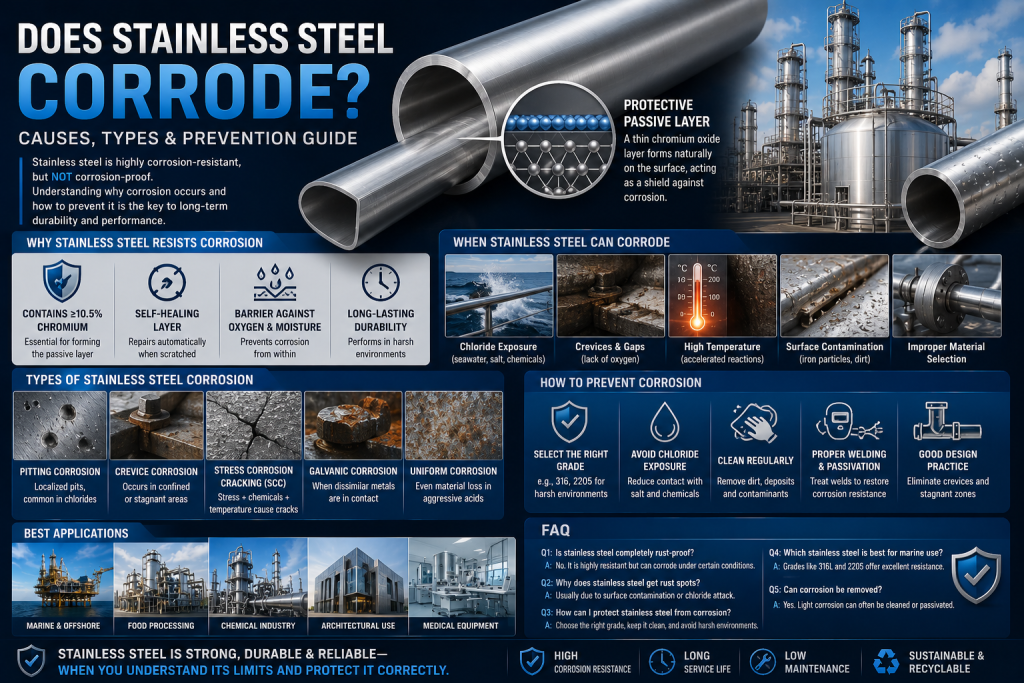
Yes. Stainless steel is corrosion-resistant, not corrosion-proof.
Its resistance comes from a thin, invisible chromium oxide passive layer that forms naturally on the surface. This layer protects the underlying metal by blocking oxygen and moisture from reaching the iron.
As long as this passive film remains intact, stainless steel remains protected. However, when the layer is damaged or overwhelmed, corrosion can occur.
2. Why Stainless Steel Resists Corrosion
The key to stainless steel’s performance lies in its composition:
- Contains at least 10.5% chromium
- Forms a self-healing oxide layer only a few nanometers thick
- Automatically regenerates when scratched (in presence of oxygen)
This “passivation” mechanism allows stainless steel to maintain long-term durability in most environments.
3. When Does Stainless Steel Corrode?
Corrosion occurs when the passive layer is compromised. Common triggers include:
- Chloride exposure: seawater, salt, industrial chemicals
- Low oxygen conditions: crevices, tight joints
- High temperature: accelerates chemical reactions
- Surface contamination: embedded iron particles
- Improper material selection: wrong grade for environment
In engineering terms, stainless steel corrosion is typically an environment-driven failure, not a material defect.
4. Types of Stainless Steel Corrosion
Different corrosion forms indicate different failure mechanisms:
1. Pitting Corrosion
- Localized holes or pits
- Common in chloride environments
- Most dangerous due to sudden failure
2. Crevice Corrosion
- Occurs in confined spaces (gaskets, joints)
- Caused by lack of oxygen
3. Stress Corrosion Cracking (SCC)
- Combination of stress + chemicals + temperature
- Leads to cracking rather than visible rust
4. Galvanic Corrosion
- Occurs when stainless steel contacts other metals
- Accelerated by electrolytes like water
5. Uniform Corrosion (Rare)
- Even material loss across surface
- Usually caused by strong acids
Among these, pitting and crevice corrosion are the most common in real-world applications.
5. Does Stainless Steel Rust?
Technically, stainless steel does not rust in the same way as carbon steel. However:
- It can develop rust-like stains
- Surface contamination may cause discoloration
- Localized corrosion may resemble rust
True corrosion in stainless steel is usually localized and aggressive, rather than uniform surface rust.
6. Welding and Surface Finish Impact
Welding Risks
- Heat can reduce chromium content near weld zones
- Weakens corrosion resistance
- Requires post-treatment (pickling & passivation)
Surface Finish
- Smoother surfaces = better corrosion resistance
- Rough surfaces trap contaminants and moisture
Proper fabrication and finishing are critical for maintaining corrosion resistance.
7. How to Prevent Stainless Steel Corrosion
Effective prevention strategies include:
- Select the correct grade (e.g., 316 for marine environments)
- Avoid chloride exposure where possible
- Ensure proper cleaning and maintenance
- Use passivation after welding or fabrication
- Design to eliminate crevices and stagnant zones
Material selection + environment control = optimal performance.
8. Best Applications for Stainless Steel
- Marine and offshore engineering
- Food processing and hygiene environments
- Chemical and pharmaceutical industries
- Architectural and decorative structures
When properly selected and maintained, stainless steel offers exceptional long-term reliability.
Frequently Asked Questions (FAQ)
Is stainless steel completely corrosion-proof?
No. It is highly corrosion-resistant but can fail under extreme conditions.
What is the main cause of stainless steel corrosion?
Breakdown of the chromium oxide passive layer, often due to chlorides or lack of oxygen.
Which stainless steel grade is most corrosion-resistant?
Duplex and high-molybdenum grades (e.g., 2205, 316L) offer superior resistance.
Can stainless steel rust in seawater?
Yes, especially lower grades like 304. Marine-grade steels like 316 perform better.
How can corrosion be prevented?
Use proper grade selection, surface treatment, and avoid harsh environmental exposure.
Conclusion: Stainless steel is one of the most corrosion-resistant materials available, but it is not invincible. Its performance depends on the integrity of the passive layer, proper grade selection, and environmental conditions. Understanding these factors ensures optimal durability and long-term value in industrial applications.
