
Copper vs Stainless Steel: Strength, Corrosion, Conductivity, Cost & Applications
When comparing copper vs stainless steel, the right choice depends on what your project needs most: electrical conductivity, thermal conductivity, corrosion resistance, mechanical strength, hygiene, durability or total cost control.
Copper is one of the best engineering metals for electrical and heat-transfer performance. Stainless steel, on the other hand, is valued for high strength, corrosion resistance, clean surface performance and long-term structural reliability.
This guide explains the key differences between copper and stainless steel from the perspective of composition, mechanical properties, conductivity, corrosion resistance, maintenance, fabrication, cost and real-world applications. For more stainless steel material knowledge, visit the Jude Steel Knowledge Center.
Fast Comparison: Copper vs Stainless Steel
| Feature | Copper | Stainless Steel |
|---|---|---|
| Base Metal | Copper element, Cu | Iron-based alloy with at least 10.5% chromium |
| Main Advantage | Electrical and thermal conductivity | Strength, corrosion resistance and durability |
| Electrical Conductivity | Excelente | Low compared with copper |
| Thermal Conductivity | Excelente | Much lower than copper |
| Mechanical Strength | Relatively soft | High strength and good wear resistance |
| Corrosion Resistance | Good in many environments, but forms patina | Excellent in many industrial and hygienic environments |
| Appearance Over Time | Can darken or turn green due to patina | Maintains a clean metallic surface more easily |
| Typical Applications | Electrical wiring, busbars, heat exchangers, plumbing | Food equipment, chemical plants, architecture, tanks, pipelines |
1. What Is Copper?
Copper is a pure metal element known for exceptional electrical conductivity, thermal conductivity, ductility and formability. It has been used in human civilization for thousands of years and remains essential in modern electrical, plumbing, HVAC and heat-transfer systems.
Main Properties of Copper
- Outstanding electrical conductivity
- Excellent thermal conductivity
- Easy to bend, form and draw into wire
- Good corrosion resistance in many indoor environments
- Natural surface oxidation and patina formation
- Good antimicrobial surface behavior in certain conditions
Common Copper Grades
| Copper Grade | Common Name | Typical Applications |
|---|---|---|
| C11000 | Electrolytic Tough Pitch Copper | Electrical wiring, conductors, busbars |
| C12200 | Phosphorus Deoxidized Copper | Plumbing tubes, HVAC tubes, refrigeration lines |
| C10100 | Oxygen-Free Copper | High-conductivity electronics and precision components |
Copper performs extremely well where energy transfer, heat transfer or electrical conductivity is the main design requirement. However, it is softer and weaker than stainless steel.
2. What Is Stainless Steel?
Stainless steel is an iron-based alloy containing at least 10.5% chromium. Chromium forms a thin, self-protective passive oxide layer on the surface, giving stainless steel its well-known corrosion resistance.
Unlike copper, stainless steel is engineered for strength, durability, surface stability and resistance to demanding industrial environments. Jude Steel supplies stainless steel products including stainless steel sheet, stainless steel coil, stainless steel strip and stainless steel sheet metal.
Common Stainless Steel Grades
| Grado | Type | Typical Applications |
|---|---|---|
| 304 Stainless Steel | Austenitic | Food equipment, kitchen systems, tanks, architecture |
| 316L Stainless Steel | Austenitic | Marine environments, chemical equipment, coastal applications |
| 430 Stainless Steel | Ferritic | Appliance panels, decorative parts, indoor applications |
| 2205 Duplex Stainless Steel | Dúplex | High-strength corrosion-resistant industrial applications |
3. Chemical Composition Difference
The most fundamental difference between copper and stainless steel is composition. Copper is a non-ferrous metal, while stainless steel is an iron-based alloy system.
| Element / Feature | Copper | Stainless Steel |
|---|---|---|
| Base Metal | Copper | Iron |
| Chromium | None | Minimum 10.5% |
| Nickel | None | Often added in grades such as 304 and 316L |
| Carbon | Very low | Controlled depending on grade |
| Corrosion Protection | Natural oxide or patina layer | Chromium-rich passive oxide layer |
| Metal Family | Non-ferrous metal | Ferrous alloy |
Copper relies on natural oxidation and patina formation for surface protection. Stainless steel relies on chromium passivation, which is self-healing in oxygen-containing environments.
4. Strength and Mechanical Properties
Copper is easier to bend and form, but stainless steel is much stronger. This makes stainless steel more suitable for structural, load-bearing and wear-resistant applications.
| Property | Copper | Stainless Steel |
|---|---|---|
| Resistencia a la tracción | Lower | Much higher, depending on grade |
| Yield Strength | Lower | Higher |
| Dureza | Soft to moderate | Medium to high |
| Wear Resistance | Limited | Better |
| Ductility | Excelente | Good to excellent, depending on grade |
| Structural Suitability | Limited | Excelente |
Practical Meaning
- Copper is excellent for tubing, wiring and heat-transfer parts.
- Stainless steel is better for tanks, frames, structural components, food machinery and industrial piping.
- For heavy loads, pressure systems and long-term durability, stainless steel is usually the safer choice.
5. Electrical Conductivity Comparison
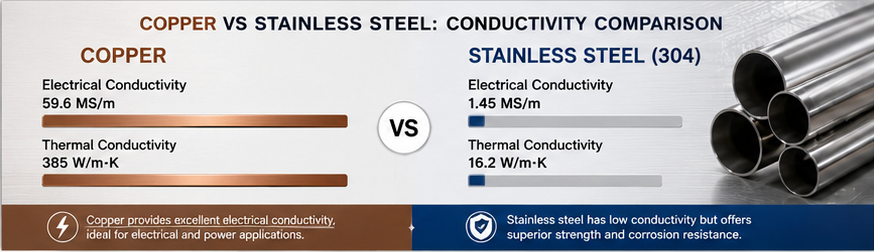
Electrical conductivity is where copper clearly dominates. Copper is one of the most widely used conductor materials because it allows electrical current to flow efficiently with low resistance.
| Material | Electrical Conductivity | Best Use |
|---|---|---|
| Copper | Extremely high | Electrical wiring, busbars, power systems, electronics |
| Stainless Steel | Very low compared with copper | Structural and corrosion-resistant parts, not primary conductors |
Copper dominates in electrical systems such as power transmission, electrical wiring, busbars, grounding systems, electric motors and precision electronics. Stainless steel is not normally selected when electrical conductivity is the main requirement.
6. Thermal Conductivity and Heat Transfer
Copper also transfers heat far more efficiently than stainless steel. This makes copper a preferred material in heat exchangers, HVAC systems, refrigeration coils and radiators.
| Material | Thermal Conductivity | Typical Heat-Transfer Applications |
|---|---|---|
| Copper | Very high | Heat exchangers, radiators, HVAC coils, refrigeration tubes |
| Stainless Steel | Lower | Heat-resistant structures, food equipment, corrosion-resistant vessels |
Stainless steel cannot match copper in heat-transfer efficiency. However, it performs better when corrosion resistance, hygiene, strength and pressure-bearing capability are more important than maximum heat conduction.
7. Corrosion Resistance: Copper Patina vs Stainless Passive Layer
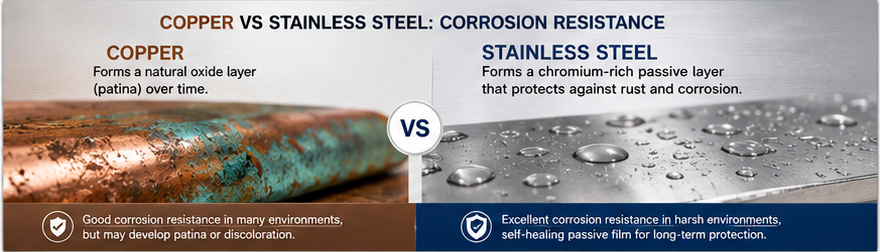
Both copper and stainless steel resist corrosion, but they do so in different ways.
Copper Corrosion Behavior
Copper forms a natural oxide layer and may develop a green patina over time. This patina can protect the surface in many outdoor environments, but copper can still be affected by acidic environments, ammonia compounds, certain industrial atmospheres and galvanic corrosion when in contact with incompatible metals.
Stainless Steel Corrosion Behavior
Stainless steel forms a chromium-rich passive film. This protective layer helps the material resist moisture, many chemicals and atmospheric corrosion. Grades such as 304 are suitable for general use, while 316L performs better in chloride-rich or coastal environments.
| Environment | Copper | Stainless Steel |
|---|---|---|
| Indoor Dry Environment | Good | Excelente |
| Outdoor Architecture | Develops patina | Maintains cleaner metallic appearance |
| Food Processing | Limited use depending on application | Excellent with 304 or 316L |
| Marine Environment | Application-specific | 316L or duplex grades preferred |
| Acidic or Ammonia Exposure | Risk of attack | Grade selection required |
8. Maintenance and Surface Appearance
Copper naturally changes color over time. It may darken, oxidize or form a green patina depending on exposure conditions. Some architects appreciate this natural aging effect, but it may not be suitable for projects requiring a clean and consistent metallic finish.
Stainless steel is easier to maintain visually in many industrial and architectural applications. With proper grade selection and surface finishing, stainless steel can retain a clean, bright or brushed appearance for many years.
| Factor | Copper | Stainless Steel |
|---|---|---|
| Surface Change Over Time | Oxidizes and may form patina | More stable metallic appearance |
| Cleaning Frequency | Moderate | Low to moderate |
| Decorative Appearance | Warm reddish tone, aging patina | Clean modern metallic finish |
| Industrial Hygiene | Application-specific | Excellent for food and pharmaceutical environments |
9. Fabrication, Welding and Processing
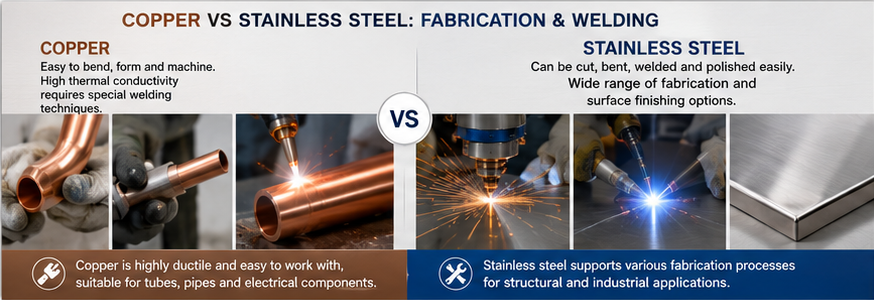
Copper Fabrication
Copper is soft, ductile and easy to bend. It is commonly formed into tubes, wires, coils and heat-transfer components. However, welding copper can require specialized techniques because its high thermal conductivity rapidly removes heat from the weld zone.
Stainless Steel Fabrication
Stainless steel is widely processed by cutting, bending, welding, polishing, brushing and CNC fabrication. Jude Steel offers stainless steel processing and sheet metal solutions through products such as stainless steel sheet metal, helping industrial buyers obtain finished or semi-finished parts for global projects.
10. Cost Comparison
Copper is usually more expensive than stainless steel on a weight basis. It is also strongly affected by global commodity market fluctuations because of high demand from electrical, energy and infrastructure industries.
Stainless steel can also fluctuate due to nickel, chromium and molybdenum pricing, but it is often more cost-effective for structural, corrosion-resistant and long-life industrial applications.
| Cost Factor | Copper | Stainless Steel |
|---|---|---|
| Raw Material Cost | Usually higher | Moderate to high depending on grade |
| Structural Cost Efficiency | Lower | Higher |
| Electrical Application Value | Excelente | Poor |
| Heat-Transfer Value | Excelente | Limited |
| Corrosion-Resistant Equipment Value | Application-specific | Excelente |
| Maintenance Cost | May increase when appearance control is required | Often lower with proper grade selection |
11. Typical Copper Applications
- Electrical wiring and conductors
- Busbars and power distribution systems
- Heat exchangers
- HVAC and refrigeration coils
- Plumbing tubes
- Radiators and cooling systems
- Electronic components
- Architectural roofing and decorative elements
12. Typical Stainless Steel Applications
- Food processing equipment
- Commercial kitchen systems
- Chemical tanks and industrial vessels
- Marine and coastal components
- Architectural cladding and panels
- Industrial pipelines
- Pharmaceutical equipment
- Structural and fabricated metal parts
For stainless steel supply, Jude Steel provides stainless steel sheets, stainless steel coils, stainless steel strips and customized processing services for global industrial applications.
13. Copper vs Stainless Steel: Quick Selection Guide
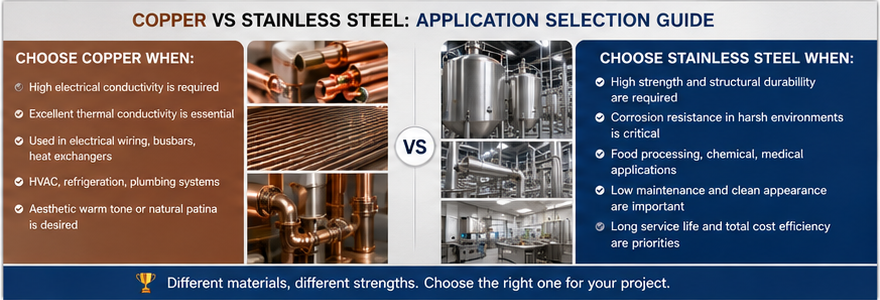
| Project Requirement | Recommended Material | Reason |
|---|---|---|
| Electrical wiring | Copper | Excellent electrical conductivity |
| Busbars and power transmission | Copper | Low electrical resistance |
| Heat exchangers | Copper | Excellent thermal conductivity |
| Food processing equipment | Stainless Steel | Hygiene, corrosion resistance and cleanability |
| Structural components | Stainless Steel | Higher strength and durability |
| Marine or coastal equipment | 316L or Duplex Stainless Steel | Better chloride corrosion resistance |
| Decorative warm-tone architecture | Copper | Unique reddish appearance and patina |
| Modern clean metallic architecture | Stainless Steel | Stable appearance and low maintenance |
14. Which Material Should You Choose?
Choose Copper If:
- Electrical conductivity is the top priority
- Thermal conductivity or heat transfer is critical
- The product requires excellent ductility and easy bending
- You need copper tubing, wiring, busbars or heat exchanger components
- A warm decorative metal appearance or natural patina is desired
Choose Stainless Steel If:
- Mechanical strength and structural durability are important
- The application requires corrosion resistance and long service life
- Food-grade, sanitary or hygienic performance is needed
- The project involves tanks, pipelines, chemical equipment or architecture
- You need low maintenance and stable metallic appearance
Frequently Asked Questions
Is copper better than stainless steel?
Copper is better for electrical conductivity, thermal conductivity and heat-transfer applications. Stainless steel is better for strength, corrosion resistance, hygiene, durability and industrial structural use.
Which is stronger, copper or stainless steel?
Stainless steel is much stronger than copper. Copper is softer and easier to form, while stainless steel provides higher tensile strength, yield strength and wear resistance.
Which has better corrosion resistance?
Both materials resist corrosion differently. Copper forms oxide and patina layers, while stainless steel forms a chromium-rich passive layer. For hygienic, structural and many industrial environments, stainless steel usually provides more stable corrosion resistance.
Why is copper used for electrical wiring?
Copper has extremely high electrical conductivity, which allows efficient current flow with low resistance. Stainless steel has much lower electrical conductivity and is not normally used as a primary conductor.
Is copper more expensive than stainless steel?
Copper is usually more expensive per kilogram than standard stainless steel grades. However, copper is still worth using when conductivity or heat-transfer performance is essential.
Can stainless steel replace copper?
Stainless steel can replace copper in structural, hygienic, corrosion-resistant and high-strength applications. It cannot replace copper effectively where high electrical or thermal conductivity is required.
Which material is better for food processing equipment?
Stainless steel, especially 304 and 316L, is generally preferred for food processing equipment because it offers corrosion resistance, smooth cleanable surfaces, hygiene and long service life.
Conclusión
Copper and stainless steel are both important industrial metals, but they solve different engineering problems. Copper is the superior choice for electrical conductivity, heat transfer, tubing and energy-efficient thermal systems. Stainless steel is the better choice for strength, corrosion resistance, hygiene, durability, structural reliability and low-maintenance industrial applications.
For electrical wiring, busbars, heat exchangers and HVAC coils, copper remains difficult to replace. For food equipment, chemical processing, architectural panels, tanks, pipelines and structural components, stainless steel provides better long-term industrial value.
Jude Steel supplies stainless steel sheets, coils, strips and customized stainless steel processing solutions for global buyers. Explore more materials at Judesteel.com, or visit our product pages for stainless steel sheet, stainless steel coil and stainless steel sheet metal.
