
Chemical Composition of Common Stainless Steel Grades
The chemical composition of stainless steel is the fundamental factor that determines its
corrosion resistance, mechanical properties, and suitability for various industrial applications.
By carefully balancing elements such as chromium, nickel, molybdenum, and carbon, manufacturers
produce a wide range of stainless steel grades tailored to specific performance requirements.
This article provides a detailed overview of the chemical composition of common stainless steel
grades, helping engineers, buyers, and industry professionals make informed material selections.
1. Key Alloying Elements in Stainless Steel
1.1 Chromium (Cr)
Chromium is the most critical element in stainless steel. A minimum of 10.5% chromium is required
to form a passive oxide layer that protects the material from corrosion.
1.2 Nickel (Ni)
Nickel improves ductility, toughness, and corrosion resistance, particularly in austenitic
stainless steels.
1.3 Molybdenum (Mo)
Molybdenum enhances resistance to pitting and crevice corrosion, especially in chloride environments.
1.4 Carbon (C)
Carbon increases strength and hardness but may reduce corrosion resistance if not properly controlled.
1.5 Nitrogen (N)
Nitrogen improves strength and pitting resistance, particularly in duplex stainless steels.
1.6 Manganese (Mn) and Silicon (Si)
These elements contribute to deoxidation during steelmaking and improve mechanical properties.
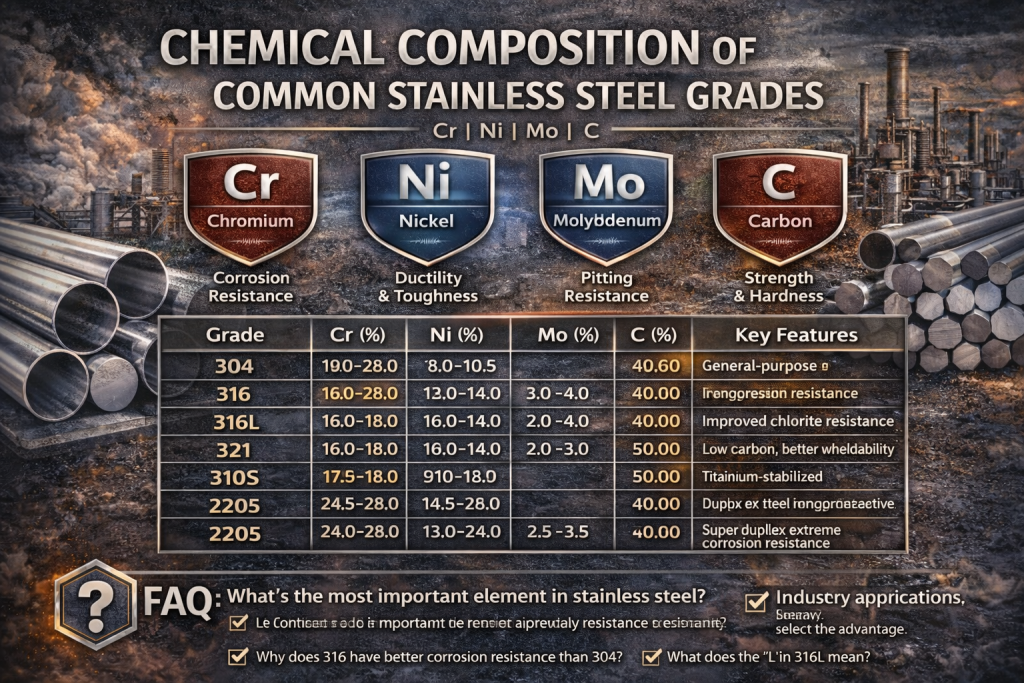
2. Chemical Composition of Common Stainless Steel Grades
| Grado | Cr (%) | Ni (%) | Mo (%) | C (%) | Key Features |
|---|---|---|---|---|---|
| 304 | 18.0–20.0 | 8.0–10.5 | - | ≤0.08 | General-purpose, good corrosion resistance |
| 316 | 16.0–18.0 | 10.0–14.0 | 2.0–3.0 | ≤0.08 | Improved chloride resistance |
| 316L | 16.0–18.0 | 10.0–14.0 | 2.0–3.0 | ≤0.03 | Low carbon, better weldability |
| 321 | 17.0–19.0 | 9.0–12.0 | - | ≤0.08 | Titanium-stabilized, high-temperature use |
| 310S | 24.0–26.0 | 19.0–22.0 | - | ≤0.08 | Excellent high-temperature resistance |
| 2205 | 21.0–23.0 | 4.5–6.5 | 2.5–3.5 | ≤0.03 | Duplex, high strength and corrosion resistance |
| 2507 | 24.0–26.0 | 6.0–8.0 | 3.0–5.0 | ≤0.03 | Super duplex, extreme corrosion resistance |
3. How Composition Affects Performance
3.1 Corrosion Resistance
Higher chromium and molybdenum content significantly improve resistance to oxidation and
localized corrosion such as pitting.
3.2 Mechanical Strength
Nitrogen and carbon contribute to increased strength, while duplex structures provide
higher yield strength compared to austenitic grades.
3.3 Weldability
Low carbon variants such as 316L reduce carbide precipitation, improving weldability and
preventing intergranular corrosion.
3.4 High-Temperature Performance
Grades with higher chromium and nickel content, such as 310S and 321, perform better in
elevated temperature environments.
4. Selecting the Right Grade Based on Composition
- General Use: 304 stainless steel
- Marine/Chloride Environments: 316 / 316L
- High Temperature: 310S / 321
- High Strength + Corrosion Resistance: 2205 duplex
- Extreme Conditions: 2507 super duplex
5. Industry Applications
- Construction and architecture
- Oil and gas pipelines
- Chemical processing equipment
- Marine engineering
- Food and pharmaceutical industries
FAQ
Q1: What is the most important element in stainless steel?
Chromium is the most important element as it provides corrosion resistance by forming a passive layer.
Q2: Why does 316 have better corrosion resistance than 304?
Because it contains molybdenum, which improves resistance to chloride-induced corrosion.
Q3: What does the “L” in 316L mean?
It stands for low carbon content, which improves weldability and reduces corrosion after welding.
Q4: What is the advantage of duplex stainless steel?
Duplex stainless steel combines high strength with excellent corrosion resistance due to its dual-phase structure.
Q5: How do I choose the right stainless steel grade?
Selection depends on environmental conditions, mechanical requirements, and cost considerations.
Conclusión
Understanding the chemical composition of stainless steel is essential for selecting the right
material for specific applications. By analyzing key elements such as chromium, nickel, and
molybdenum, engineers and buyers can ensure optimal performance, durability, and cost efficiency
in their projects.
