
Brass vs Stainless Steel: Strength, Corrosion & Long-Term Value
Brass and stainless steel are two of the most widely used engineering metals in modern manufacturing, construction, plumbing, marine systems, and architectural applications. Although both materials offer excellent durability and corrosion resistance compared with ordinary carbon steel, they differ significantly in strength, wear resistance, maintenance requirements, cost efficiency, and long-term performance.
Selecting the correct material is not simply about appearance or initial price. In industrial environments, the wrong choice can lead to premature corrosion, mechanical failure, leakage, deformation, or expensive maintenance cycles. Understanding the real-world differences between brass and stainless steel is essential for engineers, fabricators, procurement managers, and project owners.
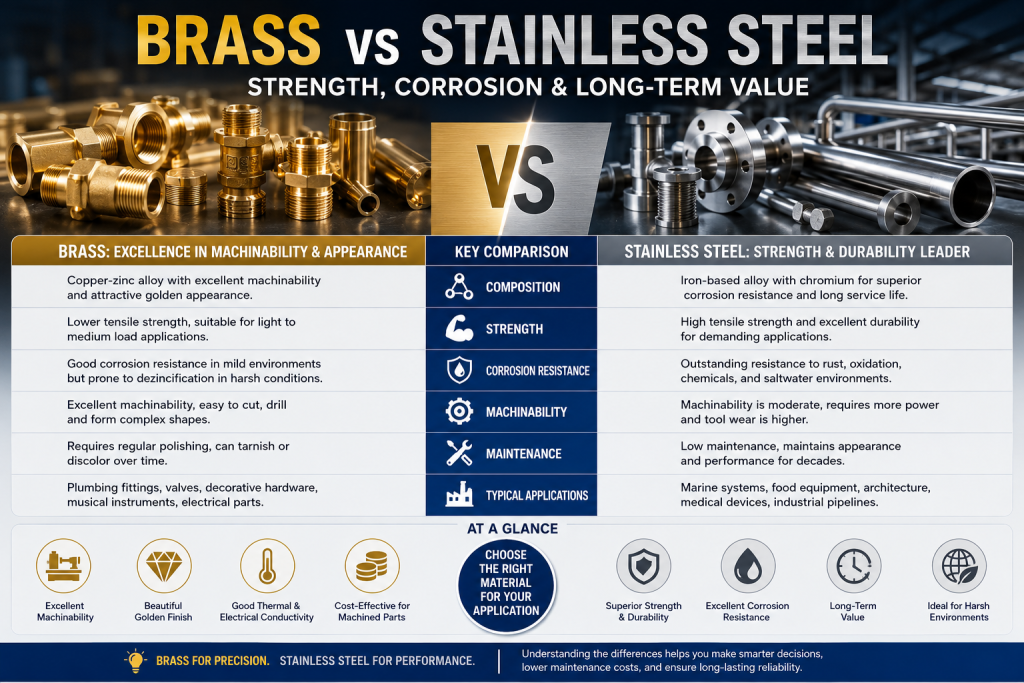
1. What Is Brass?
Brass is a copper-zinc alloy known for its excellent machinability, decorative appearance, and good corrosion resistance in mild environments.
Depending on the alloy composition, brass may also contain:
- Lead
- Tin
- Aluminum
- Manganese
Brass is widely used because it offers:
- Easy machining
- Excellent thermal conductivity
- Good electrical conductivity
- Elegant gold-like appearance
- Good formability
It is commonly found in:
- Plumbing fittings
- Valves
- Decorative hardware
- Musical instruments
- Electrical connectors
2. What Is Stainless Steel?
Stainless steel is an iron-based alloy containing a minimum of approximately 10.5% chromium. Chromium forms a thin passive oxide layer on the surface, providing outstanding corrosion resistance.
Common alloying elements include:
- Nickel
- Molybdenum
- Carbon
- Nitrogen
Stainless steel is valued for:
- High mechanical strength
- Excellent corrosion resistance
- Long service life
- Heat resistance
- Low maintenance requirements
Popular grades include:
- Acero inoxidable 304
- Acero inoxidable 316L
- Acero inoxidable 430
- 2205 duplex stainless steel
3. Brass vs Stainless Steel: Composition Comparison
| Property | Brass | Stainless Steel |
|---|---|---|
| Base Metal | Copper + Zinc | Iron + Chromium |
| Main Strength | Machinability | Durability |
| Corrosion Resistance | Moderate | High |
| Appearance | Golden yellow | Silver metallic |
| Mechanical Strength | Medium | High |
| Heat Resistance | Moderate | Excelente |
4. Strength Comparison
One of the biggest differences between brass and stainless steel is mechanical strength.
Brass Strength Characteristics
- Softer material structure
- Lower tensile strength
- Easy forming and machining
- More prone to deformation under heavy load
Stainless Steel Strength Characteristics
- Much higher tensile strength
- Excellent wear resistance
- Superior impact resistance
- Better structural stability
Typical tensile strength:
- Brass: approximately 250–500 MPa
- Stainless steel: approximately 500–1200 MPa depending on grade
This makes stainless steel significantly more suitable for:
- Load-bearing structures
- Industrial machinery
- Marine hardware
- High-pressure systems
Industrial material comparisons consistently show stainless steel outperforming brass in high-stress applications.
5. Corrosion Resistance Comparison
Brass Corrosion Performance
Brass offers good corrosion resistance in:
- Freshwater systems
- Indoor environments
- Low-humidity applications
However, brass may experience:
- Tarnishing
- Dezincification
- Galvanic corrosion
Especially in:
- Saltwater environments
- Acidic conditions
- Ammonia exposure
Stainless Steel Corrosion Performance
Stainless steel provides superior corrosion resistance because of its chromium-rich passive layer. Grades such as 316L offer particularly strong resistance to:
- Salt spray
- Marine environments
- Industrial chemicals
- Humidity
For long-term outdoor or coastal use, stainless steel is generally considered the safer and more durable choice.
6. Machinability and Fabrication
| Feature | Brass | Stainless Steel |
|---|---|---|
| Machinability | Excelente | Moderate |
| Cutting Speed | High | Lower |
| Tool Wear | Low | Higher |
| Complex Components | Easy | More Difficult |
Brass is widely preferred for precision-machined fittings and decorative components because it is easier to process and requires less tool wear.
Stainless steel machining requires more powerful equipment and higher processing costs but delivers greater long-term durability.
7. Appearance and Aesthetic Value
Brass and stainless steel create very different visual impressions.
Brass Appearance
- Warm golden color
- Vintage luxury appearance
- Decorative elegance
Stainless Steel Appearance
- Modern metallic finish
- Industrial sophistication
- Contemporary architectural style
Brass is often used in luxury interior design and decorative hardware, while stainless steel dominates modern architecture and industrial aesthetics.
8. Long-Term Maintenance and Lifecycle Value
Long-term operating cost is one of the most important considerations in industrial material selection.
Brass Maintenance
- Requires periodic polishing
- Can discolor over time
- May require protective coatings
Stainless Steel Maintenance
- Low maintenance
- Excellent surface stability
- Long service life
- Strong resistance to weathering
While stainless steel may have higher initial manufacturing costs, its longer lifespan and lower maintenance requirements often deliver better long-term value.
9. Common Industrial Applications
Typical Brass Applications
- Valves and fittings
- Musical instruments
- Decorative hardware
- Electrical terminals
- Precision machined components
Typical Stainless Steel Applications
- Food processing equipment
- Marine systems
- Industrial pipelines
- Medical devices
- Architectural structures
- Chemical processing equipment
10. Which Material Should You Choose?
Choose Brass If:
- You need excellent machinability
- A decorative appearance is important
- The environment is mild and non-corrosive
- Electrical conductivity matters
Choose Stainless Steel If:
- Strength and durability are critical
- The environment is humid or corrosive
- Long service life is required
- Marine or chemical exposure exists
- Low maintenance is preferred
Frequently Asked Questions (FAQ)
Is stainless steel stronger than brass?
Yes. Stainless steel generally offers significantly higher tensile strength, hardness, and wear resistance than brass.
Which material resists corrosion better?
Stainless steel usually provides better long-term corrosion resistance, especially in marine and chemical environments.
Why is brass easier to machine?
Brass has a softer material structure and lower hardness, making cutting and shaping easier during manufacturing.
Does brass rust?
Brass does not rust like carbon steel, but it can tarnish and experience dezincification under certain conditions.
Which is better for outdoor applications?
Stainless steel is generally the better choice for outdoor and coastal environments due to its superior corrosion resistance and durability.
Conclusion: Brass and stainless steel each offer valuable engineering advantages, but they serve different industrial priorities. Brass excels in machinability, decorative appearance, and precision manufacturing, while stainless steel dominates in strength, corrosion resistance, structural reliability, and long-term lifecycle value. Choosing the correct material depends on environmental conditions, mechanical requirements, maintenance expectations, and project lifespan. For demanding industrial, marine, architectural, and infrastructure applications, stainless steel is often the preferred long-term investment.
