
430 vs 440 Stainless Steel: Differences, Properties, Applications & Performance
When selecting stainless steel for industrial, commercial, or manufacturing applications, understanding the differences between 430 and 440 stainless steel is essential. Although both grades belong to the stainless steel family, they are designed for very different purposes. 430 stainless steel is known for its affordability, corrosion resistance, and formability, while 440 stainless steel is valued for its exceptional hardness, wear resistance, and edge retention.
Choosing the correct material can significantly impact product performance, maintenance requirements, and long-term operating costs. This guide provides a detailed comparison of 430 vs 440 stainless steel, covering chemical composition, mechanical properties, corrosion resistance, applications, and selection considerations.
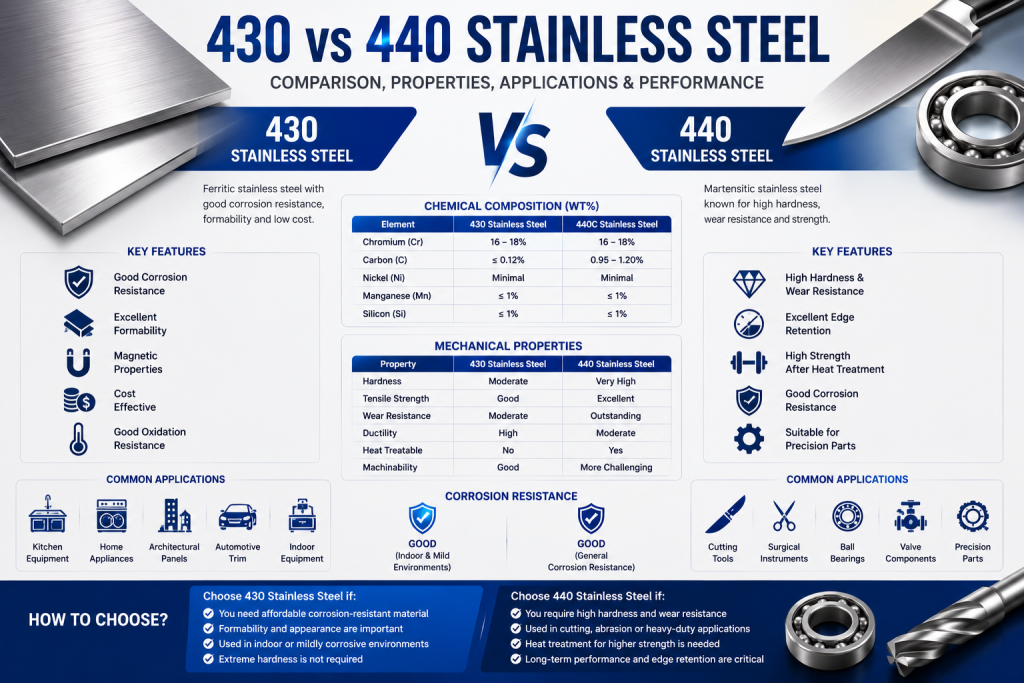
What Is 430 Stainless Steel?
430 stainless steel is a ferritic stainless steel containing approximately 16–18% chromium with low carbon content. It does not contain significant amounts of nickel, making it a cost-effective alternative to many austenitic stainless steels.
Key characteristics of 430 stainless steel include:
- Good corrosion resistance
- Excellent formability
- Good oxidation resistance
- Magnetic properties
- Lower material cost
430 stainless steel is widely used in decorative applications, kitchen equipment, household appliances, and automotive trim components.
What Is 440 Stainless Steel?
440 stainless steel is a high-carbon martensitic stainless steel designed for hardness and wear resistance. It is available in several variants, including 440A, 440B, and 440C, with 440C offering the highest hardness and wear resistance.
Key characteristics of 440 stainless steel include:
- High hardness after heat treatment
- Excellent wear resistance
- Strong edge retention
- Good corrosion resistance
- Superior mechanical strength
440 stainless steel is commonly found in cutting tools, bearings, surgical instruments, valves, and industrial machinery components.
Chemical Composition Comparison
| Elemento | 430 Stainless Steel | 440C Stainless Steel |
|---|---|---|
| Chromium (Cr) | 16–18% | 16–18% |
| Carbon (C) | ≤ 0.12% | 0.95–1.20% |
| Nickel (Ni) | Minimal | Minimal |
| Manganese (Mn) | ≤ 1% | ≤ 1% |
| Silicon (Si) | ≤ 1% | ≤ 1% |
The significantly higher carbon content in 440 stainless steel is responsible for its exceptional hardness and wear resistance.
Mechanical Properties Comparison
| Property | 430 Stainless Steel | 440 Stainless Steel |
|---|---|---|
| Dureza | Moderate | Very High |
| Resistencia a la tracción | Good | Excelente |
| Wear Resistance | Moderate | Outstanding |
| Ductility | High | Moderate |
| Machinability | Good | More Challenging |
For applications requiring extreme hardness and abrasion resistance, 440 stainless steel has a clear advantage.
Corrosion Resistance Comparison
430 Stainless Steel
430 stainless steel performs well in indoor and mildly corrosive environments. It offers excellent resistance to atmospheric corrosion and oxidation, making it suitable for decorative and household applications.
440 Stainless Steel
440 stainless steel provides good corrosion resistance but is primarily optimized for hardness and wear resistance. In highly corrosive environments, grades such as 304 or 316 stainless steel may provide superior protection.
For general corrosion resistance, 430 often performs comparably or better in non-wear-critical applications.
Heat Treatment Capabilities
One of the biggest differences between these grades is heat treatment.
- 430 stainless steel cannot be significantly hardened through heat treatment.
- 440 stainless steel can be heat treated to achieve very high hardness levels.
This characteristic makes 440 stainless steel particularly valuable in cutting and wear-intensive applications.
Common Applications of 430 Stainless Steel
- Kitchen appliances
- Dishwashers
- Decorative trim
- Automotive components
- Architectural panels
- Indoor equipment
Its combination of affordability and corrosion resistance makes it ideal for large-scale consumer products.
Common Applications of 440 Stainless Steel
- Industrial knives
- Cutting tools
- Surgical instruments
- Ball bearings
- Valve components
- Precision mechanical parts
Where sharpness retention and wear resistance are critical, 440 stainless steel is often the preferred choice.
Cost Comparison
430 stainless steel is generally less expensive because:
- Lower carbon content
- Simpler processing requirements
- No significant heat treatment costs
440 stainless steel is typically more expensive due to:
- Higher carbon content
- Heat treatment requirements
- Higher performance characteristics
430 vs 440 Stainless Steel: Quick Comparison
| Feature | 430 Stainless Steel | 440 Stainless Steel |
|---|---|---|
| Corrosion Resistance | Good | Good |
| Dureza | Moderate | Excelente |
| Wear Resistance | Moderate | Outstanding |
| Formability | Excelente | Moderate |
| Heat Treatable | No | Yes |
| Cost | Lower | Higher |
Which Stainless Steel Should You Choose?
Choose 430 Stainless Steel If:
- You need affordable corrosion-resistant material
- Formability is important
- The application is decorative or architectural
- Extreme hardness is not required
Choose 440 Stainless Steel If:
- You require high hardness
- Wear resistance is critical
- The application involves cutting or abrasion
- Long-term edge retention is needed
Frequently Asked Questions (FAQ)
Is 440 stainless steel stronger than 430?
Yes. After heat treatment, 440 stainless steel offers significantly higher hardness and wear resistance than 430 stainless steel.
Does 430 stainless steel rust?
430 stainless steel has good corrosion resistance but may develop surface corrosion in highly aggressive environments if not properly maintained.
What is 440 stainless steel commonly used for?
440 stainless steel is widely used in knives, surgical tools, bearings, industrial blades, and precision components requiring exceptional hardness.
Which grade is better for kitchen equipment?
430 stainless steel is commonly used for kitchen appliances and decorative surfaces because of its affordability and corrosion resistance.
Is 440 stainless steel food safe?
Yes. Properly processed 440 stainless steel is commonly used in food-processing blades and high-quality kitchen knives.
Conclusión
430 and 440 stainless steel serve different purposes despite sharing similar chromium content. 430 stainless steel excels in affordability, corrosion resistance, and formability, making it ideal for architectural and consumer applications. In contrast, 440 stainless steel delivers exceptional hardness, wear resistance, and mechanical performance, making it the preferred choice for cutting tools and precision engineering components. Understanding the operating environment and performance requirements is the key to selecting the right stainless steel grade for long-term success.
