
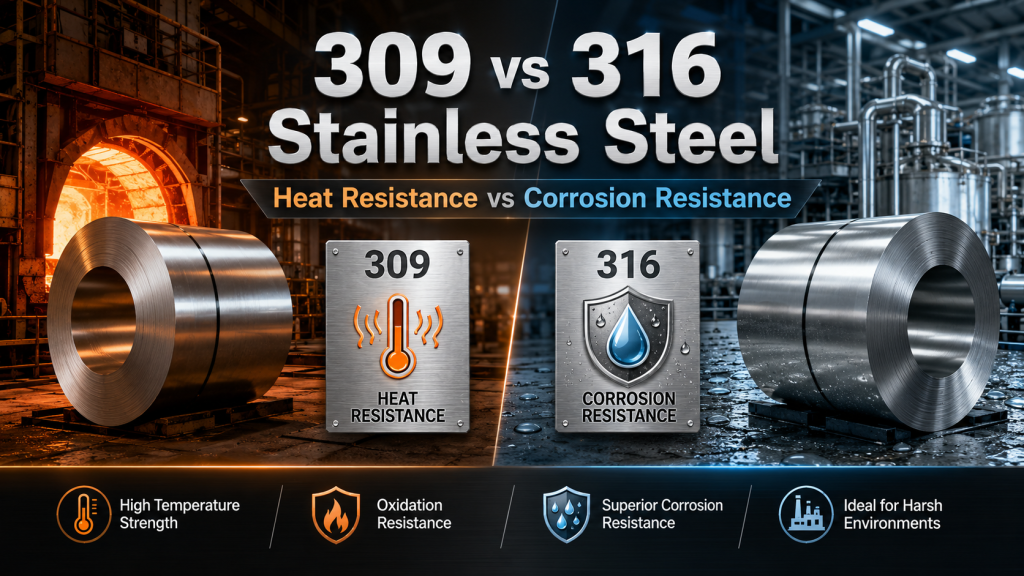
 The difference between 309 and 316 stainless steel is mainly the service environment each alloy is designed to handle. Grade 309 contains higher chromium and nickel and is primarily selected for resistance to oxidation and scaling at elevated temperatures. Grade 316 contains molybdenum and is primarily selected for improved resistance to aqueous corrosion, pitting and crevice corrosion in many chloride-bearing environments.
Neither grade is universally better. Grade 309 may be the more appropriate choice for furnace components, heat-treatment fixtures and thermal-processing equipment. Grade 316 is generally more suitable for chemical tanks, process piping, food equipment, pharmaceutical systems and selected coastal applications.
A reliable material decision must consider temperature, atmosphere, chemical composition, chloride concentration, fabrication, mechanical loading and expected service life. This guide explains how engineers and buyers can compare 309 vs 316 stainless steel and prepare a technically complete purchase specification.
Quick Answer: Should You Choose 309 or 316 Stainless Steel?
- Choose 309 stainless steel when the primary requirement is resistance to high-temperature oxidation, scaling and thermal exposure.
- Choose 316 stainless steel when the primary requirement is resistance to wet corrosion, process chemicals and chloride-related localized corrosion.
- Choose 309S when a lower-carbon 309 variant is needed for welded fabrication.
- Choose 309H when higher-temperature strength and creep performance are important and the project specification permits the higher-carbon grade.
- Choose 316L for welded corrosion-resistant tanks, piping and equipment where reduced sensitization risk is important.
309 vs 316 Stainless Steel Comparison
| Comparison Factor | 309 Stainless Steel | 316 Stainless Steel |
|---|---|---|
| Stainless family | Austenitic chromium-nickel heat-resistant stainless steel | Austenitic chromium-nickel-molybdenum corrosion-resistant stainless steel |
| Common UNS designation | S30900 | S31600 |
| Primary design purpose | High-temperature oxidation and scaling resistance | Aqueous corrosion and localized corrosion resistance |
| Chromium content | Approximately 22–24% | Approximately 16–18% |
| Nickel content | Approximately 12–15% | Approximately 10–14% |
| Molybdenum content | Not normally specified as an intentional addition | Approximately 2–3% |
| High-temperature oxidation | Normally the better starting choice | Not primarily designed as a furnace oxidation-resistant grade |
| Chloride pitting resistance | Lower than 316 in many chloride environments | Improved by the molybdenum addition |
| Weldability | Good; 309S is often considered for welded fabrication | Good; 316L is commonly preferred for welded corrosion-sensitive equipment |
| Typical applications | Furnaces, burners, heat-treatment trays, baffles and thermal-processing components | Tanks, piping, food equipment, pharmaceutical systems, pumps and valves |
What Is 309 Stainless Steel?
309 stainless steel
is an austenitic chromium-nickel alloy developed for improved oxidation and scaling resistance at elevated temperatures.
Its relatively high chromium content supports the formation of a protective chromium-rich oxide layer during hot service. Its nickel content helps maintain an austenitic structure and contributes to toughness, formability and high-temperature performance.
Typical 309 Stainless Steel Applications
- Industrial furnace components
- Burner parts and flame shields
- Heat-treatment trays and baskets
- Annealing boxes
- Baffle plates
- Thermowells
- Kiln components
- Boiler and thermal-processing parts
- High-temperature supports and fixtures
Grade 309 should not be selected from a maximum-temperature number alone. Component loading, atmosphere, thermal cycling, welding and required creep life may be more important than the nominal temperature.
What Is 316 Stainless Steel?
Grade 316 is an austenitic chromium-nickel stainless steel containing molybdenum. The molybdenum addition improves resistance to pitting and crevice corrosion in many chloride-bearing and industrial process environments.
Grade 316 is commonly considered when 304 does not provide a sufficient corrosion margin. However, it is not automatically suitable for every acid, seawater or high-chloride application.
Typical 316 Stainless Steel Applications
- Chemical-processing tanks
- Process piping
- Food and beverage machinery
- Pharmaceutical equipment
- Pumps, valves and flanges
- Heat exchangers
- Pulp and paper equipment
- Medical equipment components
- Selected coastal and marine hardware
- Industrial washdown systems
For welded fabrication, buyers frequently specify
316L stainless steel
because its lower carbon content reduces the risk of chromium-carbide precipitation and intergranular corrosion in the heat-affected zone.
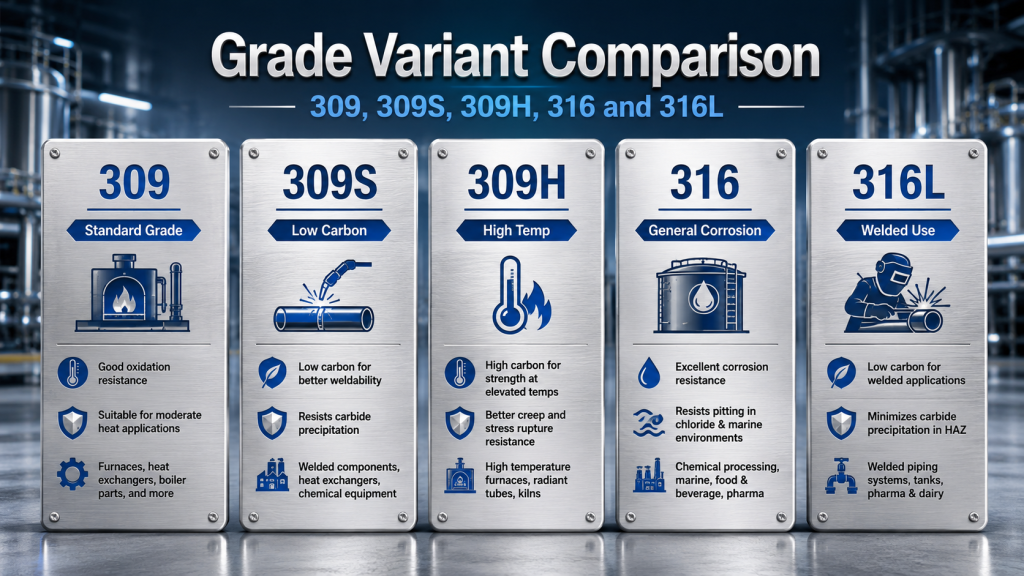
309, 309S, 309H, 316 and 316L
| Grado | UNS Designation | Main Distinction | Typical Selection Reason |
|---|---|---|---|
| 309 | S30900 | Standard-carbon 309 composition | General high-temperature applications |
| 309S | S30908 | Lower maximum carbon content | Welded heat-resistant components |
| 309H | S30909 | Controlled higher carbon range | High-temperature service where creep strength is important |
| 316 | S31600 | Standard-carbon molybdenum-bearing grade | General corrosion-resistant equipment |
| 316L | S31603 | Low-carbon version of 316 | Welded tanks, piping and corrosion-sensitive assemblies |
The exact grade variant should be written into the purchase order. A quotation that states only “309 material” or “316 material” may be insufficient for a critical project.
Standards and Grade Cross-References
| Grado | ASTM / UNS | Common EN Reference | Common JIS Reference |
|---|---|---|---|
| 309 | Type 309 / UNS S30900 | No universal exact one-to-one equivalent | SUS309 |
| 309S | Type 309S / UNS S30908 | 1.4833 is commonly cross-referenced | SUS309S |
| 309H | Type 309H / UNS S30909 | Confirm against the selected EN high-temperature grade | Project-specific confirmation required |
| 316 | Type 316 / UNS S31600 | 1.4401 | SUS316 |
| 316L | Type 316L / UNS S31603 | 1.4404 | SUS316L |
Cross-reference tables should be used only for initial material comparison. The purchase order should identify one governing standard, applicable edition and exact grade.
Chemical Composition Comparison
 The following table shows commonly specified composition ranges for ASTM flat products. These are standard limits rather than the actual chemistry of a specific heat.
| Elemento | 309 Stainless Steel | 316 Stainless Steel | Practical Significance |
|---|---|---|---|
| Carbon | Maximum approximately 0.20% | Maximum approximately 0.08% | Affects sensitization, welding and elevated-temperature strength |
| Chromium | Approximately 22–24% | Approximately 16–18% | Supports oxidation and general corrosion resistance |
| Nickel | Approximately 12–15% | Approximately 10–14% | Stabilizes the austenitic structure and supports toughness |
| Molybdenum | Not normally specified | Approximately 2–3% | Improves resistance to pitting and crevice corrosion |
Higher chromium does not automatically make 309 more corrosion resistant in every liquid. The molybdenum in 316 is particularly important when chloride-related localized corrosion is the governing risk.
High-Temperature Performance
Why 309 Is Normally Better for Furnace Service
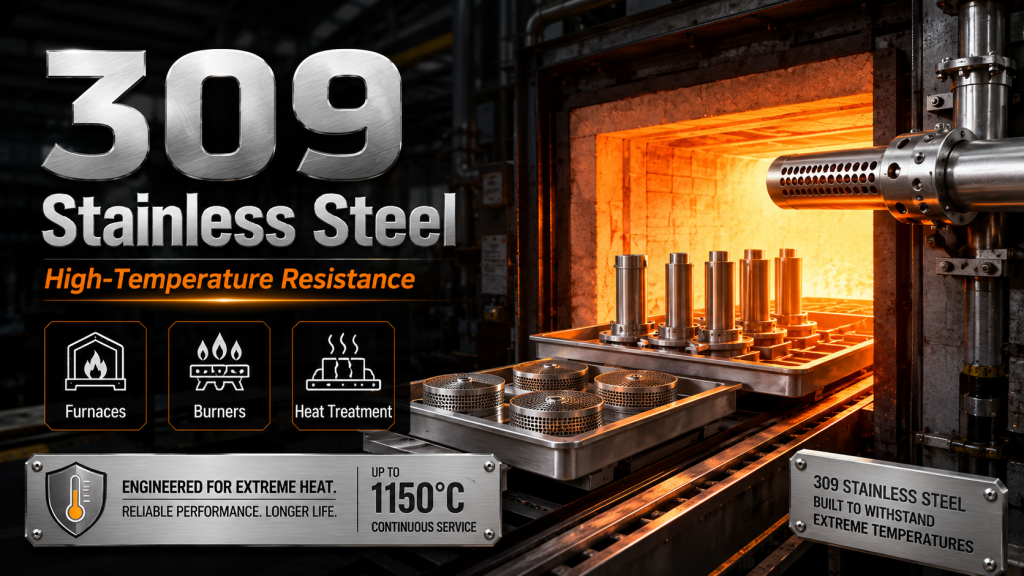
Grade 309 contains more chromium and nickel than 316 and is designed for elevated-temperature oxidation and scaling resistance.
309S is commonly used in furnace equipment, annealing boxes, thermowells, baffles and other thermal-processing components. Published oxidation-temperature values usually refer to air and unloaded laboratory or material-reference conditions.
High-temperature selection should consider:
- Continuous or intermittent operation
- Normal and maximum temperature
- Thermal-cycle frequency
- Component load and creep life
- Oxidizing or reducing atmosphere
- Sulfur-bearing gases
- Carburizing or nitriding conditions
- Scale formation and spalling
- Weld locations and residual stress
Can 316 Be Used at Elevated Temperature?
316 retains useful properties at moderately elevated temperatures, but it is not primarily designed as a furnace oxidation-resistant alloy.
Where prolonged oxidation, scaling and creep are important, 309, 309S, 309H, 310S or another heat-resistant grade should be reviewed before specifying 316.
Corrosion and Chloride Resistance
Where 316 Has the Advantage
The molybdenum in 316 generally provides better resistance to chloride pitting and crevice corrosion than 309.
316 or 316L is commonly considered for:
- Chloride-bearing wash water
- Food-processing brine
- Chemical-processing liquids
- Pharmaceutical cleaning systems
- Wet tanks, pumps and valves
- Selected coastal environments
Can 316 Be Used in Seawater?
316 is frequently used in marine atmospheres and selected splash-zone applications, but the term “marine grade” should not be interpreted as universal seawater immunity.
Continuous immersion, stagnant seawater, crevices, deposits and elevated temperature can cause localized corrosion. Duplex, super duplex or higher-alloy stainless steel may be necessary for severe seawater service.
Where 309 May Perform Better
309 can perform better than 316 in certain high-temperature oxidizing gases and furnace environments. The correct choice depends on whether high-temperature corrosion or aqueous corrosion controls the service life.
Mechanical Properties and Strength
In the annealed condition, 309 and 316 are both ductile austenitic stainless steels with broadly similar room-temperature strength.
Exact mechanical requirements depend on:
- Applicable standard
- Product form
- Espesor
- Annealed or cold-worked condition
- Temperature
- Specified carbon variant
For most 309 vs 316 decisions, room-temperature tensile strength is not the main differentiator. Oxidation, creep, chlorides and chemical exposure are usually more important.
Welding and Fabrication
Both grades can be welded using common austenitic stainless steel welding processes, provided that the filler metal, joint design, shielding gas, heat input and cleaning procedure are appropriate.
Welding 309
- Confirm whether the base material is 309, 309S or 309H.
- Control heat input and distortion in thin sheet.
- Review the weld metal for the intended high-temperature atmosphere.
- Do not assume one filler metal is suitable for every dissimilar-metal joint.
Welding 316
- 316L is often preferred for welded corrosion-resistant equipment.
- Remove heat tint when maximum corrosion performance is required.
- Avoid carbon-steel contamination during fabrication.
- Use an approved pickling or passivation procedure where specified.
JUDE provides
stainless steel sheet-metal processing
for projects requiring cutting, bending, forming and fabricated components.
Product Forms and Surface Conditions
309-family and 316-family stainless steel may be supplied as sheet, plate, coil, strip or custom-fabricated components, subject to mill and service-center availability.
- Stainless steel sheet and plate
for furnace panels, trays, tanks, baffles and fabricated vessels - Stainless steel coil
for continuous production and cut-to-length processing - Stainless steel strip
for narrow components, shields, clips and formed parts
Common surface conditions include:
- No.1 hot-rolled finish
- 2B cold-rolled finish
- BA bright annealed finish
- No.4 brushed finish
- Project-specific polished finishes
High-temperature exposure can discolor or oxidize the original surface. Decorative finish requirements should therefore be reviewed against the actual operating temperature.
309 vs 316 Application Selection
| Application | Recommended Starting Grade | Main Reason |
|---|---|---|
| Industrial furnace component | 309, 309S or 309H | High-temperature oxidation resistance |
| Heat-treatment tray | 309 family | Thermal cycling and elevated-temperature performance |
| Burner shield | 309 family | Hot-gas and flame exposure |
| Chemical storage tank | 316 or 316L after chemical review | Corrosion resistance in many wet process environments |
| Food-processing brine system | 316L or higher alloy | Chloride exposure and frequent cleaning |
| Pharmaceutical equipment | 316L | Weldability and corrosion control |
| Coastal outdoor equipment | 316 or 316L after exposure review | Better chloride resistance than 309 |
| Continuous seawater immersion | Project-specific duplex or higher alloy | 316 may not provide sufficient localized-corrosion resistance |
| Hot sulfur-bearing gas | Application-specific heat-resistant grade | Gas composition may control material performance |
Cost and Availability
309 often has a higher alloy cost because of its chromium and nickel content. 316 contains molybdenum, which can also significantly affect its price.
The final quotation depends on:
- Nickel and molybdenum market prices
- 309, 309S, 309H, 316 or 316L grade
- Sheet, plate, coil or strip form
- Thickness and width
- Surface finish
- Order quantity
- Cutting and fabrication
- Certificación
- Packaging and freight
Buyers should compare lifecycle cost rather than only price per kilogram. An unsuitable alloy can result in oxidation damage, pitting, shutdowns and premature replacement.
Common Purchasing Mistakes
1. Choosing the More Expensive Grade Automatically
316 is not automatically better than 309, and 309 is not automatically better because it contains more chromium.
2. Treating 309, 309S and 309H as Interchangeable
Carbon content affects welding, sensitization and elevated-temperature mechanical performance.
3. Describing 316 as Completely Seawater Resistant
Severe seawater exposure can exceed the localized-corrosion resistance of 316.
4. Using a Published Maximum Temperature as a Design Temperature
Actual allowable temperature depends on gas composition, stress, thickness, thermal cycling and required life.
5. Ordering Only by AISI Grade
A purchase order should also identify the UNS designation, governing product standard, dimensions and delivery condition.
6. Ignoring Traceability
The mill test certificate, heat number and delivered material markings should correspond to each other.
Material Inspection and Quality Documents
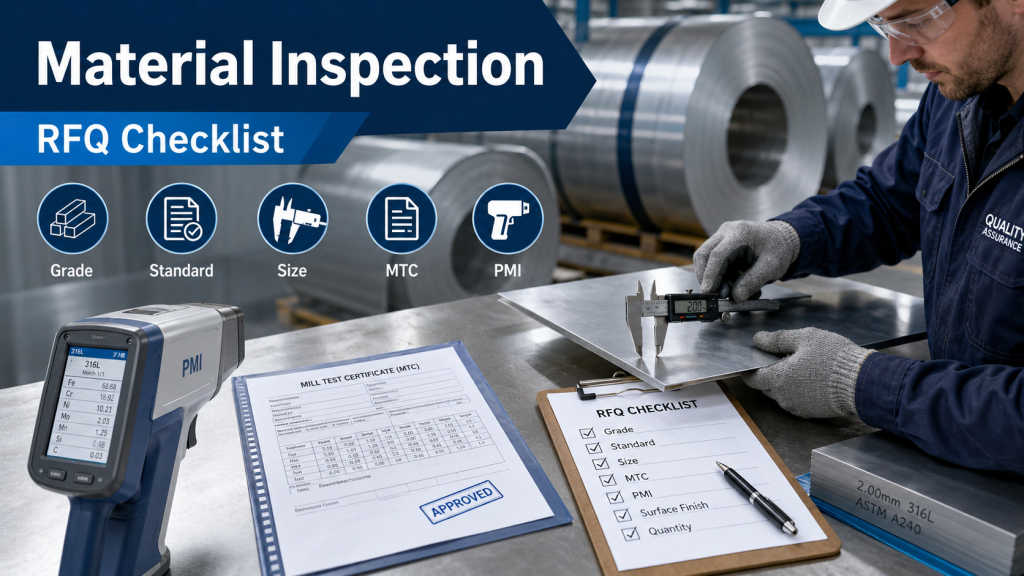
A typical inspection plan may include:
- Grade and standard review
- Mill test certificate verification
- Heat-number traceability
- Positive material identification when required
- Thickness, width and length measurement
- Surface inspection
- Flatness inspection
- Edge-condition inspection
- Packaging and marking review
Selected JUDE
stainless steel inspection reports
are available for buyers reviewing material quality documents.
309 or 316 Stainless Steel RFQ Checklist
Send the following information when requesting a quotation:
- Exact grade: 309, 309S, 309H, 316 or 316L
- UNS designation: where required
- Product standard: ASTM, ASME, EN, JIS or GB
- Product form: sheet, plate, coil, strip or fabricated component
- Dimensions: thickness, width, length and tolerances
- Surface condition: No.1, 2B, BA, No.4 or another finish
- Service temperature: normal, maximum and upset values
- Service atmosphere: air, combustion gas or another atmosphere
- Corrosive medium: chemical name, concentration, pH and chloride content
- Mechanical loading: pressure, weight, vibration or creep requirement
- Processing: cutting, bending, welding, machining or polishing
- Inspection: MTC, PMI, dimensional report or third-party inspection
- Quantity: number of pieces, total weight or coil quantity
- Packaging: waterproof packing, pallets and edge protection
- Delivery: destination port, Incoterm and required date
Frequently Asked Questions
Is 309 stainless steel better than 316?
No grade is universally better. 309 is normally more suitable for high-temperature oxidation service, while 316 is normally more suitable for many wet and chloride-bearing environments.
Which grade handles higher temperatures?
The 309 family is generally preferred for sustained elevated-temperature oxidation service. The final allowable temperature depends on atmosphere, load, thermal cycling and expected life.
Which grade is better for saltwater?
316 normally provides better chloride resistance than 309 because it contains molybdenum. Severe seawater service may still require duplex or another higher-alloy grade.
What is the difference between 309 and 309S?
309S has a lower maximum carbon content than standard 309 and is commonly considered for welded heat-resistant components.
What is the difference between 309S and 309H?
309S limits carbon to improve welding-related behavior, while 309H uses a controlled higher carbon range to support elevated-temperature strength.
What is the difference between 316 and 316L?
316L has lower maximum carbon content, reducing the risk of sensitization and intergranular corrosion in welded areas.
Can 316 stainless steel be used in a furnace?
It may be used at moderately elevated temperatures in suitable conditions, but it is not normally the first choice for sustained furnace oxidation service.
Are 309 and 316 stainless steel magnetic?
Both are generally nonmagnetic or weakly magnetic in the solution-annealed condition. Cold working and welding can introduce measurable magnetic response.
Conclusión
The choice between 309 vs 316 stainless steel should begin with the actual failure risk.
Choose the 309 family when high-temperature oxidation, scaling and thermal exposure are the primary concerns. Choose 316 or 316L when wet corrosion, process chemicals and chlorides are the dominant concerns.
Critical projects should specify the exact grade variant, UNS designation, product standard, dimensions, service conditions, fabrication route and inspection requirements.
When the equipment must withstand both extreme heat and aggressive corrosion, a higher-alloy or application-specific material may be required.
Request a 309 or 316 Stainless Steel Quotation
JUDE supplies stainless steel sheet, plate, coil, strip and processed components for high-temperature and corrosion-resistant applications.
Send the exact grade, product standard, dimensions, quantity, surface finish, service temperature, atmosphere, corrosive medium, processing requirements, inspection documents and destination.
Contact JUDE Steel for a material review and quotation.
