
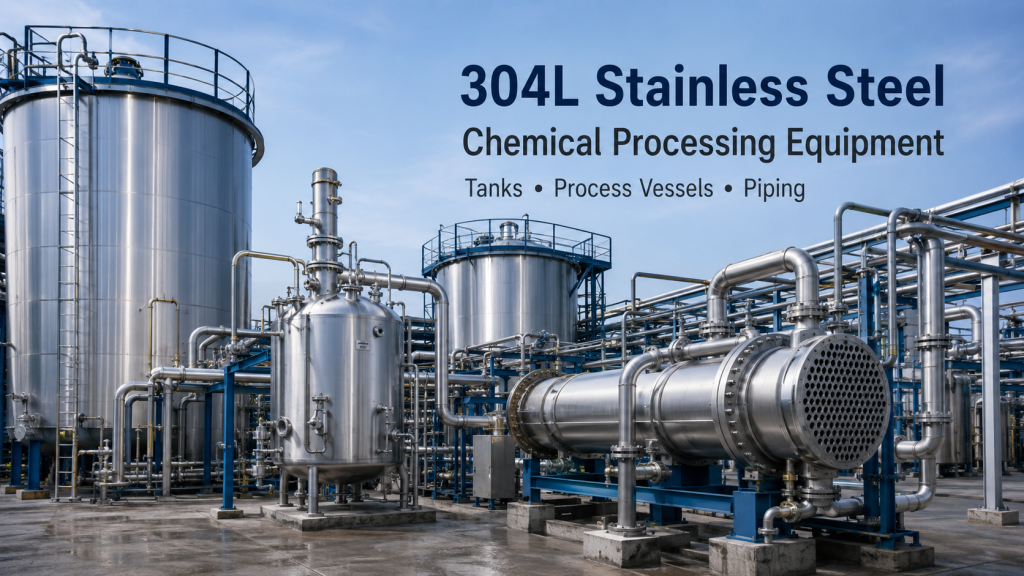
 304L stainless steel is one of the most widely used low-carbon austenitic stainless steels for welded process equipment in chemical manufacturing and other process industries.
When the process environment is compatible with its corrosion resistance, 304L can be fabricated into storage tanks, mixing vessels, process equipment, piping, heat-exchanger components, tank containers and other welded assemblies.
In petrochemical and refinery projects, however, the material must be selected more carefully.
304L should be chosen from the actual process fluid, concentration, temperature, chloride level, contaminants, pressure, welding requirement and equipment design—not simply because the application is described as “chemical” or “refinery.”
Quick Answer: What Chemical and Refinery Equipment Can Use 304L Stainless Steel?
Where corrosion conditions are compatible with 304L, potential equipment includes:
- chemical storage tanks;
- mixing and blending tanks;
- selected process vessels;
- tank containers;
- process piping and pipe spools;
- selected heat-exchanger shells and components;
- flanges and valve components;
- welded structural and equipment components;
- selected petrochemical storage and transfer equipment;
- selected refinery utility and process equipment after corrosion review.
304L should not automatically be specified for warm chloride solutions, seawater, aggressive refinery overhead condensates, severe acid service, sour environments, high-temperature sulfidation or other highly corrosive process conditions.
What Is 304L Stainless Steel?
304L is the low-carbon version of the Type 304 chromium-nickel austenitic stainless steel family.
Common international references include:
- ASTM: Type 304L;
- UNS: S30403;
- EN: 1.4307 / X2CrNi18-9 as a common direct reference;
- JIS: SUS304L.
JUDE publishes a dedicated
304L Stainless Steel
grade page for buyers reviewing the material.
EN designation note:
EN 1.4306 and EN 1.4307 are separate low-carbon Cr-Ni grades. They should not be treated as automatically identical simply because both can be associated with the broader 304L family.
Why Does the Low Carbon Content Matter?
The main metallurgical purpose of the lower carbon level is to reduce chromium-carbide precipitation caused by thermal exposure during welding.
This can improve resistance to intergranular corrosion in welded equipment and is one reason 304L is widely considered for:
- large storage tanks;
- welded vessels;
- process piping;
- fabricated chemical equipment;
- equipment that cannot conveniently be solution annealed after fabrication.
Low carbon does not make 304L immune to corrosion, and it does not upgrade the alloy’s resistance to chlorides or aggressive acids.
304L Standards and Grade Identification
| Product / System | Common Grade Reference | Relevant Standard | Purchasing Note |
|---|---|---|---|
| ASTM flat product | Type 304L / UNS S30403 | ASTM A240/A240M-26 | For stainless steel plate, sheet and strip. |
| ASTM general requirements | Flat-rolled stainless steel | ASTM A480/A480M-25b | Applies with relevant product specifications. |
| EN flat product | 1.4307 / X2CrNi18-9 | EN 10088-2:2024 | State the exact EN designation in the purchase order. |
| JIS hot rolled | SUS304L | JIS G 4304:2021 | For applicable hot-rolled flat products. |
| JIS cold rolled | SUS304L | JIS G 4305:2021 | For applicable cold-rolled sheet and strip. |
| ASTM process pipe | TP304L | ASTM A312/A312M-25 | Pipe standard; do not use this as the raw plate or sheet specification. |
Which Chemical Equipment Uses 304L Stainless Steel?
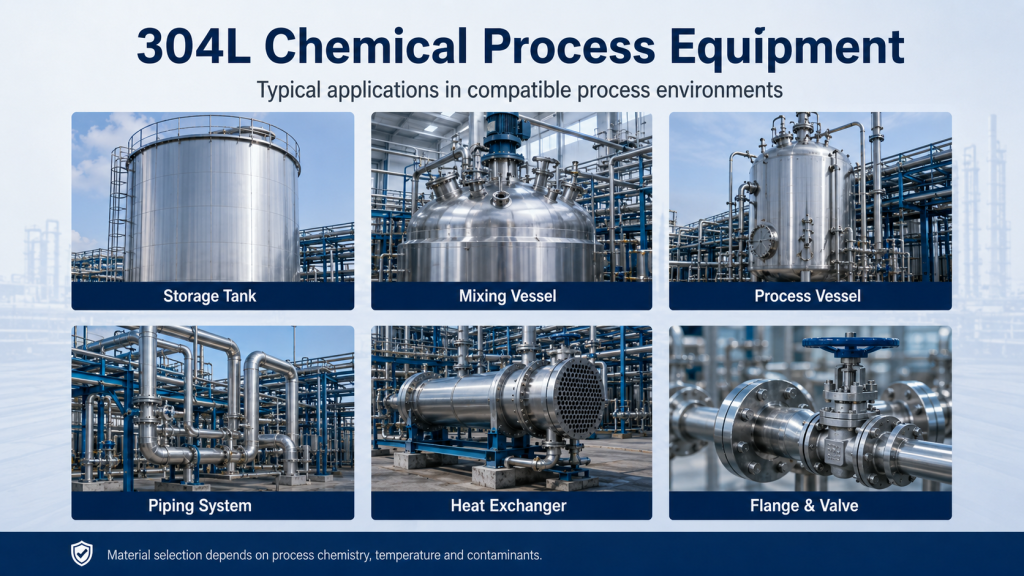
| Equipment | 304L Selection | Typical Raw Material | Main Engineering Check |
|---|---|---|---|
| Chemical storage tank | Common candidate for compatible media | Plate / sheet | Fluid chemistry and chloride level |
| Mixing or blending tank | Common in mild-to-medium corrosion service | Plate / sheet | Process chemicals and cleaning solution |
| Process vessel | Application dependent | Plate | Temperature, pressure and corrosion rate |
| Process piping | Common for compatible process streams | Finished TP304L pipe or tube feedstock | Fluid, temperature, pressure and piping code |
| Heat exchanger | Application dependent | Plate / sheet / tube | Both process and cooling-side chemistry |
| Flanges and valves | Established application family | Plate, bar, forging or machined stock | Pressure class and fluid compatibility |
| Refinery process equipment | Selected services only | Plate / pipe / fabricated components | Sulfur, acids, chlorides and operating temperature |
304L Stainless Steel Chemical Storage Tanks
Storage tanks are one of the strongest application areas for 304L when the stored chemical is compatible with the alloy.
A tank manufacturer may use 304L plate or sheet for:
- tank shells;
- roofs;
- bottom plates;
- nozzles and fabricated attachments;
- internal partitions;
- selected access covers.
The material decision should consider:
- chemical identity;
- concentration;
- normal temperature;
- maximum temperature;
- chloride contamination;
- cleaning chemicals;
- expected service life.
Mixing and Blending Vessels
304L is also widely considered for mixing and blending equipment where both fabrication and corrosion resistance are important.
Potential components include:
- vessel shells;
- heads;
- internal baffles;
- covers;
- support brackets;
- selected agitator-related fabricated components.
For batch processing, the cleaning cycle can sometimes be more corrosive than the product itself. The material review should therefore include both the process medium and the cleaning chemistry.
304L Process Vessels and Reactor Shells
304L can be fabricated into selected atmospheric or pressure-containing process vessels when permitted by the project specification and design code.
The phrase “chemical reactor” alone is not enough to select the material.
The corrosion review should consider:
- every reactant;
- reaction products;
- impurities;
- temperature;
- pressure;
- startup and shutdown conditions;
- cleaning and sterilization chemicals;
- possible process upset conditions.
304L Stainless Steel Process Piping
304L is widely used in welded and seamless process piping for compatible industrial media.
For finished ASTM process pipe, the designation is commonly TP304L under ASTM A312/A312M.
Do not confuse the finished pipe standard with the raw flat-product standard.
Typical purchasing information includes:
- NPS or outside diameter;
- schedule or wall thickness;
- seamless or welded construction;
- pipe standard;
- end preparation;
- heat treatment;
- testing and inspection;
- process fluid.
Can 304L Be Used for Heat Exchangers?
Yes, but heat-exchanger material selection is highly dependent on both sides of the exchanger.
The engineer must consider:
- process-side fluid;
- cooling-water composition;
- chloride concentration;
- operating temperature;
- flow velocity;
- crevice locations;
- shutdown conditions;
- cleaning procedure.
304L can be appropriate in compatible mild-to-moderate process conditions.
If chloride or acid exposure increases, 316L, 317L, duplex stainless steel or a more highly alloyed material may be required.
Flanges, Valves and Process Components
304L-family stainless steels are also used for flanges, valve parts, fittings and other process components.
These parts may be manufactured from:
- plate;
- bar;
- forgings;
- castings;
- machined components.
Each product form can have a different ASTM, EN or JIS specification.
304L in Petrochemical Equipment
304L can be considered for selected petrochemical equipment where process contaminants and temperature remain within its corrosion capability.
Potential applications can include:
- compatible hydrocarbon storage;
- selected transfer systems;
- process vessels;
- utility piping;
- heat-exchanger components;
- general fabricated process equipment.
The grade should never be selected from the word “petrochemical” alone.
Small concentrations of chlorides, sulfur compounds, acids or water can significantly change the corrosion mechanism.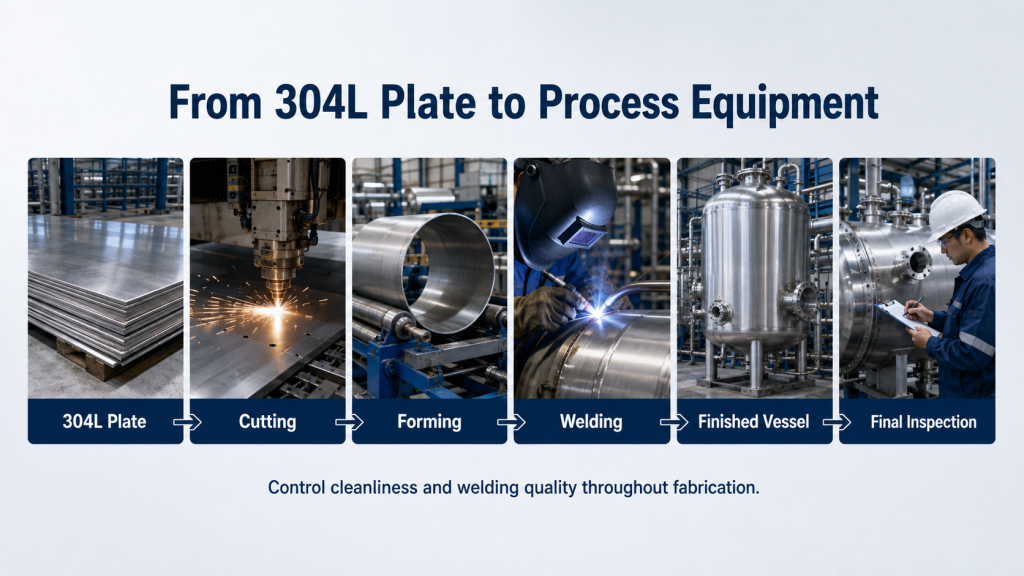
Where Can 304L Be Used in a Refinery?
304-series stainless steels have a long history in selected petroleum-refinery systems, including certain transfer lines, exchanger components and other areas where corrosion or scale control justifies stainless steel.
However, refinery corrosion is highly process-specific.
Important threats can include:
- high-temperature sulfur corrosion;
- naphthenic acid corrosion;
- hydrochloric-acid-containing overhead condensate;
- chloride salts;
- wet hydrogen sulfide environments;
- ammonium salts;
- process upsets.
Refinery rule:
Do not substitute 304L into an existing refinery material specification simply because it is stainless steel. The corrosion mechanism and project metallurgy specification must control the selection.
When Is 304L Not Enough?
304L should be reconsidered when the process environment has corrosion demands beyond the standard Cr-Ni alloy family.
Warm Chloride and Brine Environments
304L contains no intentional molybdenum addition and has less localized-corrosion resistance than molybdenum-alloyed stainless steels such as 316L.
Warm chlorides can increase the risk of:
- pitting;
- crevice corrosion;
- chloride stress-corrosion cracking.
Aggressive Acid Service
The word “acid” covers a wide range of corrosion environments.
Material suitability can change dramatically with:
- acid type;
- concentration;
- temperature;
- oxidizing contaminants;
- chloride contamination.
Do not use a generic statement such as “304L is acid resistant” as the design basis.
Refinery Overhead Systems
Refinery overhead condensation can create extremely aggressive local environments, particularly when chlorides and acidic condensates are involved.
304L should not be assumed to provide adequate durability without a dedicated refinery-corrosion review.
Prolonged High-Temperature Service
304L’s low carbon content is valuable for welding, but this does not make it the preferred material for every long-term elevated-temperature process.
Where sustained high-temperature stability is the dominant design issue, stabilized or heat-resistant stainless steels should be reviewed.
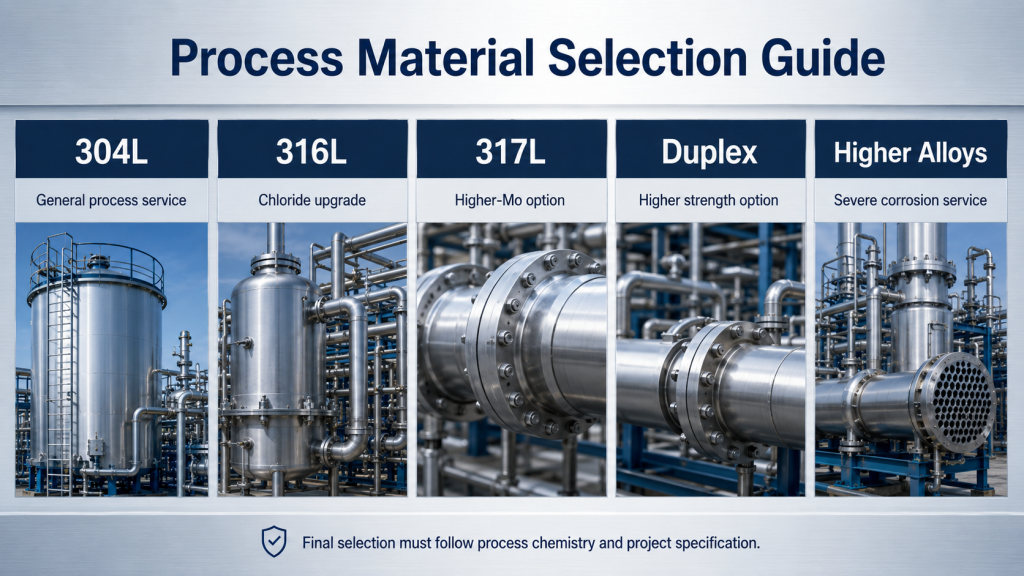
304L vs Other Stainless Steel Grades for Process Equipment
| Grade Family | Primary Selection Logic | Typical Upgrade Reason |
|---|---|---|
| 304L / S30403 | General welded process equipment in compatible mild-to-medium corrosive environments | Baseline Cr-Ni process stainless steel |
| 316L / S31603 | Mo-alloyed low-carbon austenitic stainless steel | Greater chloride and localized-corrosion margin |
| 317L / S31703 | Higher-Mo austenitic grade | When 304L or even 316L does not provide sufficient corrosion resistance |
| 321 / 347 family | Stabilized austenitic stainless steels | Evaluate for prolonged elevated-temperature exposure and thermal service |
| Duplex stainless steel | Higher-strength Cr-Ni-Mo-N duplex family | Higher chloride-SCC resistance and strength in appropriate temperature ranges |
| Higher alloys | Super austenitic / nickel alloy systems | Severely corrosive acid, chloride or refinery environments |
For more corrosion-resistant austenitic options, review JUDE’s
316L Stainless Steel
and
317L Stainless Steel
pages.
 Should Chemical Equipment Manufacturers Buy Sheet, Plate, Coil or Strip?
304L Stainless Steel Plate
Plate is commonly required for:
- large tank shells;
- pressure vessels;
- reactor shells;
- heavy fabricated equipment;
- large heads and structural components.
See JUDE’s
Stainless Steel Sheet and Plate
range.
304L Stainless Steel Coil
Stainless Steel Coil
is appropriate for high-volume fabrication, continuous processing and thinner-gauge equipment components.
304L Stainless Steel Sheet
Sheet can be practical for:
- equipment covers;
- smaller tanks;
- ducts;
- formed components;
- fabricated internal parts.
304L Stainless Steel Strip
Stainless Steel Strip
can be used for narrow fabricated components, clamps, formed parts and specialized process-equipment components.
Fabrication and Welding of 304L Chemical Equipment
304L is widely selected for welded equipment because the low-carbon chemistry reduces sensitization risk during welding.
That does not eliminate the need to control:
- weld heat input;
- filler metal;
- joint design;
- shielding;
- heat tint;
- surface contamination;
- post-weld cleaning.
Welding oxide and embedded carbon-steel contamination can reduce corrosion resistance.
Depending on the equipment specification, post-fabrication treatment can include:
- mechanical cleaning;
- pickling;
- passivation;
- final rinse;
- surface inspection.
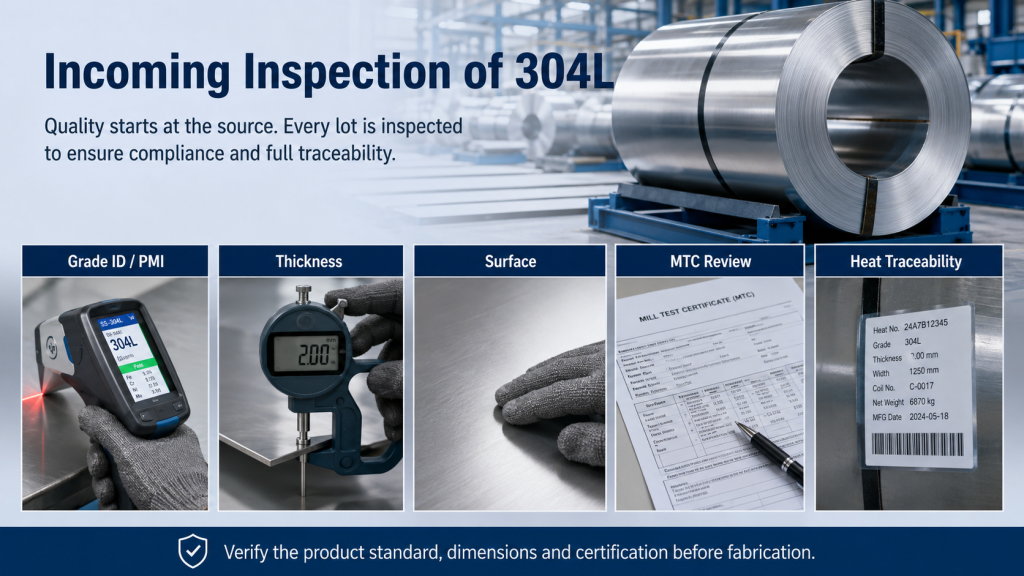
Incoming Inspection of 304L for Chemical and Refinery Projects
- Confirm Type 304L / UNS S30403 or the required EN/JIS designation.
- Verify the governing product standard.
- Review the MTC.
- Match heat number and plate/coil identification.
- Verify thickness.
- Verify width and length.
- Check surface condition.
- Review flatness and dimensional tolerances.
- Confirm the required finish.
- Perform PMI when required by the project.
- Review intergranular-corrosion testing requirements where specified.
- Verify pressure-equipment documentation where applicable.
Buyers can review JUDE’s available
Inspection Reports
when defining material-verification requirements.
 Common 304L Purchasing Mistakes
Mistake 1: Ordering only “304L stainless steel.”
State the product standard, form, thickness, dimensions and project specification.
Mistake 2: Selecting the material without process-fluid data.
The fluid, concentration, temperature and contaminants are fundamental to corrosion performance.
Mistake 3: Assuming 304L is suitable for every refinery process.
Refineries contain several fundamentally different corrosion mechanisms.
Mistake 4: Ignoring chlorides.
A small change in chloride concentration and temperature can significantly alter localized-corrosion risk.
Mistake 5: Treating 1.4306 and 1.4307 as automatically identical.
Specify the exact EN grade required by the design package.
Mistake 6: Confusing ASTM A240 and ASTM A312.
A240 applies to flat products; A312 applies to finished austenitic stainless steel pipe.
Mistake 7: Ignoring post-weld cleaning.
Heat tint and contamination can undermine corrosion performance even when the correct grade was purchased.
JUDE 304L Stainless Steel Supply Options
JUDE currently lists 304L across its stainless steel flat-product portfolio.
304L Stainless Steel
— grade information.
Stainless Steel Sheet / Plate
— for tanks, process vessels and fabricated equipment.
Stainless Steel Coil
— for continuous processing and thinner fabricated components.
Stainless Steel Strip
— for narrow-width fabricated products.
Strip Processing
— for customized slit-width requirements.
304L Chemical and Refinery RFQ Checklist
For an accurate quotation, send:
- Final equipment: tank, vessel, piping, exchanger, duct or another component.
- Process industry: chemical, petrochemical, refinery, pharmaceutical or another sector.
- Process fluid: identify the actual chemical or hydrocarbon stream.
- Concentration: provide the operating concentration where applicable.
- Normal temperature.
- Maximum design temperature.
- Pressure or vacuum condition.
- Chloride content where known.
- Sulfur / H2S / acid contaminants where relevant.
- Grade: Type 304L / S30403, EN 1.4307, SUS304L or exact project designation.
- Product standard: ASTM A240, EN 10088-2, JIS or project specification.
- Product form: sheet, plate, coil or strip.
- Thickness.
- Width and length.
- Surface finish.
- Dimensional tolerances.
- Welding process.
- Post-weld cleaning requirement.
- PMI requirement.
- MTC / EN 10204 documentation requirement.
- Additional corrosion testing where specified.
- Quantity.
- Destination port and Incoterm.
Frequently Asked Questions
Is 304L stainless steel suitable for chemical tanks?
Yes, 304L is widely used for chemical storage and process tanks when the stored medium, temperature and contaminants are compatible with the alloy.
Can 304L be used in petroleum refineries?
Yes, in selected services. Refinery material selection must consider sulfur compounds, naphthenic acids, chlorides, acidic condensates, H2S and operating temperature. 304L is not a universal refinery grade.
Can 304L be used for process piping?
Yes. TP304L is widely used for compatible process piping. Finished ASTM pipe is commonly specified to ASTM A312/A312M rather than the ASTM A240 flat-product standard.
Is 304L suitable for heat exchangers?
It can be. The process side and cooling side must both be reviewed. Chloride-rich cooling water or aggressive process fluids may require 316L, 317L, duplex stainless steel or another alloy.
What is the difference between 304 and 304L?
304L has a lower maximum carbon level, reducing the risk of chromium-carbide precipitation during welding and improving resistance to intergranular corrosion in welded fabrication.
When should I choose 316L instead of 304L?
316L should be evaluated when the process contains chlorides or requires a greater localized-corrosion margin because its molybdenum addition improves resistance to pitting and crevice corrosion.
Can 304L handle acids?
The answer depends on the specific acid, concentration, temperature and contaminants. “Acid resistant” should never be used as a universal description of 304L.
Is 304L suitable for seawater?
304L is generally not the preferred grade for sustained seawater or high-chloride service. More highly alloyed stainless steels should normally be evaluated.
Is EN 1.4307 the same as 304L?
EN 1.4307 / X2CrNi18-9 is a common European counterpart to Type 304L / UNS S30403. The exact governing standard should still be stated in the purchase order.
Is EN 1.4306 the same as 1.4307?
No. Both are low-carbon Cr-Ni austenitic stainless steels, but they are separate EN grades with different composition requirements.
What information should I send when requesting 304L for chemical equipment?
Provide the final equipment, process medium, concentration, temperature, pressure, chloride content, exact grade and standard, dimensions, welding requirements, inspection documentation, quantity and destination.
Conclusión
304L stainless steel is one of the most important welded materials used in general chemical processing.
Its low-carbon chemistry, good fabrication characteristics and established availability make it a practical raw material for compatible tanks, vessels, piping, heat exchangers and other process equipment.
Its application in petrochemical and refinery plants requires a more detailed corrosion review.
The correct selection sequence is:
Process Fluid → Concentration → Temperature → Contaminants → Corrosion Mechanism → Grade → Product Standard → Fabrication → Inspection.
304L is an effective starting point for many mild-to-medium process environments. When chloride, acid, sulfur, high temperature or other aggressive conditions become dominant, 316L, 317L, duplex stainless steel, stabilized stainless steel or higher alloys should be evaluated.
The project corrosion specification and process engineer always take priority over a generic online grade recommendation.
Request 304L Stainless Steel for Chemical and Process Equipment
Send JUDE your equipment drawing, process medium, concentration, normal and design temperature, chloride content, pressure, required material standard, thickness, dimensions, welding requirements, inspection documentation, quantity and destination.
For refinery or petrochemical projects, include the project material specification and known sulfur, acid, chloride or H2S conditions where applicable.
