
304 and 316L Stainless Steel for Aircraft Support Equipment
 304 and 316L Stainless Steel for Aircraft Support Equipment
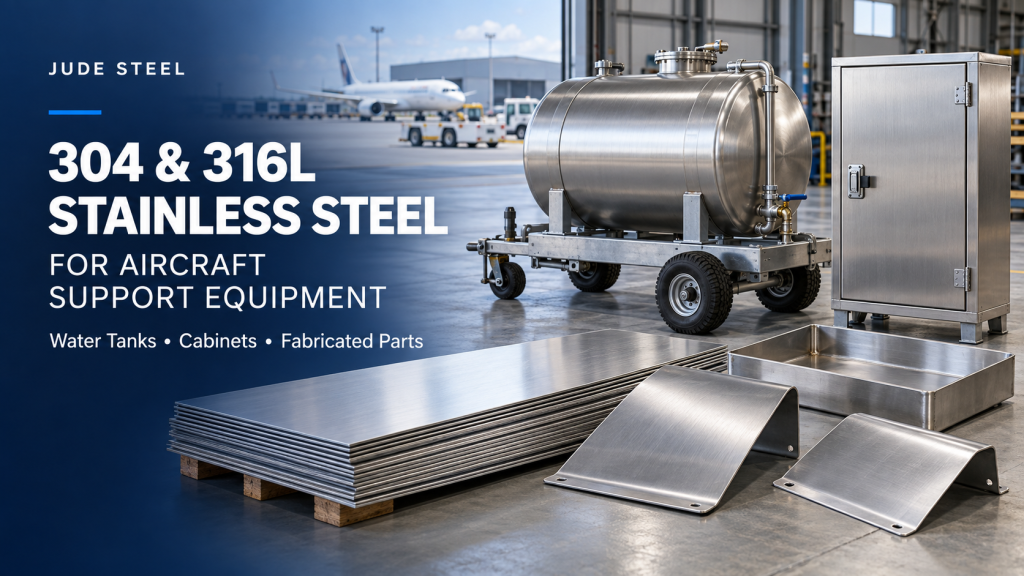
304 and 316L stainless steel have documented uses in aircraft ground support equipment, including potable-water tanks and offshore helicopter refueling assemblies. For manufacturers buying flat products, these applications create demand for tank panels, cabinet skins, containment trays and support brackets.
The useful purchasing question is which material belongs in each component. A tank exposed to water and disinfectants, an outdoor cabinet and a dry access cover can have different requirements even when they belong to the same equipment package.
This guide focuses on ground equipment in the aerospace supply chain. Aircraft-installed parts require a separate review of the approved drawing, material specification and customer requirements.
Published Examples: Where Are These Grades Used?
304 stainless steel: aircraft potable-water carts
Stinar specifies Type 304 stainless steel for the tank on its CPW-200 aircraft potable-water cart. Its description also identifies welded construction, leak testing and internal baffles. This is a concrete example of 304 in aviation servicing equipment.
316L stainless steel: water-service truck tanks
Tianyi lists 316L as the fresh-water tank material in its aircraft potable-water service truck specification. The existence of both 304 and 316L designs shows why buyers should obtain the equipment manufacturer’s material requirement instead of assuming that every aircraft water tank uses one grade.
316L stainless steel: offshore helicopter refueling equipment
Millennium Systems International’s MARS offshore helifuel brochure identifies 316L construction for cabinets, piping, skid bases and pipe supports. It also describes cabinet enclosures with welded containment pans. These applications connect aviation equipment manufacturing with the offshore energy supply chain.
Which Fabricated Products Create Demand for Sheet, Coil and Plate?
The equipment examples above can be translated into a purchasing list for the fabricator. The table identifies parts to discuss with the designer; final grades, thicknesses and manufacturing routes remain drawing-specific.
| Product being manufactured | Flat products to specify | Purchasing detail that matters |
|---|---|---|
| Potable-water tank shells and end panels | 304 or 316L sheet and plate, as specified for the tank | Forming dimensions, weld layout, wetted-surface finish and cleaning access |
| Refueling cabinet doors, covers and side panels | 316L sheet or coil for designs requiring this grade | Bend geometry, flatness, visible-face protection and finish direction |
| Containment pans and drip trays | Sheet blanks with formed edges and welded corners | Approved grade, drain arrangement, weld access and leak-test requirements |
| Plate-type pipe supports and mounting brackets | Plate or strip blanks where the support drawing permits this construction | Loads, hole positions, edge condition and required mechanical properties |
For individual builds, stainless steel sheet can be specified against the component cutting list. Repeated panel production may justify coil procurement, while narrow repeated parts may suit stainless steel strip. Match the supply form to your equipment, order volume and nesting plan.
304 and 316L: Identify the Grade Before Comparing Quotations
| Type | UNS designation | Common EN counterpart | Main distinction |
|---|---|---|---|
| 304 | S30400 | 1.4301 | Austenitic chromium-nickel stainless steel |
| 316L | S31603 | 1.4404 | Low-carbon austenitic chromium-nickel-molybdenum stainless steel |
These identifiers help locate the intended grade; they do not establish complete interchangeability between product standards. Outokumpu documents the corresponding designations in its Core range and Supra range. Confirm the full specification and certificate requirements for the ordered product.
316L’s molybdenum addition generally improves resistance to chloride-related localized corrosion compared with 304. Its low carbon content reduces susceptibility to sensitization during welding. However, neither grade is immune to corrosion; temperature, chemical concentration, crevices, deposits and cleaning practices affect performance.
Also distinguish 304 from 304L. When a welded component requires a low-carbon grade or dual-certified material, make that requirement explicit. Do not replace the drawing grade simply because an alternative belongs to the same stainless steel family.
Which Material Specification Belongs on the Purchase Order?
ASTM A240/A240M is a material specification for stainless flat products, including sheet, strip and plate, used in general fabrication and pressure-vessel applications. It can be relevant to a ground-equipment material list when the equipment specification calls for it. State the required grade, standard edition, dimensions and delivery condition.
A240 is a flat-product specification. Buying tubing, fittings or bar requires the appropriate specification for that product form. Likewise, a sheet certificate does not certify the finished tank, piping assembly or refueling unit.
For an aircraft-installed part, obtain the exact drawing callout, including any AMS or OEM material specification, revision, condition and approved-source restrictions. An order for “aerospace-grade 304” or “aviation 316L” does not provide enough information to establish conformity. Any material substitution needs the relevant engineering and customer approval.
Five Details That Affect Fabrication and Acceptance
1. Thickness and forming condition
Specify the nominal thickness and permitted variation, together with the required material condition. Bending and forming depend on thickness, tooling, geometry and prior cold work. A generic minimum bend radius or one thickness for every water tank would be misleading.
2. Surface finish and inspection method
State which side contacts the fluid and which side remains visible. A finish description such as 2B or No. 4 does not, by itself, establish a particular surface-roughness value. If roughness matters, specify the parameter, limit, measurement method and stage of manufacture at which it will be checked.
3. Welding and post-fabrication cleaning
Identify welding requirements, acceptance criteria and responsibility for post-weld treatment. Low-carbon material still requires suitable fabrication procedures. Address weld heat tint, embedded iron and processing residues; a specified passivation treatment should not be assumed to replace every cleaning or oxide-removal operation.
4. Material identity after cutting
Agree how sheet, coil and cut blanks will remain connected to their material certificates. Component labels, heat or coil references and a controlled cutting record can help preserve traceability. Keep different grades identifiable during storage and fabrication.
5. Raw-material checks versus equipment tests
Material inspection may cover dimensions, surface condition and certificate conformity. The equipment manufacturer separately defines finished-product checks, such as tank leak testing, cleanliness verification or operational testing. Assign these responsibilities before comparing supplier quotations.
Prepare an RFQ Around the Product You Are Making
A useful enquiry connects the material to the intended component and production quantity. Include:
- Equipment and component: water-cart tank, refueling cabinet, containment pan or support bracket.
- Material callout: grade, product standard, revision or edition, condition and any approved-mill restrictions.
- Dimensions and quantities: sheet or plate sizes, coil or strip width, piece count or order weight, and repeat demand.
- Fabrication information: drawing revision, blank geometry, bend direction, holes, edge quality and cut-part tolerances.
- Surface and exposure: wetted face, finish, protective film, process fluid, cleaning chemicals and relevant operating conditions.
- Acceptance and logistics: certificates, supplementary tests, identification, packing, required arrival date and destination.
Ask for raw material, processing, inspection and transport costs to be identified clearly. Compare usable material for the same specification and delivery scope. A low unit price is difficult to assess when one offer excludes surface protection or additional testing.
Frequently Asked Questions
Does 316L automatically qualify a tank for drinking-water service?
No. The finished water-contact system may also need to satisfy applicable health-effects, hygiene and customer requirements. Welds, seals, hoses, cleaning and system design matter. Where specified, verify the required product certification; NSF’s explanation of drinking-water component requirements illustrates why a metal grade alone is insufficient.
Can one equipment package contain both 304 and 316L?
Yes, if its design specifies different grades for different components. For example, an enclosure panel and a wetted tank need not have identical exposure conditions. Record the grade against each part number and preserve that distinction through purchasing, marking and assembly.
Should a prototype order use coil or individual sheets?
Compare the total quantity you can use with the supplier’s available sizes and minimum order. Individual sheets may suit a small prototype, while repeat production may support a coil-based plan. Include blank yield, handling equipment, storage and processing charges in the comparison.
Send JUDE Steel Your 304 or 316L Material List
Preparing a water-service tank, refueling cabinet or support-component order? Review JUDE’s 304 stainless steel and 316L stainless steel pages, then send the material callout and drawing requirements for a quotation.
Suggested enquiry subject: 304 / 316L Aircraft Support Equipment Material RFQ
Equipment / part number:
Grade / standard / condition:
Thickness / width / length:
Quantity / repeat requirement:
Finish / protective film:
Drawing revision / processing:
Certificates / approved-source requirements:
Required arrival date / destination:
Ask JUDE to confirm the available supply route, documentation, processing scope and lead time against your specification before placing the order.
Request a 304 / 316L Material Quote
To share your material list and drawings by email, contact support@jiscojude.com.
