
2507 Stainless Steel for SWRO Desalination: Feed Lines, Brine Manifolds and Pump Parts
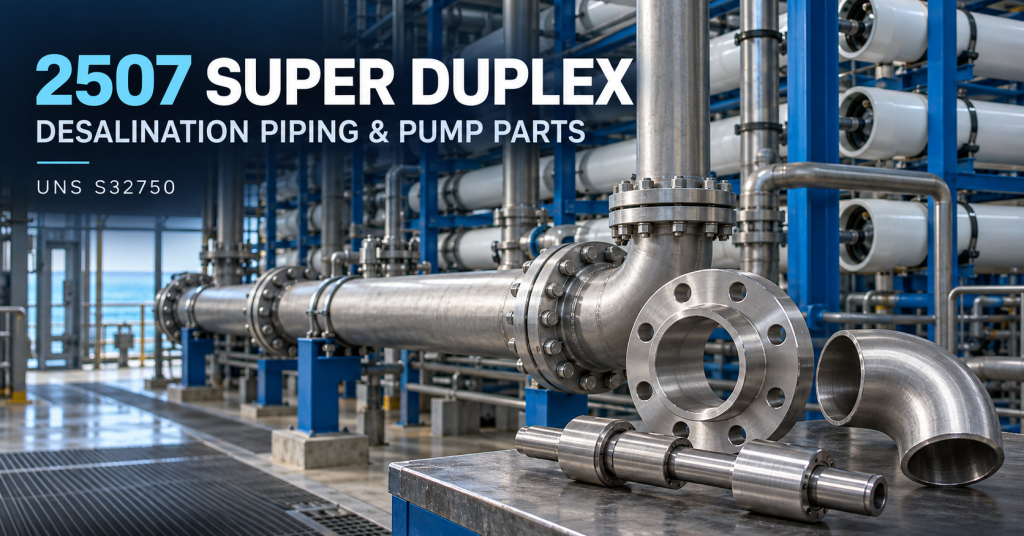 2507 stainless steel can be specified for seawater reverse-osmosis feed piping, concentrate manifolds, forged connections and selected pump or valve components. It also has applications in approved seawater filter housings and heat-exchanger parts. The material purchase must follow the component design and the actual water chemistry.
Where 2507 Fits in a Seawater RO Plant
Seawater reverse osmosis, or SWRO, separates feed into lower-salinity permeate and a more concentrated reject stream. The high-pressure feed and concentrate circuits are established areas for evaluating super duplex stainless steel. IMOA’s desalination materials review documents 2507 in seawater RO high-pressure piping.
A useful purchasing boundary follows the wetted circuit: pump discharge, feed manifold, membrane connections, concentrate outlet and associated energy-recovery piping. List each component against its approved material. This does not mean every energy-recovery device or every part of an RO skid is made from 2507.
Industrial water-reuse plants may also evaluate 2507 for chloride-rich concentrate equipment. Freshwater storage and comparatively mild treated-water duties need their own economic and corrosion assessment; the presence of a desalination process elsewhere on site does not justify upgrading every component.
Which Products Can Be Manufactured from 2507?
The following are candidate manufacturing routes after the equipment designer approves the material. Each order also needs the applicable standard edition, dimensions, delivery condition and inspection requirements.
| Manufactured product | Material specification to confirm | Purchasing detail that matters |
|---|---|---|
| High-pressure feed spools and brine manifolds | Pipe to ASTM A790/A790M, UNS S32750 | Seamless or welded route, outside diameter, wall thickness, ends and the separate requirements for completed spools |
| Elbows, tees and reducers | Wrought fittings to ASTM A815/A815M, with the specified S32750 grade designation and class | Dimensions, construction class, heat treatment and applicable examination requirements |
| Forged flanges and forged valve pressure parts | ASTM A182/A182M Grade F53, associated with UNS S32750 | Component standard, pressure class, facing, bore, drawing revision and forging requirements |
| Machined pump shafts, sleeves and valve stems | S32750 bar to ASTM A276/A276M or A479/A479M, as required by the component specification | Blank dimensions, machining allowance, straightness and any specified internal-soundness examination |
| Fabricated seawater filter shells, covers and approved heat-exchanger plates or tubesheets | Flat stock to ASTM A240/A240M, UNS S32750 | Plate versus formed-sheet route, minimum finished thickness, flatness and cutting or forming allowances |
| Seawater heat-exchanger tube bundles | Tube to ASTM A789/A789M, UNS S32750 | Tube dimensions, manufacturing route, tube-to-tubesheet joint and required tube inspection |
These routes address wrought products. Cast pump casings and impellers require a separately specified casting grade and casting standard. A plate certificate cannot qualify a casting, and material chemistry alone does not establish a flange’s pressure rating.
Identify the Alloy Without Turning a Cross-Reference into a Guarantee
2507 is a super duplex stainless steel with an austenitic-ferritic microstructure. Its commonly associated designations are UNS S32750 and EN 1.4410, X2CrNiMoN25-7-4. Where an EN specification is required, state the relevant product standard; a grade cross-reference does not prove dual certification.
Manufacturer documents distinguish product forms. For example, Alleima’s 2507 bar datasheet lists bar specifications, while its billet datasheet identifies material suitable for further manufacture to ASTM A182 F53. A billet datasheet does not certify a finished flange.
Flat-product strength reference: Outokumpu’s Forta duplex datasheet lists ASTM A240 minimum values of 550 MPa for 0.2% yield strength and 795 MPa for tensile strength for S32750 plate, sheet and strip. These are not design allowable stresses or universal values for every supply form. Confirm the contract edition, condition and applicable requirements for the ordered product.
Review Conditions at the Component, Including Cleaning and Shutdown
2507 has limits in chloride service. Material selection should consider the most demanding credible exposure at the metal surface, rather than only the plant’s average feed analysis.
- Feed versus concentrate: obtain the chemistry and temperature for the actual circuit, including changes with operating recovery.
- Oxidants: record residual chlorine or other disinfectants at the component, including intermittent dosing and cleaning.
- Crevices and deposits: review gasket joints, stagnant branches, retained solids and inaccessible wetted surfaces.
- Off-design exposure: include cleaning chemicals, contact time, shutdown preservation and startup conditions.
- Mechanical duty: identify design pressure, temperature, cycling and hydraulic transients through the equipment specification.
There is no single seawater temperature or chloride concentration that makes 2507 suitable for every geometry and operating cycle. A corrosion review and the applicable mechanical design remain necessary. JUDE’s 2205 water-recovery equipment guide covers a different material option for separately assessed duties.
Use PREN to Screen Chemistry, Then Specify the Required Evidence
A commonly used pitting-resistance index is PREN = %Cr + 3.3 × %Mo + 16 × %N, using mass percentages. It helps compare alloy chemistry, but it does not account for every influence of microstructure, welding, surface condition or crevice geometry.
If the project requires a minimum PREN, state the formula and threshold in the order and calculate it from the required chemistry evidence. A commercial label such as “super duplex” should not replace that check. A laboratory corrosion-test temperature also should not be copied into a datasheet as the maximum permissible seawater operating temperature.
Agree an inspection plan that distinguishes what each result demonstrates:
- Material identity: inspection documents and markings must connect the supplied pieces to the reported heat and ordered specification.
- Metallurgical condition: verify the specified solution treatment and cooling requirements. Where required and applicable, ASTM A923 provides methods for detecting detrimental intermetallic phases.
- Corrosion testing: if ASTM G48 is required, identify the method, test temperature, duration, specimen condition and acceptance criteria. The words “G48 tested” alone leave the requirement incomplete.
- Fabricated assembly: define weld examination, dimensional inspection and pressure or leak testing separately. Passing one category does not automatically satisfy the others.
The fabricator should use a qualified welding procedure addressing filler selection, shielding and root protection, heat input and interpass temperature. Specify weld-oxide removal and final surface acceptance. IMOA’s duplex fabrication guidance explains why processing control matters. A visually clean weld is not evidence that all metallurgical requirements have been met.
Build an RFQ Around the Actual Supply Package
Separate raw material from finished components in the inquiry. A plate quotation may exclude rolling, welding, machining and finished-vessel inspection; a pipe quotation may exclude spool fabrication. Ask bidders to identify those boundaries explicitly.
For each item, send the component tag, drawing revision, grade, product standard and edition, dimensions, tolerances, quantity and required delivery condition. Add the certificate type, supplementary tests, inspection stages, destination, delivery date and commercial delivery terms.
For fabricated packages, assign responsibility for test-water quality, permitted holding time, flushing, draining and preservation after testing. For material-only orders, define packaging and traceability transfer after cutting. These are procurement recommendations to be completed against the project’s approved procedures.
JUDE’s stainless steel sheet and plate offering and processing services provide starting points for flat-stock inquiries. Request written confirmation of 2507 size availability, processing suitability and included documentation. Identify pipe, bar and forged items separately so their supply scope can be confirmed.
Frequently Asked Questions
Does an SWRO plant need 2507 membrane pressure vessels?
Not necessarily. Membrane housings can use other construction materials. Pentair Codeline documents FRP membrane housings. Specify the housing separately from metallic connections and high-pressure piping, following the system designer’s requirements.
Can S32760 be supplied against an S32750 purchase order?
Only through an approved substitution. They are distinct UNS grades with different composition requirements, even though both are super duplex stainless steels. A supplier’s description of comparable corrosion resistance does not establish compliance with an order specifying S32750.
Can handheld XRF alone confirm all S32750 chemistry requirements?
No. Handheld XRF helps verify elements such as chromium, nickel and molybdenum, but cannot establish carbon or nitrogen content. Jindal Stainless explains these XRF limitations. Use the required mill analysis and an appropriate laboratory method where independent verification is specified.
Do approvals listed on another mill’s 2507 datasheet cover the offered material?
No. Manufacturer qualifications and product approvals apply to their stated producer, product and scope. Request evidence for the actual supply route. A matching alloy designation does not transfer another manufacturer’s approvals to the material being quoted.
