
Monel vs Hastelloy: Marine Corrosion, Chemical Resistance, Cost & Applications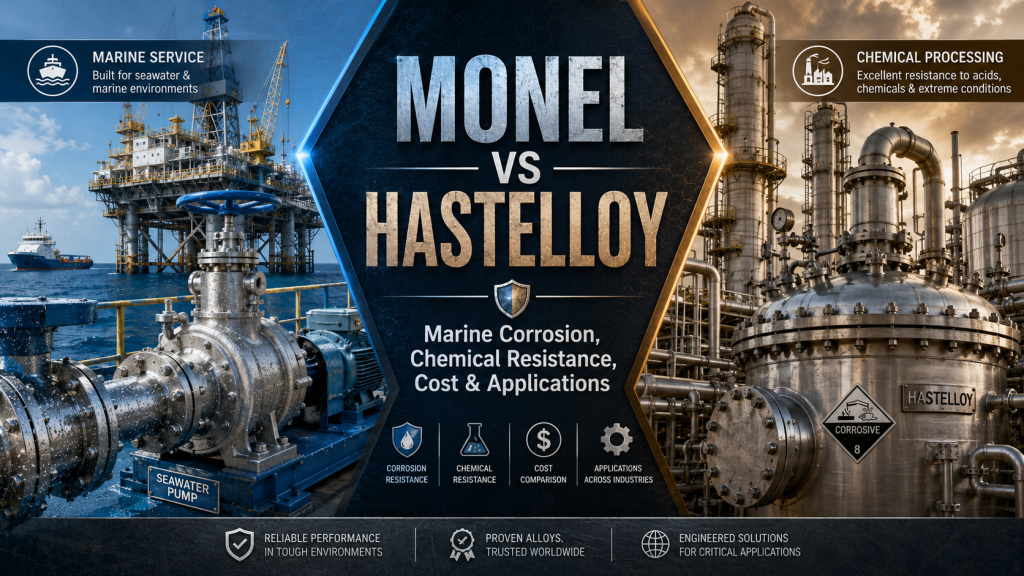
When comparing Monel vs Hastelloy, buyers are usually dealing with severe environments where ordinary stainless steel, carbon steel or standard corrosion-resistant alloys may not provide enough service life. Both Monel and Hastelloy are high-performance nickel alloys, but they are designed for different corrosion problems.
Monel is mainly known for excellent seawater, brine and marine corrosion resistance. Hastelloy is mainly known for outstanding resistance to aggressive chemicals, strong acids, pitting, crevice corrosion and mixed process media.
This guide compares Monel and Hastelloy in chemical composition, seawater resistance, acid corrosion resistance, mechanical performance, temperature capability, machining difficulty, cost and application selection. For related material comparisons, visit Stainless Steel vs Nickel Alloy, Monel vs Inconel, Hastelloy vs Inconel and Monel vs Stainless Steel.
Fast Comparison: Monel vs Hastelloy
| Feature | Monel | Hastelloy |
|---|---|---|
| Material Family | Nickel-copper alloy | Nickel-molybdenum-chromium alloy family |
| Main Strength | Seawater and marine corrosion resistance | Severe chemical and acid corrosion resistance |
| Key Alloying Elements | Nickel and copper | Nickel, molybdenum, chromium, iron and sometimes tungsten |
| Best Environment | Seawater, brine, offshore systems and marine hardware | Acids, mixed chemicals, scrubbers, reactors and process equipment |
| Acid Resistance | Good in selected environments, but not universal | Excellent in many aggressive acid and chemical systems |
| Seawater Resistance | Превосходно | Good to excellent depending on grade and condition |
| Pitting / Crevice Resistance | Strong in marine environments | Excellent in many chloride and chemical environments |
| Machining Difficulty | Difficult | Very difficult |
| Стоимость | Very high | Very high to extremely high |
| Typical Applications | Marine shafts, seawater valves, pumps, offshore hardware, desalination | Chemical reactors, acid pipelines, scrubbers, pharmaceutical systems, pollution control |
1. What Is Monel?
Monel is a nickel-copper alloy family widely used in marine, offshore and seawater-related applications. Its nickel-copper chemistry gives it strong resistance to seawater corrosion, brine exposure and many chloride-rich environments.
Monel is often selected when stainless steel, bronze or ordinary nickel alloys cannot provide enough corrosion resistance in seawater systems. It is especially common in pumps, valves, shafts, fasteners, seawater piping and desalination equipment.
Common Monel Grades
| Monel Grade | Main Feature | Typical Applications |
|---|---|---|
| Monel 400 | Excellent seawater and marine corrosion resistance | Seawater piping, valves, pumps, heat exchanger tubing, marine hardware |
| Monel K-500 | Higher strength with age-hardening capability | Pump shafts, propeller shafts, offshore fasteners, springs and high-strength marine parts |
| Monel R-405 | Improved machinability compared with Monel 400 | Automatic screw machine parts and precision machined components |
Main Characteristics of Monel
- Excellent resistance to seawater and brine
- Strong chloride and marine atmosphere performance
- Good toughness in marine service
- Good resistance to selected alkalis and reducing environments
- Higher cost than stainless steel and many copper alloys
- Difficult machining compared with common stainless steel
- Best used when seawater corrosion failure would be expensive
2. What Is Hastelloy?
Hastelloy is a family of nickel-based alloys designed mainly for severe chemical corrosion resistance. Many Hastelloy grades contain high levels of molybdenum and chromium, which help resist strong acids, pitting, crevice corrosion and mixed chemical media.
Hastelloy is widely used in chemical processing, acid handling, pharmaceutical production, pollution control, scrubbers, reactors, heat exchangers and corrosive process pipelines.
Common Hastelloy Grades
| Hastelloy Grade | Main Feature | Typical Applications |
|---|---|---|
| Hastelloy C-276 | Broad corrosion resistance in many severe chemical environments | Chemical reactors, scrubbers, acid systems, pollution control equipment |
| Hastelloy C-22 | Excellent resistance to oxidizing and reducing media | Pharmaceutical equipment, chemical process vessels, waste treatment systems |
| Hastelloy B-2 | Strong resistance to hydrochloric acid in selected conditions | Hydrochloric acid systems, chemical processing, acid equipment |
| Hastelloy X | Good high-temperature strength and oxidation resistance | Gas turbine parts, furnace components and thermal equipment |
Main Characteristics of Hastelloy
- Outstanding resistance to aggressive chemical corrosion
- Excellent acid resistance in selected grades
- Strong resistance to pitting and crevice corrosion
- Good performance in mixed chemical media
- Often selected when stainless steel and Monel are not enough
- Very high material and fabrication cost
- Requires careful machining, welding and inspection control
3. Chemical Composition Comparison
The major difference between Monel and Hastelloy comes from alloy design. Monel relies on nickel-copper chemistry for marine durability. Hastelloy relies on nickel-molybdenum-chromium chemistry for chemical corrosion resistance.
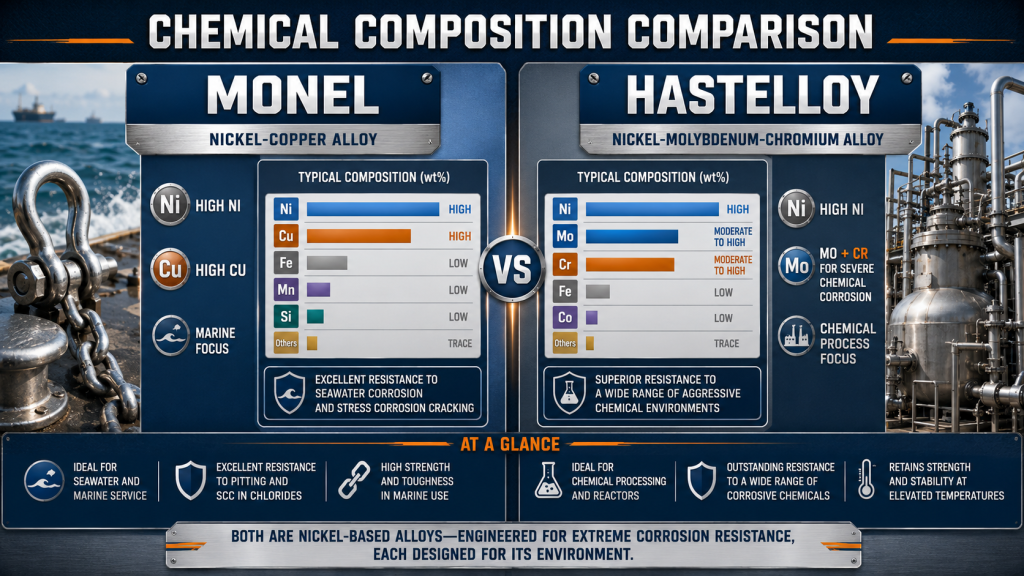
| Element / Feature | Monel | Hastelloy |
|---|---|---|
| Base Alloy System | Nickel-copper | Nickel-molybdenum-chromium |
| Nickel | Very high | Very high |
| Copper | High | Usually low |
| Molybdenum | Usually low or not primary | High in many corrosion-resistant grades |
| Chromium | Low or not the primary design element | Moderate to high depending on grade |
| Iron | Grade-dependent and usually limited | Grade-dependent |
| Primary Design Purpose | Marine and seawater corrosion resistance | Acid and chemical process corrosion resistance |
Why Composition Matters
Nickel-copper chemistry gives Monel excellent durability in seawater and marine environments. Nickel-molybdenum-chromium chemistry gives Hastelloy stronger resistance to acids, oxidizing chemicals, reducing chemicals, pitting and crevice corrosion.
4. Corrosion Resistance Comparison
Corrosion resistance is the most important reason buyers compare Monel and Hastelloy. Both are corrosion-resistant nickel alloys, but their best environments are different.
Monel performs extremely well in seawater, salt spray, brine and marine atmosphere. Hastelloy performs better in many aggressive chemical systems, especially where strong acids, mixed chemicals, chlorides, pitting or crevice corrosion are serious risks.
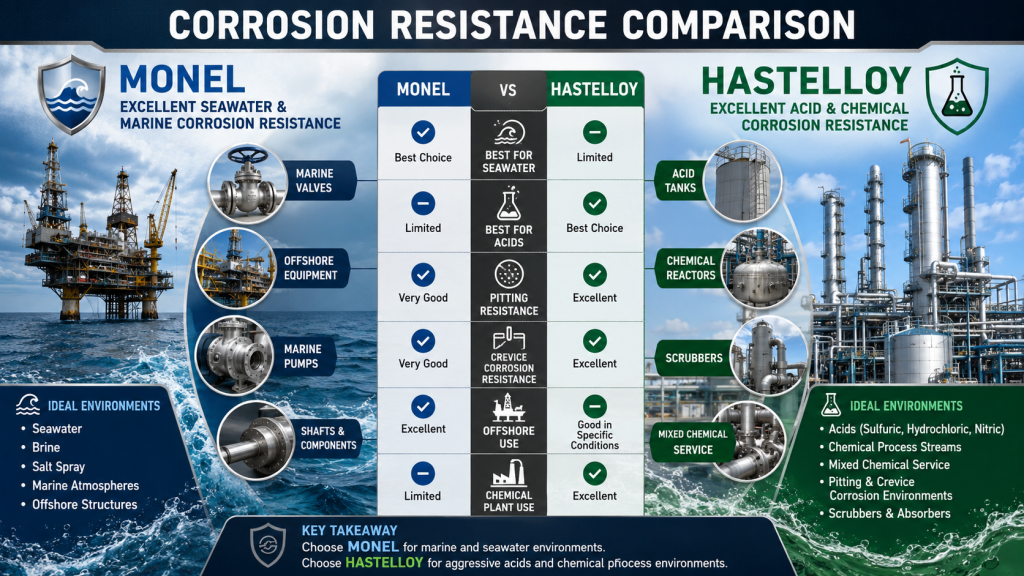
| Environment | Better Choice | Reason |
|---|---|---|
| Seawater immersion | Monel | Excellent long-term marine corrosion resistance |
| Salt spray and marine atmosphere | Monel | Strong chloride and marine durability |
| Brine systems | Monel | Good performance in many saltwater and brine conditions |
| Hydrochloric acid systems | Hastelloy | Selected Hastelloy grades are designed for acid resistance |
| Sulfuric acid service | Hastelloy | Better chemical corrosion resistance in suitable grades |
| Wet chlorine or mixed chemicals | Hastelloy | Stronger resistance to aggressive process media |
| Scrubber systems | Hastelloy | Excellent resistance to acidic and chloride-containing environments |
| Marine pumps and valves | Monel | Optimized for seawater and offshore service |
| Chemical reactors | Hastelloy | Better resistance to acid, mixed chemicals and localized corrosion |
5. Seawater and Marine Performance
Monel is often preferred for long-term seawater exposure because it is widely recognized for marine corrosion resistance. It is commonly used in offshore oil and gas systems, naval equipment, desalination plants, seawater pumps and marine shafts.
Hastelloy can also resist many chloride-containing environments, but it is usually not the first choice when the main challenge is seawater alone. In many marine applications, Monel provides a more practical balance of corrosion resistance, toughness and lifecycle value.
| Marine Application | Recommended Material | Reason |
|---|---|---|
| Seawater piping | Monel | Excellent marine corrosion resistance |
| Marine valves | Monel | Strong resistance to seawater and brine |
| Offshore fasteners | Monel K-500 | Higher strength and good marine durability |
| Desalination equipment | Monel or higher corrosion alloy depending on design | Final choice depends on chloride, temperature and pressure |
| Seawater heat exchangers | Monel or selected nickel alloy | Material depends on flow condition, temperature and fouling risk |
| Marine shafts | Monel K-500 | High strength and corrosion resistance in marine service |
6. Chemical and Acid Resistance
Chemical resistance is where Hastelloy usually has the strongest advantage. Hastelloy C-276, C-22 and B-2 are widely used in chemical processing because they can resist many aggressive media that may attack stainless steel, Monel or other common alloys.
Monel can perform well in selected reducing environments and alkalis, but it is not a universal solution for strong acids or mixed chemical systems. When the environment includes hydrochloric acid, sulfuric acid, wet chlorine, oxidizing acids or mixed chemical media, Hastelloy is often evaluated first.
| Chemical Environment | Monel | Hastelloy |
|---|---|---|
| Hydrochloric acid | Limited to selected conditions | Excellent in suitable grades such as Hastelloy B-2 or C-family grades depending on condition |
| Sulfuric acid | Condition-dependent | Good to excellent depending on grade, concentration and temperature |
| Oxidizing acids | Limited | Excellent in selected C-family grades |
| Mixed acid systems | Limited | Often preferred |
| Alkalis | Good in many conditions | Good depending on grade and environment |
| Wet chlorine gas | Usually not preferred | Selected Hastelloy grades may be suitable |
| Pitting and crevice corrosion | Strong in marine service | Excellent in many chemical and chloride environments |
7. Strength and Mechanical Performance
Both Monel and Hastelloy offer good mechanical performance, but their strength profiles depend on specific grade. Monel 400 provides good toughness and marine reliability. Monel K-500 offers higher strength through age hardening. Hastelloy C-276 and C-22 offer strong corrosion reliability and good mechanical stability in chemical systems.
| Mechanical Factor | Monel | Hastelloy |
|---|---|---|
| Room-Temperature Strength | Good | Good to high depending on grade |
| High-Strength Options | Monel K-500 | Grade-dependent |
| Toughness | Excellent in marine environments | Excellent in many chemical environments |
| Fatigue Resistance | Good in marine parts and shafts | Good depending on grade and environment |
| Best Mechanical Use | Marine shafts, pumps, valves and fasteners | Chemical reactors, scrubbers, pressure components and corrosion-critical parts |
8. Temperature Performance
Neither Monel nor Hastelloy should automatically be treated as the best high-temperature alloy for every situation. In extreme aerospace heat or turbine service, Inconel may be more appropriate. However, Hastelloy often performs better than Monel in elevated-temperature chemical environments.
| Temperature Factor | Monel | Hastelloy |
|---|---|---|
| Moderate Temperature Service | Good | Good |
| Hot Seawater / Brine | Strong in many marine conditions | Condition-dependent |
| Hot Chemical Process Media | Limited depending on media | Often better in suitable grades |
| Oxidation Resistance | Moderate | Good depending on grade |
| Extreme High-Temperature Systems | Consider Inconel or heat-resistant alloy | Consider Hastelloy X, Inconel or other heat-resistant alloys depending on condition |
For high-temperature nickel alloy comparisons, review Hastelloy vs Inconel and Monel vs Inconel.
9. Machining, Welding and Fabrication
Both Monel and Hastelloy are more difficult to machine than common stainless steel. They can work harden, generate heat during cutting and cause rapid tool wear. Hastelloy is often more difficult to process because of its high alloy content and strong corrosion-resistant matrix.
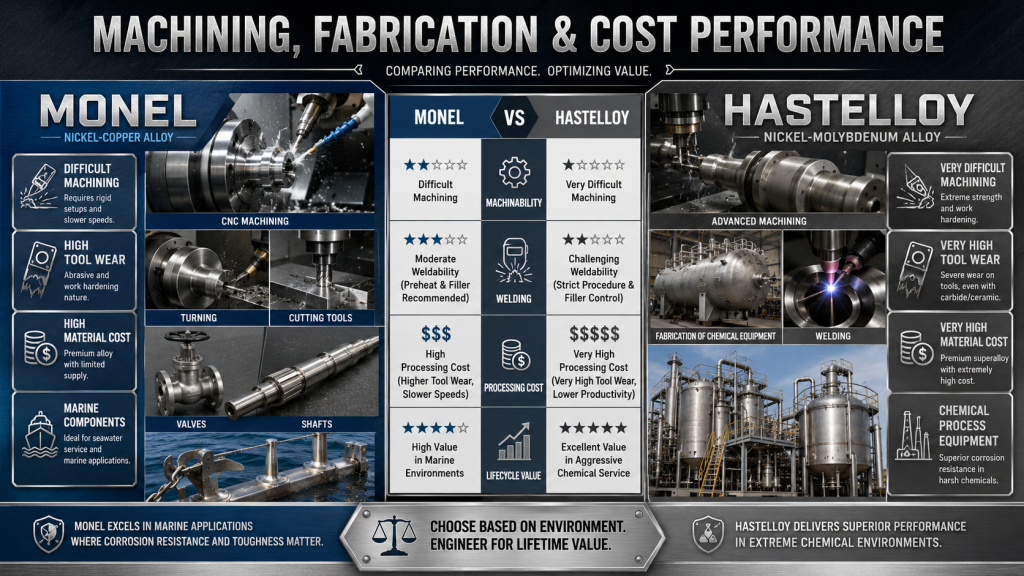
| Processing Factor | Monel | Hastelloy |
|---|---|---|
| Machinability | Difficult | Very difficult |
| Work Hardening | Moderate to strong | Strong |
| Tool Wear | High | Very high |
| Welding | Possible with suitable filler and procedure | Possible but strict control is required |
| Surface Preparation | Important for marine service | Critical for chemical corrosion service |
| Fabrication Cost | High | Very high |
For stainless steel and high-alloy material processing support, Jude Steel provides services such as laser cutting, bending, brushing and polishing.
10. Cost and Lifecycle Value
Both Monel and Hastelloy are premium nickel alloys, and both are far more expensive than common stainless steel. However, Hastelloy is often more expensive because many grades contain high molybdenum and are designed for advanced chemical corrosion resistance.
The correct cost comparison should not only consider purchase price. In severe seawater systems, Monel may deliver better lifecycle value by preventing marine corrosion failure. In aggressive chemical plants, Hastelloy may deliver better lifecycle value by preventing acid attack, pitting, leakage and unplanned shutdowns.
| Cost Factor | Monel | Hastelloy |
|---|---|---|
| Raw Material Cost | Very high | Very high to extremely high |
| Processing Cost | High | Very high |
| Availability | Moderate and grade-dependent | Moderate and grade-dependent |
| Best Value Scenario | Seawater, marine and offshore service | Acid, chemical process and severe corrosion service |
| Lifecycle Value | Best when marine corrosion failure is costly | Best when chemical corrosion failure is costly |
11. Application Comparison
| Application | Better Choice | Reason |
|---|---|---|
| Seawater pumps | Monel | Excellent marine corrosion resistance |
| Marine shafts | Monel K-500 | Higher strength and seawater durability |
| Offshore valves | Monel | Strong resistance to seawater and brine exposure |
| Desalination systems | Monel or other high-alloy material | Depends on chloride level, temperature and pressure |
| Chemical reactors | Hastelloy | Superior resistance to aggressive chemical media |
| Acid pipelines | Hastelloy | Better acid corrosion resistance in suitable grades |
| Scrubbers | Hastelloy | Excellent resistance to acidic, chloride-containing environments |
| Pharmaceutical equipment | Hastelloy C-22 or C-276 depending on media | Strong chemical corrosion resistance and clean process reliability |
| General stainless steel replacement | Depends on failure mode | Monel for marine corrosion, Hastelloy for chemical corrosion |
12. Monel vs Hastelloy: Selection Guide
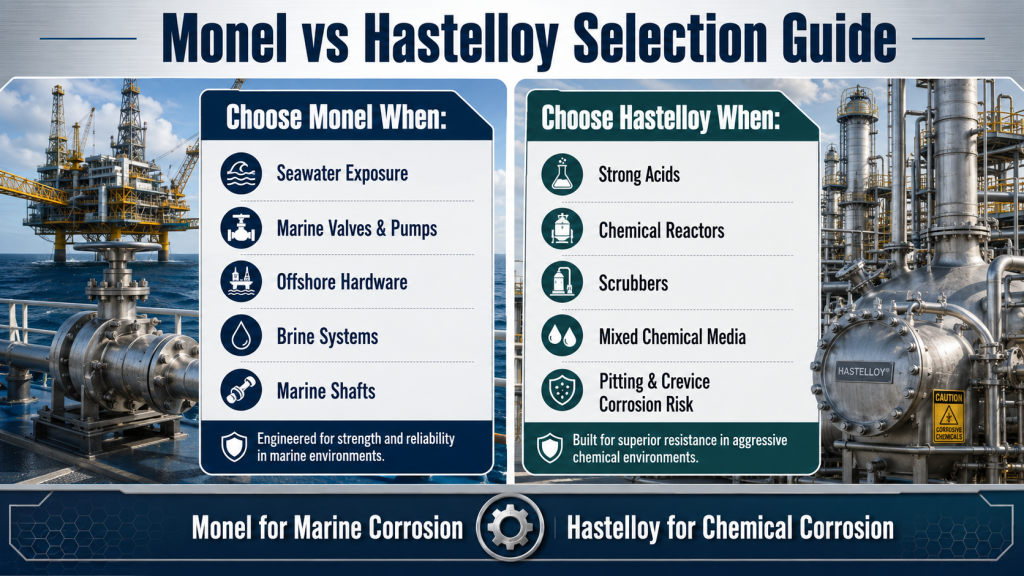
Choose Monel If:
- The application involves seawater exposure
- Marine corrosion is the main concern
- Brine or saltwater service is continuous
- Offshore durability is critical
- The component is a marine valve, pump, shaft or fastener
- Chloride-rich marine conditions are more important than acid resistance
- Monel K-500 strength is required for marine mechanical parts
Choose Hastelloy If:
- Acid corrosion is severe
- Chemical processing is aggressive
- The system involves mixed chemical media
- Pitting and crevice corrosion are critical risks
- The project involves chemical reactors, scrubbers or acid pipelines
- Stainless steel, Monel or standard nickel alloy is not reliable enough
- Shutdown, leakage or chemical failure would be very expensive
Consider Other Alloys If:
- Inconel is needed for extreme heat and oxidation resistance
- 316L stainless steel is sufficient for moderate corrosion conditions
- Duplex or super duplex stainless steel can provide strength and chloride resistance at lower cost
- Titanium is more suitable for lightweight seawater applications
- 904L or 254SMO can meet corrosion requirements at lower cost than nickel alloys
13. Common Buyer Mistakes to Avoid
- Choosing Monel for severe acid service where Hastelloy is required
- Choosing Hastelloy for basic seawater service when Monel is more practical
- Comparing only purchase price and ignoring failure risk
- Assuming all nickel alloys perform the same way
- Ignoring temperature, chemical concentration and chloride level
- Ignoring pitting, crevice design and stagnant zones
- Underestimating machining and welding cost
- Not confirming grade, specification, test certificate and service environment
- Using stainless steel when the application already requires nickel alloy performance
Frequently Asked Questions
What is the main difference between Monel and Hastelloy?
Monel is a nickel-copper alloy mainly optimized for seawater, brine and marine corrosion resistance. Hastelloy is a nickel-molybdenum-chromium alloy family mainly optimized for aggressive chemical corrosion, acids, pitting and crevice corrosion.
Is Monel better than Hastelloy?
Not universally. Monel is generally better for seawater and marine applications. Hastelloy is generally better for aggressive chemical processing, acid systems, scrubbers and mixed corrosive media.
Which alloy is better for seawater?
Monel is often preferred for long-term seawater exposure because it offers excellent marine corrosion resistance and is widely used in seawater pumps, valves, shafts and offshore hardware.
Which alloy is better for chemical plants?
Hastelloy is usually better for chemical plants where strong acids, wet chlorine, mixed chemicals, pitting or crevice corrosion are major risks.
Is Hastelloy more expensive than Monel?
Both alloys are expensive, but Hastelloy is often more expensive because of high molybdenum content, advanced corrosion resistance and more difficult processing requirements.
Can Monel replace Hastelloy?
Usually not in highly aggressive acid systems. Monel is marine-focused, while Hastelloy is designed for severe chemical corrosion. Replacement should only be considered after evaluating the actual media, temperature and concentration.
Which alloy is easier to machine?
Both are difficult to machine compared with stainless steel. Monel is often slightly easier than Hastelloy, but both require rigid tooling, controlled cutting parameters and experienced fabrication.
Заключение
Monel and Hastelloy are both premium nickel alloys, but they solve different corrosion problems. Monel is the better choice when the main challenge is seawater, brine, marine atmosphere or offshore corrosion. It is widely used in seawater pumps, valves, marine shafts, fasteners and desalination systems.
Hastelloy is the better choice when the main challenge is severe chemical corrosion, acid exposure, mixed process media, pitting or crevice corrosion. It is widely used in chemical reactors, scrubbers, acid pipelines, pharmaceutical equipment and pollution control systems.
Choose Monel for marine corrosion. Choose Hastelloy for chemical corrosion. Jude Steel provides stainless steel, nickel alloy comparison resources and processing support for global industrial buyers. Explore more at Judesteel.com, or read related guides such as Stainless Steel vs Nickel Alloy, Monel vs Inconel and Hastelloy vs Inconel.
