
Hastelloy vs Inconel: Corrosion Resistance, Heat Performance, Strength & Cost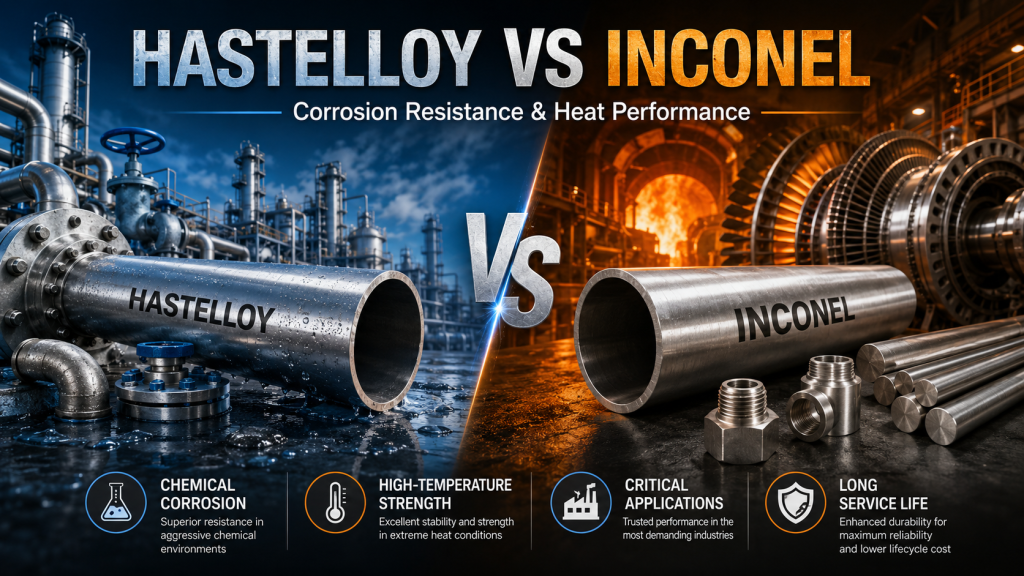
When comparing Hastelloy vs Inconel, buyers are usually evaluating materials for severe service conditions where ordinary stainless steel may not provide enough corrosion resistance, heat strength or long-term reliability. Both materials are high-performance nickel alloys, but they are engineered for different priorities.
Hastelloy is best known for outstanding resistance to aggressive chemical corrosion, including acids, chlorides, pitting and crevice corrosion. Inconel is best known for high-temperature strength, oxidation resistance, creep resistance and thermal stability in demanding heat environments.
This guide compares Hastelloy and Inconel in chemical composition, corrosion resistance, high-temperature performance, oxidation resistance, strength, fabrication, cost and application selection. For related materials, visit Inconel 625, Inconel 718 and the Jude Steel Stainless Steel Grade Center.
Fast Comparison: Hastelloy vs Inconel
| Feature | Hastelloy | Inconel |
|---|---|---|
| Material Family | Nickel-molybdenum-chromium alloy family | Nickel-chromium superalloy family |
| Main Strength | Severe chemical corrosion resistance | High-temperature strength and oxidation resistance |
| Key Alloying Elements | Nickel, molybdenum, chromium, iron, tungsten depending on grade | Nickel, chromium, iron, molybdenum, niobium or other strengthening elements |
| Best Corrosion Environment | Acids, chlorides, pitting, crevice corrosion and chemical processing | Hot corrosive environments, oxidation, seawater and selected chemicals |
| Best Heat Environment | Moderate to high temperature depending on grade | Excellent high-temperature strength and oxidation resistance |
| Oxidation Resistance | Good in selected grades | Excellent in many grades |
| Machining Difficulty | Difficult | Very difficult |
| Стоимость | Very high | High to very high |
| Typical Applications | Chemical reactors, acid processing, scrubbers, pollution control, severe corrosion systems | Aerospace engines, gas turbines, furnaces, heat exchangers, high-temperature reactors |
1. What Is Hastelloy?
Hastelloy is a group of high-performance nickel alloys designed mainly for severe corrosion environments. Many Hastelloy grades contain high levels of molybdenum and chromium, helping them resist strong acids, chloride attack, pitting, crevice corrosion and reducing or oxidizing chemical media.
Hastelloy is widely used in chemical processing, pollution control, acid production, flue gas desulfurization, pharmaceutical equipment and severe industrial corrosion systems. It is often selected when stainless steel, duplex stainless steel or standard nickel alloys cannot provide sufficient corrosion resistance.
Common Hastelloy Grades
| Hastelloy Grade | Main Feature | Typical Applications |
|---|---|---|
| Hastelloy C-276 | Excellent resistance to many acids, chlorides, pitting and crevice corrosion | Chemical processing, scrubbers, reactors, acid equipment |
| Hastelloy C-22 | Strong resistance to oxidizing and reducing environments | Pharmaceutical equipment, chemical plants, waste treatment systems |
| Hastelloy B-2 | Excellent resistance to hydrochloric acid in selected conditions | Acid processing equipment and chemical reactors |
| Hastelloy X | Good high-temperature strength and oxidation resistance | Gas turbine combustors, furnace parts and thermal equipment |
Main Characteristics of Hastelloy
- Excellent resistance to severe chemical corrosion
- Strong performance in acid and chloride-containing environments
- Good resistance to pitting and crevice corrosion
- Often used when stainless steel fails in aggressive media
- Suitable for reactors, scrubbers, heat exchangers and chemical vessels
- High material cost
- Difficult machining and fabrication requirements
2. What Is Inconel?
Inconel is a family of nickel-chromium superalloys designed for high-temperature strength, oxidation resistance, thermal stability and corrosion resistance under severe service conditions. Many Inconel grades are used where materials must resist heat, pressure, oxidation, creep and fatigue at the same time.
Inconel is widely used in aerospace engines, gas turbines, heat treatment equipment, chemical processing, offshore systems, furnace hardware and high-temperature industrial components.
Common Inconel Grades
| Inconel Grade | Main Feature | Typical Applications |
|---|---|---|
| Inconel 600 | Good oxidation and corrosion resistance | Furnace parts, heat treatment equipment, chemical systems |
| Inconel 625 | Strong corrosion resistance with nickel-chromium-molybdenum design | Offshore systems, marine components, heat exchangers, chemical processing |
| Inconel 718 | High strength, fatigue resistance and creep resistance | Aerospace engines, turbines, fasteners and high-pressure components |
| Inconel X-750 | High-temperature strength and relaxation resistance | Springs, fasteners, turbine parts and thermal equipment |
Main Characteristics of Inconel
- Excellent high-temperature strength
- Strong oxidation and scaling resistance
- Good corrosion resistance in selected severe environments
- Excellent creep and fatigue resistance in selected grades
- Suitable for aerospace, turbines, furnaces and high-temperature reactors
- High material and processing cost
- Very difficult machining due to work hardening and heat generation
3. Chemical Composition Comparison
The key difference between Hastelloy and Inconel comes from alloy design. Hastelloy is generally optimized for chemical corrosion resistance through nickel, molybdenum and chromium chemistry. Inconel is generally optimized for high-temperature strength and oxidation resistance through nickel-chromium chemistry and strengthening elements.
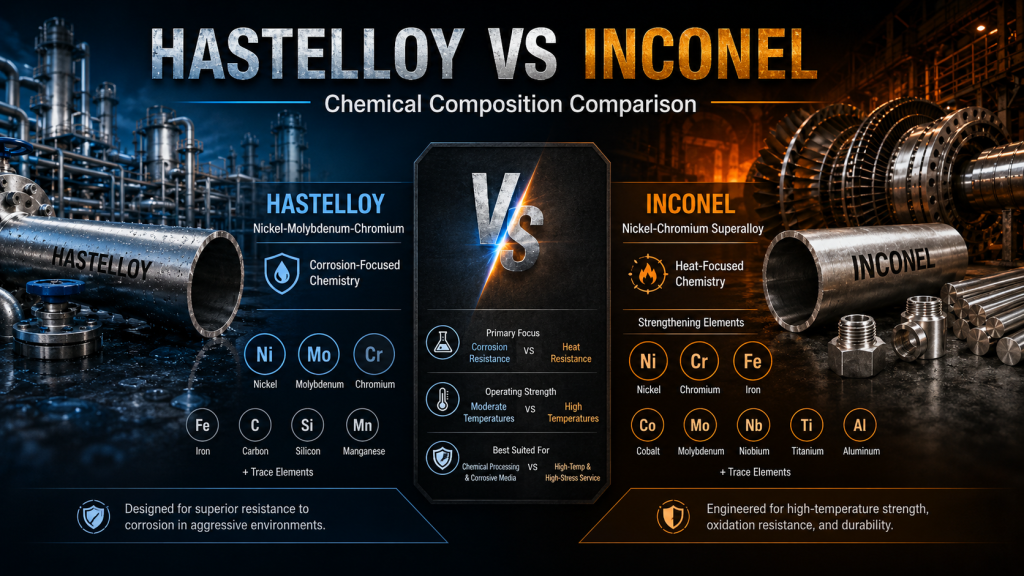
| Element / Feature | Hastelloy | Inconel |
|---|---|---|
| Base Alloy System | Nickel-molybdenum-chromium | Nickel-chromium |
| Nickel | High | High |
| Chromium | Important for oxidizing corrosion resistance | Important for oxidation and corrosion resistance |
| Molybdenum | Usually high in many Hastelloy grades | Present in selected grades such as Inconel 625 |
| Iron | Grade-dependent | Common in many Inconel grades |
| Strengthening Elements | May include tungsten or other elements depending on grade | May include niobium, titanium or aluminum depending on grade |
| Primary Design Goal | Severe chemical corrosion resistance | High-temperature strength and oxidation resistance |
4. Corrosion Resistance Comparison
Corrosion resistance is where Hastelloy often has a clear advantage. Hastelloy grades such as C-276 and C-22 are widely used in aggressive chemical environments involving acids, chlorides, mixed chemicals, scrubber systems and pollution control equipment.
Inconel also provides strong corrosion resistance, especially in grades such as Inconel 625. However, when the environment is mainly chemical corrosion rather than high temperature, Hastelloy is often evaluated first.
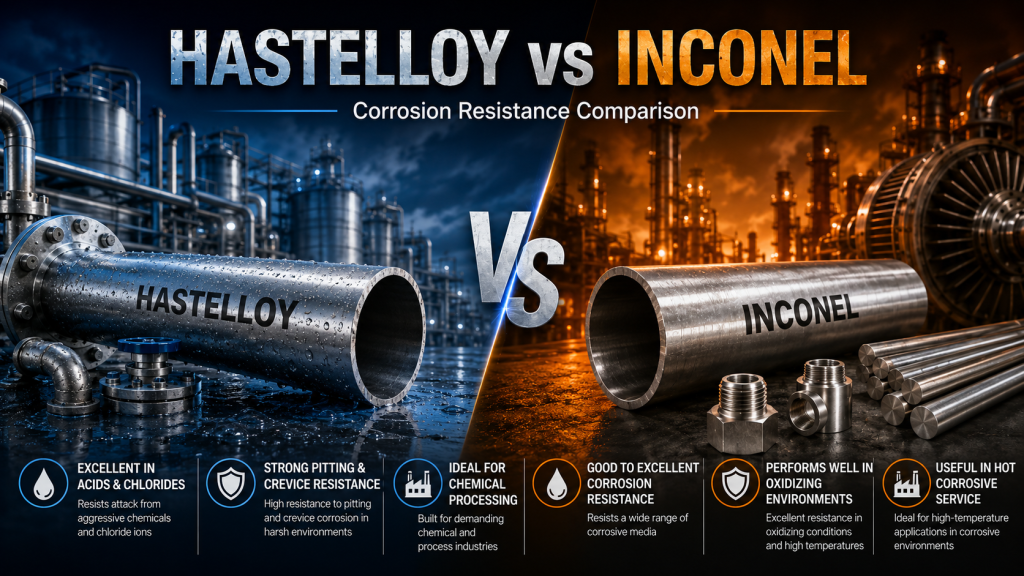
| Environment | Hastelloy | Inconel |
|---|---|---|
| Strong Acid Environments | Excellent in selected grades | Good to excellent depending on grade and temperature |
| Chloride Pitting | Excellent resistance in many C-family grades | Good to excellent in grades such as Inconel 625 |
| Crevice Corrosion | Excellent in severe chemical systems | Grade-dependent |
| Scrubber Systems | Commonly selected | Used when heat or other requirements justify it |
| Seawater | Very good in selected grades | Excellent in selected grades such as Inconel 625 |
| Hot Corrosive Gas | Grade-dependent | Often stronger due to oxidation resistance |
| Mixed Chemical Media | Excellent in many severe conditions | Depends strongly on chemistry and temperature |
5. Heat Performance and Oxidation Resistance
Heat performance is where Inconel often has a clear advantage. Many Inconel grades are specifically designed to maintain strength at elevated temperatures while resisting oxidation, scaling, thermal fatigue and creep.
Hastelloy can perform well at elevated temperatures depending on grade, but its strongest advantage is usually chemical corrosion resistance. For extreme heat, furnace components, turbine systems and aerospace engines, Inconel is often the preferred choice.
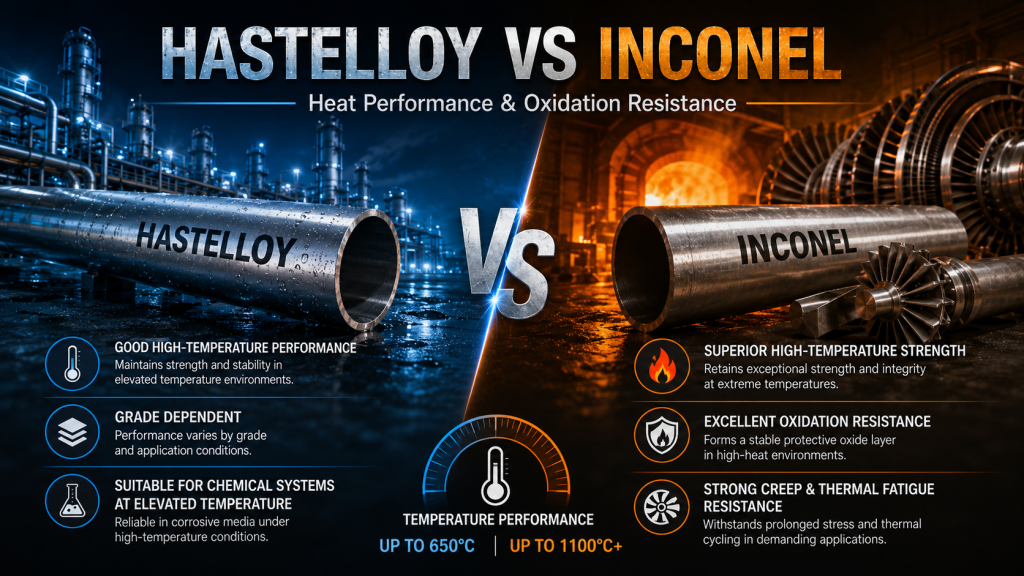
| High-Temperature Factor | Hastelloy | Inconel |
|---|---|---|
| High-Temperature Strength | Good in selected grades | Excellent in many grades |
| Oxidation Resistance | Good to excellent depending on grade | Excellent in nickel-chromium grades |
| Creep Resistance | Grade-dependent | Excellent in grades such as Inconel 718 |
| Thermal Fatigue | Good in selected applications | Excellent in severe thermal cycling |
| Best Heat Use | Chemical systems with elevated temperature | Turbines, engines, furnaces, reactors and exhaust systems |
Engineering Insight
- Choose Hastelloy when chemical attack is the primary risk.
- Choose Inconel when high temperature and oxidation are the primary risks.
- Choose Inconel when high heat, mechanical stress and fatigue occur together.
- Choose Hastelloy when acids, chlorides and pitting risk dominate the application.
6. Strength and Mechanical Performance
Both Hastelloy and Inconel offer strong mechanical performance, but their best-use environments differ. Hastelloy is valued for mechanical reliability under severe chemical corrosion. Inconel is valued for strength retention under heat, stress and thermal fatigue.
| Mechanical Factor | Hastelloy | Inconel |
|---|---|---|
| Room-Temperature Strength | Good to high depending on grade | Good to very high depending on grade |
| High-Temperature Strength | Grade-dependent | Excellent in selected grades |
| Fatigue Resistance | Good in suitable environments | Excellent in aerospace and thermal applications |
| Creep Resistance | Limited to selected grades | Excellent in high-temperature grades |
| Best Mechanical Use | Chemical reactors, scrubbers, pressure vessels and severe corrosion systems | Turbines, engines, springs, fasteners and high-temperature components |
7. Machining, Welding and Fabrication
Both Hastelloy and Inconel are difficult to machine compared with ordinary stainless steel. They work harden quickly, generate heat during machining and cause significant tool wear. Proper tooling, rigid machine setup, coolant control and experienced operators are important.
Inconel is often more challenging to machine because of its high-temperature strength and work-hardening behavior. Hastelloy also requires careful processing, especially when used for corrosion-critical chemical equipment where surface quality and weld integrity matter.
| Processing Factor | Hastelloy | Inconel |
|---|---|---|
| Machinability | Difficult | Very difficult |
| Work Hardening | Strong | Strong to severe |
| Tool Wear | High | Very high |
| Welding | Possible with suitable procedure and filler metal | Possible but strict control is required |
| Surface Preparation | Important for corrosion-critical service | Important for heat and fatigue-critical service |
| Fabrication Cost | High | Very high |
For stainless steel and high-alloy material processing support, Jude Steel provides services such as laser cutting, bending, brushing and polishing.
8. Cost Comparison
Hastelloy and Inconel are both premium nickel alloys. Their cost is much higher than common stainless steel because of high nickel content, expensive alloying elements, controlled manufacturing, limited availability and difficult machining.
The more economical choice depends on the failure risk. Hastelloy may be more cost-effective when chemical corrosion failure would cause shutdown, leakage or environmental risk. Inconel may be more cost-effective when high-temperature failure would cause safety risk, turbine damage or production downtime.
| Cost Factor | Hastelloy | Inconel |
|---|---|---|
| Raw Material Cost | Very high | High to very high |
| Machining Cost | High | Very high |
| Welding Cost | High due to corrosion-critical requirements | High due to heat and stress-critical requirements |
| Availability | Grade-dependent and often limited | Grade-dependent and often limited |
| Best Cost Scenario | Severe chemical corrosion service | High-temperature and high-stress service |
| Lifecycle Value | Excellent when chemical corrosion failure is costly | Excellent when heat, oxidation and fatigue failure are costly |
9. Application Comparison
| Application | Better Choice | Reason |
|---|---|---|
| Chemical reactors | Hastelloy | Excellent resistance to aggressive chemical media |
| Acid processing equipment | Hastelloy | Strong resistance to acid attack in suitable grades |
| Scrubber systems | Hastelloy | Good resistance to chlorides, acids and mixed corrosion |
| Gas turbine components | Inconel | High-temperature strength and oxidation resistance |
| Aerospace engines | Inconel | Excellent strength retention under extreme heat and stress |
| Furnace hardware | Inconel | Strong oxidation and scaling resistance |
| Seawater heat exchangers | Inconel 625 or Hastelloy depending on chemistry | Final selection depends on temperature, chloride level and pressure |
| Pollution control systems | Hastelloy | Resists aggressive acid and chloride-containing gases or liquids |
| High-temperature chemical reactors | Hastelloy or Inconel | Final choice depends on whether corrosion or heat strength is the main risk |
10. Hastelloy vs Inconel: Selection Guide
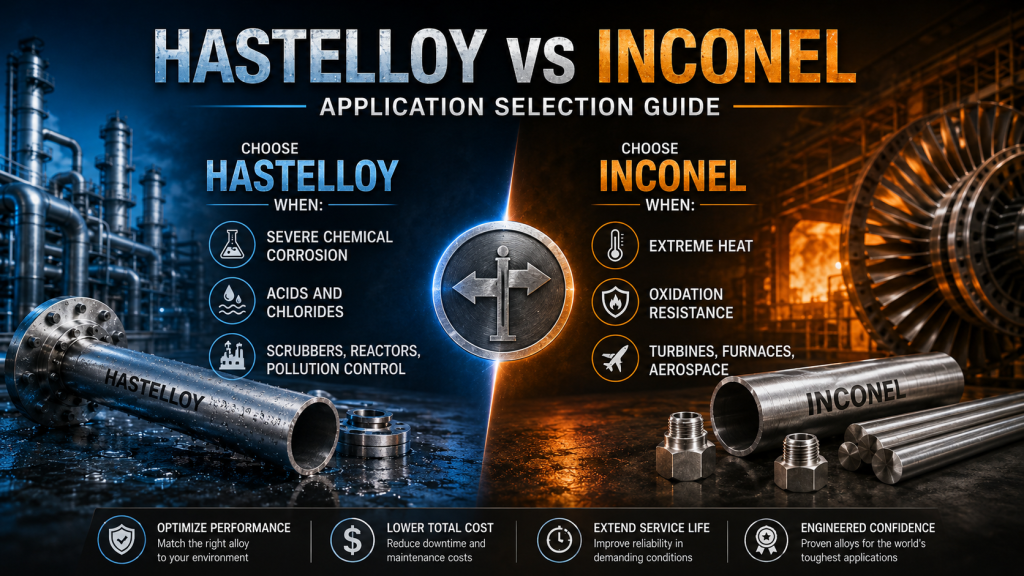
Choose Hastelloy If:
- Strong acids are present
- Chloride pitting and crevice corrosion are critical risks
- The application involves chemical processing or pollution control
- Stainless steel or duplex stainless steel cannot survive the environment
- Corrosion failure would cause leakage, shutdown or environmental risk
- Scrubbers, reactors, acid tanks or chemical vessels are involved
- Temperature is not the main design challenge
Choose Inconel If:
- High temperature is the main operating condition
- Oxidation resistance is critical
- Creep, fatigue and strength retention are required
- The component is used in turbines, engines, furnaces or reactors
- Thermal cycling and mechanical stress occur together
- Failure risk is high and reliability is essential
- High material and machining cost can be justified by performance
Consider Stainless Steel or Other Alloys If:
- 316L is sufficient for moderate corrosion conditions
- 904L or 254SMO can meet the corrosion requirement at lower cost
- Duplex 2205 or super duplex 2507 can provide strength and chloride resistance
- Titanium is better for lightweight seawater service
- Monel is more suitable for seawater and marine corrosion at moderate temperature
- The project does not require extreme corrosion or heat performance
11. Common Buyer Mistakes to Avoid
- Choosing Inconel for severe acid service when Hastelloy may be better
- Choosing Hastelloy for extreme heat where Inconel is required
- Comparing only corrosion resistance and ignoring temperature
- Ignoring pitting, crevice corrosion and chloride concentration
- Ignoring oxidation, creep and fatigue at high temperature
- Comparing only raw material price and ignoring machining cost
- Assuming all nickel alloys perform the same way
- Not confirming welding procedure and post-fabrication inspection
- Using stainless steel when the environment clearly requires a nickel alloy
Correct material selection should consider chemical environment, temperature, mechanical stress, pressure, flow velocity, fabrication method, inspection standard, failure risk and total lifecycle cost.
Frequently Asked Questions
What is the main difference between Hastelloy and Inconel?
Hastelloy is mainly designed for severe chemical corrosion resistance, especially acids, chlorides, pitting and crevice corrosion. Inconel is mainly designed for high-temperature strength, oxidation resistance and thermal stability.
Is Hastelloy better than Inconel for corrosion resistance?
Hastelloy is generally better for aggressive chemical corrosion, especially acid and chloride-containing environments. Inconel also resists corrosion, but its main advantage is high-temperature strength and oxidation resistance.
Is Inconel better than Hastelloy for high temperature?
Yes, in many high-temperature applications Inconel is preferred because it maintains strength and resists oxidation, creep and thermal fatigue better than most Hastelloy grades.
Which alloy is better for chemical processing?
Hastelloy is often preferred for chemical processing, especially when acids, chlorides, mixed chemicals, scrubbers or pollution control systems are involved. Inconel may be selected when heat and corrosion occur together.
Which alloy is better for aerospace applications?
Inconel is usually better for aerospace applications because many Inconel grades are designed for high-temperature strength, fatigue resistance, oxidation resistance and reliability in engine environments.
Which is more expensive, Hastelloy or Inconel?
Both alloys are expensive. The final cost depends on grade, size, product form, availability and machining difficulty. Hastelloy can be very costly in severe chemical grades, while Inconel can be very costly in aerospace and high-temperature grades.
Can stainless steel replace Hastelloy or Inconel?
Stainless steel can replace Hastelloy or Inconel only in moderate environments. When strong acids, chlorides, extreme temperature, oxidation, creep or failure-critical service is involved, Hastelloy or Inconel may be necessary.
Заключение
Hastelloy and Inconel are both premium nickel alloys, but they are not designed for the same purpose. Hastelloy is usually the better choice for severe chemical corrosion, acids, chlorides, pitting, crevice corrosion, scrubbers and chemical processing equipment.
Inconel is usually the better choice for high-temperature strength, oxidation resistance, creep resistance, fatigue resistance, turbines, aerospace engines, furnaces and thermal processing equipment.
The correct choice depends on the main failure risk. Choose Hastelloy when chemical corrosion is the biggest concern. Choose Inconel when heat, oxidation and mechanical stress are the main concerns. Jude Steel provides stainless steel sheets, coils, strips, processing services and related high-alloy material information for global buyers. Explore more at Judesteel.com, or visit Inconel 625, Inconel 718 and Stainless Steel Grade Center.
