
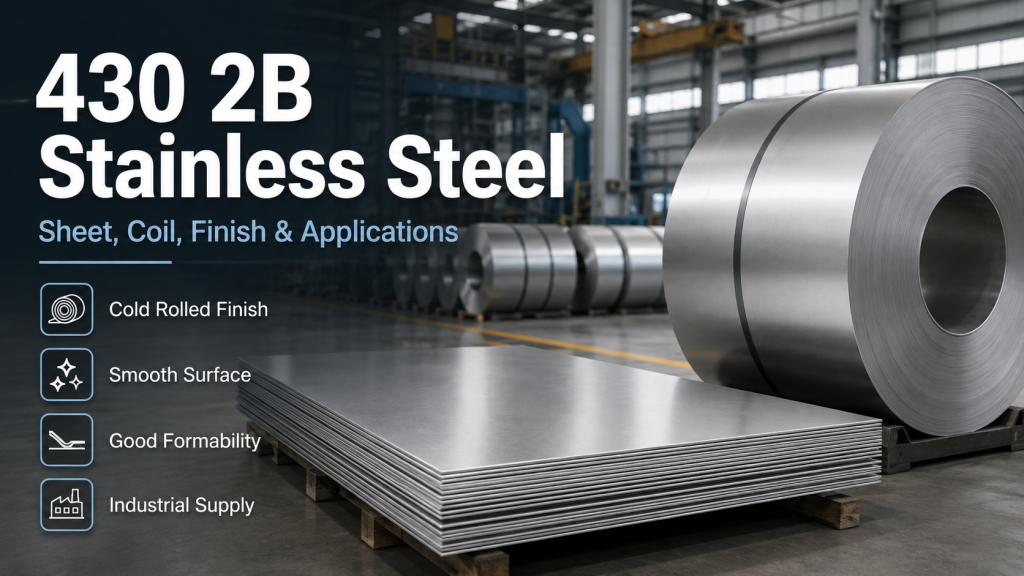
430 2B stainless steel is a cold-rolled ferritic stainless steel product widely used for household appliances, kitchen equipment, metal housings, decorative components, stamped parts and general manufacturing.
The designation combines two different specifications: 430 identifies the stainless steel grade, while 2B describes the cold-rolled surface finish. Buyers therefore need to evaluate the base alloy and the surface condition separately.
For industrial purchasing, specifying only “430 2B” is rarely sufficient. Thickness tolerance, width, flatness, forming requirements, edge condition, protective film, surface acceptance and material traceability can be equally important to the success of the finished component.
Quick Answer: What Is 430 2B Stainless Steel?
430 2B stainless steel is Type 430 ferritic stainless steel supplied with a general-purpose cold-rolled No. 2B finish.
- Grade: Type 430 / UNS S43000
- Common EN reference: 1.4016 / X6Cr17
- Common JIS reference: SUS430
- Microstructure: Ferritic
- Magnetic: Normally yes
- Heat hardenable: No conventional quench-hardening response
- Surface: Smooth, bright, general-purpose cold-rolled finish
- Main forms: Sheet, coil and strip
430 2B is most appropriate where moderate corrosion resistance, practical formability, a clean industrial surface and controlled material cost are required.
What Is 430 2B Stainless Steel?
Type 430 is a classic chromium ferritic stainless steel. It is commonly identified as ASTM Type 430 or UNS S43000, with EN 1.4016 and JIS SUS430 frequently used as cross-reference designations.
JUDE 430 stainless steel
is supplied for applications requiring a practical combination of corrosion resistance, formability, surface quality and material economy.
The material is ferritic rather than austenitic. This gives 430 several characteristics that distinguish it from 304:
- Normally magnetic behavior
- Lower dependence on nickel alloying
- Lower thermal expansion than conventional austenitic stainless steels
- Moderate corrosion resistance
- Good forming capability for suitable geometries
- No conventional hardening through austenitizing and quenching
430 describes the alloy. 2B describes the surface. A purchase order should identify both independently.
What Does 2B Stainless Steel Finish Mean?
No. 2B is one of the most widely used cold-rolled stainless steel finishes.
A typical manufacturing route is:
1. Cold Rolling
The stainless steel is cold rolled to develop the required thickness and dimensional control.
2. Annealing
The cold-worked structure is annealed to restore the required material condition.
3. Descaling or Pickling
Surface oxides generated during conventional annealing are removed.
4. Light Final Rolling Pass
The annealed and descaled material receives a light pass on polished rolls, producing the characteristic smoother and brighter 2B appearance.
The result is a relatively smooth, bright and uniform industrial finish that can be used directly or as a starting surface for further polishing and fabrication.
It normally has substantially less reflectivity than BA or No.8 mirror-polished stainless steel.
430 2B Standards and Designations
| System | Common Designation | Relevant Flat-Product Standard | Purchasing Note |
|---|---|---|---|
| ASTM / UNS | Type 430 / UNS S43000 | ASTM A240/A240M-26 | ASTM A480/A480M-25b provides applicable general flat-product requirements. |
| EN | 1.4016 / X6Cr17 | EN 10088-2:2024 | 2B is also used as the EN surface designation. |
| JIS | SUS430 | JIS G 4305 for applicable cold-rolled products | Confirm the exact standard edition and ordered condition. |
ASTM Type 430, EN 1.4016 and SUS430 are commonly compared because they occupy a similar ferritic stainless steel category, but buyers should not assume automatic chemical or mechanical equivalence.
A purchase order should identify one governing standard and separately state any additional customer requirements.
430 Stainless Steel Material Characteristics
| Characteristic | Нержавеющая сталь 430 | Purchasing Significance |
|---|---|---|
| Metallurgical family | Ferritic stainless steel | Normally magnetic and not conventionally quench hardenable |
| Chromium level | Approximately 16–18% under common Type 430 specifications | Provides stainless corrosion resistance in suitable environments |
| Nickel | Not intentionally alloyed at the level used in 304; limited residual nickel may be permitted by the specification | Reduces direct dependence on nickel alloy pricing |
| Corrosion resistance | Suitable for many mildly corrosive environments | Chlorides, salt deposits and aggressive chemicals require additional review |
| Formability | Good for suitable cold-forming operations | Severe drawing may require enhanced-formability ferritic grades |
| Магнетизм | Normally strongly magnetic | Magnetic response alone cannot verify the exact grade |
| Hardening | Not conventionally hardened by quenching | Do not specify final martensitic hardness targets |
Published mill chemistry and mechanical-property examples should not be copied directly into a purchase contract as guaranteed values. Use the governing standard and agreed customer specification.
What Should a Good 430 2B Surface Look Like?
A commercially acceptable 430 2B surface should normally appear smooth and reasonably uniform without unacceptable defects for the intended application.
Important surface characteristics include:
- Uniform visual tone
- Controlled brightness
- Absence of unacceptable scratches
- Limited roll marks
- No severe dents or impressions
- No excessive scale or staining
- No unacceptable rust contamination
- Consistent appearance between sheets or coils when required
The term “2B” does not create one universal gloss value.
For appearance-sensitive components, buyers should define:
- Approved physical sample
- Viewing distance
- Lighting condition
- Scratch limits
- Roll-mark limits
- Surface roughness when necessary
- Gloss measurement when necessary
430 2B Sheet, Coil and Strip
430 2B Sheet
430 2B stainless steel sheet
is convenient for cut parts, prototypes, lower-volume manufacturing, covers, panels and individual blanks.
Important specifications include thickness, sheet size, flatness and surface protection.
430 2B Coil
430 2B stainless steel coil
is normally more suitable for continuous blanking, stamping and high-volume production.
Buyers should specify coil weight, ID, maximum OD, camber and permitted coil welds when relevant.
430 2B Strip
430 2B stainless steel strip
is used for narrow components, clips, formed parts and precision manufacturing.
Custom Slit Material
JUDE’s
stainless steel strip processing
can convert parent coil into custom-width strip.
Width tolerance, camber, burr and edge condition should be agreed before slitting.
430 2B vs 430 BA
| Feature | 430 2B | 430 BA |
|---|---|---|
| Basic alloy | Type 430 | Type 430 |
| Finish route | Cold rolled, annealed/descaled and lightly skin passed | Cold rolled and bright annealed in a controlled atmosphere |
| Appearance | Smooth and moderately bright | Brighter and more reflective |
| Typical role | General-purpose finished or further-processing surface | Visible components requiring greater brightness |
| Further polishing | Suitable | Suitable |
| Стоимость | Depends on mill, specification and quantity | May involve a different processing premium depending on producer |
Neither finish is universally better.
Choose 2B when surface consistency, general manufacturing performance and further processing are the priorities. Choose BA when a brighter as-delivered appearance is important.
430 2B vs No.4 Stainless Steel
No.4 is a mechanically polished directional finish, while 2B is a mill-produced cold-rolled finish.
The practical difference is visible:
- 2B has no intentionally applied decorative brushing direction.
- No.4 contains a directional abrasive pattern.
- 2B is commonly used as a starting surface for additional finishing.
- No.4 is often selected when the final product requires a brushed appearance.
For equipment panels, appliance parts or architectural components, the designer should specify whether the visible directional grain of No.4 is required.
430 2B vs 304 2B
Both 430 and 304 are commonly supplied with a 2B finish, but the underlying alloys are very different.
| Comparison | 430 2B | 304 2B |
|---|---|---|
| Stainless family | Ferritic | Austenitic |
| Magnetic response | Normally strong | Normally low in the annealed condition, though cold work can increase magnetic response |
| Nickel alloying | Very limited compared with 304 | Nickel is an important alloying element |
| General formability | Good for suitable shapes | Generally better for severe forming |
| General corrosion margin | Suitable for many mild environments | Generally broader than 430 |
| Chloride exposure | More limited | Better than 430 in many conditions, but still not chloride-proof |
| Thermal expansion | Lower | Higher |
| Common purchasing driver | Functional performance and alloy-cost control | Greater corrosion and forming margin |
For a wider cost and material comparison, see JUDE’s
430 vs 304 vs 201 stainless steel guide
.
Forming and Stamping 430 2B Stainless Steel
430 2B is commonly used for stamping, bending, roll forming and moderate drawing operations.
Successful forming depends on:
- Material thickness
- Blank orientation
- Rolling direction
- Bend radius
- Tooling condition
- Lubrication
- Drawing ratio
- Surface requirements
Rolling Direction
Ferritic stainless steel can show directional forming behavior. For severe bends or visible formed surfaces, blank orientation should be validated through a trial.
Ridging or Roping
Ferritic stainless steels can develop visible ridging or roping during significant deformation.
This may be especially important for:
- Appliance panels
- Deep-drawn components
- Large decorative surfaces
- Highly polished products
When standard 430 reaches its forming limit, enhanced-formability ferritic grades or deep-drawing-quality 430 variants may be evaluated.
Can 430 2B Stainless Steel Be Welded?
430 can be welded, but standard Type 430 is less forgiving than stabilized ferritic stainless steels for demanding welded structures.
Potential concerns include:
- Heat-affected-zone grain growth
- Reduced ductility
- Localized corrosion near the weld
- Weld discoloration
- Surface distortion
For welded components, control:
- Heat input
- Joint design
- Filler selection
- Part thickness
- Post-weld cleaning
- Surface restoration
When welding performance is a major design requirement, stabilized ferritic grades such as
439 stainless steel
may deserve consideration.
430 2B Corrosion Resistance
The corrosion resistance of 430 comes from its chromium-containing ferritic alloy—not from the 2B finish alone.
430 performs well in many:
- Indoor environments
- Household appliances
- Kitchen equipment
- Mild atmospheric environments
- Selected industrial applications
Corrosion risk increases with:
- Chloride deposits
- Road salt
- Coastal exposure
- High humidity combined with contamination
- Acidic or aggressive cleaners
- Crevices
- Carbon-steel contamination
A smooth 2B surface may improve cleanability compared with a rough surface, but it does not give Type 430 the corrosion resistance of 304, 316L or a higher-alloy ferritic stainless steel.
Typical Applications of 430 2B Stainless Steel
| Industry | Typical Components | Why 430 2B May Be Selected |
|---|---|---|
| Household appliances | Internal panels, oven parts, washing-machine parts and appliance housings | Clean surface, magnetic behavior and practical forming |
| Kitchen equipment | Panels, equipment covers, trays and selected utensils | Moderate corrosion resistance and cleanability |
| Metal fabrication | Brackets, covers, enclosures and stamped components | General-purpose cold-rolled surface |
| Automotive | Selected trim, brackets and non-severe-corrosion components | Ferritic properties and controlled alloy cost |
| Decorative manufacturing | Panels and components receiving further polishing | Suitable starting surface for additional finishing |
| Industrial equipment | Guards, covers and selected machine components | Functional surface and dimensional consistency |
Common 430 2B Surface Defects
Appearance-sensitive orders should define acceptable and unacceptable surface conditions before production.
Possible defects include:
- Scratches
- Roll marks
- Dents
- Coil-break marks
- Edge damage
- Rust staining
- Uneven surface tone
- Embedded iron contamination
- Protective-film residue
- Oil or handling marks
Surface Defect Acceptance
For functional industrial products, minor cosmetic variation may not affect service.
For visible components, buyers should agree on:
- Reference sample
- Critical surface side
- Inspection lighting
- Viewing distance
- Defect size and frequency
- Surface roughness if relevant
Does 430 2B Need Protective Film?
Protective film is not automatically required for every 2B order.
It is useful when the sheet or coil will undergo:
- Лазерная резка
- Blanking
- Press forming
- Сгибание
- Long-distance transport
- Appearance-sensitive fabrication
The film specification should identify:
- Adhesion level
- Film thickness
- UV resistance
- Storage period
- Forming compatibility
- Residual adhesive limit
- Peeling requirements
An unsuitable film can leave adhesive residue or become difficult to remove after long-term or high-temperature storage.
How to Inspect 430 2B Stainless Steel
1. Verify the MTC
Confirm grade, product standard, heat number, chemistry and applicable mechanical properties.
2. Match Heat and Coil Numbers
The physical material identification should remain traceable to the supplied documentation.
3. Measure Thickness and Width
Use calibrated measuring equipment and apply the agreed dimensional standard.
4. Check Surface Quality
Inspect both sides when required and pay particular attention to the customer-designated critical surface.
5. Inspect Flatness and Camber
Flatness is particularly important for sheet processing, while camber is important for narrow strip and automated feeding.
6. Inspect Edge Quality
Check burr, edge wave, cracks and width after slitting.
7. Perform Grade Verification When Required
PMI can support alloy identification, but analytical limitations must be understood and test methods selected according to the grade difference being investigated.
JUDE publishes selected
stainless steel inspection reports
for buyers defining documentation and material-verification requirements.
Common 430 2B Purchasing Mistakes
This does not define thickness tolerance, width, flatness, edge, film or surface acceptance.
2B is a general-purpose cold-rolled finish, not No.8 mirror polish.
Mill route, rolls, thickness and processing conditions can affect appearance.
The service environment and forming requirement should be evaluated before comparing material cost.
Blank orientation can influence forming and visible ridging.
Burr can affect stamping, safety, assembly and downstream forming.
Chlorides, iron contamination and poor storage can still cause staining or localized corrosion.
JUDE 430 2B Stainless Steel Supply Options
JUDE’s published flat-product range includes Type 430 and No. 2B surface options for stainless steel sheet, coil and strip.
430 Stainless Steel
— grade information and material specifications.
430 2B Stainless Steel Sheet
— suitable for cut-to-size material and sheet-based fabrication.
430 2B Stainless Steel Coil
— suitable for continuous production and high-volume stamping.
430 2B Stainless Steel Strip
— suitable for narrower components and custom widths.
Stainless Steel Strip Processing
— for slitting, leveling and customized strip requirements.
Exact stock, thickness, width, coil weight, surface requirements and delivery schedule should be confirmed for each quotation.
430 2B Stainless Steel RFQ Checklist
- Exact grade:
Type 430, UNS S43000, EN 1.4016, SUS430 or another specifically required designation. - Governing standard:
ASTM A240/A240M-26, EN 10088-2:2024, JIS G 4305 or another project standard. - Product form:
Sheet, coil, strip or cut blank. - Surface:
2B. - Thickness:
State nominal thickness and tolerance. - Width:
State width and tolerance. - Sheet length:
Specify length when ordering sheet or cut-to-length material. - Coil weight:
Specify minimum and maximum acceptable coil weight. - Coil ID and OD:
Provide line-compatible dimensions. - Flatness:
Define special requirements where standard tolerance is insufficient. - Camber:
Specify maximum value for strip or automated feeding. - Edge:
Mill edge, slit edge, deburred edge or rounded edge. - Surface acceptance:
Define critical side, scratches, roll marks and approved sample where required. - Protective film:
Specify film type, adhesion and residue requirements. - Processing:
Cut-to-length, slitting, blanking, bending or another requirement. - Final application:
Appliance, kitchen equipment, stamped component, automotive part or another use. - Service environment:
Indoor, outdoor, humid, chloride-containing or chemical exposure. - Inspection:
MTC, heat-number traceability, dimensional report, surface inspection or third-party inspection. - Quantity:
Pieces, sheets, coils or total weight. - Delivery:
Destination, Incoterm and required delivery date.
Frequently Asked Questions
What does 430 2B stainless steel mean?
430 identifies the ferritic stainless steel grade, while 2B identifies the general-purpose cold-rolled surface finish.
Is 430 2B stainless steel magnetic?
Yes. Type 430 is ferritic stainless steel and is normally strongly magnetic.
Is 430 2B the same as BA?
No. 2B normally receives annealing, descaling and a light final rolling pass. BA is bright annealed in a controlled atmosphere and is generally brighter and more reflective.
Is 430 2B a mirror finish?
No. It is a smooth general-purpose cold-rolled surface. A mirror finish normally requires additional mechanical polishing.
Can 430 2B stainless steel rust?
Yes. It has useful corrosion resistance in mild environments, but chlorides, salt, trapped moisture and iron contamination can cause staining or localized corrosion.
Can 430 2B be bent and stamped?
Yes. 430 provides practical cold-forming capability for many applications. Severe deep drawing may require material trials or an enhanced-formability ferritic grade.
Is 430 2B better than 304 2B?
Neither is universally better. 430 can provide an attractive cost and performance balance for mild environments, while 304 generally provides a broader corrosion and forming margin.
Can 430 2B be polished to No.4 or mirror finish?
Yes. 2B is commonly used as a starting surface for subsequent mechanical polishing when the starting material quality is suitable.
Should I buy 430 2B sheet or coil?
Sheet is convenient for lower-volume production and individual blanks. Coil is generally more efficient for continuous blanking, stamping and high-volume manufacturing.
What information should I send for a 430 2B quotation?
Provide the exact grade, standard, product form, thickness, width, surface, tolerances, edge, protective film, processing, inspection requirements, quantity and destination.
Заключение
430 2B stainless steel is a practical flat-rolled material for manufacturers that require a smooth cold-rolled surface, ferritic stainless steel properties, good manufacturing capability and controlled alloy cost.
The most important purchasing principle is to separate the alloy from the finish. Type 430 defines the material, while 2B defines its cold-rolled surface condition.
For reliable production, buyers should go beyond the basic description “430 2B” and define thickness tolerance, width, flatness, camber, edge condition, protective film, surface acceptance, processing and inspection requirements.
Request a 430 2B Stainless Steel Quotation
Send JUDE your required grade, standard, thickness, width, sheet or coil format, surface requirements, edge condition, protective film, processing, inspection documents, quantity and destination.
For coil and strip orders, also provide coil weight, inner diameter, maximum outer diameter, camber and slit-edge requirements.
