
What Is Passivation of Stainless Steel? Process, Purpose, and Industrial Benefits
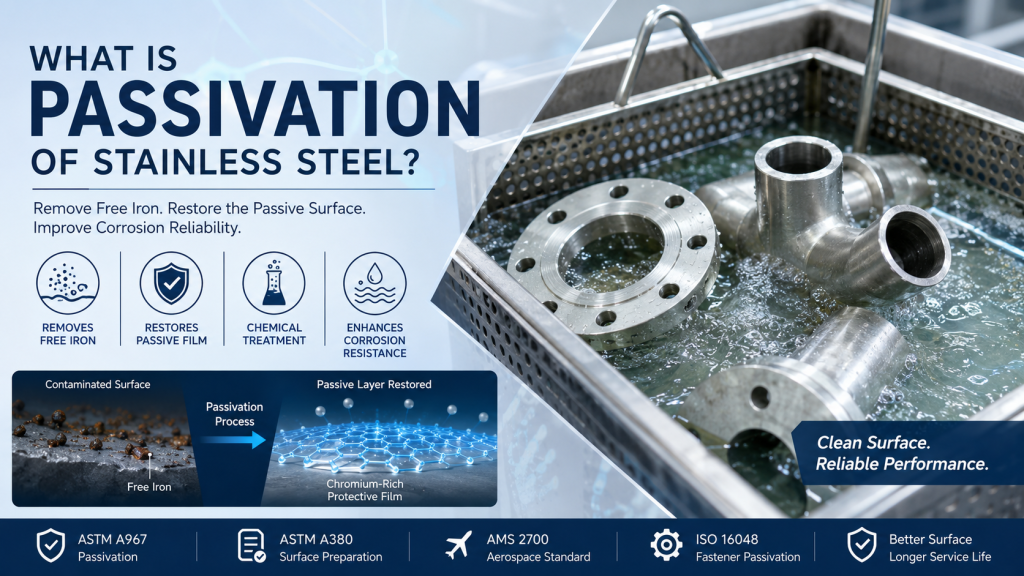 Passivation of stainless steel is a controlled surface-treatment process used to remove free iron, embedded steel particles and other reactive contamination from a stainless steel surface. Once the surface is properly cleaned, the alloy can form or maintain a stable, chromium-rich passive film in an oxygen-containing environment.
A successful passivation specification must define the surface condition before treatment, the governing standard, the treatment method, rinsing, contamination control and the test used to verify acceptance.
Quick Answer: What Is Passivation of Stainless Steel?
Stainless steel passivation is a chemical or qualified electrochemical treatment that removes external iron and less noble surface contamination without intentionally depositing a coating.
The treatment allows a properly cleaned stainless steel surface to develop or maintain its natural protective oxide film. This film is extremely thin and is enriched in chromium compared with the underlying iron-rich alloy.
- Passivation removes free iron and reactive surface contamination.
- It does not normally remove heavy welding scale or thick heat tint.
- It does not add measurable coating thickness when correctly controlled.
- It does not make stainless steel completely immune to corrosion.
- It must be followed by thorough rinsing, drying and verification.
What Does Passivation Mean?
The word passivation is used in more than one way in stainless steel engineering.
It may describe:
- The natural formation of a chemically stable surface film when clean stainless steel is exposed to air or another oxygen-containing environment.
- The chemical removal of external iron, iron compounds and less noble contaminants from a stainless steel surface.
- A controlled oxidizing treatment intended to support the development of a stable passive surface after cleaning.
For purchasing purposes, the word should not be used alone. The purchase order should identify the applicable standard, method, pre-cleaning requirements and acceptance test.
Writing only “passivate after fabrication” leaves important questions unanswered. The supplier still needs to know whether weld scale must be removed, whether nitric or citric treatment is required and how the finished surface will be tested.
How Does the Stainless Steel Passive Film Work?
Stainless steel contains chromium. When a clean stainless surface is exposed to oxygen, chromium at the surface participates in forming an extremely thin protective oxide film.
This film reduces the rate at which the underlying metal reacts with moisture and the surrounding environment. It is the principal reason stainless steel normally resists uniform rusting better than carbon steel.
The passive film is:
- Extremely thin and normally invisible
- Rich in chromium relative to the bulk iron-rich alloy
- Capable of reforming after minor damage when the surface remains clean and oxygen is available
- Vulnerable to chlorides, deposits, crevices, aggressive chemicals and inappropriate cleaning
The passive film is not indestructible. A stainless surface may still suffer pitting, crevice corrosion, intergranular corrosion or stress-corrosion cracking when the alloy or design is unsuitable for the environment.
Why Can Stainless Steel Rust After Fabrication?
Rust spots on fabricated stainless steel do not always mean that the base alloy is counterfeit or incorrectly specified. They may originate from carbon-steel contamination deposited on the surface.
Common contamination sources include:
- Carbon-steel grinding dust
- Shared wire brushes or abrasives
- Steel worktables, chains and lifting equipment
- Machining tools previously used on carbon steel
- Shot blasting with contaminated media
- Handling with rusty fixtures
- Rail dust and storage contamination
- Iron-bearing process water
- Welding spatter and heat-affected contamination
When external iron particles are exposed to moisture, they may corrode and produce visible orange or brown stains. Removing this contamination is one of the main purposes of chemical passivation.
What Passivation Does—and What It Does Not Do
| Passivation Can Help With | Passivation Alone Cannot Reliably Fix |
|---|---|
| Free iron deposited during machining or handling | Heavy mill scale |
| Light iron-rich surface contamination | Thick weld oxide and severe heat tint |
| Improved cleanliness before corrosion-sensitive service | Deep rust penetration or existing pitting |
| Re-establishing a clean surface after fabrication | An unsuitable stainless steel grade |
| Reducing rust complaints caused by embedded iron | Poor crevice design or stagnant chloride deposits |
| Supporting hygienic and precision manufacturing controls | Rough welds, porosity or uncleanable geometry |
| Preparing a clean stainless surface for inspection | Mechanical defects, cracks or dimensional distortion |
Passivating 304 does not give it the chloride resistance of 316L, duplex stainless steel or a higher-alloy grade.
How Is Stainless Steel Passivated?
A professional passivation process normally includes more than placing a part into an acid bath.
1. Review the Material and Surface Condition
Confirm the stainless steel grade, heat-treatment condition, surface finish, weld condition and type of contamination.
2. Pre-Clean the Part
Remove grease, machining fluid, polishing compound, adhesive, dirt and other organic contamination. Residual oil can prevent the treatment solution from contacting the metal surface.
3. Remove Scale or Heat Tint When Required
Heavy oxide, welding heat tint and mill scale may require pickling, descaling or a qualified mechanical or electrochemical process before passivation.
4. Apply the Specified Passivation Treatment
Use the required nitric acid, citric acid or qualified electrochemical method according to the applicable standard and approved process instructions.
5. Rinse Thoroughly
Stop the chemical reaction and remove residual treatment solution using the specified water quality and rinsing sequence.
6. Neutralize When Required
A separate neutralization stage may be included when required by the approved process or chemical supplier.
7. Dry Without Recontamination
Use clean equipment, clean air and protected handling. A correctly treated part can be contaminated again by dirty racks, steel tools or unsuitable packaging.
8. Inspect and Test
Perform the required visual, cleanliness, free-iron or corrosion test and retain the necessary processing records.
Nitric, Citric and Electrochemical Passivation
Nitric Acid Passivation
Nitric acid treatments have a long industrial history and are recognized by major passivation standards.
Potential advantages include:
- Established industrial acceptance
- Effective removal of many forms of free iron
- Availability of established aerospace and industrial process controls
Important considerations include:
- Worker exposure control
- Ventilation
- Chemical storage
- Wastewater treatment
- Grade compatibility
- Risk of surface attack when incorrectly controlled
Citric Acid Passivation
Citric acid treatments are also recognized in current passivation standards and are increasingly used for precision, food, pharmaceutical and general fabricated components.
Potential advantages include:
- Effective chelation and removal of free iron under a qualified process
- Potentially lower handling and environmental burden than conventional nitric processes
- Suitability for many stainless steel grades and precision components
Citric acid is not automatically suitable for every alloy, soil condition or acceptance requirement. Bath chemistry, temperature, time, rinsing and test selection still require documented control.
Electrochemical Treatment
ASTM A967/A967M-25 also recognizes electrochemical treatment. Electrochemical methods may be useful for fabricated components, localized weld areas and applications where full immersion is impractical.
The term must be defined carefully because electrochemical weld cleaning, electrochemical passivation and electropolishing are related but not identical operations.
Passivation vs Cleaning, Pickling and Electropolishing
| Process | Main Purpose | Typical Material Removed | Typical Surface Effect |
|---|---|---|---|
| Cleaning / Degreasing | Remove oils, grease and organic contamination | Machining fluid, adhesive, polishing compound and dirt | Prepares the surface for further treatment |
| Descaling / Pickling | Remove oxide scale and heat tint | Weld oxide, mill scale and affected surface metal | Can visibly change the surface and roughness |
| Passivation | Remove free iron and less noble contamination | External iron particles and reactive surface contamination | Normally limited visual and dimensional change when controlled |
| Electropolishing | Electrochemically remove a controlled surface layer | Microscopic peaks and surface metal | Can reduce roughness and increase brightness |
| Mechanical Polishing | Create the specified appearance or roughness | Surface metal through abrasion | Produces brushed, satin or mirror finishes |
Does Stainless Steel Need Passivation After Welding?
Welding can produce heat tint, oxide scale, spatter and iron-rich contamination. The surface adjacent to a weld may have reduced corrosion performance if the oxide and contamination remain.
A typical post-weld sequence may include:
- Remove oil, marker ink and fabrication residue.
- Remove spatter and mechanical defects.
- Remove heat tint and welding oxide using a qualified method.
- Rinse and neutralize as required.
- Passivate the cleaned surface.
- Perform the specified acceptance test.
Passivation alone should not be expected to remove substantial weld oxide. The acceptable treatment depends on the alloy, weld discoloration, final finish and service environment.
Which Stainless Steel Grades Can Be Passivated?
Many austenitic, ferritic, martensitic, duplex and precipitation-hardening stainless steels can be passivated, but the same chemical process should not be assumed suitable for every alloy.
| Stainless Steel Family | Examples | Passivation Considerations |
|---|---|---|
| Austenitic | 304, 304L, 316L and 317L | Commonly passivated; confirm surface finish, weld condition and final environment |
| Ferritic | 430, 439 and 444 | Use a treatment qualified for the exact grade and surface condition |
| Martensitic | 410S, 420J1 and 420J2 | Process control is important to avoid surface attack, discoloration or hydrogen-related concerns |
| Дуплекс | 2205 and 2507 | Use grade-compatible chemistry and avoid uncontrolled over-treatment |
| Precipitation Hardening | 17-4PH and 15-5PH | Confirm heat-treatment condition and aerospace or customer-specific requirements |
For general fabricated equipment,
304 stainless steel
and
304L stainless steel
are widely selected in suitable mild environments.
For welded components exposed to more demanding chloride-bearing or chemical conditions,
316L stainless steel
may provide a greater corrosion margin. Passivation improves surface cleanliness but does not remove the need for correct grade selection.
When Should Stainless Steel Be Passivated?
Passivation is commonly specified:
- After machining with tools or fixtures that may introduce iron
- After grinding, polishing or blasting
- After welding and removal of welding oxide
- After fabrication of food-processing equipment
- For pharmaceutical tanks and sanitary piping
- For medical and precision components
- For aerospace parts
- For components exposed to moisture or frequent cleaning
- When customer specifications require free-iron removal
- After repair, rewelding or major surface rework
When Might Passivation Be Unnecessary?
A properly produced, clean mill surface that has not been contaminated or fabricated may already possess an adequate naturally passive surface for a mild application.
Whether a separate chemical treatment is needed depends on:
- Customer specification
- Industry requirements
- Fabrication history
- Contamination risk
- Service environment
- Inspection and warranty requirements
The decision should not be based only on appearance. Free iron contamination can be difficult to identify visually.
Stainless Steel Passivation Standards
| Стандарт | Current Reference | Main Scope | Purchasing Use |
|---|---|---|---|
| ASTM A967/A967M | ASTM A967/A967M-25 | Chemical passivation treatments and alternative verification tests for stainless steel parts | Common industrial passivation specification |
| ASTM A380/A380M | ASTM A380/A380M-25 | Cleaning, descaling, pickling and passivation of parts, equipment and systems | Useful when broader surface-preparation procedures are required |
| SAE AMS2700 | AMS2700G | Removal of free iron or other less noble contaminants from corrosion-resistant steel parts | Common in aerospace and controlled manufacturing |
| ISO 16048 | ISO 16048:2003 | Passivation methods for corrosion-resistant stainless steel fasteners | Use specifically for fasteners |
| ISO 8074 | ISO 8074:2025 | Surface treatment of austenitic stainless steel aerospace parts | Aerospace 300-series and related austenitic parts |
| ISO 8075 | ISO 8075:2025 | Surface treatment of hardenable stainless steel aerospace parts | Martensitic and precipitation-hardening aerospace parts |
An RFQ should identify one primary specification and clearly state any additional customer tests or aerospace requirements.
How Is Passivation Verified?
Visual cleanliness alone may not prove that free iron has been removed. The verification method should be selected before production and written into the purchase order.
Potential verification methods include:
- Visual inspection
- Water-break or surface-cleanliness evaluation
- Free-iron detection tests
- Copper sulfate testing where permitted
- Ferroxyl or related iron-contamination testing
- High-humidity exposure
- Water-immersion testing
- Salt-spray testing when specifically required
- Customer-specific corrosion testing
Not every test is suitable for every stainless steel family. Test selection, lot definition, sample frequency and acceptance criteria must follow the applicable standard and project specification.
A complete passivation record may include:
- Customer and part number
- Stainless steel grade
- Heat number or batch number
- Pre-cleaning process
- Passivation method
- Bath identification and control records
- Treatment date
- Rinsing and drying method
- Acceptance test
- Inspector authorization
Buyers can review selected JUDE
stainless steel inspection reports
when preparing material and traceability requirements.
Does Passivation Change the Appearance or Dimensions?
A correctly controlled passivation process does not intentionally deposit material or create a measurable coating.
The component should normally retain its basic geometry and specified finish. However, actual appearance can be affected by:
- Incorrect acid selection
- Excessive treatment time
- High bath temperature
- Residual scale or welding oxide
- Poor rinsing
- Grade incompatibility
- Mixed-metal assemblies
- Previously damaged or corroded surfaces
A successful process should not leave unacceptable etching, pitting, frosting, staining or chemical residue.
For mirror, No.4 or hairline finishes, approve the finished appearance or a representative sample before high-volume production.
How Long Does Stainless Steel Passivation Last?
Passivation is not a permanent external coating with a fixed expiration date.
The passive surface can remain effective for a long period when:
- The correct stainless steel grade is used
- The environment remains within the alloy’s corrosion capability
- The surface remains clean
- Chloride deposits are controlled
- Cleaning chemicals are compatible
- Carbon-steel contamination is prevented
Re-passivation may be appropriate after:
- Repair welding
- Grinding or machining
- Major maintenance
- Replacement of fittings or sections
- Iron contamination
- Failure of the specified cleanliness test
A fixed re-passivation interval should not be applied to every installation. Inspection history, cleaning regime and service conditions should determine the maintenance plan.
Common Passivation Failures
Inadequate Pre-Cleaning
Oil, grease or polishing compound prevents uniform chemical contact and can cause test failures or staining.
Attempting to Passivate Through Scale
Heavy weld oxide and heat tint can shield the underlying surface. The oxide should be removed using an approved process before passivation.
Wrong Chemistry for the Grade
A process suitable for 304 may not automatically be appropriate for a martensitic, duplex or precipitation-hardening grade.
Insufficient Rinsing
Residual acid, dissolved metal and contaminated rinse water can leave stains or cause later corrosion complaints.
Recontamination After Treatment
Carbon-steel racks, dirty gloves, shared tools or unsuitable packaging can contaminate the surface again.
Incorrect Acceptance Test
Using a test that is not suitable for the grade can create misleading results or damage the part.
Over-Treatment
Excessive concentration, temperature or exposure time may cause etching, pitting, discoloration or dimensional concerns.
JUDE Stainless Steel Product Options
The effectiveness of passivation begins with selecting the correct stainless steel grade, surface and product form.
Stainless steel sheet and plate
for tanks, panels, equipment housings, fabricated vessels and hygienic equipment.
Stainless steel coil
for continuous production, roll forming and cut-to-length processing.
Stainless steel strip
for narrow components, clips, precision parts and formed products.
When requesting passivated material or fabricated parts, confirm whether the treatment will be completed by the mill, JUDE, the component manufacturer or an approved third-party surface-treatment supplier.
The quotation should distinguish between material supply, mechanical finishing, weld-oxide removal, pickling, passivation and acceptance testing.
Stainless Steel Passivation RFQ Checklist
- Exact stainless steel grade:
304, 304L, 316L, 317L, 430, 410S, 420J1, 420J2, 2205, 2507 or another specified grade. - Product standard:
State the ASTM, EN, JIS, GB, ASME or customer specification for the base material. - Product form:
Sheet, plate, coil, strip, pipe, tube, fastener, tank, assembly or fabricated component. - Dimensions:
Thickness, width, length, diameter, part size and dimensional tolerances. - Current surface:
No.1, 2B, BA, No.4, hairline, mirror, machined, ground or welded. - Fabrication history:
Cutting, bending, machining, grinding, welding, polishing or blasting. - Contamination condition:
Oil, free iron, rust staining, weld oxide, heat tint, scale or unknown contamination. - Required preparation:
Degreasing, mechanical cleaning, descaling, pickling or weld cleaning. - Passivation standard:
ASTM A967/A967M-25, ASTM A380/A380M-25, AMS2700G, ISO 16048 or another project standard. - Required method:
Nitric, citric, electrochemical or supplier-proposed qualified method. - Areas to treat:
Complete part, internal surface, weld area or specified local zones. - Areas to protect:
Threads, seals, dissimilar metals, labels, coatings or precision surfaces. - Acceptance test:
Visual, free-iron, copper sulfate, ferroxyl, humidity, immersion, salt spray or customer-specific test. - Documentation:
MTC, heat number, passivation certificate, bath records, test report and third-party inspection. - Quantity and delivery:
Number of parts, total weight, packaging, destination, Incoterm and required date.
Frequently Asked Questions
Is stainless steel passivation the same as pickling?
No. Pickling or descaling is primarily used to remove oxide scale and heat tint. Passivation is primarily used to remove free iron and less noble surface contamination from a clean stainless steel surface.
Does passivation add a coating to stainless steel?
No thick coating is intentionally deposited. The process cleans the surface so the stainless steel can maintain or reform its natural passive oxide film.
Can passivation remove welding heat tint?
Passivation alone should not be relied on to remove substantial welding oxide or dark heat tint. Pickling, descaling or qualified weld cleaning is normally required first.
Does stainless steel always need passivation after welding?
The requirement depends on the service environment, customer specification and final surface condition. Corrosion-sensitive, hygienic and regulated applications commonly require post-weld oxide removal and surface treatment.
Is citric acid passivation better than nitric acid passivation?
Neither method is universally better. The correct choice depends on the stainless steel grade, contamination, governing standard, acceptance test, safety requirements and approved process capability.
Does passivation change part dimensions?
A properly controlled process does not intentionally add material and normally has little dimensional effect. Incorrect chemistry or excessive treatment can still etch or damage the surface.
Can passivated stainless steel still rust?
Yes. Passivation reduces corrosion risk caused by free iron but does not make stainless steel corrosion proof. Incorrect grade selection, chlorides, crevices, deposits and later contamination can still cause corrosion.
How often should stainless steel be re-passivated?
There is no universal interval. Re-passivation is commonly considered after welding, repair, machining, contamination or failure of a required surface-cleanliness test.
How can buyers verify successful passivation?
Use the acceptance method specified by the applicable standard or purchase order. Options may include visual inspection, free-iron tests, humidity, immersion or other agreed corrosion tests.
Can passivation be performed on assembled equipment?
It may be possible by immersion, circulation, spraying, swabbing or qualified electrochemical treatment, but the process must account for trapped chemicals, rinsing, seals, dissimilar metals and inaccessible surfaces.
Заключение
Passivation of stainless steel is primarily a controlled method for removing external iron and reactive surface contamination from a properly prepared stainless steel surface.
It supports the formation and maintenance of the natural chromium-rich passive film, but it is not a coating and cannot correct incorrect grade selection, heavy scale, severe corrosion damage or poor equipment design.
Reliable results require correct pre-cleaning, removal of welding oxide when necessary, a grade-compatible treatment, thorough rinsing, clean handling and a clearly defined acceptance test.
For international procurement, specify the applicable standard, treatment method, test, documentation and responsibility for each surface-processing stage before production begins.
Request Stainless Steel Material and Surface-Treatment Support
Send JUDE the stainless steel grade, product standard, product form, dimensions, surface finish, fabrication history, weld condition, passivation requirement, inspection documents, quantity and destination.
Where chemical passivation, pickling or third-party surface treatment is required, confirm the treatment method, responsible supplier, acceptance test and documentation before placing the order.
Technical References
ASTM A967/A967M-25 — Chemical Passivation Treatments for Stainless Steel Parts
ASTM A380/A380M-25 — Cleaning, Descaling, Pickling and Passivation
SAE AMS2700G — Passivation of Corrosion-Resistant Steels
ISO 16048:2003 — Passivation of Corrosion-Resistant Stainless-Steel Fasteners
ISO 8074:2025 — Surface Treatment of Austenitic Stainless Steel Aerospace Parts
ISO 8075:2025 — Surface Treatment of Hardenable Stainless Steel Aerospace Parts
