
What Is in Stainless Steel? Key Elements, Composition, Grades & Buying Guide
When people talk about stainless steel, they often think of a shiny, corrosion-resistant metal used in kitchens, factories, buildings, tanks and industrial equipment. But stainless steel is not a single material. It is a family of iron-based alloys whose performance comes from a carefully controlled combination of alloying elements.
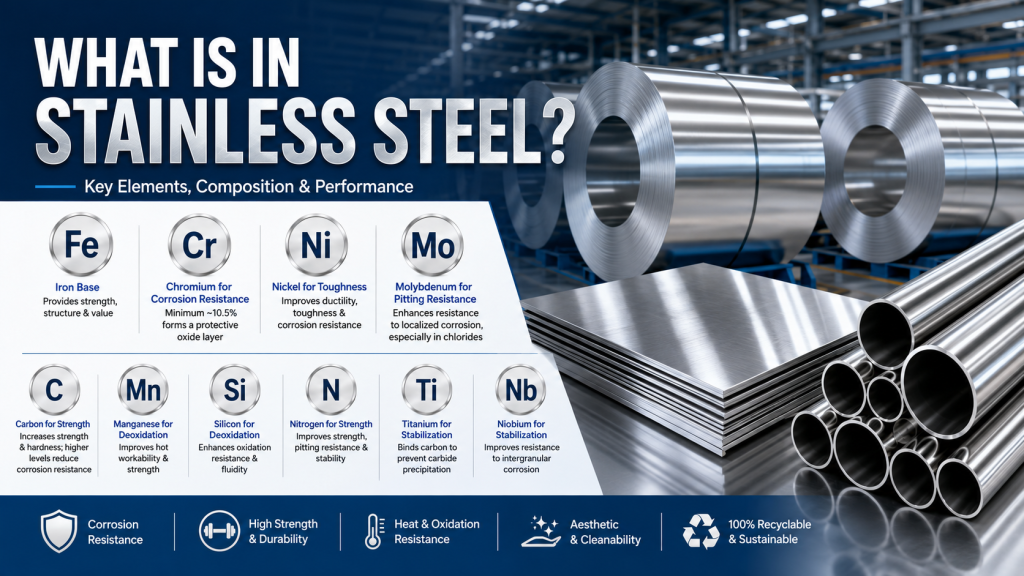
At the most basic level, stainless steel contains iron and chromium. Chromium is the key element that allows stainless steel to form a protective passive layer on the surface. Depending on the grade, stainless steel may also contain nickel, molybdenum, carbon, manganese, silicon, nitrogen, titanium, niobium and other elements.
This guide explains what is in stainless steel, why each element matters, how composition affects corrosion resistance, strength, weldability, heat resistance, magnetism and cost, and how buyers can select the right stainless steel grade for different projects. For related products, visit stainless steel sheet, stainless steel coil, stainless steel strip and the Jude Steel Stainless Steel Grade Center.
Quick Answer: What Is Stainless Steel Made Of?
Stainless steel is an iron-based alloy containing enough chromium to form a protective passive layer. Most stainless steels contain at least about 10.5% chromium. This chromium content is what separates stainless steel from ordinary carbon steel.
In addition to iron and chromium, different stainless steel grades may contain nickel, molybdenum, carbon, manganese, silicon, nitrogen, titanium, niobium, copper and other elements. These elements are added to achieve specific properties such as stronger corrosion resistance, better formability, higher strength, improved weldability or better high-temperature performance.
| Элемент | Main Function in Stainless Steel | Common Grade Examples |
|---|---|---|
| Iron (Fe) | Base metal; provides structure and bulk material strength | All conventional stainless steels |
| Chromium (Cr) | Forms passive layer; improves corrosion and oxidation resistance | 304, 316L, 430, 2205, 310S |
| Nickel (Ni) | Stabilizes austenite; improves toughness, formability and corrosion resistance | 304, 304L, 316L, 310S, 904L |
| Molybdenum (Mo) | Improves chloride, pitting and crevice corrosion resistance | 316L, 2205, 2507, 904L |
| Carbon (C) | Increases hardness and strength; affects weldability and sensitization risk | 420, 440C, 304H, 316H |
| Manganese (Mn) | Supports steelmaking; improves strength; can partially replace nickel | 201, 202 |
| Silicon (Si) | Improves oxidation resistance and high-temperature performance | 309S, 310S, heat-resistant grades |
| Nitrogen (N) | Improves strength and pitting resistance | 2205, 2507, high-strength austenitic grades |
| Titanium (Ti) | Stabilizes carbon and improves resistance to intergranular corrosion | 321, 316Ti, 409L |
| Niobium (Nb) | Improves high-temperature stability and weld performance | 347, 441 |
1. Iron: The Base of Stainless Steel
Iron is the foundation of most stainless steels. In many stainless steel grades, iron makes up the largest portion of the alloy. Iron provides basic metallic strength, structure, formability and processability.
However, iron alone rusts easily when exposed to oxygen and moisture. That is why chromium and other alloying elements are added. These elements change the surface chemistry and create the corrosion-resistant behavior that makes stainless steel valuable.
What Iron Provides
- Base metal structure
- Mechanical strength
- Formability
- Weldability support depending on grade
- Cost-effective alloy foundation
Without iron, conventional stainless steel would not be stainless steel. But without chromium, iron-based steel would not have the corrosion resistance expected from stainless steel.
2. Chromium: The Element That Makes Stainless Steel Stainless
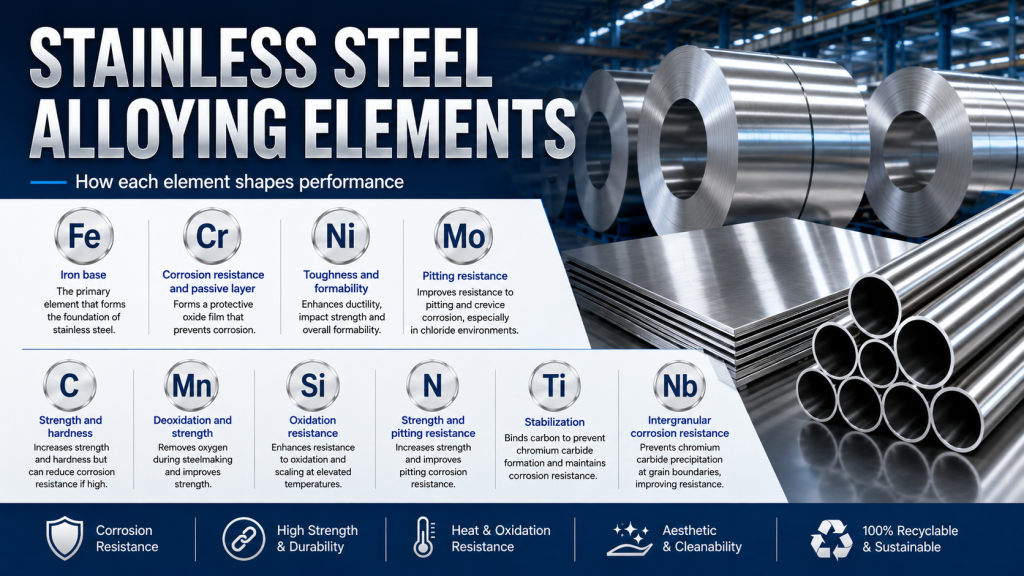
Chromium is the most important element in stainless steel. When chromium is present in sufficient quantity, it reacts with oxygen and forms a thin, invisible chromium oxide film on the surface. This protective film is called the passive layer.
Why the Passive Layer Matters
- It protects the steel surface from rust
- It slows down corrosion attack
- It can self-repair when exposed to oxygen
- It improves oxidation resistance
- It is the main reason stainless steel lasts longer than carbon steel in many environments
| Класс | Typical Chromium Level | Performance Meaning |
|---|---|---|
| Нержавеющая сталь 304 | About 18%–20% | General corrosion resistance and broad usability |
| 316L Stainless Steel | About 16%–18% | Better chloride resistance due to molybdenum addition |
| Нержавеющая сталь 430 | About 16%–18% | Economical ferritic stainless steel for indoor decorative use |
| 2205 Duplex Stainless Steel | About 21%–23% | Higher strength and stronger chloride resistance |
| 310S Stainless Steel | About 24%–26% | Heat-resistant stainless steel for high-temperature oxidation |
3. Nickel: Toughness, Formability and Austenitic Structure
Nickel is one of the most valuable alloying elements in stainless steel. It helps stabilize the austenitic structure, improves toughness, enhances formability and supports corrosion resistance in many environments.
Nickel is also a major reason why some stainless steels cost more than others. For example, 304 and 316L contain nickel, while many ferritic stainless steels such as 409, 430, 439 and 441 contain little or no nickel.
What Nickel Improves
- Austenitic structure stability
- Toughness at low temperature
- Formability and deep drawing performance
- Weldability
- Surface quality and polishability
- General corrosion resistance
| Класс | Nickel Condition | Typical Use |
|---|---|---|
| 304 | Contains nickel | Kitchen equipment, tanks, sheet, coil, general fabrication |
| 316L | Contains more nickel than 304 in many specifications | Chemical, marine atmosphere, food processing, medical equipment |
| 310S | High nickel | High-temperature service |
| 430 | Little or no nickel | Appliances, indoor decorative panels, cost-sensitive products |
| 409 / 439 / 441 | Little or no nickel | Automotive exhaust and ferritic stainless steel applications |
4. Molybdenum: Chloride and Pitting Resistance
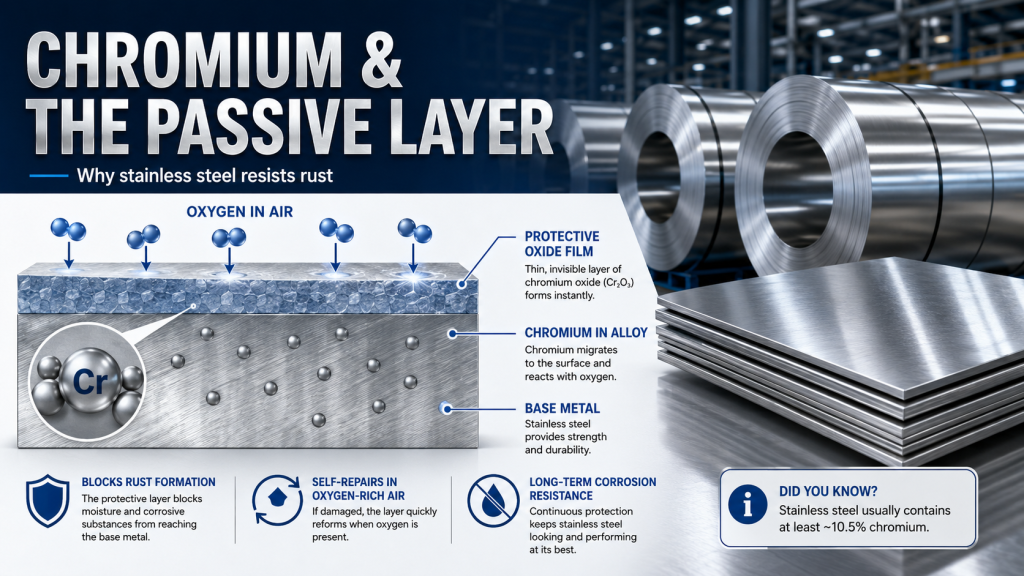
Molybdenum is added when stainless steel needs better resistance to chlorides, pitting corrosion, crevice corrosion and marine-related environments. This is why 316L is usually preferred over 304 in coastal, marine atmosphere or chloride-containing conditions.
Molybdenum is also important in duplex stainless steels such as 2205 and super duplex stainless steels such as 2507. These grades are selected for more demanding chloride environments where 304 or 316L may not be enough.
What Molybdenum Improves
- Resistance to chloride attack
- Pitting corrosion resistance
- Crevice corrosion resistance
- Marine atmosphere performance
- Chemical corrosion performance in selected environments
| Класс | Molybdenum Role | Typical Application |
|---|---|---|
| 316 / 316L | Improves chloride and pitting resistance | Food processing, coastal equipment, marine atmosphere, chemical equipment |
| 2205 Duplex | Supports high chloride resistance and high strength | Pressure systems, tanks, heat exchangers, offshore structures |
| 2507 Super Duplex | Provides very strong pitting and crevice corrosion resistance | Seawater, desalination, offshore and severe chloride applications |
| 904L | Supports strong chemical corrosion resistance | Chemical processing and severe corrosion environments |
5. Carbon: Strength, Hardness and Weldability
Carbon is usually present in small amounts, but it has a strong effect on stainless steel behavior. Higher carbon can increase strength and hardness. This is useful in martensitic stainless steels such as 410, 420 and 440C, which are used for blades, wear parts, shafts and high-hardness components.
However, too much carbon can reduce weldability and increase the risk of sensitization in some stainless steels. That is why low-carbon grades such as 304L and 316L are often preferred for welded structures and corrosion-critical fabrication.
Carbon Effects in Stainless Steel
- Increases hardness
- Improves strength
- Affects heat treatment response
- Can reduce weld corrosion resistance if not controlled
- Creates the need for low-carbon or stabilized grades in some welded applications
| Carbon Condition | Typical Grade Example | Why It Matters |
|---|---|---|
| Low carbon | 304L, 316L | Better for welding and reducing intergranular corrosion risk |
| Standard carbon | 304, 316 | Good general-purpose performance |
| Higher carbon | 420, 440C | Higher hardness and wear resistance after heat treatment |
| High-temperature carbon-controlled grades | 304H, 316H | Used for selected elevated-temperature applications |
6. Manganese, Silicon and Nitrogen
Manganese
Manganese supports steelmaking, improves hot working and contributes to strength. In some 200 series stainless steels, manganese and nitrogen are used to partially replace nickel. This helps control cost, but it also changes corrosion resistance, formability and market positioning.
Silicon
Silicon improves oxidation resistance and high-temperature performance. It is important in heat-resistant stainless steels such as 309S and 310S, where scaling resistance and thermal stability are important.
Nitrogen
Nitrogen improves strength and pitting resistance. It is especially important in duplex stainless steels, where it helps increase strength and corrosion resistance without relying only on high nickel content.
| Элемент | Main Benefit | Common Grade / Family |
|---|---|---|
| Manganese | Improves hot working, supports strength and can partially replace nickel | 201, 202 |
| Silicon | Improves oxidation and high-temperature performance | 309S, 310S, heat-resistant grades |
| Nitrogen | Improves strength and pitting resistance | 2205, 2507, duplex stainless steels |
7. Titanium and Niobium: Stabilizing Elements
Titanium and niobium are commonly used as stabilizing elements. They help tie up carbon and reduce the risk of chromium carbide precipitation, which can improve weld performance and reduce intergranular corrosion risk in certain conditions.
Grades such as 321, 316Ti and 347 are often selected when the material must resist intergranular corrosion or maintain stability in elevated-temperature service. Ferritic grades such as 441 may also use stabilization to improve performance in automotive exhaust and thermal environments.
| Элемент | Function | Typical Grade Example |
|---|---|---|
| Titanium | Stabilizes carbon and improves intergranular corrosion resistance | 321, 316Ti, 409L |
| Niobium | Improves weldability and high-temperature stability | 347, 441 |
| Titanium + Niobium | Dual stabilization for ferritic and heat-related applications | 441 нержавеющая сталь |
8. Typical Stainless Steel Composition Examples
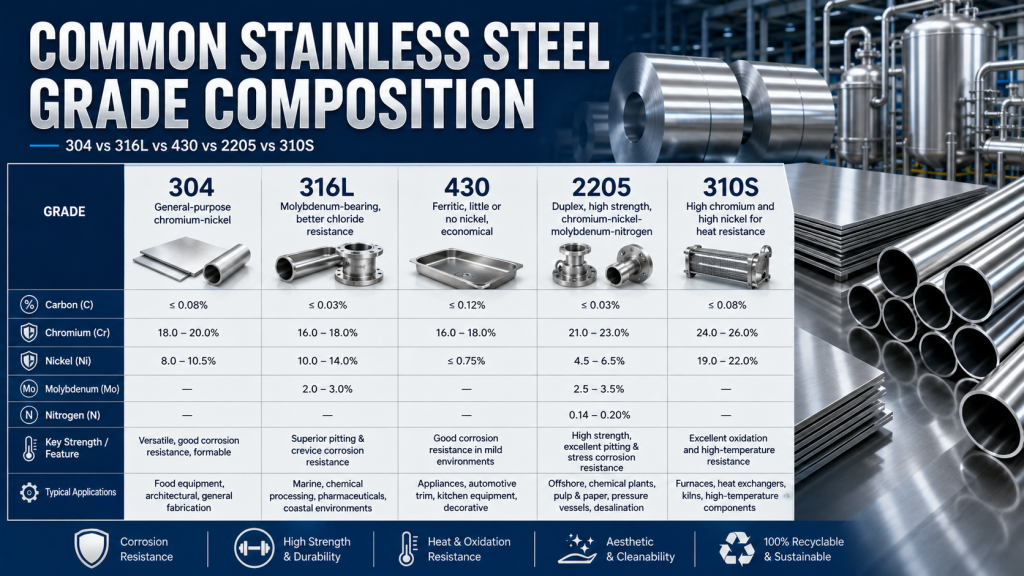
Different stainless steel grades use different combinations of elements. This is why 304, 316L, 430, 2205 and 310S perform differently even though all are called stainless steel.
| Класс | Major Composition Feature | Main Performance Advantage | Typical Applications |
|---|---|---|---|
| Нержавеющая сталь 304 | Chromium-nickel austenitic stainless steel | Excellent general corrosion resistance, formability and weldability | Kitchen equipment, tanks, sheet, coil, industrial fabrication |
| 316L Stainless Steel | Chromium-nickel-molybdenum low-carbon grade | Better chloride and pitting resistance than 304 | Marine atmosphere, food processing, chemical equipment, medical equipment |
| Нержавеющая сталь 430 | Chromium ferritic stainless steel with little or no nickel | Economical, magnetic, good indoor decorative performance | Appliances, kitchen panels, indoor decoration, elevator panels |
| 2205 Duplex Stainless Steel | Chromium-nickel-molybdenum-nitrogen duplex structure | High strength and excellent chloride resistance | Chemical tanks, pressure systems, heat exchangers, offshore components |
| 310S Stainless Steel | High chromium and high nickel heat-resistant stainless steel | Strong high-temperature oxidation resistance | Furnaces, heat treatment equipment, thermal processing parts |
9. Does All Stainless Steel Contain Nickel?
No. This is one of the most common misunderstandings in stainless steel purchasing. Many austenitic stainless steels contain nickel, but many ferritic stainless steels contain little or no nickel.
| Nickel Condition | Common Grades | Typical Meaning |
|---|---|---|
| Contains nickel | 304, 304L, 316, 316L, 321, 310S | Usually better toughness, formability and austenitic structure stability |
| Little or no nickel | 409, 430, 439, 441, 444 | Usually lower cost, magnetic behavior and ferritic structure |
| High nickel | 904L, 310S, nickel alloys | Used for severe corrosion, high-temperature or special environments |
This difference affects cost, magnetism, corrosion resistance, forming behavior and final application. For example, 430 stainless steel is often selected for cost-sensitive indoor decorative applications, while 304 is selected for better formability and general corrosion resistance.
10. How Composition Affects Stainless Steel Properties
The composition of stainless steel directly determines how it performs. Two grades may look similar on the surface, but their chemical composition can make one better for seawater, another better for kitchen equipment, and another better for high-temperature service.
| Property Requirement | Key Elements | Suitable Grade Examples |
|---|---|---|
| General corrosion resistance | Chromium, nickel | 304, 304L |
| Chloride / marine resistance | Chromium, molybdenum, nitrogen | 316L, 2205, 2507 |
| High-temperature oxidation resistance | Chromium, nickel, silicon | 309S, 310S, 253MA |
| High strength | Nitrogen, carbon, duplex structure | 2205, 2507, 17-4PH |
| Low-cost decorative use | Chromium with little or no nickel | 430 |
| Welding performance | Low carbon, titanium, niobium | 304L, 316L, 321, 347 |
| Hardness and wear resistance | Carbon, martensitic structure | 410, 420, 440C |
11. Stainless Steel Families by Composition
Stainless steel grades are often grouped by metallurgical structure and composition. Understanding these families helps buyers avoid choosing the wrong grade.
| Family | Composition Character | Main Advantages | Common Grades |
|---|---|---|---|
| Austenitic Stainless Steel | Chromium-nickel or chromium-nickel-molybdenum | Excellent corrosion resistance, formability and weldability | 304, 304L, 316L, 321, 310S |
| Ferritic Stainless Steel | Chromium-based, little or no nickel | Cost-effective, magnetic, good oxidation resistance | 409, 430, 439, 441, 444 |
| Martensitic Stainless Steel | Chromium with higher carbon | High hardness and wear resistance after heat treatment | 410, 420, 440C |
| Duplex Stainless Steel | Chromium-nickel-molybdenum-nitrogen with mixed austenite and ferrite | High strength and strong chloride resistance | 2205, 2507 |
| Precipitation Hardening Stainless Steel | Special strengthening elements with heat treatment response | High strength and good corrosion resistance | 17-4PH, 15-5PH |
12. Stainless Steel Composition Selection Guide
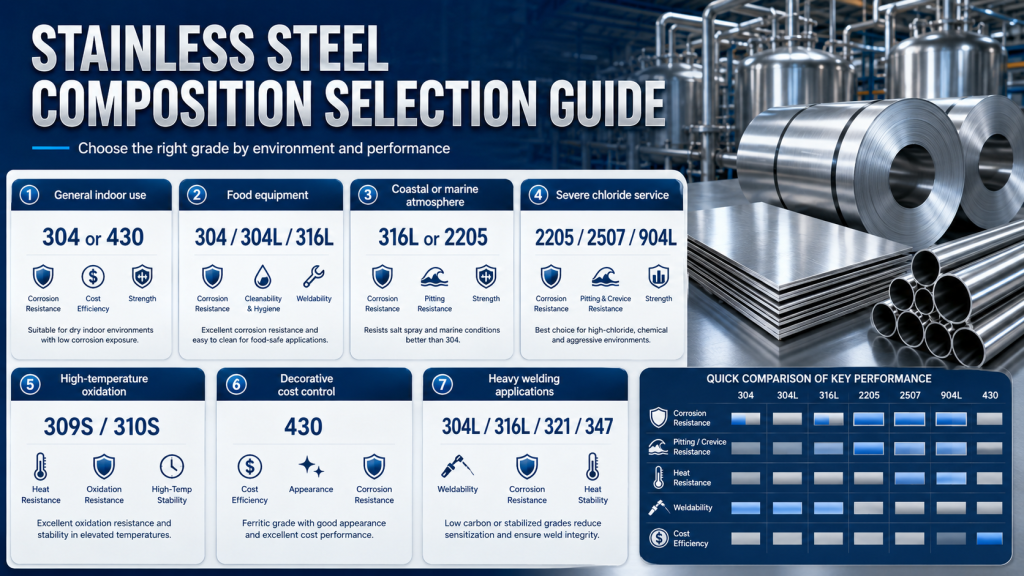
| Project Requirement | Recommended Composition Direction | Suggested Grade Examples |
|---|---|---|
| General indoor use | Chromium-nickel or chromium ferritic grade | 304 or 430 |
| Food equipment | Chromium-nickel austenitic stainless steel | 304, 304L, 316L |
| Coastal or marine atmosphere | Molybdenum-bearing stainless steel | 316L, 2205 |
| Severe chloride environment | High chromium, molybdenum and nitrogen | 2205, 2507, 904L, 254SMO |
| High-temperature oxidation | High chromium, high nickel and silicon support | 309S, 310S, 253MA |
| Automotive exhaust | Stabilized ferritic stainless steel | 409L, 439, 441 |
| Decorative cost control | Chromium ferritic grade with little nickel | 430 |
| High hardness | Higher carbon martensitic stainless steel | 410, 420, 440C |
| Heavy welding | Low carbon or stabilized stainless steel | 304L, 316L, 321, 347 |
Choose 304 If:
- You need a safe general-purpose stainless steel
- The environment is indoor, food-related or mildly corrosive
- Formability and weldability are important
- Sheet, coil, tank, pipe or general fabrication is required
Choose 316L If:
- The environment contains chlorides or salt
- Better pitting resistance is needed
- The project involves food, chemical, coastal or marine atmosphere applications
- Welding and corrosion resistance are both important
Choose 430 If:
- Cost control is important
- The application is indoor or decorative
- Magnetism is acceptable
- The product is an appliance panel, kitchen panel or decorative sheet
Choose 2205 If:
- You need higher strength than 304 or 316L
- Chloride stress corrosion resistance is important
- The project involves pressure systems, tanks, heat exchangers or offshore structures
13. Common Buyer Mistakes to Avoid
- Assuming all stainless steel has the same composition
- Choosing only by price without checking alloying elements
- Using 304 in severe chloride environments where 316L or duplex is needed
- Using 430 in wet or coastal conditions without evaluation
- Assuming all stainless steel contains nickel
- Ignoring carbon content when welding stainless steel
- Ignoring molybdenum when selecting for marine or chemical applications
- Using magnetic testing alone to judge stainless steel quality
- Not checking material certificates, grade standards and actual chemical composition
- Forgetting that surface finish and maintenance also affect corrosion resistance
Frequently Asked Questions
What is stainless steel made of?
Stainless steel is mainly made of iron and chromium. Depending on the grade, it may also contain nickel, molybdenum, carbon, manganese, silicon, nitrogen, titanium, niobium and other alloying elements.
What element makes stainless steel stainless?
Chromium is the key element. It forms a thin chromium oxide passive layer on the surface, helping protect the metal from rust and corrosion.
Does all stainless steel contain nickel?
No. Austenitic grades such as 304, 304L, 316L and 310S usually contain nickel. Ferritic grades such as 409, 430, 439 and 441 contain little or no nickel.
Why is molybdenum added to stainless steel?
Molybdenum improves resistance to pitting, crevice corrosion and chloride environments. It is important in grades such as 316L, 2205 and 2507.
Why are low-carbon stainless steels used for welding?
Low-carbon grades such as 304L and 316L help reduce the risk of sensitization and intergranular corrosion after welding, especially in corrosion-critical applications.
Is stainless steel magnetic?
It depends on the grade. Ferritic and martensitic stainless steels are usually magnetic. Austenitic stainless steels such as 304 and 316L are usually non-magnetic in the annealed condition, but they may become slightly magnetic after cold working.
Which stainless steel composition is best?
There is no single best composition for every project. 304 is excellent for general use, 316L is better for chloride exposure, 430 is economical for indoor decorative use, 2205 provides high strength and chloride resistance, and 310S is designed for high-temperature service.
Заключение
Stainless steel is an engineered alloy system, not just ordinary steel with a shiny surface. Its performance comes from its chemical composition. Iron provides the base structure, chromium creates the passive layer, nickel improves toughness and formability, molybdenum strengthens chloride resistance, carbon affects hardness and weldability, and elements such as nitrogen, titanium and niobium fine-tune strength, pitting resistance and high-temperature stability.
Understanding what is in stainless steel helps buyers choose the right grade for the right application. 304 is a reliable general-purpose grade, 316L is better for chloride and marine atmosphere, 430 is economical for indoor decorative products, 2205 offers high strength and chloride resistance, and heat-resistant grades such as 310S are used for elevated-temperature service.
Jude Steel supplies stainless steel sheets, coils, strips and customized processing services for global buyers. Explore more at Judesteel.com, or visit our pages for stainless steel sheet, stainless steel coil, stainless steel strip and the Stainless Steel Grade Center.
