
Stainless Steel Grades Explained: ASTM, EN, JIS
Stainless steel grades are defined by international standards to ensure consistency in chemical
composition, mechanical properties, and performance. Among the most widely used systems are ASTM
(American Society for Testing and Materials), EN (European Norm), and JIS (Japanese Industrial Standards).
Understanding how these grading systems relate to each other is essential for engineers,
procurement professionals, and global buyers to ensure correct material selection and
compatibility across international markets.
1. What Are Stainless Steel Grades?
Stainless steel grades are standardized classifications that define the chemical composition,
microstructure, and mechanical properties of stainless steels. These grades ensure that materials
meet specific performance requirements for applications such as construction, chemical processing,
and manufacturing.
2. Overview of Major Standards
2.1 ASTM (United States)
ASTM standards are widely used in North America and globally. They specify both material composition
and product forms (plates, pipes, bars, etc.).
- Example Grades: 304, 316, 321, 310S
- Common Specifications: ASTM A240 (plates), ASTM A312 (pipes)
- Focus: Mechanical properties and application requirements
2.2 EN (European Standard)
EN standards (also known as DIN EN) are used across Europe and follow a structured numbering system.
- Example Grades: 1.4301 (304), 1.4401 (316), 1.4541 (321)
- Naming System: Numeric (material number) + chemical composition-based naming
- Focus: Harmonized European material classification
2.3 JIS (Japan)
JIS standards are widely used in Asia and are known for their practical classification system.
- Example Grades: SUS304, SUS316, SUS321
- Prefix “SUS” indicates stainless steel
- Focus: Industrial usability and manufacturing standards
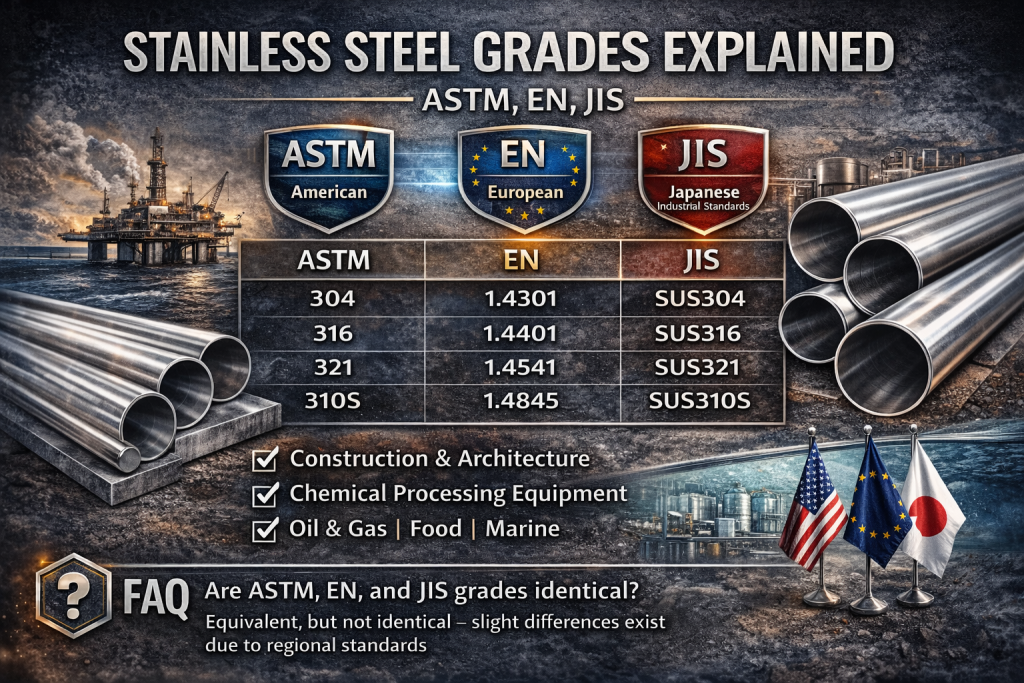
3. Comparison of Equivalent Grades
| Common Name | ASTM | EN | JIS |
|---|---|---|---|
| Нержавеющая сталь 304 | 304 | 1.4301 | SUS304 |
| 316 Stainless Steel | 316 | 1.4401 | SUS316 |
| 321 Stainless Steel | 321 | 1.4541 | SUS321 |
| 310S Stainless Steel | 310S | 1.4845 | SUS310S |
4. Key Differences Between ASTM, EN, and JIS
4.1 Naming Conventions
- ASTM: Numeric grade system (e.g., 304, 316)
- EN: Numeric + chemical designation (e.g., 1.4301)
- JIS: Prefix-based system (e.g., SUS304)
4.2 Scope of Standards
ASTM standards often include detailed mechanical properties and testing requirements, while EN
focuses on harmonization across Europe. JIS standards emphasize practical industrial usage.
4.3 Regional Application
- ASTM: North America and global trade
- EN: Europe
- JIS: Japan and Asia-Pacific
5. Why Grade Equivalency Matters
In international trade, equivalent grades allow buyers and suppliers from different regions
to communicate effectively. However, while grades may be equivalent, slight differences in
composition or standards may exist, requiring careful verification.
- Ensures compatibility in global sourcing
- Reduces risk of material mismatch
- Improves procurement efficiency
6. Applications Across Standards
- Construction and architecture
- Oil and gas pipelines
- Chemical processing equipment
- Food and medical industries
- Marine and offshore engineering
7. How to Choose the Right Standard
Selecting the correct standard depends on project requirements, geographic location,
and customer specifications.
- Use ASTM for projects in North America
- Use EN for European compliance
- Use JIS for Asian manufacturing compatibility
FAQ
Q1: Are ASTM, EN, and JIS grades identical?
No, they are equivalent but not identical. Minor differences in composition and standards may exist.
Q2: What does SUS mean in JIS standards?
SUS stands for “Steel Use Stainless” and indicates stainless steel grades in JIS.
Q3: Which standard is most widely used globally?
ASTM is widely recognized globally, but EN and JIS are dominant in their respective regions.
Q4: Can I substitute one grade for another?
Substitution is possible if the grades are equivalent, but technical verification is required.
Q5: Why are there different standards for the same material?
Different regions developed their own standards based on industrial needs, regulations,
and historical practices.
Заключение
Understanding stainless steel grading systems such as ASTM, EN, and JIS is essential for
global material selection and procurement. By recognizing equivalencies and differences,
professionals can ensure proper application, compliance, and performance in international projects.
