
Stainless Steel for Kitchen Equipment: Grades, Applications and Hygienic Design
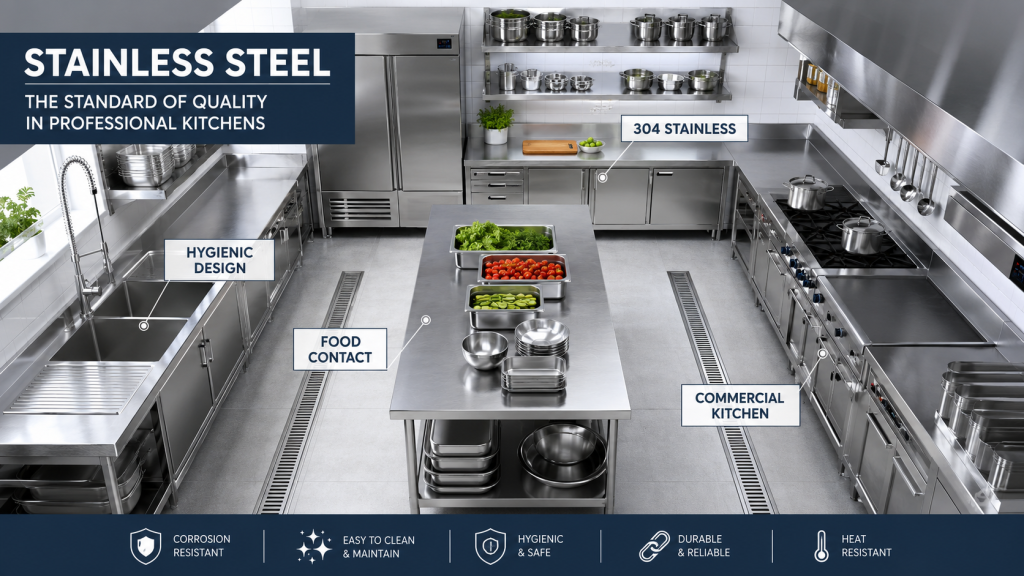 Stainless steel is widely used in domestic kitchens, commercial kitchens and industrial food-processing equipment because it combines corrosion resistance, cleanability, strength and fabrication flexibility.
Stainless steel is one of the most important engineering materials used in cookware, sinks, worktables, cabinets, steamers, fryers, food-preparation machines and complete industrial food-processing lines.
Its popularity comes from a practical combination of corrosion resistance, durability, heat resistance, surface cleanability, formability and attractive appearance. However, not every stainless steel grade is suitable for every kitchen application.
A dry exterior panel, a cooking pot, a knife blade and a tank holding salty or acidic food all have different material requirements. Selecting the wrong grade can cause staining, pitting, difficult cleaning, weld corrosion, distortion or unnecessary material cost.
This guide explains how to select stainless steel for kitchen utensils, commercial kitchen equipment and food-processing machinery. It compares 201, 304, 304L, 316L, 430 and martensitic blade grades by corrosion resistance, heat resistance, formability, hygienic performance, surface finish, fabrication and price.
Quick Answer: What Is the Best Stainless Steel for Kitchen Equipment?
304 stainless steel is the most common general-purpose choice for food-contact surfaces, sinks, worktables, pots, trays, mixers and commercial kitchen equipment.
304L stainless steel is useful for heavily welded tanks, vessels, hoppers and fabricated food-processing equipment because its lower carbon content reduces sensitization risk during welding.
316L stainless steel is preferred for salty, acidic, seafood, pickle, sauce, brine and aggressive washdown environments where additional molybdenum provides stronger resistance to pitting and crevice corrosion.
430 stainless steel can be used for dry appliance panels, cooker components, magnetic cookware layers and selected noncritical kitchen parts where cost and magnetic response are important.
201 stainless steel may be suitable for cost-sensitive structural frames or non-food-contact components in mild environments, while hardenable 420-series grades are commonly considered for knife blades and cutting tools.
Why Is Stainless Steel Used in Kitchen Equipment?
Kitchen and food-processing equipment must tolerate water, steam, food acids, oils, salt, cleaning agents, temperature changes and repeated mechanical use.
Stainless steel offers several important advantages:
- Good resistance to rust and staining in suitable environments
- Smooth surfaces that can be cleaned and sanitized
- Low water absorption
- Good impact and wear resistance
- Useful strength at relatively low thickness
- Good heat and low-temperature performance
- Compatibility with welding, bending, stamping and deep drawing
- Availability in sheet, coil, strip, tube, bar and fabricated forms
- Attractive brushed, satin, bright and mirror finishes
- Long service life when the grade and cleaning system are correctly selected
Stainless steel is also suitable for equipment that must be repeatedly dismantled, pressure washed or cleaned through automated Clean-In-Place systems.
Chlorides, prolonged chemical exposure, rough welds, iron contamination, stagnant liquid and incorrect cleaning products can damage the passive surface film and cause localized corrosion.
What Does “Food-Grade Stainless Steel” Really Mean?
“Food-grade stainless steel” is a common commercial term, but it is not one single universal alloy designation.
A material suitable for food contact must be evaluated as part of the complete equipment system. Important factors include:
- Stainless steel grade and chemical composition
- Type of food or beverage
- Salt, acid and chloride concentration
- Operating temperature
- Contact time
- Surface roughness and finish
- Weld quality
- Crevices and drainage
- Cleaning and sanitizing chemicals
- Material traceability
- Applicable national and international regulations
Food-contact surfaces should generally be smooth, corrosion resistant, nonabsorbent, durable and accessible for effective cleaning.
In many commercial kitchen and food-processing applications, SUS304 is used for parts in direct contact with food. In more aggressive salty or acidic processing lines, SUS316 or 316L may be selected for additional corrosion resistance.
Manufacturers seeking complete commercial kitchen equipment and food-processing solutions can review
HSYL commercial kitchen equipment
and its range of stainless steel food machinery.
Stainless Steel Grades for Kitchen Equipment
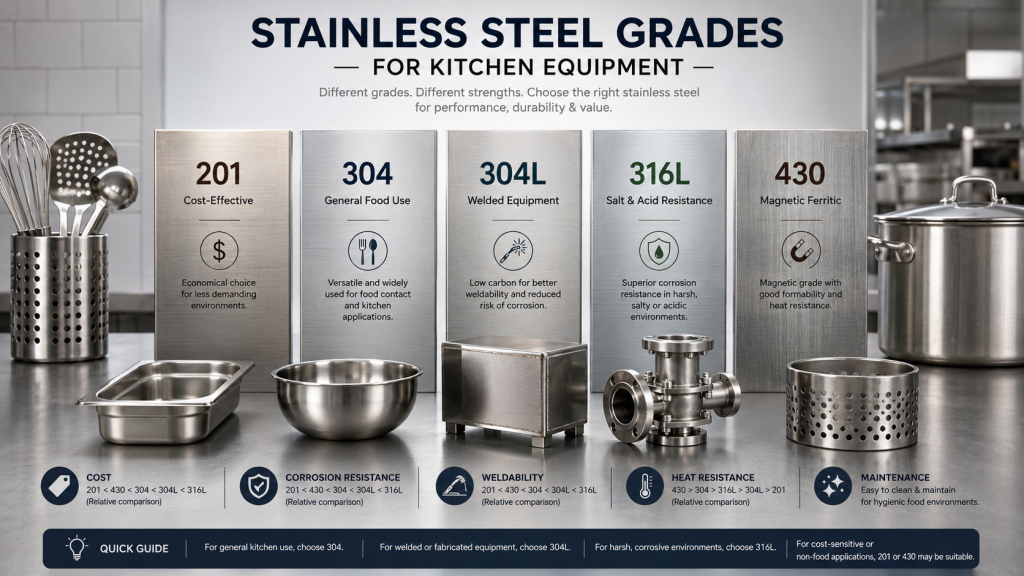
Kitchen equipment may use several stainless steel grades according to food contact, corrosion exposure, welding, magnetic response and mechanical requirements.
| Класс | Main Advantage | Typical Kitchen Applications | Important Limitation |
|---|---|---|---|
| 201 | Lower material cost and useful strength | Frames, cabinets, carts and selected non-food-contact components | Lower corrosion margin in wet, salty or acidic environments |
| 304 | Balanced corrosion resistance, formability and cost | Sinks, worktables, cookware, trays, steamers, tanks and food-contact surfaces | Can pit in severe chloride or prolonged salt exposure |
| 304L | Low carbon for welded equipment | Welded tanks, hoppers, vessels, piping and fabricated food equipment | Does not provide the molybdenum-enhanced chloride resistance of 316L |
| 316L | Improved chloride and chemical resistance | Seafood, pickle, brine, sauce, dairy, pharmaceutical and aggressive washdown equipment | Higher material cost |
| 430 | Magnetic ferritic grade with competitive cost | Appliance panels, cooker parts, dry cabinets and cookware induction layers | Lower corrosion resistance and weldability than 304 in many environments |
| 420 series | Can be hardened for cutting edges | Knives, blades, scissors and cutting components | Requires controlled heat treatment and careful corrosion maintenance |
304 Stainless Steel for General Kitchen Equipment
304 stainless steel
is the most widely used stainless steel grade in domestic kitchens, restaurants, hotels, central kitchens and general food-processing plants.
It contains chromium and nickel and offers a practical balance of corrosion resistance, ductility, weldability, surface appearance and material cost.
Common 304 Kitchen Applications
- Commercial kitchen worktables
- Sinks and wash basins
- Food-preparation counters
- Storage cabinets
- Cookware and pots
- Serving trays
- Mixing bowls
- Steam cabinets
- Food trolleys
- Mixers and blending equipment
- Washing and cleaning machines
- Food-processing conveyors
304 can be cold rolled, deep drawn, stamped, bent, welded and polished. This makes it suitable for both simple utensils and complex fabricated equipment.
When Is 304 Not Enough?
Grade 304 may be inadequate when equipment is repeatedly exposed to:
- Concentrated salt or brine
- Acidic sauces
- Pickled food
- Seafood residue
- Chloride-bearing cleaning chemicals
- Warm stagnant wash water
- Tight crevices that retain liquid
In these conditions, 316L may provide a more reliable corrosion margin.
304L Stainless Steel for Welded Kitchen Equipment
304L stainless steel
is the low-carbon version of 304. Under common standards, its carbon content is restricted to reduce the risk of chromium-carbide precipitation during welding.
This makes 304L attractive for heavily welded equipment such as:
- Storage tanks
- Mixing vessels
- Cooking kettles
- Ingredient hoppers
- Food-transfer piping
- Large fabricated sinks
- Welded conveyor systems
- Custom food-processing machines
The lower carbon content supports better resistance to intergranular corrosion in welded zones, but correct shielding gas, heat input, cleaning and passivation remain essential.
316L Stainless Steel for Salty and Acidic Food
316L stainless steel
contains molybdenum in addition to chromium and nickel. Molybdenum improves resistance to pitting and crevice corrosion in many chloride-bearing environments.
316L is often selected for:
- Seafood-processing machinery
- Fish and shrimp washing systems
- Pickle and fermented-food lines
- Brine tanks
- Sauce and seasoning production
- Salted meat equipment
- Dairy-processing systems
- High-hygiene tanks and piping
- Aggressive Clean-In-Place systems
- Equipment exposed to acidic cleaning cycles
For complete equipment examples, visit the
HSYL food-processing machinery catalog
,
which covers washing, cutting, cooking, freezing, mixing, drying, packaging and seafood-processing systems.
Warm concentrated chlorides, stagnant brine, harsh chemicals and poorly designed crevices can still cause localized attack.
430 Stainless Steel for Appliances and Dry Kitchen Components
430 stainless steel
is a ferritic chromium stainless steel. It is magnetic and normally contains little or no nickel, making it more economical than many austenitic grades.
Typical kitchen applications include:
- Refrigerator and oven panels
- Dry cabinet components
- Cooker and burner parts
- Dishwasher exterior panels
- Range-hood components
- Decorative appliance trim
- Magnetic cookware base layers
- Selected cutlery and utensil components
430 has useful resistance in mild environments but normally provides a lower corrosion margin than 304 or 316L in continuously wet, salty or acidic conditions.
Its magnetic behavior is valuable in induction-compatible cookware. Multilayer cookware may combine an austenitic stainless steel food-contact interior with an aluminum heat-distribution layer and a magnetic ferritic stainless steel exterior.
201 Stainless Steel for Cost-Sensitive Kitchen Structures
201 stainless steel
contains less nickel and more manganese and nitrogen than 304. This reduces alloy cost while maintaining useful strength and formability.
It may be used for:
- Structural frames
- Dry storage cabinets
- Kitchen carts
- Non-food-contact covers
- Equipment stands
- Interior decorative panels
- Cost-sensitive restaurant furniture
201 should be used cautiously in wet, salty, acidic or aggressive cleaning environments. For direct food-contact surfaces, many equipment manufacturers prefer 304 or 316L according to the application and applicable requirements.
Confirm food-contact requirements, washdown frequency, salt exposure, expected service life and customer specifications before approving the change.
Stainless Steel for Kitchen Knives and Cutting Tools
Kitchen knives require different properties from tanks, sinks and worktables. A blade must combine hardness, edge stability, wear resistance, toughness, corrosion resistance and sharpening performance.
Martensitic grades such as
420J2 stainless steel
can be hardened through quenching and tempering.
Typical applications include:
- Kitchen knives
- Food-slicing blades
- Scissors
- Peeling tools
- Cutting discs
- Processing-machine blades
Blade performance depends heavily on heat treatment, final hardness, carbide distribution, edge geometry, grinding temperature and surface finishing.
A harder blade may retain its edge longer but can become more difficult to sharpen or more sensitive to chipping. Material selection should therefore be based on the cutting task rather than hardness alone.
Stainless Steel Applications in Kitchen Equipment
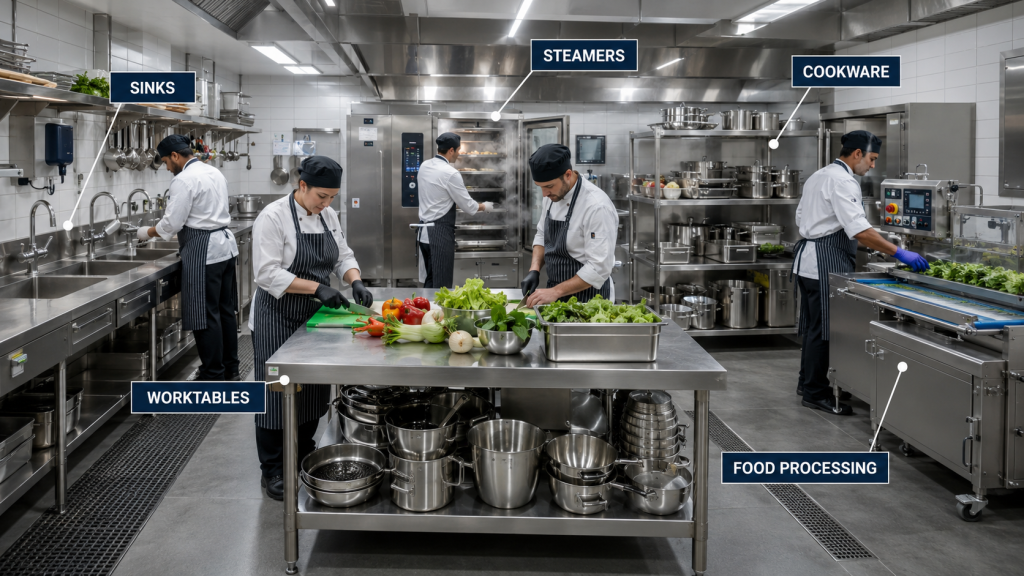
Stainless steel sheet, coil, strip and fabricated parts are used throughout commercial kitchens and catering facilities.
Commercial Worktables and Preparation Counters
Worktables require a durable, smooth and cleanable surface. 304 is a common food-contact option, while the frame or lower shelf may use 304, 430 or another specified grade according to moisture and cleaning conditions.
Sinks and Washing Stations
Sinks are repeatedly exposed to water, detergent, food residue and impact. 304 is widely used for general sinks. 316L may be considered when salt, acidic chemicals or aggressive sanitation conditions are present.
Cookware, Pots and Pans
Cookware often uses layered construction. Austenitic stainless steel can provide the food-contact surface, aluminum or copper can distribute heat, and magnetic ferritic stainless steel can support induction cooking.
Steam Cabinets and Cooking Equipment
Steam cabinets, kettles and cooking vessels require resistance to moisture, heat, food acids and repeated cleaning. 304 is common for general applications, while 316L can be specified for aggressive ingredients or cleaning cycles.
Fryers and Oil-Processing Equipment
Fryers require heat resistance, dimensional stability and cleanable surfaces. Material thickness, weld design and thermal expansion must be considered in addition to grade.
Refrigeration and Freezing Equipment
Stainless steel maintains useful toughness at low temperature and is used in cabinets, trays, conveyor systems and individual quick-freezing equipment.
Kitchen Cabinets and Storage Systems
Dry cabinets may use 430 or 201 for cost control, while wet or frequently sanitized cabinets may benefit from 304 construction.
Utensils, Trays and Containers
Deep-drawing and stamping performance are important for bowls, trays, containers and utensils. 304 is widely used because it combines ductility, finish quality and corrosion resistance.
Stainless Steel in Food-Processing Machinery
Industrial food-processing machinery extends beyond conventional restaurant equipment. A production line may include raw-material washing, cutting, mixing, cooking, cooling, freezing, inspection and packaging systems.
Stainless steel is commonly used for:
- Fruit and vegetable washing machines
- Meat and seafood cutting machines
- Mixing tanks and ribbon blenders
- Cooking kettles
- Frying lines
- Conveyor systems
- Freeze dryers and IQF equipment
- Seasoning and sauce equipment
- Metal detectors and inspection systems
- Food-filling and packaging machinery
HSYL develops commercial kitchen machines and complete food-processing solutions for washing, cutting, cooking, freezing, mixing, drying, seafood processing and packaging.
Visit
HSYL Foodline
to review stainless steel commercial kitchen equipment and turnkey food-processing systems.
Product-Contact Zones vs Structural Zones
A food machine does not necessarily require one grade for every component.
| Equipment Zone | Typical Material Approach | Main Selection Factors |
|---|---|---|
| Direct food-contact surface | 304, 304L or 316L according to service | Food chemistry, temperature, cleanability and corrosion resistance |
| Wetted piping and tanks | 304L or 316L | Welding, cleaning chemicals, chloride concentration and pressure |
| Knife or cutting blade | Hardenable martensitic stainless steel | Hardness, wear resistance, toughness and sharpening |
| Dry exterior panel | 304, 430 or selected 201 | Appearance, magnetic response, cleaning and cost |
| Structural frame | 304 or another approved structural grade | Load, washdown, corrosion environment and customer specification |
| Heating component | Heat-resistant stainless grade selected by temperature | Maximum temperature, oxidation, cycling and thermal expansion |
Choosing a Stainless Steel Surface Finish
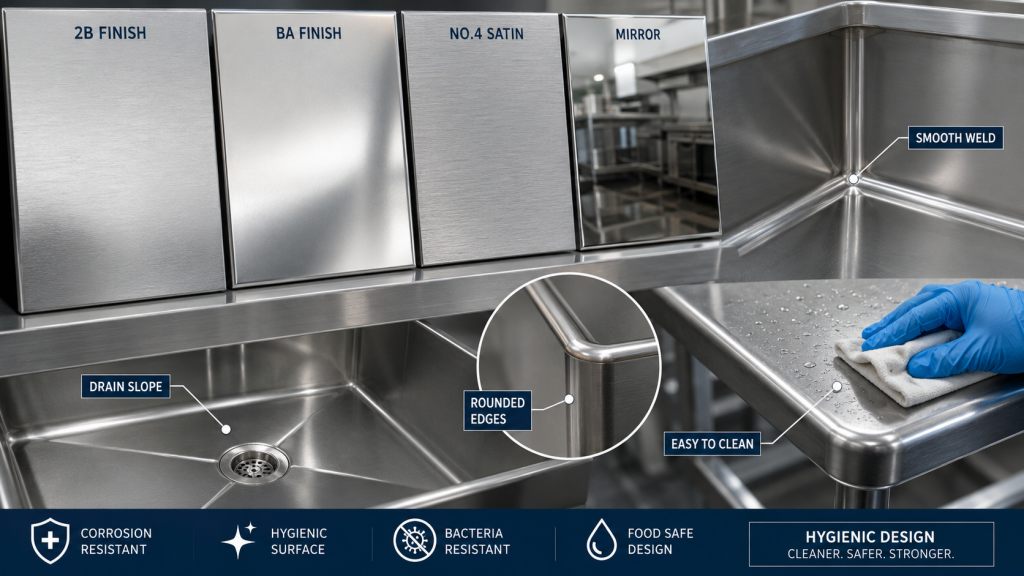
Surface finish affects cleanability, appearance, fabrication cost, scratch visibility and corrosion performance.
| Surface Finish | Appearance | Typical Kitchen Use | Important Consideration |
|---|---|---|---|
| 2B | Smooth, slightly reflective cold-rolled finish | Equipment panels, tanks, trays and general food machinery | Practical balance of cleanability and cost |
| BA | Bright and reflective | Decorative appliances and selected utensils | Shows scratches and fingerprints more easily |
| No.4 | Uniform brushed or satin finish | Worktables, cabinets, counters and visible kitchen equipment | Grinding direction and roughness should be controlled |
| Hairline | Fine linear decorative finish | Cabinets, appliance fronts and architectural kitchen panels | More decorative than sanitary unless carefully specified |
| Mirror | Highly reflective polished finish | Premium decorative equipment and selected containers | Higher processing cost and visible fingerprints |
| Electropolished | Smooth, bright and microscopically leveled | High-hygiene and specialized processing systems | Requires controlled processing and acceptance criteria |
JUDE supplies
stainless steel sheet
,
stainless steel coil
and
precision stainless steel strip
in finishes including 2B, BA, No.4, hairline and mirror-polished conditions.
Does a Brighter Finish Mean Better Hygiene?
Not automatically. A surface may look bright but still contain scratches, embedded iron, polishing residue or fabrication defects.
Hygienic performance depends on measurable roughness, continuity, absence of cracks and crevices, cleanability and compatibility with the process.
Hygienic Design Principles for Stainless Steel Equipment
Selecting the correct alloy is only the first step. Poorly designed equipment can be difficult to clean even when it is made from 316L.
Good hygienic design should consider:
- Smooth and accessible product-contact surfaces
- Continuous and properly finished welds
- Rounded internal corners
- Drainable surfaces
- Minimal ledges and horizontal pockets
- Avoidance of unsealed overlapping joints
- Easy removal of covers and guards
- Cleanable fasteners and fittings
- Separation of lubricated mechanisms from food zones
- Prevention of standing water
- Compatibility with manual cleaning or CIP
The
3-A Sanitary Standards
provide design and fabrication criteria for many categories of food-processing equipment.
Even 316L can corrode or support contamination when liquid remains trapped in rough welds, dead legs, gasket gaps or uncleanable crevices.
Welding and Post-Weld Treatment
Welding is widely used to fabricate sinks, tanks, hoppers, worktables, conveyors and machine frames.
Critical welding considerations include:
- Correct filler-metal selection
- Clean joint preparation
- Controlled heat input
- Adequate shielding gas
- Complete root protection where required
- Smooth weld profiles
- Removal of sharp undercut and excessive reinforcement
- Heat-tint removal
- Pickling or passivation when specified
- Final surface inspection
Weld heat tint indicates oxide formation. The metal beneath a heavily oxidized zone can have reduced local corrosion resistance.
Depending on the service environment, heat tint may need to be removed by controlled mechanical finishing, pickling or another qualified process.
Cleaning and Maintenance of Stainless Steel Kitchen Equipment
Correct maintenance protects the passive layer and preserves the appearance of stainless steel.
Recommended Practices
- Remove food residue promptly.
- Use cleaning agents compatible with the stainless steel grade.
- Follow the specified chemical concentration and contact time.
- Rinse thoroughly after cleaning.
- Dry surfaces when possible.
- Clean in the direction of the brushed grain.
- Use nonmetallic pads or stainless-compatible tools.
- Inspect welds, joints, gaskets and drainage areas.
- Remove surface contamination before rust staining develops.
Practices to Avoid
- Leaving concentrated salt or food acids on the surface
- Prolonged exposure to chloride-based cleaners without verification
- Using carbon-steel wire brushes
- Grinding stainless steel with contaminated tools
- Allowing standing water in crevices
- Using abrasive materials that destroy the specified finish
- Mixing cleaning chemicals without an approved procedure
A chemical that is safe for one stainless steel grade, temperature and concentration may damage another combination of alloy, surface and operating condition.
Food-Contact Standards and Compliance
Food-contact equipment must comply with the requirements that apply in the destination country and intended industry.
The
FDA Food Code
provides model recommendations covering food equipment and food-contact surfaces in the United States.
For products placed on the European market, food-contact materials must be evaluated under the applicable
European Union food-contact materials framework
.
Project requirements may also address:
- Material composition and migration
- Surface roughness
- Sanitary design
- Welding procedures
- Cleaning validation
- Material certificates
- Traceability
- Third-party inspection
- Equipment-specific certification
A stainless steel grade certificate alone does not certify the complete kitchen machine, weld design, gasket system, electrical installation or cleaning process.
Stainless Steel Purchasing Checklist for Kitchen Equipment
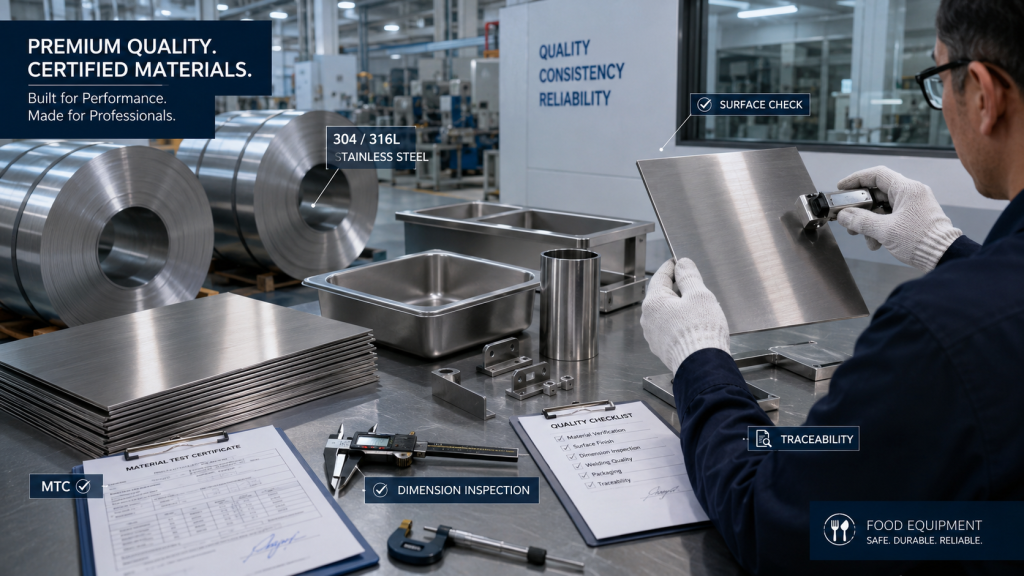
A complete purchase specification should define grade, product form, finish, dimensions, fabrication, inspection and intended food-processing environment.
- Application:
Identify whether the material will be used for cookware, a worktable, a sink, a tank, a frame, a blade or food-processing equipment. - Food-contact status:
Confirm whether the component directly contacts food, wash water or cleaning chemicals. - Food chemistry:
Provide salt, acid, fat, moisture and chloride information. - Operating temperature:
Specify cooking, steaming, freezing or ambient service temperatures. - Cleaning system:
Identify manual cleaning, pressure washing, sanitizing or CIP conditions. - Grade:
Specify 201, 304, 304L, 316L, 430 or the required blade grade. - Product standard:
Identify ASTM, EN, JIS, GB/T or another project standard. - Product form:
Sheet, plate, coil, strip, tube, bar or fabricated component. - Dimensions:
Provide thickness, width, length, diameter and tolerances. - Surface finish:
Specify 2B, BA, No.4, hairline, mirror, ground or electropolished condition. - Surface roughness:
Define the required Ra value when hygienic performance is critical. - Welding requirements:
Identify filler metal, procedure, weld finish and inspection. - Post-weld treatment:
Specify grinding, pickling, passivation or electropolishing where required. - Processing:
Include cutting, slitting, bending, forming, drilling or fabrication requirements. - Material documents:
Request an MTC, heat number and chemical and mechanical test results. - Inspection:
Define PMI, dimensional inspection, surface examination, roughness testing or third-party inspection. - Packaging:
Specify protective film, interleaving paper, edge protection and export packaging. - Quantity and delivery:
Provide the required weight, lead time and destination.
JUDE Stainless Steel Products for Kitchen Equipment
JUDE supplies stainless steel raw materials and customized processing for cookware, commercial kitchens and industrial food-processing equipment.
Stainless steel sheet and plate
Рулон нержавеющей стали
Precision stainless steel strip
Customized stainless steel sheet-metal parts- 2B, BA, No.4, hairline and mirror finishes
- Precision slitting and cut-to-length processing
- Laser, waterjet and customized cutting
- Bending and sheet-metal fabrication
- Deburred and rounded-edge processing
- Protective-film application
- Material certificates and traceability
- Dimensional and surface inspection
JUDE’s
stainless steel strip-processing service
includes uncoiling, precision slitting, leveling, rewinding and customized packaging.
Buyers can review available
stainless steel inspection reports
before placing an order.
Final Conclusion
Stainless steel is an essential material for modern kitchen utensils, commercial kitchens and industrial food-processing machinery.
304 is the most versatile general-purpose choice for food-contact equipment. 304L is valuable for heavily welded structures, while 316L provides additional protection in salty, acidic and aggressive cleaning environments.
430 can provide a cost-effective magnetic material for appliance panels and cookware base layers. 201 may be used for selected structural or non-food-contact components, while martensitic grades are used when knives and cutting tools require heat-treated hardness.
Successful material selection requires more than choosing a grade number. Food chemistry, temperature, cleaning chemicals, surface roughness, weld design, drainage, fabrication quality and regulatory requirements must all be considered.
The best kitchen equipment combines an appropriate stainless steel grade with hygienic design, smooth fabrication, verified traceability and a cleaning process suited to the real operating environment.
Frequently Asked Questions
What stainless steel is best for kitchen equipment?
304 is the most common general-purpose choice for sinks, worktables, cookware, trays and food-contact equipment. 316L is preferred for more aggressive salty, acidic or chloride-bearing environments.
Is 304 stainless steel food grade?
304 is widely used for food-contact equipment, but food-contact suitability depends on the complete application, surface condition, fabrication, cleaning system and applicable regulations.
Is 316L better than 304 for kitchen equipment?
316L offers better resistance to pitting and crevice corrosion in many chloride-bearing environments. It is useful for seafood, brine, pickles, acidic sauces and aggressive cleaning conditions, but it costs more than 304.
Can 201 stainless steel be used in commercial kitchens?
201 may be used for selected dry structural frames, cabinets and non-food-contact components. It should be evaluated carefully for wet, salty, acidic or frequently sanitized areas.
Is 430 stainless steel suitable for kitchen equipment?
Yes, for selected appliance panels, dry cabinets, cooker parts and magnetic cookware layers. It normally provides a lower corrosion margin than 304 or 316L in continuously wet environments.
Which stainless steel is used for kitchen knives?
Hardenable martensitic stainless steels such as selected 420-series grades are commonly used for kitchen knives and processing blades. Final performance depends strongly on heat treatment and edge geometry.
Why is stainless steel used in commercial kitchens?
Stainless steel combines corrosion resistance, durability, heat resistance, cleanability, formability and an attractive appearance. It can also be welded and fabricated into complex kitchen equipment.
Does stainless steel react with acidic food?
Suitable stainless steel is generally resistant to many food acids, but performance depends on grade, acid type, concentration, temperature and contact time. Aggressive acidic or salty food may require 316L or another higher-alloy grade.
Can stainless steel rust in a kitchen?
Yes. Salt, chlorides, standing water, iron contamination, rough welds and incompatible cleaning chemicals can cause staining or localized corrosion.
What is the best surface finish for commercial kitchen equipment?
2B and No.4 are common choices. The correct finish depends on food contact, appearance, roughness, cleaning method and customer specification.
Is mirror-polished stainless steel more hygienic?
Not automatically. A hygienic surface must be smooth, defect-free, cleanable and properly fabricated. Visual brightness alone does not prove hygienic performance.
Why are welds important in food equipment?
Rough, incomplete or oxidized welds can trap food and cleaning liquid and may have reduced corrosion resistance. Food-contact welds should be designed, finished and inspected according to the application.
Can bleach damage stainless steel kitchen equipment?
Chloride-containing cleaners can damage stainless steel when concentration, temperature or contact time is excessive. Cleaning products should be validated for the specific alloy and process.
What documents should I request when buying stainless steel?
Request the applicable material standard, mill test certificate, heat number, chemical composition, mechanical properties and required inspection reports.
What information should I provide when requesting a quotation?
Provide the grade, standard, product form, dimensions, finish, roughness, quantity, fabrication requirements, intended food, operating temperature, cleaning process, inspection and destination.
Where can I find commercial stainless steel kitchen equipment?
HSYL Foodline provides commercial kitchen equipment and industrial food-processing machinery for washing, cutting, cooking, freezing, mixing, drying, seafood processing and packaging applications.
Request Stainless Steel Materials or Kitchen Equipment Solutions
Send JUDE your required grade, product standard, dimensions, quantity, surface finish, fabrication requirements, inspection documents and destination.
For complete commercial kitchen machines or turnkey food-processing lines, review the equipment and engineering solutions available from HSYL Foodline.
