
Seamless vs Welded Stainless Steel Pipe: How to Choose?
Stainless steel pipes are widely used in industries such as oil and gas, construction, chemical processing, food production, and water transportation.
Among the most common types are seamless stainless steel pipes and welded stainless steel pipes.
Although they serve similar functions, the two types differ significantly in their manufacturing process, strength, cost, and application scenarios.
Understanding the differences between seamless and welded stainless steel pipes helps engineers, procurement specialists, and project managers choose the most suitable product for their specific applications.
What Is Seamless Stainless Steel Pipe?
Seamless stainless steel pipes are manufactured from a solid round billet. The billet is heated and then pierced to form a hollow tube.
Afterward, the pipe is stretched and rolled until it reaches the required diameter and wall thickness.
Because the pipe is produced without welding, it has no longitudinal seam, which results in better structural integrity and pressure resistance.
Key Features of Seamless Stainless Steel Pipe
- No weld seam
- Uniform structure and high mechanical strength
- Excellent pressure resistance
- Suitable for high-temperature environments
- Typically higher manufacturing cost
Typical Applications
- Oil and gas pipelines
- Petrochemical processing equipment
- Boilers and heat exchangers
- High-pressure fluid transportation
- Power generation plants
What Is Welded Stainless Steel Pipe?
Welded stainless steel pipes are produced by rolling stainless steel plates or coils into a cylindrical shape and welding the edges together.
Modern welding technologies such as TIG welding, laser welding, or high-frequency welding are commonly used.
After welding, the seam may undergo heat treatment and polishing to improve its strength and appearance.
Key Features of Welded Stainless Steel Pipe
- Manufactured from stainless steel sheets or coils
- Contains a weld seam
- Lower production cost
- More flexible in diameter and wall thickness
- Suitable for many industrial applications
Typical Applications
- Construction and structural engineering
- Water supply systems
- Food and beverage processing
- Architectural decoration
- General industrial piping systems
Key Differences Between Seamless and Welded Stainless Steel Pipes
| Feature | Seamless Stainless Steel Pipe | Welded Stainless Steel Pipe |
|---|---|---|
| Manufacturing Method | Made from solid billet without welding | Made by rolling and welding steel plates or coils |
| Weld Seam | No weld seam | Contains a weld seam |
| Pressure Resistance | Higher | Moderate |
| Стоимость | Higher production cost | More economical |
| Available Sizes | Limited range | Wide range of sizes available |
| Main Applications | High-pressure and critical environments | General industrial and structural uses |
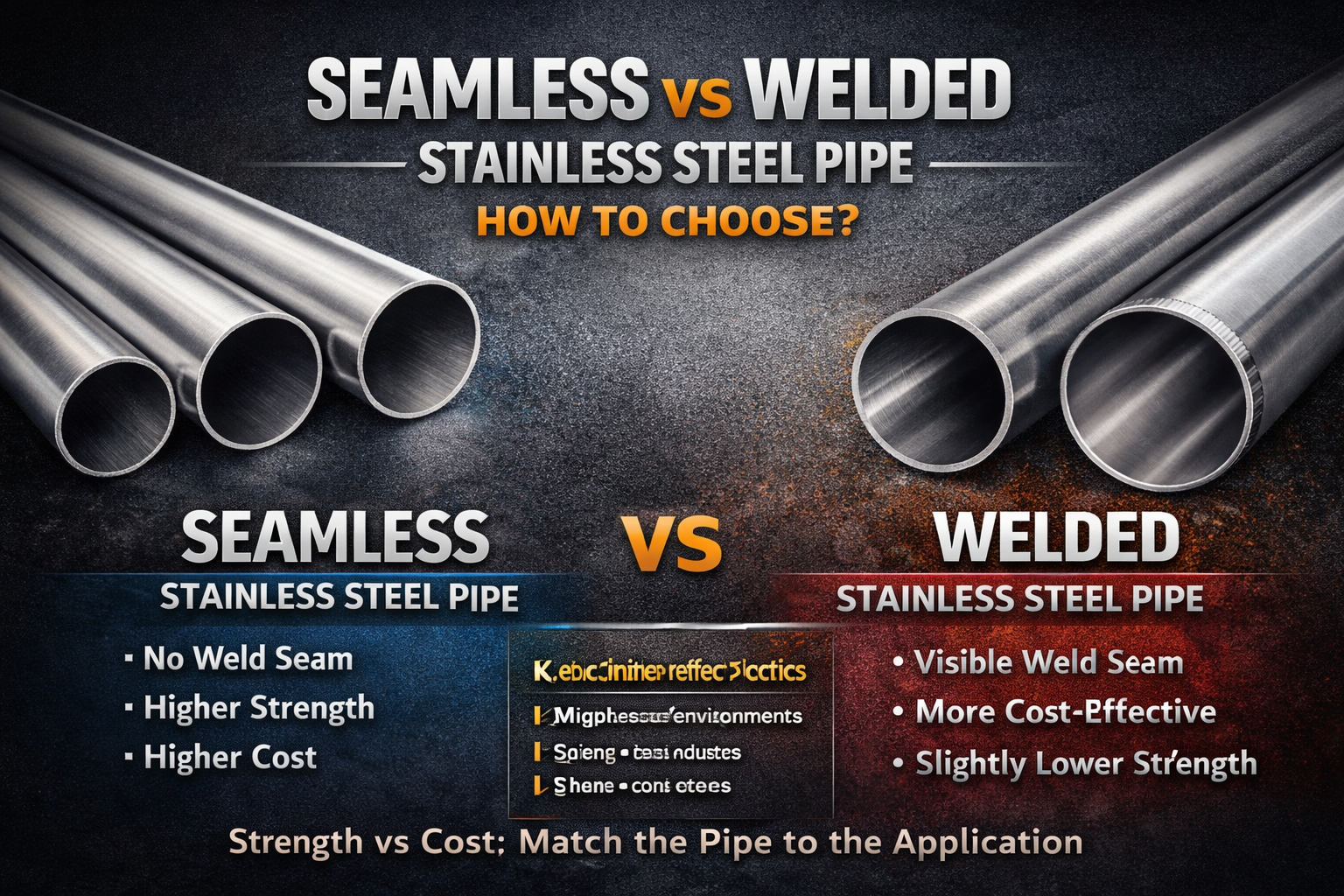
Advantages of Seamless Stainless Steel Pipe
- Higher structural strength
- No risk of weld seam failure
- Better performance under high pressure
- Suitable for critical industrial systems
Advantages of Welded Stainless Steel Pipe
- Lower manufacturing cost
- Greater flexibility in production size
- More efficient mass production
- Suitable for most general applications
How to Choose Between Seamless and Welded Stainless Steel Pipes
1. Pressure and Temperature Requirements
For high-pressure or high-temperature environments, seamless pipes are generally the preferred choice because they provide stronger structural integrity.
2. Budget Considerations
If cost efficiency is important and the operating conditions are moderate, welded stainless steel pipes may be a more practical option.
3. Application Environment
Industries such as oil, gas, and power generation often require seamless pipes, while construction and water systems frequently use welded pipes.
4. Required Dimensions
Welded pipes typically offer a wider range of diameters and wall thickness options, making them suitable for customized applications.
Common Stainless Steel Grades Used in Pipes
Both seamless and welded stainless steel pipes are available in various stainless steel grades, including:
- 304 Stainless Steel – widely used for general corrosion resistance
- 316 Stainless Steel – improved corrosion resistance for marine and chemical environments
- 321 Stainless Steel – suitable for high-temperature applications
- 310S Stainless Steel – excellent heat resistance
Заключение
Both seamless and welded stainless steel pipes have their own advantages depending on the application requirements.
Seamless pipes offer superior strength and reliability for high-pressure and critical systems, while welded pipes provide a more economical solution for general industrial and structural uses.
By carefully evaluating factors such as operating pressure, project budget, environmental conditions, and pipe dimensions, buyers and engineers can select the most suitable stainless steel pipe for their specific projects.
FAQ
1. Is seamless stainless steel pipe stronger than welded pipe?
Yes. Seamless pipes typically have higher pressure resistance because they do not contain a weld seam that could potentially weaken the structure.
2. Are welded stainless steel pipes reliable?
Modern welding technology has greatly improved the quality of welded pipes, making them reliable for many industrial and structural applications.
3. Why are seamless pipes more expensive?
Seamless pipes require a more complex manufacturing process and specialized equipment, which increases production costs.
4. Which pipe type is better for high-pressure systems?
Seamless stainless steel pipes are usually preferred for high-pressure systems such as oil pipelines, boilers, and petrochemical facilities.
5. Can welded pipes replace seamless pipes?
In many general applications, welded pipes can replace seamless pipes, especially when pressure requirements are moderate and cost efficiency is important.
