
MOQ, Packing & Delivery of Stainless Steel Products: A Professional Guide for Global Buyers
In the global stainless steel trade, understanding Minimum Order Quantity (MOQ), packaging standards, and delivery logistics is essential for efficient procurement and cost control. Whether sourcing from China or other major producing regions, buyers must carefully evaluate these factors to ensure product quality, safe transportation, and timely delivery.
This guide provides a comprehensive overview of MOQ policies, professional packing methods, and delivery solutions for stainless steel products, helping buyers optimize their supply chain and reduce risks.
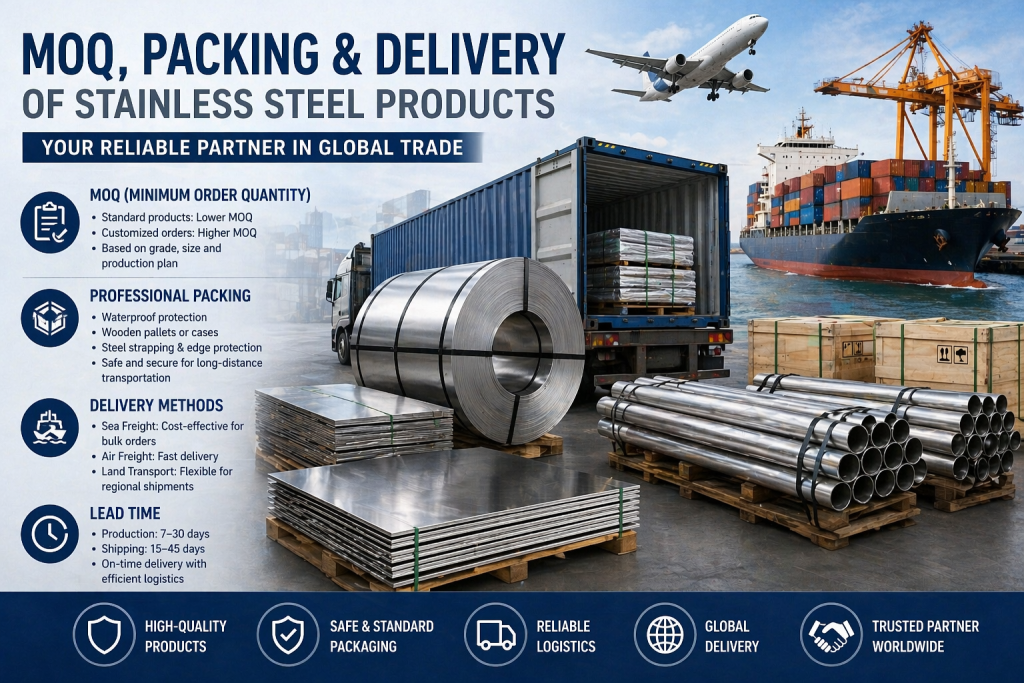
1. What is MOQ in Stainless Steel Trade?
MOQ (Minimum Order Quantity) refers to the smallest quantity a supplier is willing to produce or sell per order. In the stainless steel industry, MOQ varies depending on product type, grade, and processing requirements.
- Standard Products: Lower MOQ, typically for common grades like 304 and 316
- Customized Orders: Higher MOQ due to special dimensions or surface finishes
- Factory Production Runs: Often aligned with mill batch sizes
Understanding MOQ helps buyers plan inventory, reduce costs, and negotiate better pricing.
2. Factors Influencing MOQ
Several factors determine MOQ in stainless steel procurement:
- Raw material availability and mill production schedules
- Product specifications (thickness, width, grade)
- Surface finishing and customization requirements
- Supplier capacity and export experience
Bulk orders usually benefit from lower unit costs, while smaller orders may incur additional processing fees.
3. Professional Packing Methods
Proper packaging is critical to protect stainless steel products from damage, corrosion, and contamination during transportation and storage.
- Waterproof Packaging: Plastic film and waterproof paper to prevent moisture
- Wooden Pallets or Cases: Strong support for heavy products
- Steel Strapping: Secures coils, sheets, and plates during transit
- Edge Protection: Prevents damage to corners and surfaces
High-quality packing ensures that products arrive in optimal condition, reducing losses and claims.
4. Packaging Standards and Customization
International buyers often require specific packaging standards based on their local regulations or industry practices.
- Export-standard seaworthy packaging
- Fumigated wooden pallets (ISPM 15 compliant)
- Custom labeling and barcoding
- Brand-specific packaging solutions
Customized packaging enhances product protection and improves logistics efficiency.
5. Delivery Methods and Logistics Options
Choosing the right delivery method is essential for balancing cost and delivery time.
- Sea Freight: Most cost-effective for bulk orders
- Air Freight: Faster but significantly more expensive
- Land Transport: Suitable for regional shipments
Most stainless steel exports are shipped via sea freight due to weight and volume considerations.
6. Lead Time and Delivery Schedule
Delivery time depends on production and shipping factors:
- Production lead time (typically 7–30 days)
- Shipping time (15–45 days depending on destination)
- Customs clearance and inland transportation
Accurate planning and communication with suppliers can help avoid delays.
7. Incoterms and Shipping Responsibilities
International trade terms define responsibilities between buyers and sellers:
- EXW (Ex Works): Buyer handles all logistics
- FOB (Free on Board): Seller delivers goods to port
- CIF (Cost, Insurance, Freight): Seller covers shipping and insurance
Selecting the right Incoterm is crucial for cost control and risk management.
8. Risk Management in Packing and Delivery
Proper planning reduces risks associated with international shipments:
- Use moisture-proof packaging to prevent rust
- Ensure proper container loading and securing
- Purchase cargo insurance
- Work with experienced freight forwarders
Risk mitigation ensures safe delivery and protects financial interests.
FAQ
Q1: What is a typical MOQ for stainless steel products?
MOQ varies by supplier and product, but standard items usually have lower MOQ compared to customized orders.
Q2: Why is proper packaging important?
It protects stainless steel from damage, corrosion, and contamination during transportation.
Q3: What is the most common shipping method?
Sea freight is the most widely used method for bulk stainless steel shipments.
Q4: How can I reduce shipping risks?
Use high-quality packaging, proper loading methods, and cargo insurance.
Q5: Which Incoterm is best for buyers?
It depends on experience and logistics capability; CIF is often preferred for convenience, while FOB offers more control.
Заключение
Understanding MOQ, packing, and delivery is essential for successful stainless steel procurement. By selecting appropriate order quantities, ensuring professional packaging, and optimizing logistics, buyers can achieve cost efficiency, product safety, and reliable supply in the global market.
