
Mild Steel vs Stainless Steel: Strength, Rust & Full Cost Comparison Performance (2026 Industrial Guide)
Mild steel and stainless steel are the two most widely used metal materials across global construction, machinery manufacturing, food processing, marine engineering and general industrial fabrication. Every procurement manager, structural engineer and project contractor will face the dilemma of choosing between these two mainstream steel types. The core decision factors always focus on mechanical strength, rust & corrosion resistance and overall cost performance.
As a professional stainless steel supplier founded in 2007, JUDE STEEL maintains 50,000 tons of stainless steel sheets and coils in our Wuxi warehouse all year round. We provide a full range of stainless steel grades including 200 series, 300 series, 400 series and special grades like 904L, 2205 and 2507, with complete cutting, bending, surface treatment and heat treatment processing capabilities certified by ISO9001-2015. In this in-depth guide, we will conduct a data-driven comparison between mild steel and stainless steel, helping you select the most cost-effective material for your projects.
1. Basic Definition & Core Chemical Composition
The essential difference between mild steel and stainless steel lies in chemical composition, which fundamentally determines their subsequent performance in rust resistance, strength and service life.
1.1 What is Mild Steel?
Mild steel, also known as low-carbon steel, is defined by a carbon content ranging from 0.05% to 0.25% by weight. It contains no high-content chromium, nickel or other anti-corrosion alloy elements. Common international grades include ASTM A36, GB Q235 and EN S235JR. Its simple chemical composition leads to low production costs and excellent ductility, making it a universal structural material for basic industrial scenarios.
1.2 What is Stainless Steel?
Stainless steel is a family of alloy steels with a minimum 10.5% chromium content. Chromium reacts with oxygen in the air to form a dense, self-healing passive oxide film on the surface, which is the key to its inherent rust resistance. Different grades add nickel, molybdenum and other elements to enhance performance. JUDE STEEL supplies full-series stainless steel products covering austenitic, ferritic, martensitic and duplex stainless steel for diversified harsh working conditions.
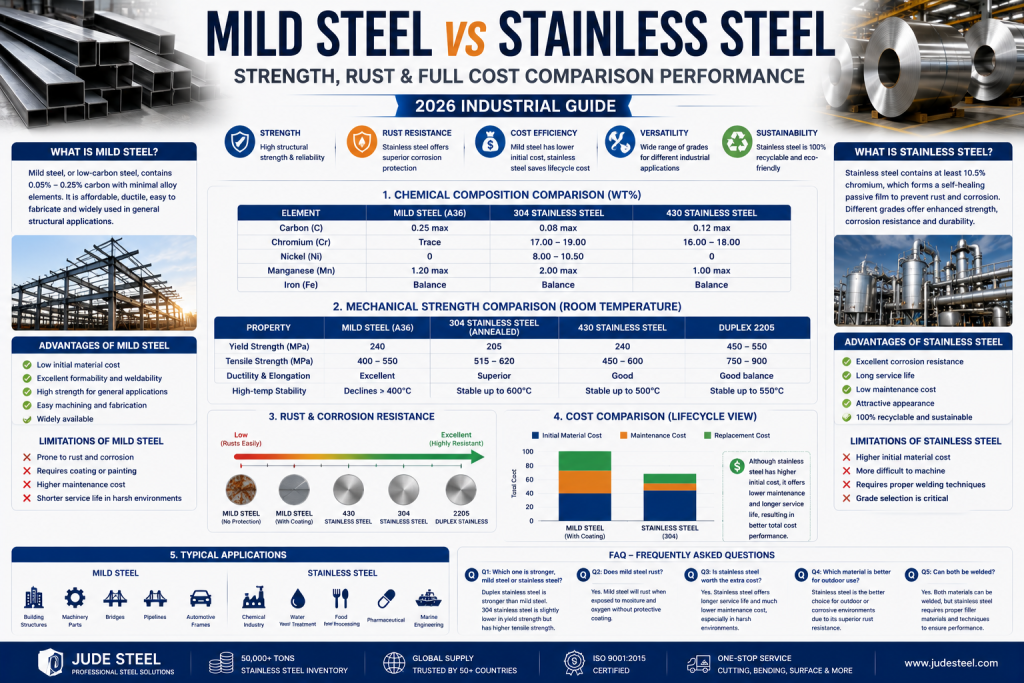
| Main Element (wt%) | Mild Steel (ASTM A36) | Нержавеющая сталь 304 | Нержавеющая сталь 430 |
|---|---|---|---|
| Carbon (C) | 0.25 max | 0.08 max | 0.12 max |
| Chromium (Cr) | Trace amount | 17.00 – 19.00 | 16.00 – 18.00 |
| Nickel (Ni) | 0 | 8.00 – 10.50 | 0 |
| Manganese (Mn) | 1.20 max | 2.00 max | 1.00 max |
2. Mechanical Strength Performance Comparison
Mechanical strength includes yield strength, tensile strength, ductility and high-temperature stability, which directly affects the load-bearing capacity and service safety of components. Below is the standard performance data of mainstream grades under room temperature, referring to ASTM industry standards.
| Performance Index | Mild Steel (A36) | 304 Stainless Steel (Annealed) | Нержавеющая сталь 430 | Duplex 2205 |
|---|---|---|---|---|
| Yield Strength (MPa) | 240 | 205 | 240 | 450 – 550 |
| Tensile Strength (MPa) | 400 – 550 | 515 – 620 | 450 – 600 | 750 – 900 |
| Ductility & Elongation | Превосходно | Superior | Good | Good balance |
| High-temperature Stability | Decline rapidly above 400°C | Stable up to 600°C | Stable up to 500°C | Stable up to 550°C |
Key Strength Analysis
- Mild Steel: It has stable yield strength for conventional static load structures. Its outstanding ductility makes it easy to bend and shape, which is suitable for complex structural parts that require large-scale cold forming. However, its strength drops sharply in high-temperature environments.
- Conventional Stainless Steel (304/430): 304 stainless steel has slightly lower yield strength than A36 mild steel but higher tensile strength and better low-temperature toughness. 430 ferritic stainless steel has strength parameters close to mild steel, with cost advantages among stainless steel grades.
- High-performance Duplex Stainless Steel: Grades like 2205 and 2507 provided by JUDE STEEL have far higher yield and tensile strength than mild steel, realizing the dual advantages of high strength and corrosion resistance for heavy-duty and harsh-environment equipment.
3. Rust & Corrosion Resistance (The Most Obvious Difference)
Rust and corrosion resistance is the core dividing line between mild steel and stainless steel, which determines the service life and maintenance cycle of components in different environments.
3.1 Rust Performance of Mild Steel
Mild steel has almost no natural anti-rust ability. When exposed to air, moisture, rainwater or salt spray, it will oxidize and rust rapidly. To extend its service life, additional protective measures are mandatory, including hot-dip galvanizing, epoxy paint coating, anti-rust oil and other surface treatments. For outdoor, coastal or chemical environments, regular re-coating and rust removal maintenance are required every 2 to 5 years, otherwise the components will fail due to severe corrosion.
3.2 Rust Performance of Stainless Steel
Relying on the chromium passive film, stainless steel achieves inherent anti-rust and anti-corrosion performance. The passive film can repair itself automatically after minor scratches in oxygen-rich environments, eliminating the need for frequent anti-rust coating:
- 304 Stainless Steel: Resists atmospheric corrosion and fresh water erosion, suitable for most indoor and ordinary outdoor industrial scenarios.
- 316L Stainless Steel: Added molybdenum element, effectively resists chloride corrosion, ideal for coastal marine equipment and brine processing facilities.
- 430 Stainless Steel: Cost-effective anti-rust grade for dry indoor equipment and household metal parts.
- Special Grades (904L/2205/2507): Adapt to strong acid, high salt and other extremely corrosive chemical working conditions.
4. Comprehensive Cost Analysis: Upfront Price & Lifecycle Cost
Most buyers only focus on the initial raw material price, while ignoring the long-term maintenance, replacement and downtime costs. JUDE STEEL divides the cost system into two dimensions for comprehensive evaluation.
4.1 Upfront Raw Material Cost
Mild steel has the lowest unit price among industrial steels, about 35% to 60% cheaper than standard 304 stainless steel. The high content of chromium, nickel and other precious alloy elements leads to higher smelting costs of stainless steel. Among stainless steel products, 430 ferritic stainless steel has a moderate price, while duplex and high-alloy special stainless steel have the highest initial procurement cost.
4.2 Total Lifecycle Ownership Cost
- Dry indoor enclosed environment: Mild steel with one-time anti-rust coating has lower total cost, which is the preferred choice for factory internal structural frames and sealed mechanical parts.
- Outdoor, humid, coastal and chemical environments: Although stainless steel has a higher initial investment, it saves repeated painting, rust repair and component replacement costs. Statistics from JUDE STEEL’s global clients show that stainless steel can reduce the total 10 to 15-year lifecycle cost by more than 40% compared with coated mild steel in corrosive environments.
5. Machinability, Weldability & Fabrication
Mild Steel
Mild steel is recognized for excellent machinability and weldability. It can be cut, bent, welded and punched with ordinary equipment and common welding processes, requiring no complex pre-treatment or post-processing. The low processing difficulty effectively reduces labor and production costs for mass production.
Stainless Steel
Stainless steel has higher hardness and thermal conductivity, bringing higher requirements for cutting tools and welding technology. Austenitic stainless steel is prone to work hardening during processing. As a one-stop processing service provider, JUDE STEEL is equipped with complete advanced slitting, CNC cutting, precision bending, welding and heat treatment equipment to solve the processing difficulties of all stainless steel grades and deliver finished products directly to global customers.
6. Typical Industrial Application Scenarios
6.1 Preferred Scenarios for Mild Steel
- Building structural beams, steel frames and engineering support components
- Ordinary mechanical bases, brackets and dry-environment gear parts
- Low-budget projects with convenient regular anti-rust maintenance
6.2 Preferred Scenarios for Stainless Steel (JUDE STEEL Main Supply Fields)
- Food & beverage processing equipment, pharmaceutical sanitary pipelines (hygiene and anti-rust required)
- Coastal marine piping, ship accessories and outdoor architectural cladding
- Chemical reactors, heat exchangers and high-temperature production lines
- Kitchen utensils, precision sheet metal parts and washdown industrial equipment
7. Frequently Asked Questions (FAQ) – Google Rich Snippet Optimized
Q1: Which material is stronger, mild steel or stainless steel?
A1: It depends on specific grades. Standard A36 mild steel has similar yield strength to 430 stainless steel and slightly higher than annealed 304 stainless steel. Duplex stainless steel like 2205 has much higher overall strength than ordinary mild steel. For high-temperature working conditions, stainless steel shows far better strength stability.
Q2: Does mild steel need anti-rust treatment?
A2: Yes, absolutely. Mild steel will rust quickly when contacting moisture and air. It must be painted, galvanized or coated with anti-rust oil. Regular maintenance is required for long-term outdoor use.
Q3: Which one is more cost-effective for outdoor projects?
A3: For short-term outdoor projects within 3-5 years, coated mild steel is more economical. For long-term outdoor, coastal or rainy areas, stainless steel is a better choice due to its low maintenance and long service life.
Q4: Is stainless steel harder to weld than mild steel?
A4: Yes. Stainless steel has higher work hardening characteristics and stricter welding parameter requirements. Professional processing equipment and skilled operators are needed. JUDE STEEL provides finished stainless steel products and customized welding services to help clients avoid processing troubles.
Q5: Which stainless steel grade can replace mild steel for general anti-rust use?
A5: 430 ferritic stainless steel is the most cost-effective option, with strength close to mild steel and basic anti-rust performance. JUDE STEEL keeps sufficient 430 stainless steel sheets and strips in stock for fast delivery.
Q6: How to get customized stainless steel solutions from Jude Steel?
A6: You can send your project drawings, working environment parameters and size requirements via judesteel.com. Our professional technical team will recommend the most suitable steel grade and provide a formal quotation within 24 working hours.
Final Material Selection Guidance
Choose mild steel if your project is located in dry indoor environments, with limited upfront budget and accessible regular anti-rust maintenance. It is the ideal choice for conventional structural load-bearing components.
Choose stainless steel if the equipment runs in humid, coastal, chemical, sanitary or high-temperature environments. You can select different grades from cost-effective 430, versatile 304/316L to high-strength duplex stainless steel according to actual working conditions to balance performance and cost.
With 18 years of industry experience, ISO9001 certified quality control and 50,000 tons of spot inventory, JUDE STEEL supplies full-series stainless steel sheets, coils, strips and customized fabricated parts. We support one-stop services including cutting, bending, surface processing and heat treatment for global industrial clients. Contact us to get reliable metal material solutions for your next project.
