
Inconel vs Stainless Steel: 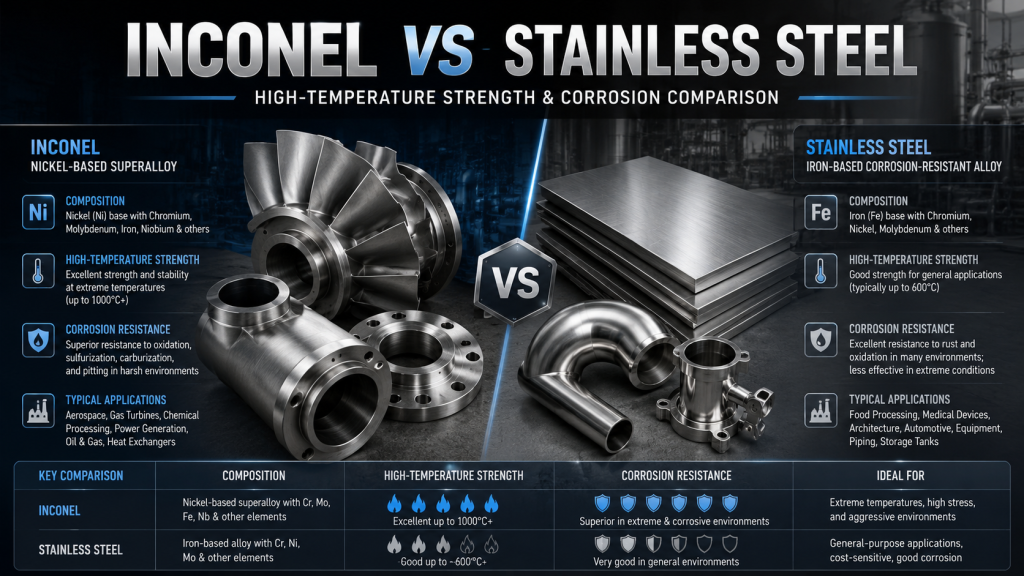
When comparing Inconel vs stainless steel, the decision is rarely about appearance or basic corrosion resistance alone. It is usually about whether the material must survive extreme heat, aggressive chemicals, pressure, oxidation, fatigue or long-term mechanical stress.
Inconel is a family of nickel-based superalloys engineered for severe operating environments. Stainless steel is an iron-based corrosion-resistant alloy designed for broad industrial use, good strength, clean surface performance and cost efficiency.
This guide compares Inconel and stainless steel in terms of chemical composition, high-temperature strength, corrosion resistance, oxidation behavior, mechanical properties, fabrication, cost and application selection. For more stainless steel grade information, visit the Jude Steel Stainless Steel Grade Center.
Fast Comparison: Inconel vs Stainless Steel
| Feature | Inconel | Stainless Steel |
|---|---|---|
| Material Family | Nickel-based superalloy | Iron-based alloy with chromium |
| Main Advantage | Extreme temperature strength and harsh corrosion resistance | Cost-effective corrosion resistance and easy fabrication |
| Base Metal | Nickel | Iron |
| Nickel Content | Very high | Low to moderate depending on grade |
| High-Temperature Strength | Превосходно | Good to limited depending on grade and temperature |
| Oxidation Resistance | Excellent at elevated temperatures | Moderate to good depending on grade |
| Устойчивость к коррозии | Excellent in severe chemical, seawater and high-heat environments | Good to excellent in general industrial environments |
| Machining Difficulty | Difficult; strong work hardening | Easier and more economical |
| Material Cost | Very high | Moderate and widely available |
| Typical Applications | Aerospace, gas turbines, chemical reactors, offshore systems | Food equipment, tanks, pipelines, architecture, industrial fabrication |
1. What Is Inconel?
Inconel is a group of nickel-based superalloys designed for high-temperature strength, oxidation resistance and severe corrosion resistance. These alloys are commonly used in systems where ordinary stainless steel may lose strength, oxidize rapidly or fail under aggressive chemical exposure.
Inconel alloys typically contain high nickel, chromium and other elements such as molybdenum, niobium, iron, cobalt or titanium depending on the grade. Jude Steel provides related material information for Inconel 625 and Inconel 718.
Main Characteristics of Inconel
- Excellent high-temperature strength
- Strong resistance to oxidation and scaling
- Superior creep and fatigue resistance
- Excellent resistance to seawater, acids and chloride environments
- Stable performance in high-pressure and high-heat systems
- Suitable for critical safety-sensitive applications
- Much higher material and machining cost than stainless steel
Common Inconel Grades
| Inconel Grade | Key Feature | Typical Applications |
|---|---|---|
| Inconel 600 | General oxidation and corrosion resistance | Heat treatment equipment, chemical processing, furnace parts |
| Inconel 625 | Strong corrosion resistance with nickel-chromium-molybdenum alloy design | Marine systems, offshore equipment, chemical processing, heat exchangers |
| Inconel 718 | High strength, fatigue resistance and creep resistance | Aerospace engines, turbines, high-pressure components |
| Inconel X-750 | High-temperature strength and relaxation resistance | Springs, fasteners, turbine components |
2. What Is Stainless Steel?
Stainless steel is an iron-based alloy containing at least 10.5% chromium. Chromium forms a thin passive oxide layer on the surface, helping the material resist corrosion in atmospheric, industrial and hygienic environments.
Compared with Inconel, stainless steel is easier to source, easier to fabricate and more economical for most general applications. Jude Steel supplies stainless steel products including stainless steel sheet, stainless steel coil, stainless steel strip and stainless steel sheet metal.
Common Stainless Steel Grades
| Класс | Type | Typical Use |
|---|---|---|
| Нержавеющая сталь 304 | Austenitic | General industrial use, food equipment, tanks, architecture |
| 316L Stainless Steel | Austenitic | Marine, chemical and chloride-exposure environments |
| 2205 Duplex Stainless Steel | Дуплекс | High-strength structural and corrosion-resistant applications |
| 310S Stainless Steel | Heat-resistant austenitic | Furnace parts, heat-resistant components, oxidation environments |
3. Chemical Composition Comparison
The biggest difference between Inconel and stainless steel is the base metal. Inconel is nickel-based, while stainless steel is iron-based. This difference strongly affects high-temperature strength, corrosion behavior, oxidation resistance and cost.
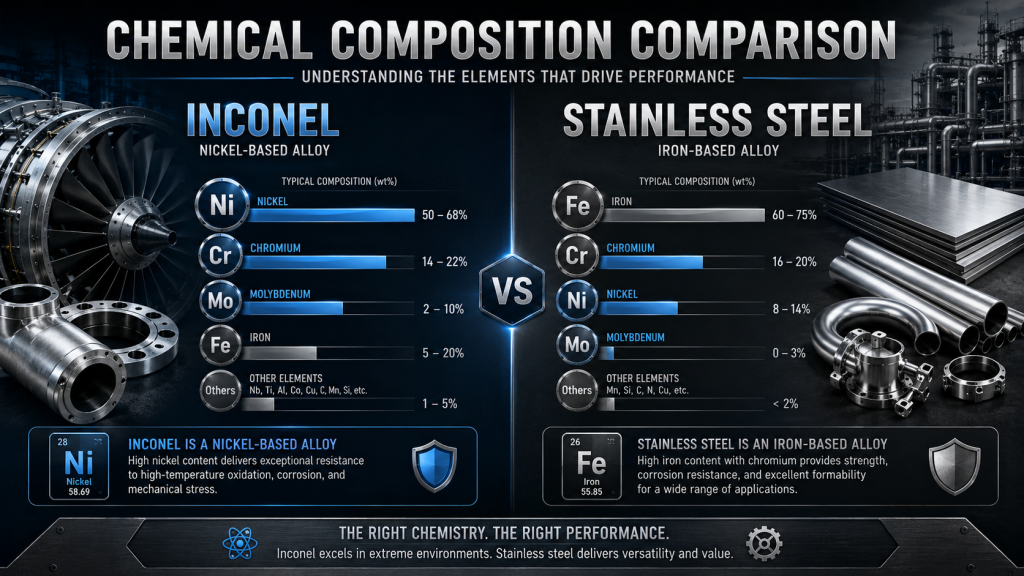
| Element / Feature | Inconel | Stainless Steel |
|---|---|---|
| Base Metal | Nickel | Iron |
| Nickel | Very high | Low, moderate or high depending on grade |
| Chromium | Commonly present for oxidation and corrosion resistance | Essential element for passive film formation |
| Molybdenum | Often added in high-corrosion grades such as Inconel 625 | Added in grades such as 316L and duplex stainless steels |
| Iron | Lower than stainless steel | Main base element |
| Strengthening Elements | May include niobium, titanium, aluminum or cobalt | Depends on grade; may include nickel, molybdenum, nitrogen or carbon |
| Primary Design Goal | Extreme performance under heat, pressure and corrosion | Balanced corrosion resistance, strength, fabrication and cost |
Why Nickel-Based Design Matters
Nickel helps maintain mechanical stability at elevated temperatures. This is why Inconel can retain strength and resist creep in environments where standard stainless steels may soften, oxidize or lose load-bearing performance.
4. High-Temperature Strength: The Critical Difference
High-temperature strength is the most important reason engineers choose Inconel instead of stainless steel. At elevated temperatures, many stainless steel grades gradually lose mechanical strength and may suffer oxidation, scaling or creep deformation.
Inconel is specifically designed to resist these problems. It maintains strength, oxidation resistance and microstructural stability in severe thermal environments.
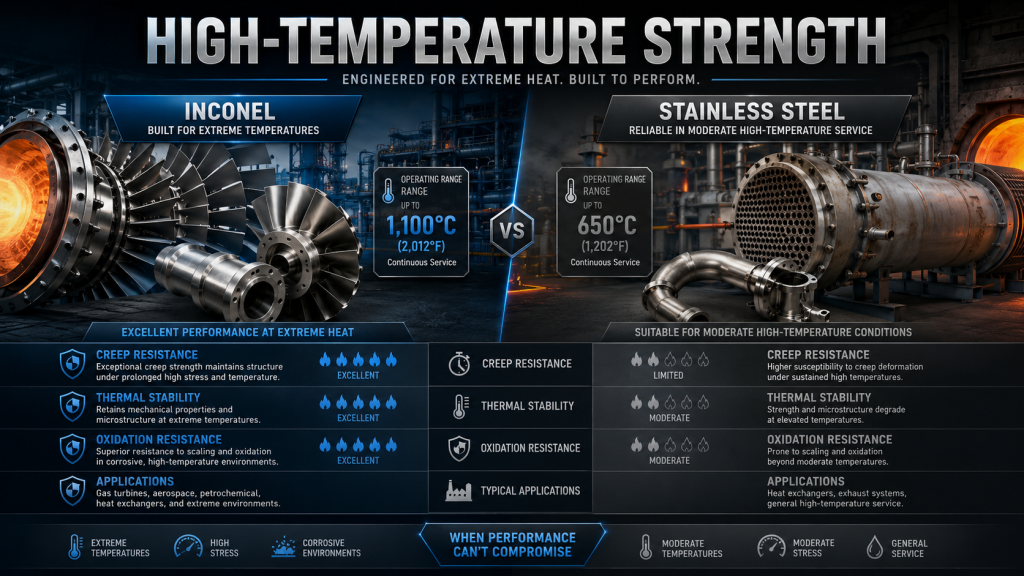
| Недвижимость | Inconel | Stainless Steel |
|---|---|---|
| High-Temperature Strength | Превосходно | Moderate to good depending on grade |
| Creep Resistance | Excellent in selected grades | Limited compared with Inconel |
| Oxidation Resistance | Excellent at elevated temperatures | Good in heat-resistant grades, limited in standard grades |
| Thermal Fatigue Resistance | Excellent for severe service | Application-dependent |
| Extreme Heat Reliability | Very high | Lower unless special heat-resistant grades are used |
Engineering Insight
- For moderate temperature, stainless steel is often sufficient.
- For repeated high-temperature cycling, special stainless grades may be considered.
- For extreme heat, creep and safety-critical systems, Inconel is often the safer choice.
- When temperature exceeds approximately 600–700°C, material selection should be carefully evaluated.
5. Mechanical Properties: Strength, Creep and Fatigue
Inconel grades such as Inconel 718 are known for excellent tensile strength, yield strength, fatigue resistance and creep resistance. This makes them suitable for aerospace, turbine and pressure-bearing components.
Stainless steel grades such as 304, 316L and 2205 can provide strong mechanical performance for general industrial use, but they are not usually designed to match Inconel under extreme temperature and stress.
| Mechanical Factor | Inconel | Stainless Steel |
|---|---|---|
| Room-Temperature Strength | High | Good to high depending on grade |
| High-Temperature Strength Retention | Превосходно | Lower than Inconel |
| Creep Resistance | Превосходно | Limited in standard grades |
| Fatigue Resistance | Excellent in grades such as Inconel 718 | Good, but application-dependent |
| Structural Cost Efficiency | Low due to high cost | High for most applications |
6. Corrosion Resistance Comparison
Both Inconel and stainless steel resist corrosion, but they are designed for different levels of severity. Stainless steel performs well in atmospheric, food, water, architectural and general industrial environments. Inconel performs better in harsh chemical, seawater, chloride, acid and high-temperature oxidation environments.
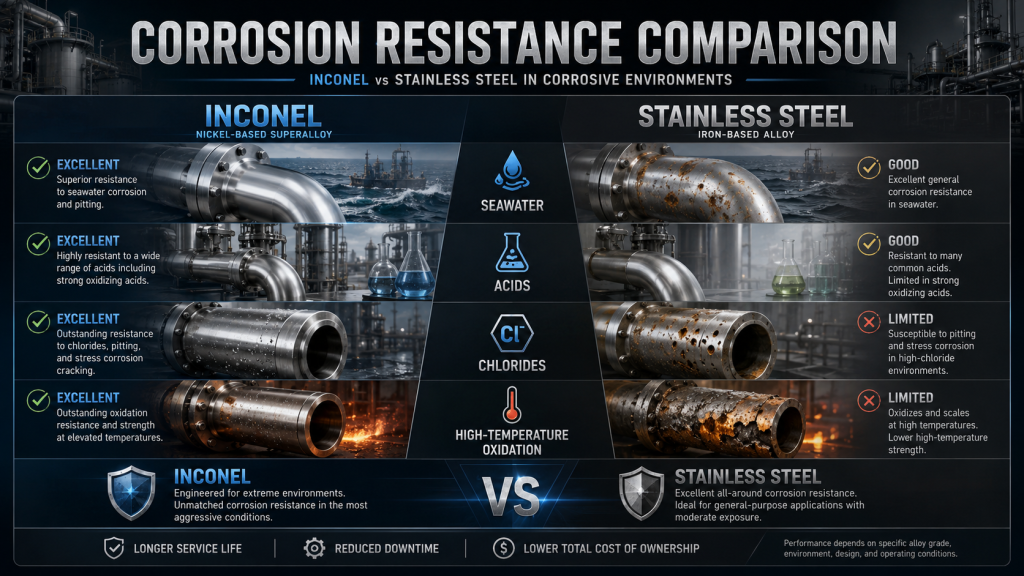
| Environment | Inconel | Stainless Steel |
|---|---|---|
| Dry Indoor Environment | Excellent, but usually unnecessary | Excellent with proper grade selection |
| General Industrial Atmosphere | Превосходно | Good to excellent |
| Food Processing | Usually unnecessary | 304 or 316L commonly used |
| Marine / Seawater | Excellent in suitable grades such as Inconel 625 | 316L or duplex grades often used for cost-effective service |
| Acidic Chemical Processing | Excellent in selected grades | Grade-dependent and may be limited |
| High-Temperature Oxidation | Превосходно | Good only in selected heat-resistant grades |
| Chloride Stress Corrosion | Strong resistance in many Inconel grades | Austenitic stainless steels may be sensitive under certain conditions |
Important Selection Point
If the environment contains chlorides, acids, seawater or high-temperature oxidation, stainless steel grade selection becomes critical. 316L, duplex 2205 or super stainless steels may solve many problems, but Inconel may be necessary when corrosion severity and temperature increase together.
7. Oxidation and Scaling Resistance
Oxidation resistance describes how well a material resists reacting with oxygen at high temperature. Scaling occurs when oxide layers grow, crack or spall from the surface. In severe heat systems, scale failure can reduce wall thickness, contaminate the process or accelerate mechanical failure.
| Factor | Inconel | Stainless Steel |
|---|---|---|
| Oxide Layer Stability | Very stable in high-temperature service | Grade-dependent; standard grades may degrade faster |
| Scaling Resistance | Превосходно | Moderate to good in heat-resistant grades |
| Thermal Cycling | Excellent for severe cycles | Application-dependent |
| Best Use | Turbines, furnaces, reactors, exhaust hot zones | Moderate heat, food equipment, tanks, general structures |
For high-temperature reactors, heat exchangers, gas turbines and furnace parts, Inconel often provides a longer and safer service life than standard stainless steel.
8. Fabrication, Welding and Machining
Stainless steel is usually easier and more economical to fabricate. It can be cut, bent, welded, polished, brushed and formed with widely available equipment and processes. Jude Steel provides related services such as laser cutting, bending, brushing and polishing.
Inconel is more difficult to machine because it work-hardens quickly, has high strength and poor thermal conductivity compared with many steels. It often requires slower cutting speeds, rigid tooling, controlled heat input and experienced machining procedures.
| Processing Factor | Inconel | Stainless Steel |
|---|---|---|
| Machinability | Difficult | Moderate to good |
| Work Hardening | Strong | Moderate depending on grade |
| Tooling Requirement | Specialized tooling often required | Standard industrial tooling often sufficient |
| Welding | Possible but requires strict procedure control | Generally easier with common grades |
| Fabrication Cost | High | Lower |
| Availability | More limited | Widely available in sheet, coil, strip, pipe and plate forms |
9. Cost Comparison: Why Inconel Is Much More Expensive
Inconel is significantly more expensive than stainless steel because of its high nickel content, complex alloy design, difficult machining and demanding quality control requirements. Stainless steel is more economical because it is produced in far larger volumes and is easier to process.
| Cost Factor | Inconel | Stainless Steel |
|---|---|---|
| Raw Material Cost | Very high | Moderate |
| Nickel Cost Exposure | Very high | Low to moderate depending on grade |
| Machining Cost | High | Lower |
| Lead Time | Often longer | Usually shorter |
| Availability | Limited compared with stainless steel | Widely available |
| Best Cost Scenario | Critical environments where failure cost is very high | General industrial projects requiring corrosion resistance and durability |
10. Typical Inconel Applications
- Aerospace engine components
- Gas turbine parts
- Heat exchangers in severe environments
- Chemical processing reactors
- Offshore and seawater equipment
- Nuclear systems
- High-temperature fasteners and springs
- Furnace hardware and thermal processing equipment
- Exhaust systems in extreme heat zones
11. Typical Stainless Steel Applications
- Food processing equipment
- Stainless steel tanks and vessels
- Industrial pipelines
- Architectural panels and cladding
- Kitchen equipment
- Chemical storage systems in moderate environments
- Marine components using 316L or duplex grades
- General sheet metal fabrication
- Structural components and frames
12. Inconel vs Stainless Steel: Quick Selection Guide
| Project Requirement | Recommended Material | Reason |
|---|---|---|
| Extreme high-temperature strength | Inconel | Better strength retention, creep resistance and oxidation stability |
| Moderate corrosion resistance at reasonable cost | Stainless Steel | 304, 316L or duplex grades often provide sufficient performance |
| Seawater and severe chloride corrosion | Inconel 625 or high-alloy stainless steel | Depends on temperature, pressure and service-life requirement |
| Food processing equipment | Stainless Steel | 304 and 316L are common, hygienic and cost-effective |
| Aerospace turbine components | Inconel | High heat, fatigue and creep performance are critical |
| General structural fabrication | Stainless Steel | Better cost, availability and processing efficiency |
| Strong acids at elevated temperature | Inconel or specialty alloy | Standard stainless steel may fail depending on chemistry |
| Decorative or architectural panels | Stainless Steel | Better economy and surface finishing options |
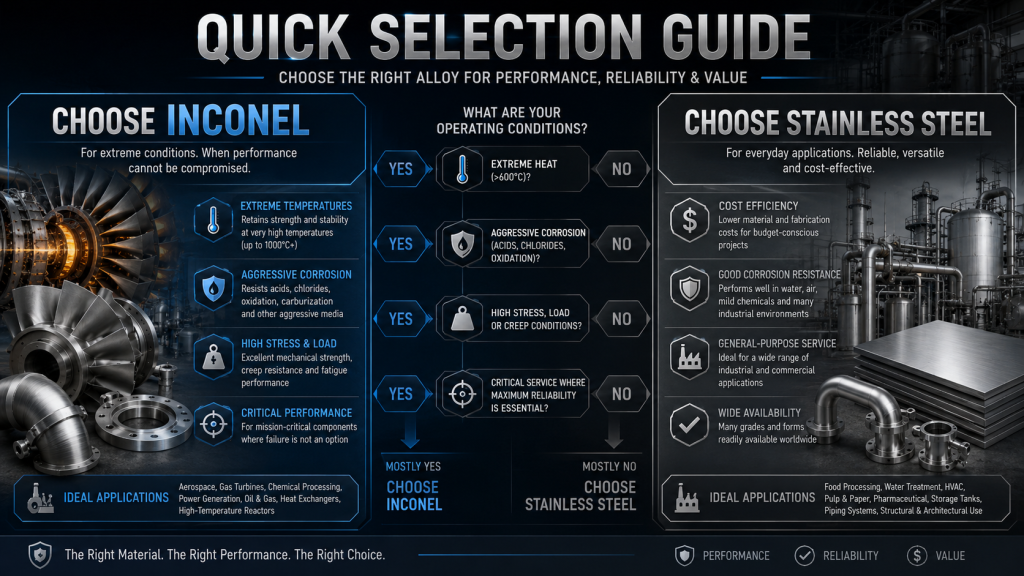
13. Which Material Should You Choose?
Choose Inconel If:
- The service temperature is extremely high
- Creep resistance is critical
- The environment contains severe acids, chlorides or seawater
- Failure would create high safety, shutdown or replacement risk
- The component is used in aerospace, turbine, reactor or offshore systems
- High-temperature oxidation and scaling resistance are essential
- Material cost is less important than reliability and service life
Choose Stainless Steel If:
- The operating temperature is moderate
- General corrosion resistance is sufficient
- Cost control is important
- The material needs to be easily fabricated, welded or formed
- The application involves tanks, pipelines, food equipment or architecture
- 304, 316L, 310S or duplex stainless steel can meet the performance requirement
- Fast delivery and broad availability are important
Consider High-Alloy Stainless Steel If:
- Standard 304 is not corrosion resistant enough
- 316L is close but still may not meet the requirement
- Duplex 2205 can provide strength and chloride resistance
- Super stainless steels may reduce the need for Inconel in some cases
- The project needs a balance between performance and cost
14. Common Buyer Mistakes to Avoid
- Choosing Inconel when stainless steel is already sufficient
- Choosing stainless steel only to reduce cost in extreme service
- Ignoring temperature when comparing corrosion resistance
- Assuming all stainless steels perform the same in chloride environments
- Ignoring machining cost and lead time for Inconel parts
- Using standard 304 stainless steel in high-temperature creep conditions
- Failing to evaluate weld procedure, heat input and post-fabrication requirements
Correct material selection should consider temperature, corrosion chemistry, stress level, expected lifetime, fabrication complexity and failure consequence.
Frequently Asked Questions
Is Inconel better than stainless steel?
Inconel is better for extreme high-temperature, oxidation, creep and severe corrosion environments. Stainless steel is better for cost-effective general corrosion resistance, fabrication and broad industrial applications.
What is the main difference between Inconel and stainless steel?
Inconel is a nickel-based superalloy, while stainless steel is an iron-based alloy containing chromium. This difference gives Inconel superior high-temperature strength and harsh-environment corrosion resistance, while stainless steel offers better cost efficiency and availability.
At what temperature should stainless steel be replaced by Inconel?
When service temperature rises above approximately 600–700°C, or when creep resistance and oxidation stability become critical, Inconel is often considered instead of standard stainless steel. The final decision should also consider stress, exposure time and corrosion environment.
Why is Inconel more expensive than stainless steel?
Inconel contains high levels of nickel and other alloying elements. It also requires more complex production, is harder to machine and is often used in demanding critical applications. These factors increase both material and processing cost.
Can stainless steel replace Inconel?
Stainless steel can replace Inconel only in moderate-temperature and less aggressive environments. It should not replace Inconel where extreme temperature strength, creep resistance or severe corrosion resistance is required.
Which is better for marine environments, Inconel or stainless steel?
Inconel 625 offers excellent seawater and chloride corrosion resistance, but 316L stainless steel or duplex 2205 may be more cost-effective for many marine applications. The best choice depends on temperature, pressure, exposure level and design life.
Is Inconel harder to machine than stainless steel?
Yes. Inconel is generally much harder to machine because it work-hardens quickly, retains high strength and generates heat during cutting. It often requires specialized tooling and slower machining parameters.
Заключение
Inconel and stainless steel are both corrosion-resistant engineering materials, but they are designed for different performance levels. Inconel is a nickel-based superalloy for extreme environments involving high temperature, oxidation, creep, fatigue and aggressive corrosion. Stainless steel is an iron-based alloy that provides cost-effective corrosion resistance, strength, hygiene, fabrication flexibility and broad availability.
For aerospace engines, gas turbines, chemical reactors, offshore systems and high-temperature components, Inconel may be necessary because failure risk is high. For food equipment, tanks, pipelines, architecture, general fabrication and moderate corrosion environments, stainless steel is usually the more economical and practical choice.
The best material is not always the strongest or most expensive one. The best material is the one that safely matches the operating temperature, corrosion environment, mechanical stress, fabrication process and lifecycle cost. Jude Steel provides stainless steel sheets, coils, strips, sheet metal processing and related high-alloy material information for global industrial buyers. Explore more at Judesteel.com, or visit our product pages for stainless steel sheet, stainless steel coil and stainless steel strip.
