
Can You Weld Stainless Steel to Mild Steel? Methods, Filler Metals, Risks & Best Practices
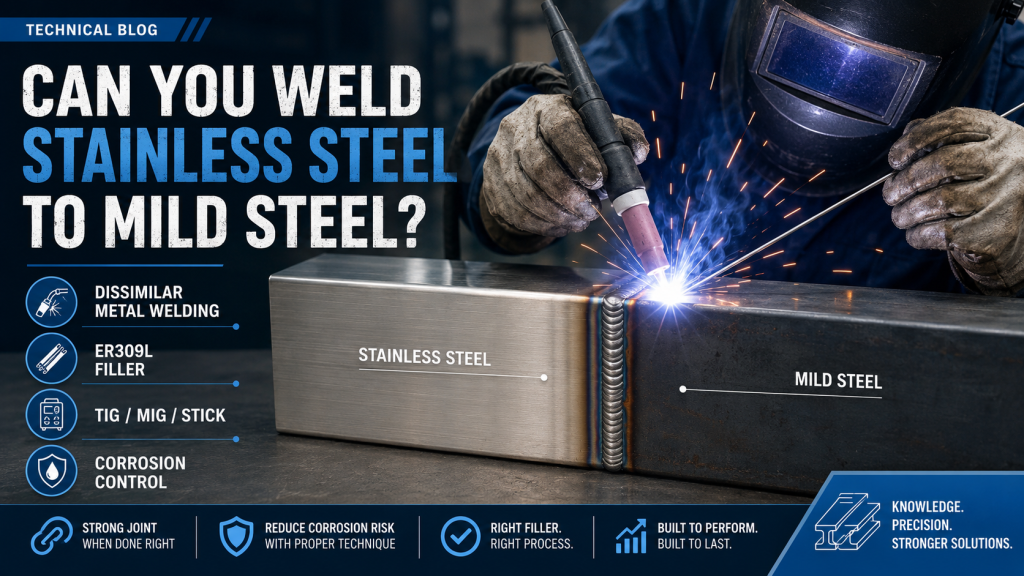 Stainless steel can be welded to mild steel when the correct filler metal, welding process, heat control and corrosion protection are used.
Yes, you can weld stainless steel to mild steel. In fact, this type of dissimilar metal welding is widely used in industrial fabrication, food equipment, water treatment systems, chemical equipment, exhaust systems, structural frames and mixed-material machinery.
However, welding stainless steel to mild steel is not the same as welding two pieces of carbon steel or two pieces of stainless steel. These two materials have different chemical composition, corrosion behavior, thermal expansion, strength, surface chemistry and service requirements. If the wrong filler metal or welding procedure is used, the joint may suffer from cracking, rust, distortion, weak weld strength or premature corrosion.
This guide explains how to weld stainless steel to mild steel correctly, which welding methods work best, why ER309L filler metal is commonly recommended, how to reduce galvanic corrosion, and when it may be better to use all-stainless construction instead. For related products and services, visit Stainless Steel Sheet, Stainless Steel Coil, Stainless Steel Pipe, Laser Cutting and the Jude Steel Stainless Steel Grade Center.
Quick Answer: Can Stainless Steel Be Welded to Mild Steel?
Yes. Stainless steel and mild steel can be welded together. The joint is called a dissimilar metal weld. The most common approach is to use a filler metal such as ER309L for TIG or MIG welding, or E309L for stick welding.
| Question | Recommended Answer | Engineering Reason |
|---|---|---|
| Can stainless steel be welded to mild steel? | Yes | It is a common dissimilar metal welding application |
| Most common filler metal | ER309L / E309L | Good compatibility between stainless steel and carbon steel |
| Best process for high-quality welds | TIG welding | Excellent heat control, clean appearance and precision |
| Best process for production fabrication | MIG welding | Faster welding speed and good productivity |
| Best process for field repair | Stick welding | Portable and suitable for outdoor work |
| Main corrosion risk | Mild steel side rusting | Carbon steel is less corrosion resistant than stainless steel |
| Best protection method | Coating, sealing, drainage and proper joint design | Reduces moisture traps and galvanic corrosion risk |
Simple rule: Use stainless steel where corrosion resistance is required, mild steel where cost and structural strength are more important, and 309L-type filler metal to bridge the two materials.
1. Why Weld Stainless Steel to Mild Steel?
Many projects do not require every component to be stainless steel. Using stainless steel only in corrosion-sensitive areas and mild steel in structural or support areas can reduce cost while maintaining performance.
For example, a food-contact surface may need 304 or 316L stainless steel, while the external frame can be mild steel. A stainless steel pipe may connect to a carbon steel flange. A stainless steel tank liner may be supported by a mild steel frame. This mixed-material strategy can improve value when designed correctly.
| Stainless Steel Part | Mild Steel Part | Reason for Combination |
|---|---|---|
| Food-contact surface | External support frame | Hygiene and corrosion resistance where needed, lower cost where possible |
| Stainless steel pipe | Carbon steel flange | Corrosion resistance in fluid contact area with cost-effective connection |
| 304 or 316L tank section | Mild steel support structure | Performance plus structural economy |
| Exhaust stainless section | Mild steel bracket | Heat and oxidation resistance in selected zones |
| Heat exchanger tube | Carbon steel shell | Corrosion resistance in process fluid path with cost-efficient body |
Common Industries
- Food processing equipment
- Water treatment systems
- Chemical processing equipment
- Structural fabrication
- Exhaust systems
- Heat exchangers
- Industrial tanks and vessels
- Machinery frames and support structures
2. Why Is Stainless-to-Mild-Steel Welding More Difficult?
Welding stainless steel to mild steel is more challenging because the two materials respond differently to heat, corrosion and filler metal dilution.
| Difference | Stainless Steel | Mild Steel | Welding Impact |
|---|---|---|---|
| Chemical composition | Contains chromium and often nickel or molybdenum | Mainly iron and carbon | Requires compatible filler metal |
| Corrosion behavior | Forms a passive chromium oxide layer | Rusts more easily | Joint design and coating are important |
| Thermal expansion | Often expands more during heating | Lower thermal expansion | Can cause stress and distortion |
| Heat sensitivity | Can lose corrosion performance if overheated | Can form hard heat-affected zones depending on carbon level | Heat input must be controlled |
| Surface contamination | Needs clean, uncontaminated surface | Mill scale, rust and oil are common | Cleaning is critical before welding |
Important: The weld may look acceptable visually, but poor filler selection, contamination or high heat input can still create cracking, corrosion or weak performance in service.
3. Best Filler Metal: Why ER309L Is Commonly Used
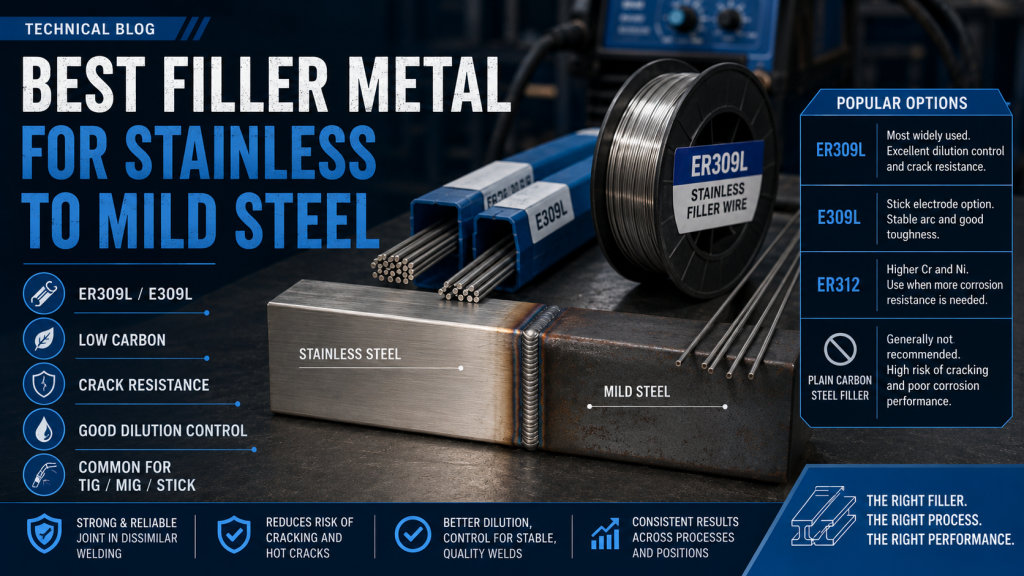
The filler metal is one of the most important decisions when welding stainless steel to mild steel. For many common combinations such as 304 stainless steel to mild steel or 316 stainless steel to carbon steel, ER309L is the most widely used filler for TIG and MIG welding. For stick welding, E309L electrodes are commonly used.
| Filler Metal | Typical Use | Key Benefit |
|---|---|---|
| ER309L | TIG or MIG welding stainless steel to mild steel | Good dissimilar metal compatibility and low-carbon corrosion resistance |
| E309L | Stick welding stainless steel to mild steel | Useful for field work, repair and structural welding |
| ER312 | Higher crack-resistance applications | Useful when cracking risk is higher or base metal is difficult to identify |
| ER316L | Usually for stainless-to-stainless welding, not the default for mild steel | Better chloride resistance but not always ideal for stainless-to-carbon steel joints |
| Carbon steel filler | Generally not recommended for stainless-to-mild-steel joints | May reduce corrosion resistance and cause compatibility issues |
Why 309L Works Well
- It is designed for dissimilar welding between stainless steel and carbon steel
- It contains higher alloy content to handle dilution from mild steel
- It improves crack resistance compared with many unsuitable fillers
- The low-carbon “L” version helps reduce carbide precipitation risk
- It provides good weld strength and practical corrosion performance
4. Best Welding Methods
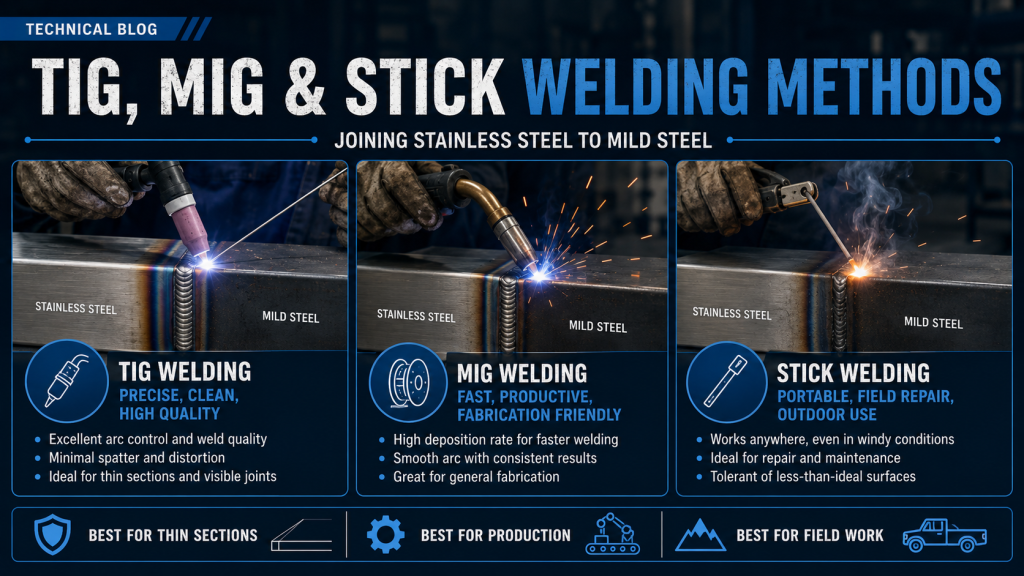
TIG, MIG and stick welding can all join stainless steel to mild steel. The best process depends on thickness, required appearance, production speed, joint design, working environment and quality expectations.
| Welding Method | Best For | Advantages | Limitations |
|---|---|---|---|
| TIG Welding | Thin materials, pipes, food equipment, high-quality welds | Precise heat control, clean weld appearance, excellent quality | Slower and requires higher skill |
| MIG Welding | Fabrication shops, frames, tanks, medium-thickness parts | Fast, productive and suitable for production welding | Requires correct wire, shielding gas and parameter control |
| Stick Welding | Field repair, outdoor work, structural maintenance | Portable and less sensitive to outdoor conditions | More spatter and cleaning may be required |
| Flux-Cored Welding | Heavy fabrication and field work in selected cases | High deposition rate and field flexibility | Consumable selection must be carefully verified |
TIG Welding Stainless Steel to Mild Steel
TIG welding is often preferred when appearance, precision and weld quality are important. It is suitable for thin sheet, pipe joints, food-grade equipment, pharmaceutical equipment and visible welds.
MIG Welding Stainless Steel to Mild Steel
MIG welding is often used in production environments because it is faster than TIG welding. It is suitable for frames, tanks, brackets, machine structures and medium-thickness components.
Stick Welding Stainless Steel to Mild Steel
Stick welding is useful for field repair, construction sites, maintenance work and thicker components. E309L electrodes are commonly used for stainless-to-carbon-steel dissimilar welds.
5. Cleaning and Surface Preparation
Cleaning is critical before welding stainless steel to mild steel. Stainless steel surfaces should be free from oil, grease, paint, oxide, carbon steel particles and grinding contamination. Mild steel surfaces should be free from rust, mill scale, oil and coating residues.
| Preparation Step | Why It Matters | Best Practice |
|---|---|---|
| Remove rust and mill scale | Prevents inclusions and poor fusion | Grind or mechanically clean mild steel surface |
| Degrease both metals | Oil and grease can cause porosity | Use suitable solvent or industrial degreasing method |
| Avoid carbon contamination | Carbon steel particles can cause rust staining on stainless steel | Use stainless-only brushes and grinding tools on stainless surfaces |
| Clean between passes | Slag, oxide and spatter affect weld quality | Use proper brushing, grinding and inspection |
| Protect finished stainless surface | Prevents cosmetic damage and corrosion sites | Use clean handling and protective covering where needed |
Fabrication tip: Tools used on carbon steel should not be used on stainless steel surfaces. Cross-contamination can cause rust marks and surface corrosion.
6. Heat Control, Cracking and Distortion
Stainless steel and mild steel expand and contract differently during welding. Excessive heat input can increase distortion, residual stress and cracking risk. It can also reduce corrosion resistance on the stainless side if the surface is overheated or contaminated.
| Risk | Причина | How to Reduce It |
|---|---|---|
| Cracking | Wrong filler, high restraint, poor joint design or high dilution | Use ER309L/E309L, proper bevel design and controlled heat input |
| Distortion | Uneven thermal expansion and high heat input | Use tack welds, balanced welding sequence and lower heat where possible |
| Porosity | Contamination, moisture, poor shielding or wrong gas | Clean surfaces and use correct shielding gas |
| Loss of corrosion resistance | Overheating, contamination or poor post-weld cleaning | Control heat, clean weld area and passivate if required |
| Rust on mild steel side | Exposure to water, oxygen and chemicals | Apply coating, paint, sealant or protective design |
7. Galvanic Corrosion Risk
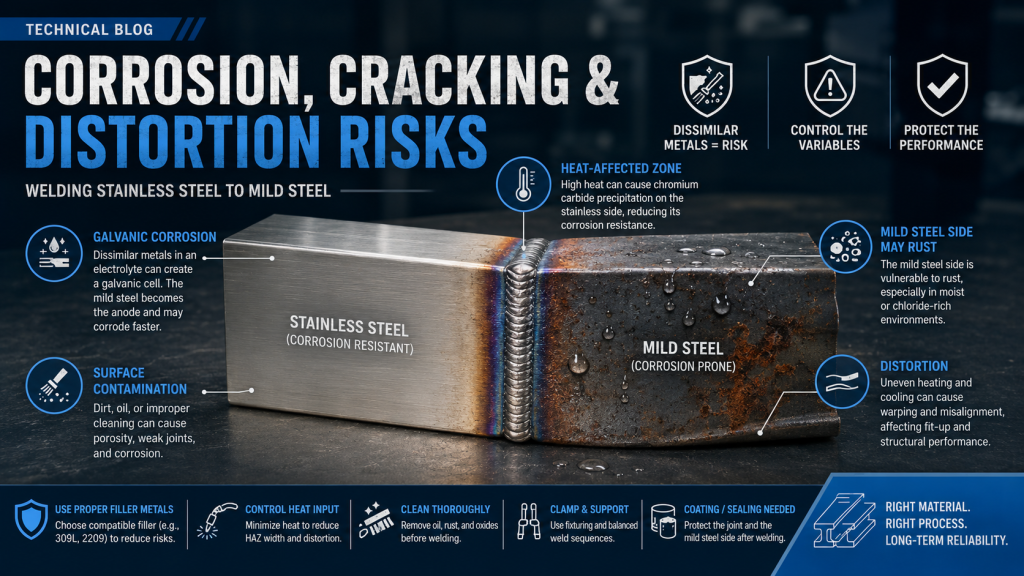
Galvanic corrosion can occur when stainless steel and mild steel are electrically connected in the presence of an electrolyte such as water, salt water, condensation or chemical solution. In many cases, the mild steel side corrodes faster because it is less noble than stainless steel.
| Corrosion Factor | Problem | Prevention Method |
|---|---|---|
| Moisture traps | Accelerates rusting on mild steel side | Design for drainage and avoid crevices |
| Salt or chloride exposure | Increases pitting and galvanic corrosion risk | Use 316L or higher stainless grades where required |
| Unprotected mild steel | Rust spreads from carbon steel surface | Paint, coat, galvanize or seal mild steel after welding |
| Carbon steel contamination | Rust staining on stainless surface | Use dedicated stainless tools and clean the weld zone |
| Poor joint design | Creates crevices and stagnant zones | Use smooth transitions and avoid water retention |
Corrosion warning: In marine, offshore, chemical or high-chloride environments, welding stainless steel to mild steel may not provide the best lifecycle value. An all-stainless design or higher alloy may be safer.
8. Welding 304 Stainless Steel to Mild Steel
Welding 304 stainless steel to mild steel is one of the most common stainless-to-carbon-steel combinations. It is used in food equipment frames, tanks, pipe supports, machinery, brackets and general fabrication.
| Item | Recommended Practice |
|---|---|
| Welding process | TIG, MIG or stick welding |
| Filler metal | ER309L for TIG/MIG; E309L for stick welding |
| Shielding gas | Argon for TIG; appropriate argon-based mixture for MIG |
| Surface preparation | Remove oil, rust, scale and contamination |
| Post-weld protection | Clean stainless side and protect mild steel side with coating or paint |
| Typical applications | Food equipment, tanks, brackets, frames, pipe systems |
For general stainless fabrication, 304 stainless steel is a widely used grade because it offers good corrosion resistance, formability and weldability for many industrial applications.
9. Welding 316L Stainless Steel to Mild Steel
Welding 316L stainless steel to mild steel is common in water treatment, chemical equipment, coastal facilities and process systems. 316L provides better chloride resistance than 304, but the mild steel side still needs corrosion protection.
| Item | Recommended Practice |
|---|---|
| Welding process | TIG or MIG for quality control; stick for field work |
| Filler metal | ER309L / E309L in many dissimilar welds; ER312 may be considered for higher crack resistance |
| Corrosion concern | Mild steel side remains vulnerable to rust |
| Best protection | Coating, sealing, drainage and proper joint design |
| Typical applications | Chemical plants, water treatment, marine atmosphere equipment, process piping |
For environments containing chlorides, salt or chemical cleaning, 316L stainless steel can provide stronger corrosion resistance than 304.
10. Can Stainless Steel Pipe Be Welded to Carbon Steel Pipe?
Yes. Stainless steel pipe can be welded to carbon steel pipe, and this is common in refineries, boilers, heat exchangers, water treatment systems and process piping. In many cases, a stainless steel pipe is joined to a carbon steel flange, shell, vessel or support.
| Pipe Combination | Typical Welding Approach | Important Control Point |
|---|---|---|
| 304 pipe to carbon steel flange | TIG root pass with ER309L filler | Clean root, controlled heat and proper shielding |
| 316L pipe to carbon steel vessel | TIG/MIG with suitable 309L-type filler | Protect carbon steel side after welding |
| Stainless tube to mild steel frame | MIG or TIG depending on thickness | Avoid stainless contamination and coating damage |
| Stainless nozzle to carbon steel shell | Qualified welding procedure recommended | Joint design and dilution control are critical |
For piping projects, buyers should confirm grade, wall thickness, schedule, joint design, welding procedure, inspection requirement and service environment before fabrication.
11. When Should You Avoid Welding Stainless Steel to Mild Steel?
Although stainless steel can be welded to mild steel, it is not always the best engineering choice. In some environments, an all-stainless design may provide better corrosion resistance, lower maintenance and longer service life.
| Condition | Potential Problem | Better Option |
|---|---|---|
| Marine or offshore service | High galvanic and chloride corrosion risk | 316L, 2205, 2507 or all-stainless construction |
| Strong chemical exposure | Mild steel side may fail quickly | 316L, 904L, duplex stainless steel or nickel alloy |
| Food-contact surface with frequent washdown | Rust contamination from mild steel side | 304 or 316L all-stainless contact area |
| Hidden moisture traps | Accelerated corrosion and difficult maintenance | Redesign joint or use corrosion-resistant material throughout |
| High-temperature service with cyclic stress | Thermal expansion mismatch may increase fatigue risk | Evaluate stainless grade and welding procedure carefully |
Design principle: Welding stainless steel to mild steel is often cost-effective, but severe corrosion environments may justify using stainless steel throughout the structure.
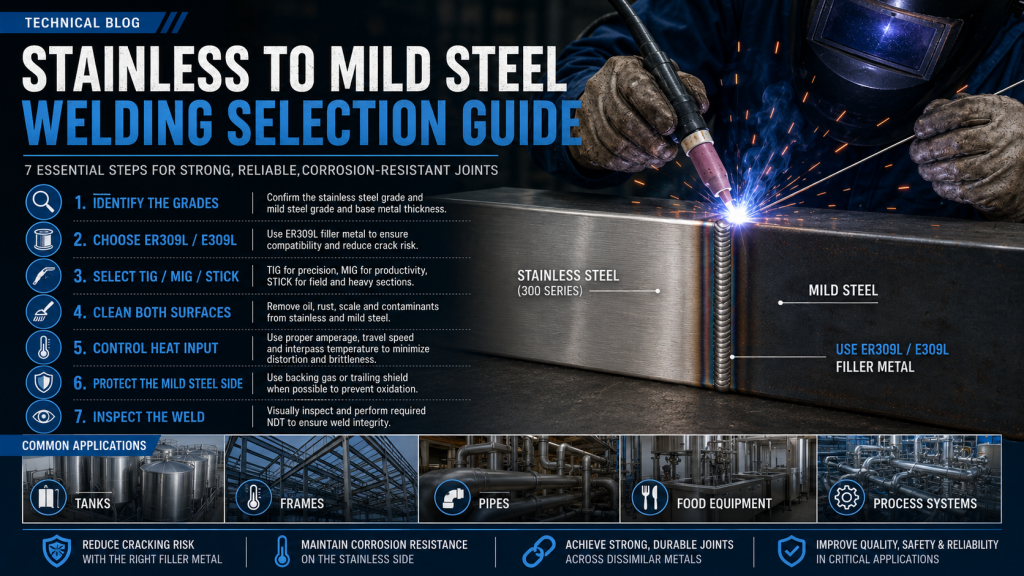
12. Stainless Steel to Mild Steel Welding Checklist
| Checklist Item | Recommended Action |
|---|---|
| Confirm stainless grade | Identify whether the stainless steel is 304, 304L, 316L, 309S, 310S or another grade |
| Confirm mild steel grade | Check carbon content, thickness, coating and mechanical requirement |
| Select filler metal | Use ER309L/E309L for many common dissimilar welds |
| Choose welding process | Use TIG for precision, MIG for production, stick for field work |
| Clean both materials | Remove rust, oil, scale, paint and contamination |
| Control heat input | Reduce distortion, cracking and corrosion risk |
| Protect carbon steel side | Paint, coat, seal or otherwise protect the mild steel after welding |
| Inspect the weld | Check fusion, cracking, porosity, undercut and surface contamination |
| Consider service environment | Evaluate moisture, salt, acid, temperature, cleaning chemicals and maintenance access |
13. Common Mistakes to Avoid
- Using ordinary carbon steel filler metal for a stainless-to-mild-steel joint
- Ignoring filler metal dilution and crack resistance
- Welding over rust, oil, mill scale or paint
- Using carbon steel brushes on stainless steel surfaces
- Overheating the stainless side and reducing corrosion performance
- Leaving the mild steel side unprotected in a wet environment
- Ignoring galvanic corrosion in outdoor or marine applications
- Choosing a mixed-metal design when all-stainless construction is required
- Failing to inspect the weld for cracks, porosity or poor fusion
- Comparing only material cost instead of lifecycle cost
Procurement warning: Stainless-to-mild-steel welding should be specified by material grade, filler metal, process, joint design and service environment. A vague instruction such as “just weld them together” can lead to avoidable failure.
Frequently Asked Questions
Can you weld stainless steel to mild steel?
Yes. Stainless steel can be welded to mild steel using the correct filler metal, welding process, joint design, cleaning method and corrosion protection. This is called dissimilar metal welding.
What filler rod should be used for welding stainless steel to mild steel?
ER309L is commonly used for TIG welding and MIG welding. E309L electrodes are commonly used for stick welding. These filler metals provide good compatibility between stainless steel and mild steel.
Can TIG weld stainless steel to mild steel?
Yes. TIG welding is excellent for stainless steel to mild steel joints where clean appearance, precise heat control and high weld quality are required.
Can MIG weld stainless steel to mild steel?
Yes. MIG welding can weld stainless steel to mild steel and is widely used in fabrication shops, frames, tanks, brackets and medium-thickness industrial components.
Will stainless steel welded to mild steel rust?
The stainless side may resist rust, but the mild steel side can rust if exposed to moisture, salt or chemicals. Protective coating, drainage design, sealing and proper post-weld cleaning help reduce corrosion risk.
Can 304 stainless steel be welded to mild steel?
Yes. 304 stainless steel can be welded to mild steel. ER309L filler metal is commonly used for this combination because it handles dissimilar metal dilution better than many standard fillers.
Can 316L stainless steel be welded to mild steel?
Yes. 316L stainless steel can be welded to mild steel, but the joint must be designed carefully when chlorides, chemicals or moisture are present. ER309L or other suitable dissimilar welding filler may be used depending on the application.
Заключение
So, can you weld stainless steel to mild steel? Yes. It is a practical and widely used industrial welding method when the correct welding procedure is followed.
The key is to treat the joint as a dissimilar metal weld, not as an ordinary carbon steel weld. Use a suitable filler metal such as ER309L or E309L, select the correct process such as TIG, MIG or stick welding, clean both metals thoroughly, control heat input and protect the mild steel side from corrosion.
When done correctly, stainless steel-to-mild steel welding can deliver strong, durable and cost-effective results for tanks, frames, pipes, brackets, food equipment, water treatment systems and industrial structures. For severe corrosion, marine or chemical environments, consider whether all-stainless construction or a higher stainless grade may provide better lifecycle value.
Jude Steel supplies stainless steel sheets, coils, pipes, strips and customized processing services for global fabrication buyers. Explore more at Judesteel.com, or visit our pages for stainless steel sheet, stainless steel coil, stainless steel pipe and stainless steel grades.
