
Can You Weld Stainless Steel? Complete Industrial Welding Guide
Can stainless steel be welded successfully?
The answer is yes. Stainless steel is highly weldable when the correct welding method, filler material, shielding gas, and heat control are used. Proper welding procedures allow stainless steel to maintain its structural integrity and corrosion resistance even in demanding industrial environments.
Today, stainless steel welding is widely applied in pressure vessels, food processing systems, marine engineering, chemical plants, energy infrastructure, and precision fabrication industries worldwide.
1. Why Stainless Steel Requires Special Welding Techniques
Unlike ordinary carbon steel, stainless steel depends on a chromium-rich passive oxide layer for corrosion protection. During welding, localized high temperatures can damage this protective layer and create several metallurgical risks:
- Chromium depletion near weld zones
- Heat tint and oxidation
- Residual stress concentration
- Intergranular corrosion
- Distortion caused by thermal expansion
Improper welding procedures may significantly reduce corrosion resistance and shorten service life. Heat input control is therefore one of the most critical aspects of stainless steel welding.
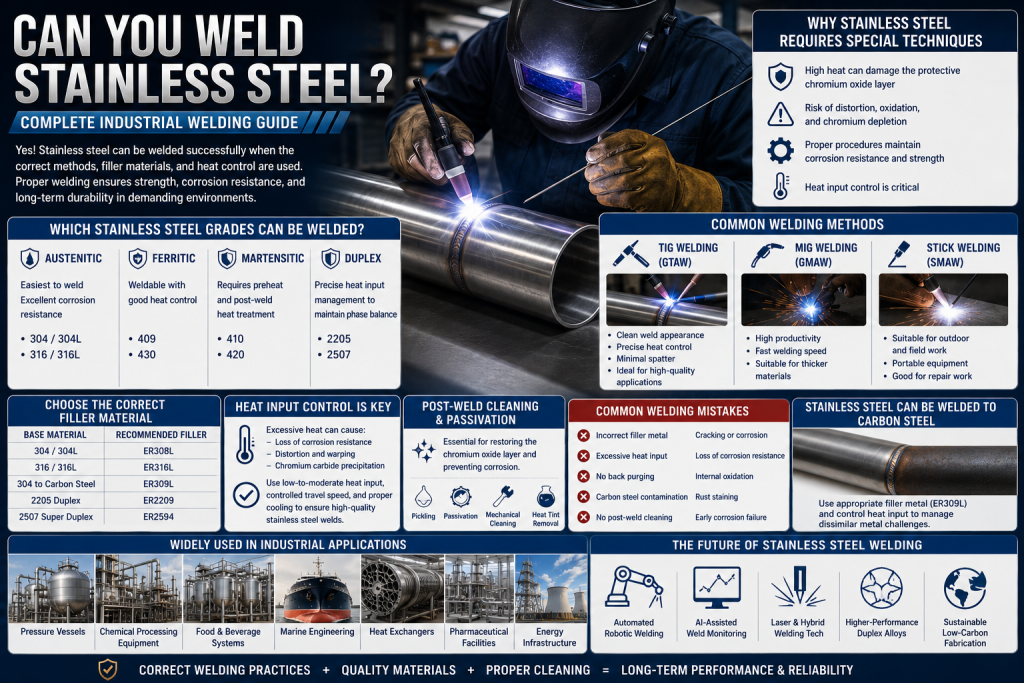
2. Which Stainless Steel Grades Can Be Welded?
Most stainless steel grades are weldable, although welding difficulty varies depending on the microstructure and alloy composition.
Austenitic Stainless Steel
Common grades:
- 304 / 304L
- 316 / 316L
These grades offer:
- Excellent weldability
- Low cracking risk
- Good ductility
- Strong corrosion resistance
Austenitic stainless steels are the easiest and most commonly welded stainless grades in industrial fabrication.
Ferritic Stainless Steel
- 409
- 430
Ferritic grades are weldable but require better heat control because excessive grain growth may reduce toughness.
Martensitic Stainless Steel
- 410
- 420
These grades are more difficult to weld and usually require:
- Preheating
- Controlled cooling
- Post-weld heat treatment
Duplex Stainless Steel
- 2205
- 2507
Duplex stainless steels provide exceptional strength and corrosion resistance, but welding requires precise heat input management to maintain ferrite-austenite phase balance.
3. Common Welding Methods for Stainless Steel
1. TIG Welding (GTAW)
TIG welding is considered the highest-quality method for stainless steel fabrication.
Advantages include:
- Clean weld appearance
- Precise heat control
- Excellent corrosion resistance
- Minimal spatter
TIG welding is widely used in:
- Food-grade equipment
- Pharmaceutical systems
- Medical devices
- Sanitary piping
2. MIG Welding (GMAW)
MIG welding offers higher productivity and faster welding speed compared with TIG.
It is commonly used for:
- Structural fabrication
- Industrial equipment
- Thicker stainless steel sections
Correct shielding gas selection is essential for weld quality.
3. Stick Welding (SMAW)
Stick welding is suitable for outdoor construction and maintenance applications.
Advantages:
- Portable equipment
- Good for field repair work
- Works in windy environments
However, weld appearance and cleanliness are generally lower than TIG or MIG processes.
4. Choosing the Correct Filler Material
Selecting the correct filler metal is critical for weld strength and corrosion resistance.
| Base Material | Recommended Filler |
|---|---|
| 304 / 304L | ER308L |
| 316 / 316L | ER316L |
| 304 to Carbon Steel | ER309L |
| 2205 Duplex | ER2209 |
| 2507 Super Duplex | ER2594 |
Low-carbon “L” filler materials reduce carbide precipitation and minimize intergranular corrosion risk.
5. Heat Input Control: The Most Important Welding Factor
Excessive heat during welding can lead to:
- Loss of corrosion resistance
- Distortion and warping
- Chromium carbide precipitation
- Microstructural instability
Professional welding procedures therefore emphasize:
- Low-to-moderate heat input
- Controlled travel speed
- Proper cooling intervals
- Minimized dwell time
In duplex stainless steel welding, heat control is especially critical because improper thermal balance may damage phase structure and reduce performance.
6. Post-Weld Cleaning and Passivation
Welding stainless steel does not end after the weld bead is completed. Surface restoration is equally important.
Common Post-Weld Treatments
- Pickling
- Passivation
- Mechanical cleaning
- Heat tint removal
These treatments restore the chromium oxide passive layer and help prevent corrosion initiation near weld zones.
7. Can You Weld Stainless Steel to Carbon Steel?
Yes. Stainless steel can be welded to carbon steel using appropriate filler materials such as ER309L.
However, several challenges must be managed carefully:
- Different thermal expansion rates
- Potential galvanic corrosion
- Dissimilar metallurgical behavior
Correct filler selection and low-heat welding procedures are essential to maintain weld reliability.
8. Common Stainless Steel Welding Mistakes
| Mistake | Possible Result |
|---|---|
| Incorrect filler metal | Cracking or corrosion |
| Excessive heat input | Loss of corrosion resistance |
| No back purging | Internal oxidation |
| Carbon steel contamination | Rust staining |
| No post-weld cleaning | Early corrosion failure |
Most stainless steel welding failures result from process errors rather than material defects.
9. Industrial Applications of Welded Stainless Steel
Welded stainless steel structures are widely used in:
- Pressure vessels
- Chemical processing equipment
- Food and beverage systems
- Marine engineering
- Heat exchangers
- Pharmaceutical facilities
- Energy infrastructure
Modern stainless steel fabrication combines advanced welding technology with precision processing to achieve long-term structural reliability.
10. Future Trends in Stainless Steel Welding
As manufacturing technology advances, stainless steel welding is evolving toward:
- Automated robotic welding systems
- AI-assisted weld monitoring
- Laser and hybrid welding technologies
- Higher-performance duplex alloys
- Low-carbon sustainable fabrication
Industries increasingly demand higher weld quality, stronger corrosion resistance, and improved production efficiency.
Frequently Asked Questions (FAQ)
Can all stainless steel grades be welded?
Most stainless steel grades are weldable, although some require stricter heat control and post-weld treatment.
What is the best welding method for stainless steel?
TIG welding generally provides the cleanest and highest-quality welds for stainless steel fabrication.
Does welding damage stainless steel corrosion resistance?
Improper welding can reduce corrosion resistance, but correct welding and passivation restore protection.
Can stainless steel be welded to carbon steel?
Yes. Special filler metals such as ER309L are commonly used for dissimilar metal welding.
Why is back purging important?
Back purging prevents internal oxidation and maintains corrosion resistance inside pipes and tubing systems.
Conclusion: Stainless steel can absolutely be welded successfully when proper welding procedures, filler materials, and heat control techniques are applied. From food-grade fabrication to marine engineering and chemical processing systems, high-quality stainless steel welding plays a critical role in modern industrial manufacturing. Correct welding practices ensure that stainless steel maintains its strength, corrosion resistance, and long-term reliability in even the most demanding environments.
