
What Is Stick Welding? Process, Uses, and Advantages
Stick welding is one of the oldest, most reliable, and widely used welding processes in industrial manufacturing, steel construction, pipeline engineering, shipbuilding, and heavy equipment fabrication. Known for its simplicity, portability, and ability to perform under harsh working conditions, stick welding remains a critical welding technology worldwide.
Although newer welding technologies such as MIG welding and TIG welding continue expanding in automated manufacturing, stick welding still plays a major role in outdoor construction, field repair work, structural steel fabrication, and infrastructure development.
This article explains the stick welding process, equipment, advantages, limitations, industrial applications, and why Shielded Metal Arc Welding (SMAW) continues to be essential in modern industry.
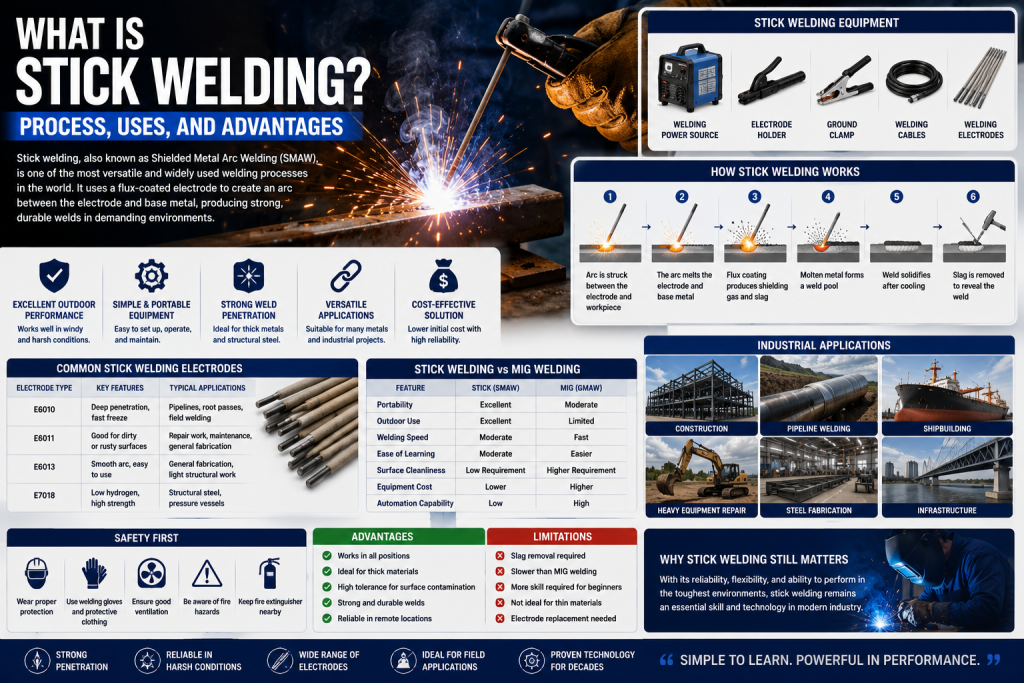
1. What Is Stick Welding?
Stick welding is officially known as:
Shielded Metal Arc Welding (SMAW)
It is a manual arc welding process that uses:
- A consumable flux-coated electrode
- An electric arc
- Heat generated between the electrode and base metal
The electrode melts during welding and acts as filler metal to join the workpieces together.
At the same time, the flux coating produces:
- Protective shielding gases
- Slag covering
These protect the molten weld pool from atmospheric contamination.
2. How Does Stick Welding Work?
The stick welding process is relatively simple compared with many modern welding methods.
Main Process Steps
- The welding machine supplies electrical current.
- The welder strikes an arc between the electrode and workpiece.
- The arc heat melts both the electrode and base metal.
- The molten metal forms a weld pool.
- The flux coating creates shielding gas and slag protection.
- The weld solidifies after cooling.
- The slag layer is removed after welding.
This process creates strong welded joints suitable for many structural and industrial applications.
3. Main Components of Stick Welding Equipment
| Component | Function |
|---|---|
| Power Source | Provides welding current |
| Electrode Holder | Holds welding electrode |
| Ground Clamp | Completes electrical circuit |
| Welding Electrodes | Provide filler material and shielding |
| Welding Cables | Transfer electrical current |
One major advantage of stick welding is its relatively simple and portable equipment setup.
4. Common Types of Stick Welding Electrodes
Different electrodes are designed for different materials and welding conditions.
| Electrode Type | Main Characteristics | Typical Applications |
|---|---|---|
| E6010 | Deep penetration | Pipelines and field welding |
| E6011 | Good for dirty surfaces | Repair and maintenance |
| E6013 | Easy operation | General fabrication |
| E7018 | Low hydrogen high strength | Structural steel |
Electrode selection greatly affects weld strength, penetration, and overall quality.
5. Advantages of Stick Welding
Excellent Outdoor Performance
Unlike MIG welding, stick welding does not require external shielding gas, making it highly suitable for outdoor environments and windy conditions.
Simple Equipment
Stick welding systems are:
- Portable
- Cost-effective
- Easy to maintain
Works on Dirty or Rusty Surfaces
Stick welding can tolerate:
- Rust
- Paint
- Dirty surfaces
better than many other welding methods.
Strong Weld Penetration
The process provides excellent penetration and strong structural welds.
Versatile Material Compatibility
Stick welding is suitable for:
- Carbon steel
- Low alloy steel
- Stainless steel
- Cast iron
6. Limitations of Stick Welding
Lower Welding Speed
Compared with MIG welding, stick welding is generally slower because electrodes must be replaced frequently.
Slag Removal Required
After welding, slag must be cleaned from the weld surface.
Higher Operator Skill Requirement
Stick welding requires:
- Good arc control
- Steady hand movement
- Experience with electrode handling
Less Suitable for Thin Materials
Thin sheet metal may deform or burn through due to high heat concentration.
7. Stick Welding vs MIG Welding
| Feature | Stick Welding | MIG Welding |
|---|---|---|
| Portability | Превосходно | Moderate |
| Outdoor Use | Превосходно | Limited |
| Welding Speed | Moderate | Fast |
| Ease of Learning | Moderate | Easier |
| Surface Cleanliness Requirement | Low | Higher |
| Automation Capability | Low | High |
Stick welding remains highly preferred for field operations and heavy structural work, while MIG welding dominates automated manufacturing environments.
8. Industrial Applications of Stick Welding
Construction Industry
- Structural steel fabrication
- Bridge construction
- Building frameworks
Pipeline Welding
- Oil pipelines
- Gas transmission systems
- Water infrastructure
Shipbuilding
- Marine structures
- Steel hull repair
- Offshore equipment
Heavy Equipment Repair
- Mining machinery
- Agricultural equipment
- Industrial maintenance
Steel Fabrication
- Industrial structures
- Pressure vessels
- Mechanical fabrication
9. Stick Welding for Stainless Steel
Although TIG and MIG welding are more common for stainless steel production, stick welding can also be used for:
- Field repair work
- Outdoor stainless steel construction
- Heavy stainless structures
Special stainless steel electrodes are required to maintain corrosion resistance and weld integrity.
10. Safety Considerations in Stick Welding
Proper welding safety is essential.
Important Safety Equipment
- Welding helmet
- Protective gloves
- Flame-resistant clothing
- Safety boots
- Ventilation systems
Stick welding produces:
- High temperatures
- Ultraviolet radiation
- Welding fumes
- Metal sparks
Following industrial safety standards is critical for worker protection.
11. Future Trends in Stick Welding
Although highly traditional, stick welding technology continues evolving through:
- Advanced inverter welding machines
- Improved low-hydrogen electrodes
- Portable digital welding systems
- Energy-efficient power supplies
Modern equipment now provides:
- More stable arc control
- Reduced power consumption
- Improved weld quality
- Greater portability
Frequently Asked Questions (FAQ)
What is stick welding used for?
Stick welding is commonly used in construction, pipeline welding, shipbuilding, structural steel fabrication, and industrial repair work.
Why is stick welding called SMAW?
SMAW stands for Shielded Metal Arc Welding, which describes the flux-shielded welding process.
Can stick welding be used outdoors?
Yes. Stick welding performs very well outdoors because it does not rely on external shielding gas.
Is stick welding stronger than MIG welding?
Both processes can create strong welds, but stick welding is often preferred for deep penetration and heavy structural applications.
What metals can be welded using stick welding?
Stick welding can weld carbon steel, low alloy steel, stainless steel, and cast iron.
Conclusion: Stick welding remains one of the most dependable and widely used welding processes in modern industry. Its portability, simplicity, strong penetration capability, and excellent outdoor performance make it ideal for construction, infrastructure, pipelines, shipbuilding, and heavy industrial repair work. Despite advances in automated welding technologies, Shielded Metal Arc Welding continues to play an essential role in global industrial manufacturing and engineering projects.
