
321 vs 316 Stainless Steel: Which Is Better for Heat Resistance?
When selecting stainless steel for high-temperature applications, material stability, oxidation resistance, and long-term mechanical performance become critical factors. Among austenitic stainless steels, Type 321 and Type 316 are frequently compared. While both offer excellent corrosion resistance, their behavior under elevated temperatures differs significantly.
This article provides a detailed, engineering-based comparison of 321 vs 316 stainless steel, focusing specifically on heat resistance, microstructural stability, and suitable operating environments.
1. Chemical Composition Overview
| Класс | Key Alloying Elements | Notable Feature |
|---|---|---|
| 316 | Cr 16–18%, Ni 10–14%, Mo 2–3% | Molybdenum improves corrosion resistance |
| 321 | Cr 17–19%, Ni 9–12%, Titanium (Ti) | Titanium stabilization prevents carbide precipitation |
The defining difference lies in the presence of titanium in 321 stainless steel, which fundamentally changes its high-temperature behavior.
2. Heat Resistance and Temperature Limits
Heat resistance is not just about melting point—it includes resistance to oxidation, carbide precipitation, creep, and loss of mechanical strength.
| Недвижимость | 316 Stainless Steel | 321 Stainless Steel |
|---|---|---|
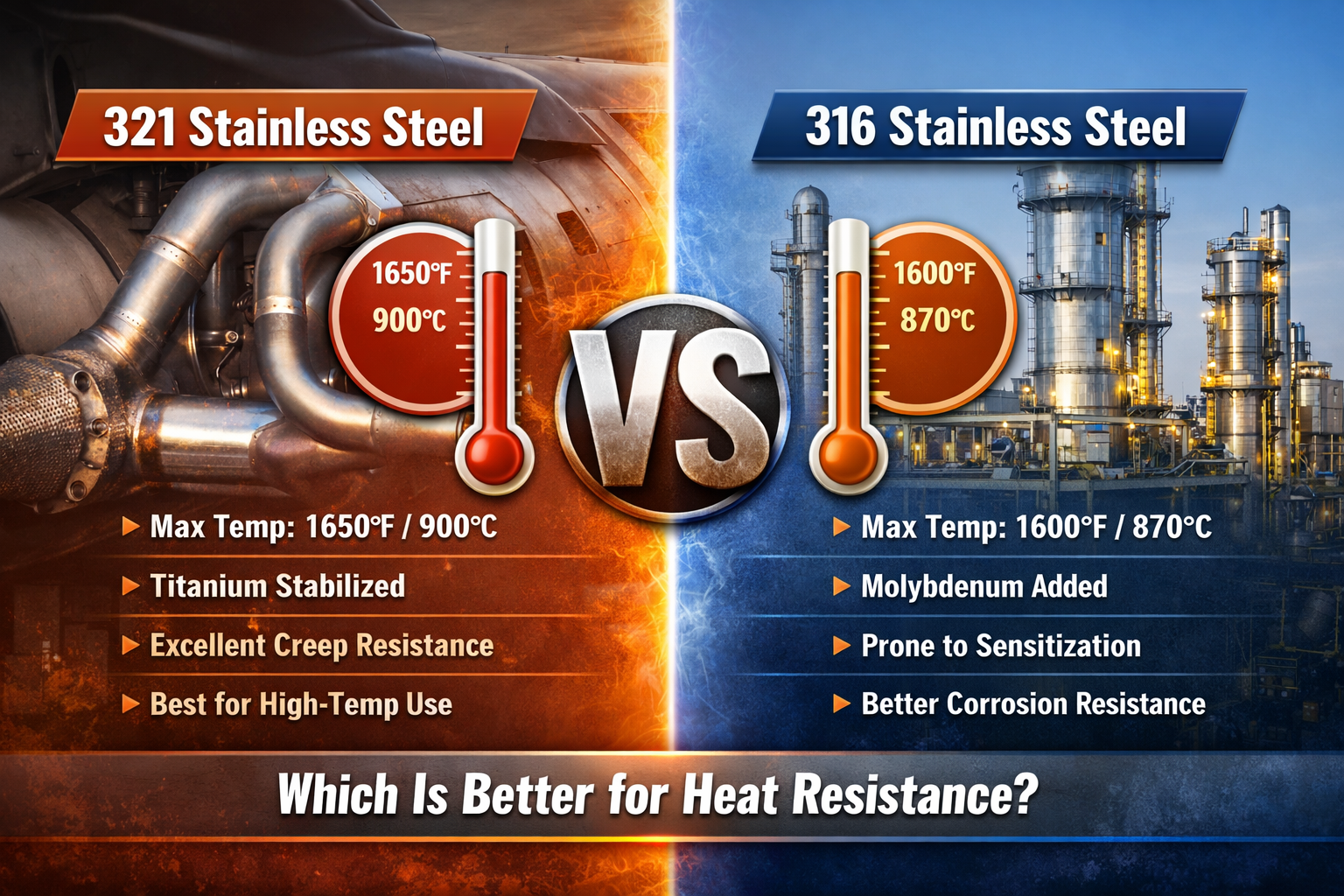
| Max Continuous Service Temperature | ~870°C (1600°F) | ~900°C (1650°F) |
| Carbide Precipitation Risk | High (500–800°C range) | Very Low (Ti stabilized) |
| Thermal Stability | Moderate | Превосходно |
| Creep Resistance | Moderate | Better than 316 |
321 stainless steel clearly outperforms 316 in sustained high-temperature environments, especially where exposure is long-term rather than intermittent.
3. Resistance to Sensitization
Sensitization occurs when chromium carbides form at grain boundaries between 500–800°C, leading to intergranular corrosion and strength loss.
- 316 Stainless Steel: Susceptible to sensitization unless low-carbon (316L) or solution annealed.
- 321 Stainless Steel: Titanium binds carbon preferentially, preventing chromium carbide formation.
This makes 321 the preferred choice for welded or cyclic thermal applications.
4. Oxidation and Scaling Resistance
Both alloys rely on chromium oxide layers for oxidation resistance. However:
- 321 maintains oxide layer stability better at elevated temperatures
- 316 may experience scaling and microstructural degradation sooner
In furnace atmospheres, exhaust systems, and thermal processing equipment, 321 demonstrates longer service life.
5. Corrosion Resistance vs Heat Resistance Trade-Off
It is important to distinguish application priorities:
- 316 excels in chloride-rich, chemical, and marine environments
- 321 excels in high-temperature, dry, or oxidizing environments
If corrosion resistance at ambient or moderate temperatures is the primary concern, 316 may be superior. If heat resistance is critical, 321 is the better material.
6. Typical Applications
316 Stainless Steel Applications
- Chemical processing equipment
- Marine components
- Heat exchangers (moderate temperature)
- Pharmaceutical and food processing
321 Stainless Steel Applications
- Aircraft exhaust manifolds
- Furnace parts
- High-temperature piping systems
- Thermal expansion joints
7. Which Is Better for Heat Resistance?
From a heat-resistance standpoint, 321 stainless steel is the superior choice.
- Better resistance to sensitization
- Higher long-term temperature stability
- Improved creep performance
- More reliable after welding
316 stainless steel remains an excellent corrosion-resistant alloy, but it is not optimized for prolonged high-temperature service.
Заключение
When comparing 321 vs 316 stainless steel for heat resistance, the answer is clear:
Choose 321 stainless steel for high-temperature, long-term, or cyclic thermal applications.
Choose 316 stainless steel for corrosive, chloride-rich environments at moderate temperatures.
Understanding the operating environment—not just material cost—is essential to selecting the correct stainless steel grade and ensuring long-term performance.
Frequently Asked Questions (FAQ)
1. Is 321 stainless steel more heat resistant than 316?
Yes. 321 stainless steel offers better heat resistance than 316 due to its titanium stabilization. Titanium prevents chromium carbide precipitation at elevated temperatures, allowing 321 to maintain mechanical strength and corrosion resistance during long-term exposure to heat.
2. What is the maximum operating temperature for 321 and 316 stainless steel?
316 stainless steel can typically operate continuously up to approximately 870°C (1600°F), while 321 stainless steel can withstand slightly higher temperatures, up to about 900°C (1650°F). More importantly, 321 performs better during prolonged exposure and thermal cycling.
3. Why is 321 stainless steel better for welded high-temperature applications?
321 stainless steel is titanium-stabilized, which prevents sensitization in the heat-affected zone after welding. This makes it more reliable than 316 stainless steel in high-temperature welded structures such as exhaust systems and furnace components.
4. Does 316 stainless steel lose strength at high temperatures?
Yes. While 316 stainless steel maintains good corrosion resistance, it is more susceptible to carbide precipitation and microstructural degradation between 500–800°C, which can reduce strength and corrosion resistance over time.
5. Which stainless steel is better for continuous high-temperature service?
For continuous or long-term high-temperature service, 321 stainless steel is the better choice. It provides superior thermal stability, improved creep resistance, and better performance after repeated heating and cooling cycles.
