
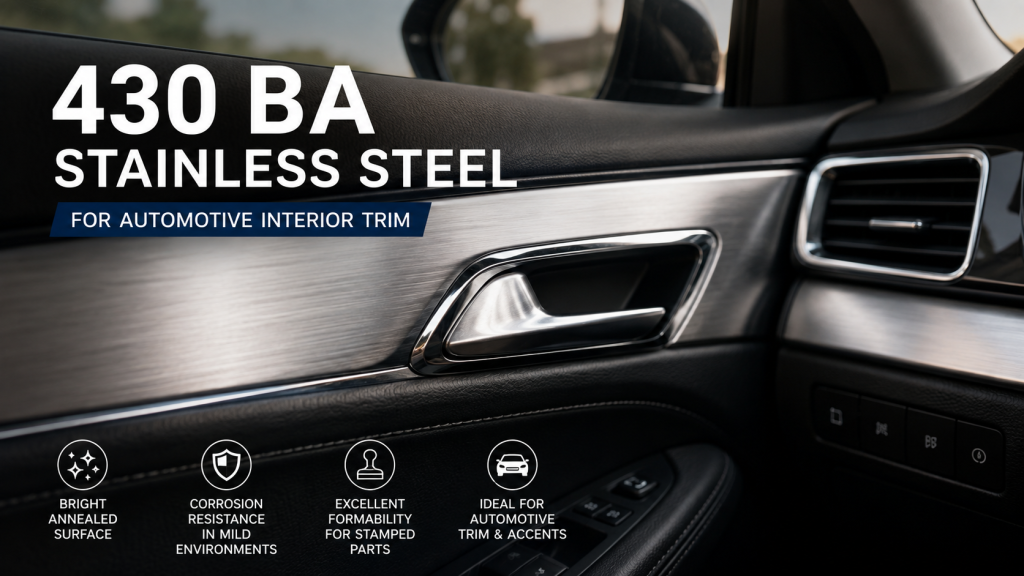
 430 BA stainless steel combines the ferritic Type 430 alloy with a bright-annealed surface designed for applications where visual appearance is an important part of the finished component.
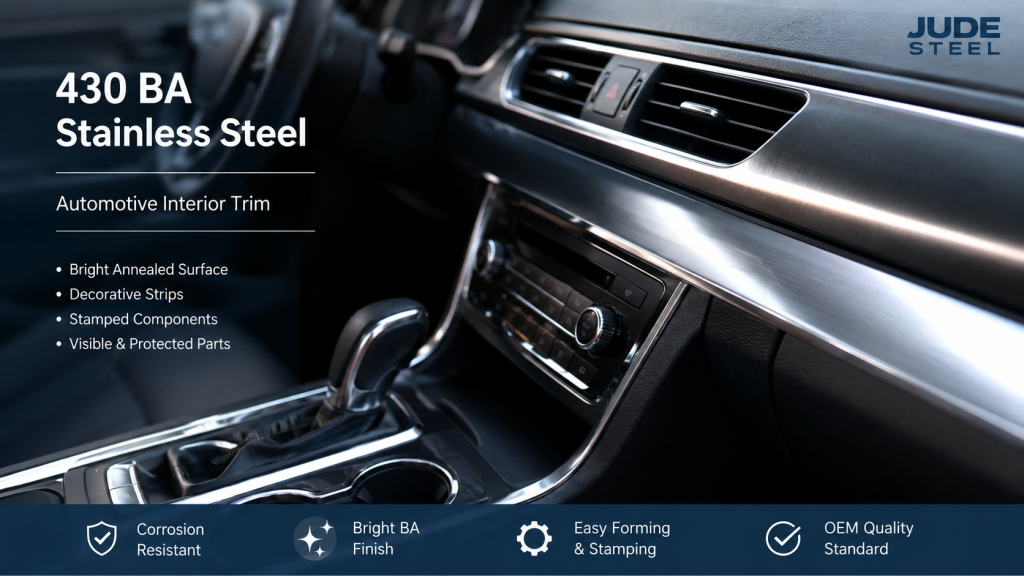
In automotive manufacturing, this combination can be particularly relevant to selected interior trim, decorative strips, bezels, metal accents and stamped components operating in relatively mild corrosion environments.
The key purchasing question is not simply whether Type 430 can be used in a vehicle.
The more useful question is whether the component needs the bright as-delivered appearance of BA stainless steel and whether Type 430 provides sufficient corrosion resistance and formability for the actual vehicle location.
Quick Answer: Where Can 430 BA Stainless Steel Be Used in Automotive Manufacturing?
Subject to the OEM material specification, 430 BA stainless steel can be considered for selected components such as:
- dashboard decorative trim;
- center-console metal accents;
- door-panel decorative strips;
- air-vent bezels and surrounds;
- control-panel frames;
- speaker trim frames;
- decorative rings and bright bezels;
- protected sill or scuff inserts;
- bright stamped covers;
- other visible, non-safety-critical components in relatively mild corrosion environments.
BA does not increase Type 430 to the corrosion level of 304 or a higher-alloy ferritic stainless steel. Exterior road-salt exposure, severe forming or demanding welding may require another material.
What Is 430 BA Stainless Steel?
430 BA stainless steel is Type 430 ferritic stainless steel supplied with a bright-annealed surface.
The designation contains two independent purchasing requirements:
- 430 defines the stainless steel grade;
- BA defines the bright-annealed surface condition.
Type 430 is commonly identified as ASTM Type 430 / UNS S43000 and is frequently cross-referenced with EN 1.4016 / X6Cr17 and JIS SUS430.
For additional grade information, see JUDE’s
430 Stainless Steel
page.
Important terminology:
BA is a surface condition, not a separate stainless steel grade. The corrosion resistance, magnetism and fundamental forming behavior still come primarily from the Type 430 base alloy.
What Does BA Finish Mean?
BA means Bright Annealed.
After cold rolling, the stainless steel is annealed in a controlled protective atmosphere that limits surface oxidation during the heat-treatment stage.
The resulting surface is typically:
- bright;
- smooth;
- relatively reflective;
- free from the directional abrasive pattern associated with mechanically brushed surfaces.
In EN surface terminology, bright annealed material is commonly identified as 2R.
BA is not automatically a mirror finish.
No.8 or EN 2P mirror surfaces require additional mechanical polishing. BA can be highly reflective, but it is produced by a different manufacturing route.
430 BA Standards and Material Identification
| System | Material Reference | Relevant Product Standard | Buyer Note |
|---|---|---|---|
| ASTM / UNS | Type 430 / UNS S43000 | ASTM A240/A240M-26 | ASTM A480/A480M-25b provides applicable general flat-product requirements. |
| EN | 1.4016 / X6Cr17 | EN 10088-2:2024 | Bright-annealed surface is commonly designated 2R. |
| JIS | SUS430 | JIS G 4305:2021 for applicable cold-rolled sheet and strip | Confirm the exact surface and dimensional requirements in the purchase order. |
Cross-reference rule:
ASTM Type 430, EN 1.4016 and SUS430 are commonly cross-referenced, but the purchaser should not mix chemistry or mechanical requirements from different standards unless dual certification is explicitly required.
Why Is BA Surface Relevant to Automotive Interior Components?
Automotive interior trim places unusual demands on stainless steel.
A component may experience relatively mild corrosion exposure while still requiring:
- a clean metallic appearance;
- high surface uniformity;
- repeatable brightness between production lots;
- controlled stamping;
- minimal visible scratches;
- protection during assembly.
A BA surface can reduce the need for a separate heavy mechanical polishing step when the as-delivered brightness already matches the design requirement.
However, the final appearance should still be approved against the customer’s actual automotive surface specification rather than relying on the word “BA” alone.
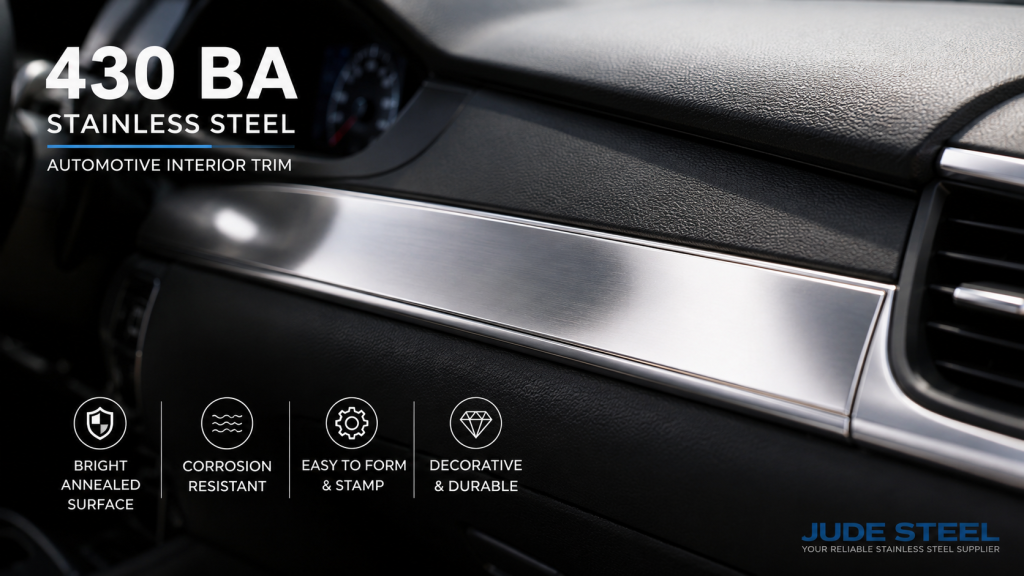 Which Automotive Components Can Use 430 BA?
| Component | 430 BA Suitability | Main Advantage | Main Risk |
|---|---|---|---|
| Dashboard decorative strip | Strong candidate in protected interiors | Bright metallic appearance | Scratch and gloss variation |
| Center-console accent | Suitable when forming is moderate | Bright as-delivered finish | Fingerprint and handling visibility |
| Door-panel decorative strip | Suitable for many cabin designs | Surface consistency and strip processing | Edge burr and cosmetic damage |
| Air-vent bezel | Application dependent | Bright stamped appearance | Ridging after forming |
| Control-panel frame | Suitable in mild environments | Decorative surface | Stamping complexity |
| Protected scuff insert | Conditional | Bright appearance | Footwear moisture, abrasion and salt |
| Exterior bright trim | Conditional | Metallic appearance | Road salt and chloride exposure |
Dashboard and Center-Console Trim
Dashboard and center-console trim are among the most logical applications for 430 BA because the cabin environment is generally more protected than the underbody or exterior of the vehicle.
Possible components include:
- horizontal dashboard strips;
- console surrounds;
- gear-selector accents;
- control-panel trims;
- decorative insert panels.
For these parts, surface acceptance can matter more than extreme corrosion resistance.
Buyers should therefore define not only the steel grade, but also the appearance standard.
Door Trim, Vent Surrounds and Decorative Strips
Narrow decorative components are often produced from slit stainless steel coil.
The manufacturing route may include:
- parent coil inspection;
- precision slitting;
- blanking or roll forming;
- stamping;
- edge finishing;
- protective-film handling;
- assembly.
For these applications, camber and edge burr can affect production stability even when the surface itself is visually acceptable.
430 BA for Bezels, Frames and Decorative Rings
BA-finished 430 may also be evaluated for stamped bezels and decorative frames used around:
- air vents;
- switch panels;
- control interfaces;
- speaker surrounds;
- interior decorative openings.
Complex geometries require additional attention because forming can change the appearance of the bright surface.
Scuff Plates and Protected Sill Components
A protected interior sill insert may be suitable for 430 BA, but door-sill components deserve more caution than dashboard trim.
They may encounter:
- wet footwear;
- abrasion;
- salt carried into the cabin;
- cleaning chemicals;
- repeated scratching.
Where long-term cosmetic resistance to chloride exposure is important, a higher-corrosion-resistance grade should be evaluated.
430 BA vs 430 2B
| Factor | 430 BA | 430 2B |
|---|---|---|
| Base grade | Type 430 | Type 430 |
| Surface process | Bright annealed in a protective atmosphere | Annealed/descaled and lightly cold rolled on polished rolls |
| Appearance | Brighter and smoother | General-purpose bright cold-rolled finish |
| Directionality | No intentional abrasive grain | No intentional decorative abrasive grain |
| Typical automotive logic | Visible decorative parts | Further processing, stamping or less appearance-critical parts |
430 BA vs No.4 and Hairline
BA differs fundamentally from mechanically brushed finishes.
No.4 and Hairline surfaces contain an intentional directional abrasive pattern.
BA does not.
The designer should therefore decide whether the finished automotive trim should look:
- smooth and bright;
- directionally brushed;
- hairline textured;
- mirror-like.
Is 430 BA a Mirror Finish?
No.
BA can be highly reflective, but it should not be specified as an automatic substitute for a No.8 or other mechanically polished mirror finish.
If the customer requires mirror-level appearance, the polishing route and final acceptance standard should be stated separately.
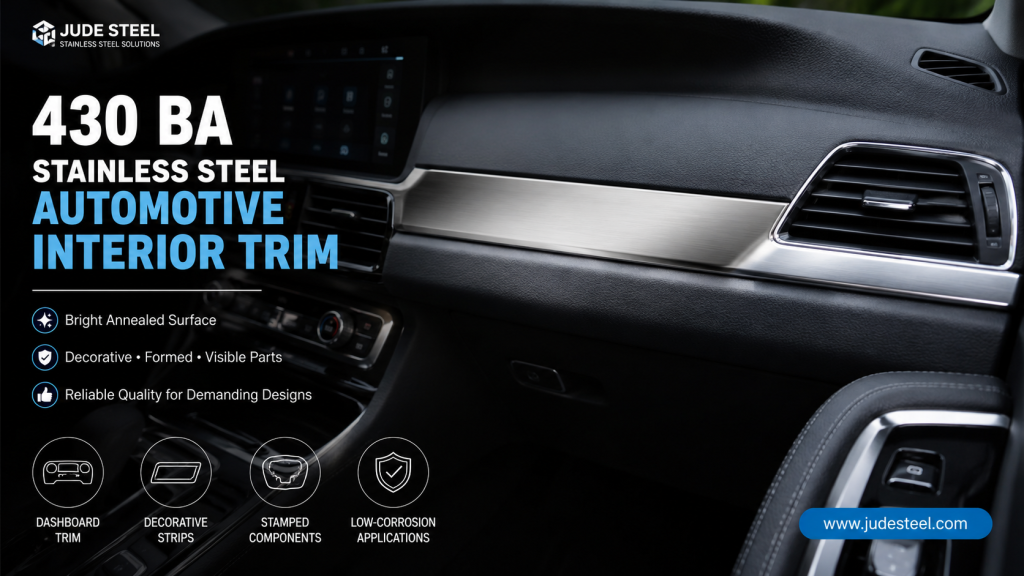 Surface Quality Requirements for Visible Automotive Parts
For visible automotive trim, “BA” should not be treated as the complete cosmetic specification.
The purchase specification may also need to define:
- critical visible surface;
- scratch limits;
- dent limits;
- roll marks;
- surface tone;
- gloss range where required;
- roughness where required;
- approved physical sample;
- inspection lighting;
- viewing distance.
Critical Side and Non-Critical Side
Many automotive trim components have only one visible face.
The drawing should therefore identify:
- Side A: visible cosmetic surface;
- Side B: hidden or assembly surface.
This prevents unnecessary rejection of minor cosmetic variation on a non-visible surface and places stricter control where the customer actually sees the material.
Approved Surface Sample
For high-volume visible trim, an approved master sample can be more useful than describing appearance only with words such as “bright” or “high gloss.”
The sample can establish:
- acceptable brightness;
- surface tone;
- minor roll-mark acceptance;
- acceptable scratch level;
- comparison between production lots.
Stamping and Forming 430 BA Stainless Steel
430 BA can be processed through moderate stamping, blanking and forming operations when the material condition and component geometry are suitable.
Important variables include:
- material thickness;
- drawing depth;
- bend radius;
- rolling direction;
- blank orientation;
- tool condition;
- lubrication;
- springback;
- surface protection.
Tool cleanliness becomes especially important because scratches that would be acceptable on a hidden industrial part may be unacceptable on a bright automotive trim surface.
Ridging and Roping After Forming
Ferritic stainless steels such as Type 430 can develop visible ridging or roping after significant plastic deformation.
A bright BA surface may make these visual effects easier to notice.
For appearance-critical stamped components, buyers and processors should consider:
- blank orientation;
- forming severity;
- tool geometry;
- production trials;
- enhanced-formability ferritic grades;
- 436-type material when a more demanding visible-forming application requires additional ridging control and corrosion margin.
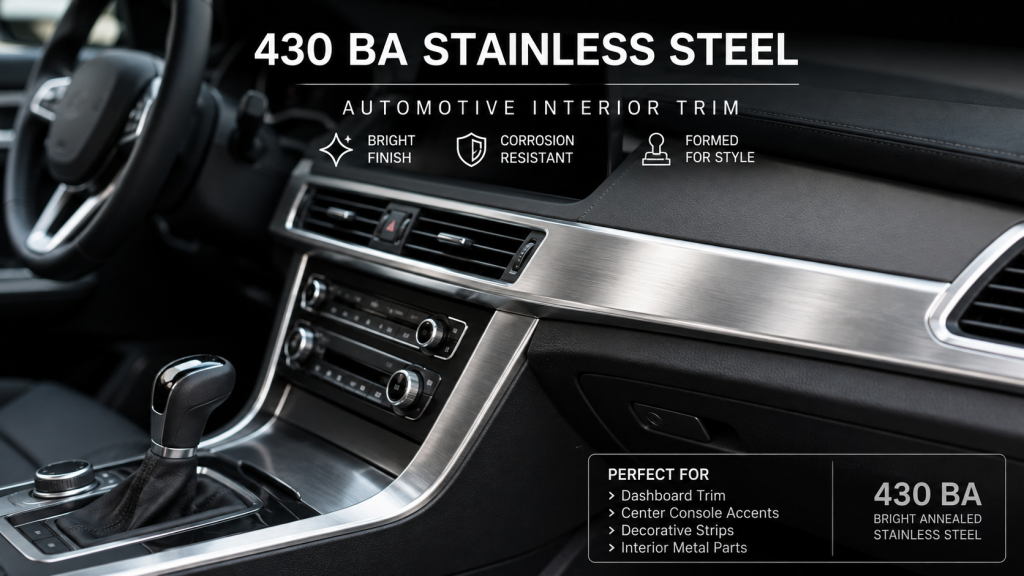 Does 430 BA Need Protective Film?
Protective film is strongly worth considering when the BA surface will remain visible after manufacturing.
Film can reduce scratching during:
- slitting;
- blanking;
- transport;
- stamping;
- manual handling;
- assembly.
When film is required, specify:
- protected side;
- film thickness;
- adhesion;
- forming compatibility;
- storage duration;
- residue limits;
- removal conditions.
430 BA vs 304 BA for Automotive Trim
| Factor | 430 BA | 304 BA |
|---|---|---|
| Microstructure | Ferritic | Austenitic |
| Magnetic behavior | Normally magnetic | Normally low magnetic response when annealed |
| Corrosion margin | Suitable for mild environments | Generally broader |
| Severe forming | More limited | Generally better |
| Welding | Standard 430 requires greater caution | Generally more forgiving |
| Primary automotive logic | Protected visible trim and cost control | More demanding corrosion and forming applications |
See JUDE’s
304 Stainless Steel
page when the component requires a larger corrosion or forming margin.
430 BA vs 436 for More Demanding Trim
When a visible 430 component experiences unacceptable ridging or the service environment requires a greater corrosion margin, 436 may deserve evaluation.
JUDE’s
436 Stainless Steel
page describes 436 as a modification of 430 developed to reduce roping during forming and improve corrosion resistance.
The decision should be made from:
- forming geometry;
- visible surface requirement;
- chloride exposure;
- OEM specification;
- material cost.
430 BA Sheet, Coil or Strip?
430 BA Coil
Stainless Steel Coil
is usually the preferred raw-material form for high-volume automotive stamping and continuous production.
430 BA Sheet
Stainless Steel Sheet
can be practical for prototypes, lower-volume parts, blank preparation and forming trials.
430 BA Strip
Stainless Steel Strip
is particularly useful for narrow decorative moldings, trim strips and continuous forming lines.
Slitting and Edge Requirements for Automotive Trim
Narrow bright trim requires more than a good surface.
The customer may need to control:
- strip width;
- width tolerance;
- camber;
- edge burr;
- edge shape;
- coil ID;
- coil weight;
- protective film;
- critical-side orientation.
JUDE’s
Strip Processing
service supports customized coil slitting and downstream strip preparation.
Welding Limitations of Standard 430 BA
Changing the surface from 2B to BA does not change the fundamental welding behavior of Type 430.
Standard 430 should therefore not be the default selection when the component requires extensive or demanding welding.
Depending on the design, alternatives may include:
- 439 or another stabilized ferritic stainless steel;
- 304;
- a dedicated stabilized 430-type product;
- another OEM-approved alloy.
Does BA Make 430 More Corrosion Resistant?
BA provides a smooth, clean surface condition, but the basic corrosion capability is still governed mainly by the Type 430 alloy and the service environment.
430 BA should be used with additional caution in:
- road-salt exposure;
- coastal chloride environments;
- persistent wet conditions;
- crevices;
- aggressive cleaning environments.
BA is a finish, not an alloy upgrade.
A bright surface does not give Type 430 the corrosion resistance of Type 304 or a more highly alloyed ferritic stainless steel.
How to Inspect 430 BA for Automotive Trim
- Verify the exact grade and governing standard.
- Review the MTC and heat/coil identification.
- Confirm BA / 2R surface requirement.
- Measure thickness and width.
- Identify the critical visible side.
- Inspect scratches, dents and roll marks.
- Compare brightness with the approved sample.
- Measure gloss or roughness when contractually specified.
- Check flatness and camber.
- Inspect slit-edge burr.
- Verify protective film.
- Perform a forming trial for appearance-critical stamped parts.
JUDE publishes selected
Stainless Steel Inspection Reports
,
including SUS430-related documentation.
 Common 430 BA Purchasing Mistakes
Mistake 1: Ordering only “430 BA.”
Also define dimensions, tolerances, critical side, surface acceptance, edge and protective film.
Mistake 2: Treating BA as No.8 mirror.
They are produced by different finishing processes.
Mistake 3: Assuming all BA coils have identical gloss.
Appearance-critical projects should use measurable criteria or an approved sample.
Mistake 4: Assuming BA improves the alloy’s corrosion resistance to 304 levels.
Type 430 remains a ferritic alloy intended primarily for relatively mild corrosion environments.
Mistake 5: Inspecting the surface only before stamping.
Forming may reveal ridging or other visual effects.
Mistake 6: Ignoring protective film.
Bright surfaces can be damaged during slitting, stamping, transportation and assembly.
Mistake 7: Assuming BA and 6K are universal standard synonyms.
Use the exact surface specification and approved appearance requirement.
JUDE 430 BA Stainless Steel Supply Options
JUDE’s published flat-product portfolio lists Type 430 and BA surface options across its stainless steel sheet, coil and strip product ranges.
430 Stainless Steel
— grade information.
Stainless Steel Coil
— for high-volume automotive production.
Stainless Steel Sheet
— for blanks, prototypes and lower-volume parts.
Stainless Steel Strip
— for narrow decorative strip and trim applications.
Strip Processing
— for customized slit widths and coil processing.
Exact BA availability, dimensions, surface appearance, coil weight and tolerances should be confirmed for each automotive project.
430 BA Automotive Stainless Steel RFQ Checklist
- Final component: dashboard trim, console accent, bezel, decorative strip, sill insert or another part.
- Component drawing: provide 2D or 3D data when available.
- Vehicle location: cabin, protected sill, exterior or another environment.
- OEM specification: provide the applicable automotive specification.
- Grade: ASTM Type 430 / UNS S43000, EN 1.4016, SUS430 or another specified grade.
- Surface: BA / 2R.
- Product form: sheet, coil, strip or blank.
- Thickness: nominal thickness and tolerance.
- Width: nominal width and tolerance.
- Critical side: identify Side A and Side B.
- Surface sample: provide approved BA appearance where required.
- Gloss: state measurement requirement if numerical control is necessary.
- Roughness: state Ra and test method if required.
- Scratch acceptance: define visible defect requirements.
- Forming process: stamping, bending, drawing, punching or roll forming.
- Drawing severity: provide component depth and radius where relevant.
- Ridging requirement: state whether visible ridging is critical.
- Camber: state maximum value for narrow strip.
- Edge: mill, slit, deburred or rounded.
- Edge burr: specify maximum allowable burr where critical.
- Protective film: state type, side and adhesion requirement.
- Coil ID: state production-line requirement.
- Coil weight: state preferred minimum and maximum.
- Inspection: MTC, heat/coil traceability, dimensional report and surface inspection.
- Quantity: prototype, trial coil or annual demand.
- Destination: country, port, Incoterm and delivery schedule.
Frequently Asked Questions
What is 430 BA stainless steel?
It is Type 430 ferritic stainless steel supplied with a bright-annealed surface finish.
What does BA mean in stainless steel?
BA means Bright Annealed. The cold-rolled stainless steel is annealed in a protective atmosphere to produce a smooth and bright surface.
Is BA the same as 2R?
BA is the commonly used ASTM-style terminology for bright annealed stainless steel, while EN surface terminology commonly identifies this finish as 2R.
Is 430 BA a mirror finish?
No. BA can be highly reflective, but a No.8 or EN 2P mirror finish normally requires additional mechanical polishing.
Is 430 BA suitable for automotive interior trim?
It can be a strong candidate for selected visible interior trim when the OEM corrosion, forming and surface requirements are compatible with Type 430.
Can 430 BA be stamped?
Yes. It can be used for many moderate stamping and forming processes. Complex or highly stretched visible parts should be validated through forming trials.
Why can 430 BA show ridging after forming?
Ferritic stainless steels can develop ridging or roping during significant plastic deformation. The bright BA surface may make these visual features easier to notice.
Does 430 BA need protective film?
Not always, but protective film is strongly worth considering when the BA surface will remain visible after stamping and assembly.
Is 430 BA better than 430 2B?
Neither is universally better. BA is normally selected for a brighter as-delivered surface, while 2B is a common general-purpose surface suitable for manufacturing and further finishing.
Can 430 BA be used for exterior automotive trim?
Only after the corrosion environment is evaluated. Persistent road salt, chlorides and wet exposure may justify a more corrosion-resistant stainless steel.
What information should I provide for a 430 BA quotation?
Provide the final component, OEM specification, grade, BA surface requirement, thickness, width, critical side, surface sample, forming process, film, edge requirement, inspection requirements, quantity and destination.
Заключение
430 BA stainless steel occupies a specific automotive niche.
Its main value is not simply that it is Type 430, but that it combines a ferritic stainless steel substrate with a bright as-delivered surface suitable for selected visible components.
Potential applications include dashboard trim, console accents, decorative strips, bezels, frames and other non-safety-critical components used in relatively mild corrosion environments.
The correct purchasing logic is:
Component → Vehicle Location → Corrosion Exposure → BA Surface Requirement → Forming Severity → Critical Side → Dimensions → Inspection.
For simple protected trim, 430 BA can provide an efficient material and surface solution. When corrosion, severe forming or welding requirements increase, 304, 436 or another OEM-approved stainless steel should be evaluated.
Request 430 BA Stainless Steel for Automotive Trim
Send JUDE your component drawing, OEM specification, Type 430 requirement, BA surface requirement, thickness, coil or strip width, approved surface sample, critical visible side, stamping process, protective-film requirement, annual quantity and destination.
For narrow trim production, also provide coil ID, coil weight, camber, width tolerance, edge condition and maximum burr.
