
420J2 vs 420HC Stainless Steel: Properties, Hardness and Applications
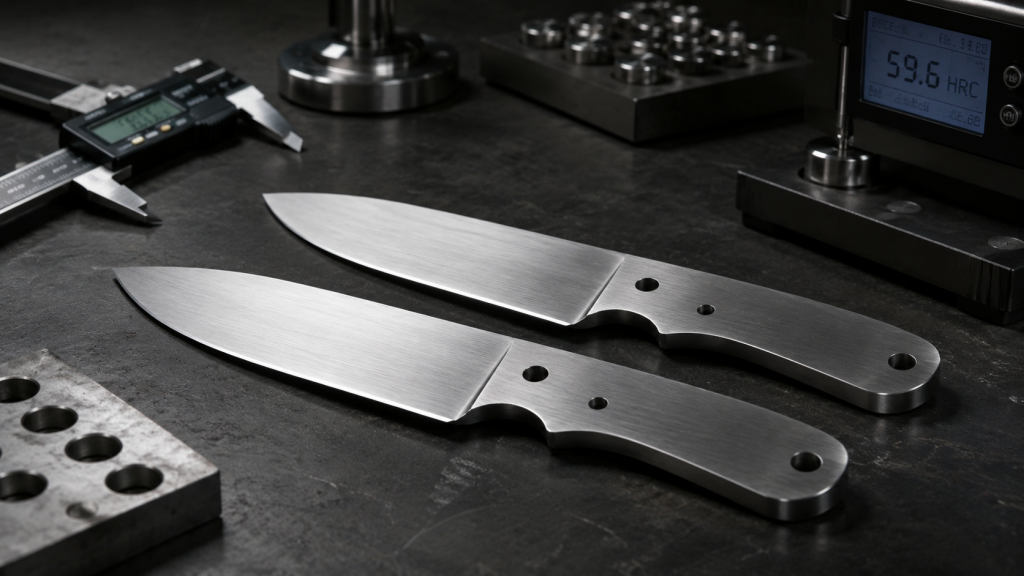
Comparison of 420J2 and 420HC martensitic stainless steels for blades, cutting tools and precision components.
420J2 and 420HC are martensitic stainless steels commonly considered for knives, scissors, surgical instruments, cutting tools and wear-resistant components. Both can be hardened through heat treatment, but they are not automatically interchangeable.
The most important difference is that 420J2 is a standardized Japanese grade with a defined chemical composition range, while 420HC is commonly used as a commercial description for a higher-carbon version of 420 stainless steel. The exact chemistry of a product sold as 420HC can vary between steel mills and manufacturers.
Therefore, buyers should compare the material certificate, carbon content, alloy additions, heat-treatment condition and final hardness instead of choosing a material only by its commercial name.
This guide explains the differences between 420J2 vs 420HC stainless steel, including chemical composition, hardness, corrosion resistance, edge retention, toughness, heat treatment, processing performance and typical applications.
Quick Answer: 420J2 vs 420HC
Choose 420J2 when you require a standardized, economical martensitic stainless steel with good hardenability, polishability and broad availability in sheet, coil or precision strip.
Choose a verified 420HC specification when improved wear resistance, higher hardness or longer edge retention is required and the supplier can provide a complete chemical composition and material test certificate.
For finished knives and cutting tools, heat-treatment quality, blade geometry, grinding control and final hardness may affect performance more than the grade name alone.
420J2 vs 420HC Stainless Steel Comparison
| Comparison | 420J2 Stainless Steel | 420HC Stainless Steel |
|---|---|---|
| Steel family | Martensitic stainless steel | Martensitic stainless steel |
| Grade status | Standardized as SUS420J2 under JIS specifications | Commercial high-carbon 420 designation; chemistry may vary |
| Typical carbon content | 0.26–0.40% | Usually higher than conventional 420 grades, depending on the producer |
| Typical chromium content | 12.00–14.00% | Commonly approximately 13%, depending on the specification |
| Heat treatable | Yes | Yes |
| Hardness potential | High after proper hardening and tempering | Usually selected for high hardness and wear resistance |
| Edge retention | Suitable for general-purpose blades and cutting tools | Often better when higher carbon and heat treatment are properly controlled |
| Toughness | Good balance at moderate hardness | Depends strongly on hardness and tempering conditions |
| Corrosion resistance | Good in mild environments | Good in mild environments, but dependent on chemistry and heat treatment |
| Sharpening | Generally easy to sharpen | May require slightly more effort at higher hardness |
| Typical applications | Scissors, cutlery, surgical tools, industrial blades and precision parts | Knives, cutting blades, wear tools, scissors and specialty components |
| Main purchasing concern | Confirm JIS grade, dimensions, condition and hardness | Confirm exact chemistry, mill specification and material certificate |
What Is 420J2 Stainless Steel?
420J2 stainless steel
is a hardenable martensitic stainless steel commonly identified as SUS420J2 under Japanese standards. It typically contains 0.26–0.40% carbon and 12.00–14.00% chromium.
Unlike austenitic stainless steels such as 304 and 316L, 420J2 can be hardened by quenching and tempering. After proper heat treatment, it can provide high hardness, good strength, useful wear resistance and a polished surface finish.
Typical characteristics of 420J2 include:
- Good hardenability after quenching and tempering
- Good wear resistance for an economical stainless steel
- Good grinding and polishing performance
- Magnetic properties in annealed and hardened conditions
- Good corrosion resistance in mild atmospheric environments
- Availability in sheet, coil and precision strip
- Suitability for high-volume blade and tool production
Common applications include scissors, industrial blades, cutlery, surgical instruments, measuring tools, mechanical components, shafts, valves and wear-resistant parts.
What Is 420HC Stainless Steel?
The term 420HC generally means “420 High Carbon.” It is commonly used for martensitic stainless steel developed to provide increased hardness and wear resistance while maintaining reasonable corrosion resistance and ease of processing.
420HC is particularly associated with knives and cutting tools because an increased carbon level can improve hardening response, carbide formation and edge stability.
420HC is not always a single globally harmonized stainless steel grade with one mandatory chemical composition. Different producers may use different carbon, chromium, vanadium or molybdenum levels while marketing the material as 420HC.
Buyers should request the producer’s technical datasheet and material test certificate before approving 420HC for an industrial project. The purchase specification should identify the required chemistry, standard, heat-treatment condition and final hardness range.
Typical uses of 420HC include:
- Hunting and outdoor knives
- Kitchen and utility knives
- Industrial cutting blades
- Scissors and shearing components
- Surgical blades and instruments
- Bearings and wear-resistant components
- Plastic extrusion tooling
- Precision mechanical parts
Chemical Composition Comparison
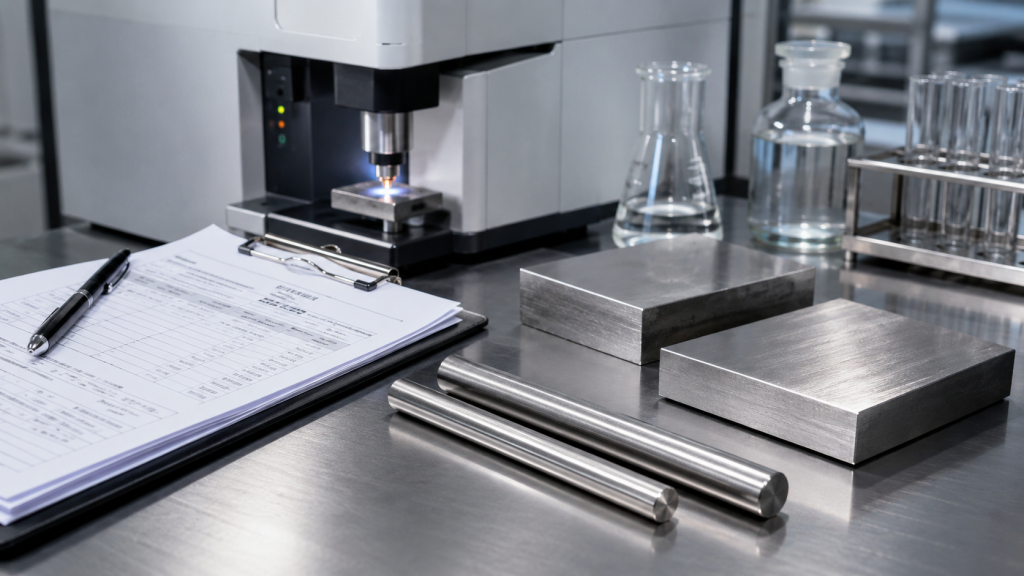
Chemical composition and mill test certificate verification are essential when comparing 420J2 with 420HC.
| Элемент | SUS420J2 | 420HC | Technical Effect |
|---|---|---|---|
| Carbon | 0.26–0.40% | Normally positioned as a higher-carbon 420 chemistry | Increases hardness potential, carbide volume and wear resistance |
| Chromium | 12.00–14.00% | Commonly around 13%, depending on the producer | Provides corrosion resistance and contributes to hardenability |
| Manganese | Maximum approximately 1.00% | Producer-dependent | Supports deoxidation and hardenability |
| Silicon | Maximum approximately 1.00% | Producer-dependent | Acts as a deoxidizer and contributes to strength |
| Vanadium | Not required in the standard basic composition | May be added in certain proprietary specifications | Can refine grain size and form wear-resistant carbides |
| Molybdenum | Not normally required | May be present in selected specifications | Can improve hardenability and selected corrosion properties |
Higher carbon generally increases the potential hardness and wear resistance of martensitic stainless steel. However, it can also reduce ductility, toughness and corrosion margin when carbide formation or heat treatment is not properly controlled.
This is why a higher carbon percentage does not automatically guarantee a better finished blade. Carbide distribution, grain size, retained austenite, decarburization and tempering quality must also be considered.
Hardness and Heat-Treatment Response
Both 420J2 and 420HC are normally supplied in a relatively soft condition for forming, blanking, machining or grinding. They are then hardened and tempered to develop their final mechanical properties.
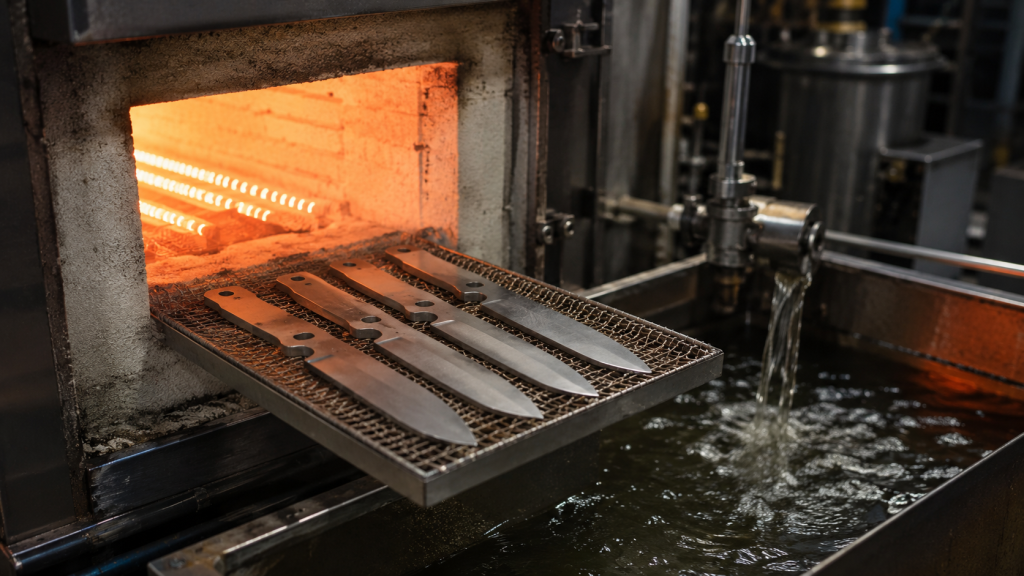
Quenching and tempering determine the final hardness, toughness and dimensional stability of martensitic stainless steel.
A typical manufacturing sequence may include:
- Annealed material preparation
- Blanking, cutting or machining
- Preheating when required
- Austenitizing at a controlled temperature
- Oil, air, gas or controlled quenching
- Immediate tempering
- Final grinding and polishing
- Hardness and dimensional inspection
Properly processed 420J2 is commonly used in applications requiring approximately 50–56 HRC, although the actual result depends on chemical composition, product thickness, furnace control and tempering conditions.
A verified 420HC composition may be designed for approximately the mid- to upper-50 HRC range. However, the target should always be defined by the component designer and validated by production testing.
Why Heat Treatment Is Critical
- Insufficient austenitizing temperature may prevent the material from reaching the required hardness.
- Excessive austenitizing temperature may cause grain growth, distortion and lower toughness.
- Uneven quenching can produce hardness variation and dimensional distortion.
- Delayed tempering can increase residual stress and cracking risk.
- Incorrect tempering may reduce hardness, toughness or corrosion performance.
- Surface decarburization may create a soft cutting edge even when the core hardness is acceptable.
Vacuum furnaces or controlled-atmosphere heat treatment can help reduce oxidation and decarburization. The correct cycle must be established according to the exact chemistry, section thickness, component geometry and target hardness.
Edge Retention and Wear Resistance
Edge retention depends on more than carbon content. Important variables include final hardness, carbide type, carbide distribution, blade geometry, sharpening angle, surface condition and cutting environment.
A properly specified 420HC material may provide better wear resistance than conventional 420J2 because its higher-carbon chemistry can support increased carbide formation and higher working hardness.
However, a professionally heat-treated 420J2 blade can outperform a poorly processed blade sold as 420HC. Material grade should therefore be combined with measurable production requirements.
For critical cutting tools, specify:
- Required Rockwell C hardness range
- Permitted hardness variation
- Maximum decarburization depth
- Required microstructure
- Blade angle and edge geometry
- Surface finish and grinding direction
- Cutting-life or wear-resistance test
Toughness and Chipping Resistance
Toughness normally decreases as hardness and carbide volume increase. A 420J2 component tempered to a moderate hardness may tolerate impact, bending or side loading better than a higher-carbon material processed to maximum hardness.
This does not mean that 420J2 is always tougher or that 420HC is always brittle. The actual result depends on chemistry, grain size, heat treatment, component thickness and service conditions.
Before selecting a grade, determine:
- Whether the component will experience impact loading
- Whether the cutting edge will be twisted or bent
- The required edge life between sharpening cycles
- The minimum acceptable toughness
- The maximum permissible hardness variation
- The consequences of edge rolling, cracking or chipping
Устойчивость к коррозии
Both materials contain enough chromium to provide useful corrosion resistance in mild atmospheric, domestic and industrial environments. Corrosion resistance is normally improved by proper hardening, tempering, fine grinding, polishing, cleaning and passivation.
Neither material should be considered equivalent to
304 stainless steel
or
316L stainless steel
in continuously wet, acidic, marine or chloride-rich environments.
In martensitic stainless steel, part of the chromium may become associated with chromium carbides. Heat treatment, carbide distribution and tempering conditions can therefore influence the amount of chromium available to maintain the passive surface layer.
Real corrosion performance is affected by:
- Exact chromium and carbon content
- Heat-treatment temperature
- Carbide precipitation
- Surface roughness
- Grinding contamination
- Passivation quality
- Salt and chloride exposure
- Cleaning and maintenance practices
For components exposed continuously to seawater or concentrated chlorides, 420J2 and 420HC require careful evaluation. A corrosion-focused stainless steel such as 316L or duplex stainless steel may be more appropriate when high blade hardness is not the primary requirement.
Machining, Grinding and Welding
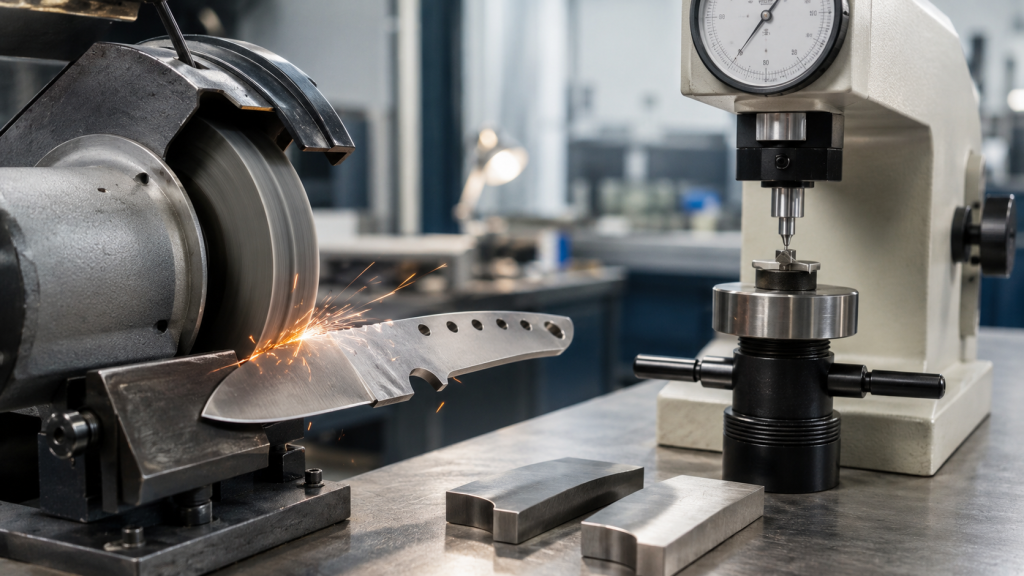
Grinding temperature and final hardness inspection are essential for controlling blade performance.
Machining
Both materials are generally easier to machine in the annealed condition. Rigid tooling, appropriate cutting speeds and adequate coolant should be used to control heat, tool wear and dimensional accuracy.
Machining hardened martensitic stainless steel is more difficult and may require grinding, electrical discharge machining or specialized tooling.
Blanking and Forming
Scissors, knife blanks and precision cutting components are commonly produced from annealed stainless steel strip before hardening.
Important strip-quality requirements include:
- Consistent thickness tolerance
- Controlled flatness
- Uniform annealed hardness
- Suitable carbide structure
- Clean and controlled slit edges
- Low surface-defect levels
JUDE provides
stainless steel strip
with customized widths, edge conditions and surface finishes for precision processing.
Grinding and Polishing
420J2 is widely used in polished blades and tools because it can achieve attractive satin, brushed and mirror finishes. A harder 420HC specification may require more grinding effort and may increase abrasive consumption.
Grinding heat must be carefully controlled. Excessive local temperature can soften the cutting edge, produce temper colors, increase residual stress or reduce corrosion performance.
Welding
Welding is not the preferred fabrication method for higher-carbon martensitic stainless steels. Rapid cooling of the heat-affected zone can produce a hard and crack-sensitive microstructure.
When welding cannot be avoided, the procedure may require preheating, controlled interpass temperature, low-hydrogen practice, suitable filler metal and post-weld heat treatment.
Welding procedures should be developed and qualified by a professional welding engineer for the actual component and service environment.
Typical Applications
| Application | Recommended Starting Point | Selection Reason |
|---|---|---|
| Economical household scissors | 420J2 | Good hardenability, polishability and cost control |
| Industrial cutting blade | 420HC or tightly controlled 420J2 | Selection depends on wear life, impact loading and required hardness |
| Hunting or outdoor knife | Verified 420HC specification | Higher-carbon chemistry may improve edge retention and wear resistance |
| Kitchen knife | 420HC for edge life; 420J2 for economical production | Final performance depends on heat treatment and blade geometry |
| Surgical instrument | 420J2 or validated 420HC | Selection depends on hardness, sterilization, polish and regulatory requirements |
| Decorative knife or display blade | 420J2 | Good polishing performance and economical manufacturing |
| Wear-resistant mechanical component | Verified 420HC or another martensitic grade | Higher hardness and carbide content may extend wear life |
| High-volume stamped blade | 420J2 precision strip | Standardized chemistry and broad strip availability |
| Marine or chloride-rich component | Application-specific evaluation required | Neither grade provides the chloride resistance of 316L or duplex stainless steel |
Which Stainless Steel Should You Choose?
Choose 420J2 When:
- You require a recognized JIS stainless steel grade.
- The project uses sheet, coil or precision strip.
- Cost control and production efficiency are important.
- Good polishing and sharpening performance are required.
- The component requires moderate-to-high hardness.
- The application includes scissors, instruments, blades or general wear parts.
Choose 420HC When:
- The supplier provides a complete chemical specification.
- Improved wear resistance is a major requirement.
- Longer edge retention is more important than minimum material cost.
- The heat-treatment process is professionally controlled.
- The final hardness range can be verified.
- The application includes specialty knives, industrial cutters or wear tools.
If your supplier cannot provide a clear chemical specification for 420HC, it may be safer to purchase a standardized grade with defined composition and performance requirements.
For applications requiring higher hardness and wear resistance than the 420 family can provide, buyers may also compare
430 vs 440 stainless steel
and other higher-carbon martensitic grades.
Purchasing Checklist for 420J2 and 420HC
A complete purchasing specification can help prevent differences between samples, production batches and suppliers.
Before placing an order, confirm the following:
- Grade and standard:
Specify SUS420J2, an EN equivalent or an approved proprietary 420HC specification. - Chemical composition:
Define acceptable carbon, chromium and alloy-addition ranges. - Product form:
Specify sheet, plate, coil, strip, blank or finished component. - Dimensions:
Confirm thickness, width, length, coil weight and dimensional tolerances. - Delivery condition:
Define annealed, cold rolled, hardened and tempered or another required condition. - Hardness:
State annealed hardness and final Rockwell C hardness requirements. - Surface finish:
Specify 2D, 2B, satin, brushed, precision ground or mirror polished. - Edge condition:
Select mill edge, slit edge, deburred edge or rounded edge. - Inspection:
Define chemical analysis, hardness mapping, flatness inspection, dimensional testing or microstructure examination. - Documentation:
Request a material test certificate, heat number, inspection report and certificate of origin when required. - End application:
Inform the supplier whether the material will be used for knives, scissors, medical tools, industrial blades or wear parts. - Heat treatment:
Confirm whether the material will be heat treated by the supplier or by the customer.
Available Product Forms and Processing Services
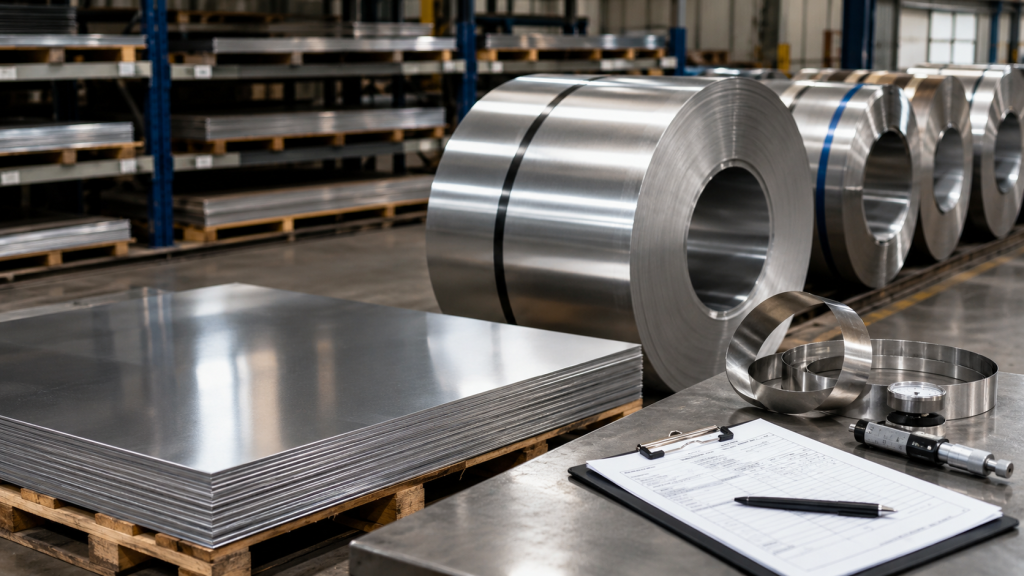
Stainless steel sheet, coil and precision strip can be supplied with customized dimensions, edges and inspection documents.
JUDE supplies stainless steel products for blade, tool and precision-component manufacturing. Available product forms include:
Stainless steel sheet and plate
Рулон нержавеющей стали
Precision stainless steel strip- Slitting and cut-to-length processing
- Customized width and thickness
- Deburred and rounded edges
- Grinding, brushing and polishing
- Dimensional inspection
- Material traceability and test certificates
JUDE’s
stainless steel strip processing
includes uncoiling, slitting, leveling, rewinding and customized packaging.
Final Conclusion
420J2 and 420HC are both useful martensitic stainless steels, but they should not be treated as interchangeable names.
420J2 provides a defined standardized composition, good hardenability, broad product availability and an attractive cost-to-performance ratio. It is widely used for scissors, cutting tools, surgical instruments, industrial blades and precision components.
420HC is generally selected when higher carbon, increased wear resistance and improved edge stability are required. However, its exact composition can vary, making supplier documentation especially important.
The safest material-selection process is to compare the chemical composition, material certificate, target hardness, heat-treatment process, surface requirements and actual operating environment rather than relying only on the grade name.
Frequently Asked Questions
Is 420HC better than 420J2?
Not in every application. A properly specified and heat-treated 420HC may provide better wear resistance and edge retention. However, 420J2 may offer better availability, lower cost, easier sharpening and more predictable standardized chemistry.
Is 420J2 stainless steel good for knives?
Yes. 420J2 is widely used for economical knives, scissors, cutlery, industrial blades and surgical instruments. It is suitable when polishability, corrosion resistance, ease of sharpening and manufacturing cost are important.
What hardness can 420J2 reach?
Properly heat-treated 420J2 is commonly used in approximately the 50–56 HRC range. The actual hardness depends on chemical composition, section thickness, austenitizing temperature, quenching method and tempering conditions.
What hardness can 420HC reach?
Depending on its exact chemistry and heat treatment, 420HC is commonly engineered for the mid- to upper-50 HRC range. Buyers should specify a required hardness range instead of relying on a general grade description.
Does 420HC hold an edge longer than 420J2?
A properly specified higher-carbon 420HC material will generally be selected for improved edge retention. However, blade geometry, carbide distribution, grinding quality and heat treatment also have a major effect on cutting performance.
Which grade has better corrosion resistance?
Both grades provide useful corrosion resistance in mild environments. The actual result depends on chromium content, heat treatment, carbide formation, surface finish, passivation and maintenance. Neither grade is ideal for continuous chloride or seawater exposure.
Are 420J2 and 420HC magnetic?
Yes. Both belong to the martensitic stainless steel family and are normally magnetic in annealed and hardened conditions.
Can 420J2 and 420HC be heat treated?
Yes. Both grades can be hardened through austenitizing, quenching and tempering. Professional heat-treatment control is necessary to achieve the required hardness without excessive distortion, cracking or loss of toughness.
Can 420J2 and 420HC be welded?
Welding is possible but difficult because the heat-affected zone can become hard and crack-sensitive. Critical components require a qualified welding procedure, controlled preheating and appropriate post-weld heat treatment.
Is 420HC a standardized stainless steel grade?
420HC is commonly used as a commercial high-carbon 420 designation rather than one universally harmonized grade. Its chemical composition may vary between producers, so the mill specification and material certificate should be reviewed.
What information should I provide when requesting a quotation?
Provide the grade, standard, thickness, width, quantity, delivery condition, surface finish, edge condition, target hardness, end application, inspection requirements and destination port.
Request a 420J2 Stainless Steel Quotation
Send JUDE your required grade, dimensions, quantity, surface finish, hardness, delivery condition and destination port. For 420HC inquiries, please include an approved chemical specification or supplier datasheet.
For critical blade or wear applications, drawings and end-use information will help our technical team review the material and processing requirements.
