
409 vs 304 Stainless Steel: Heat Resistance, Corrosion, Cost & Applications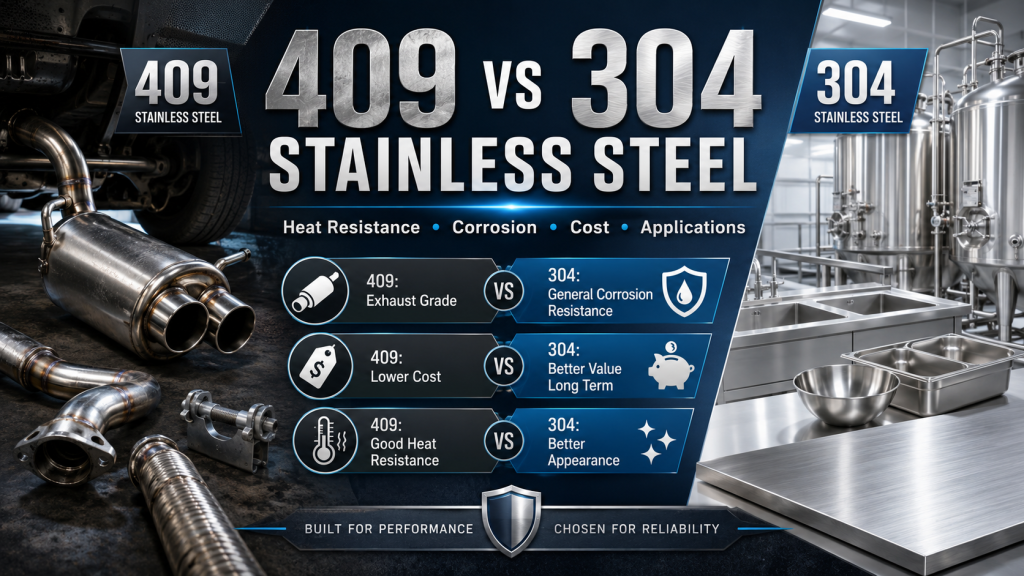
When comparing 409 vs 304 stainless steel, the best choice depends on the working environment. 409 stainless steel is mainly selected for automotive exhaust systems, mufflers, heat shields and industrial heat applications where cost efficiency and thermal fatigue resistance matter. 304 stainless steel is selected for food equipment, kitchenware, tanks, architecture, decorative panels and general industrial projects where corrosion resistance, appearance and long-term durability are more important.
Although both materials are stainless steels, they belong to different stainless steel families. 409 is a ferritic stainless steel with lower chromium and very low nickel content. 304 is an austenitic stainless steel with higher chromium and nickel content, giving it stronger corrosion resistance and better formability.
This guide compares 409 and 304 stainless steel in chemical composition, corrosion resistance, high-temperature behavior, surface appearance, welding, forming, cost and application selection. For related material information, visit 304 Stainless Steel, Jude Steel Stainless Steel Grade Center, Stainless Steel Sheet and Stainless Steel Coil.
Fast Comparison: 409 vs 304 Stainless Steel
| Feature | 409 Stainless Steel | Нержавеющая сталь 304 |
|---|---|---|
| Stainless Steel Family | Ferritic stainless steel | Austenitic stainless steel |
| Typical Chromium Content | About 10.5%–11.75% | About 18%–20% |
| Typical Nickel Content | Very low or none | About 8%–10.5% |
| Устойчивость к коррозии | Moderate | Превосходно |
| Heat Resistance | Good for exhaust and thermal cycling | Excellent oxidation resistance, but higher cost |
| Магнетизм | Magnetic | Usually non-magnetic in annealed condition |
| Surface Appearance | Industrial gray appearance | Brighter, smoother and more decorative |
| Formability | Good for utility and exhaust applications | Excellent for forming, deep drawing and fabrication |
| Стоимость | Lower | Higher |
| Typical Applications | Exhaust pipes, mufflers, catalytic converter shells, heat shields, burners | Food equipment, kitchenware, tanks, architectural panels, chemical pipelines |
1. What Is 409 Stainless Steel?
409 stainless steel is a ferritic stainless steel designed for cost-effective heat resistance and automotive exhaust service. It contains chromium, very low carbon and little to no nickel. Because it has less nickel than 304, it is usually more economical.
The main strength of 409 stainless steel is not decorative appearance. Its value is in practical performance: good oxidation resistance at elevated temperatures, acceptable corrosion resistance in many exhaust environments and strong cost-performance balance.
Main Characteristics of 409 Stainless Steel
- Ferritic stainless steel structure
- Magnetic behavior
- Lower chromium and very low nickel content
- Lower cost than 304 stainless steel
- Good high-temperature oxidation resistance
- Good thermal fatigue resistance
- Commonly used in automotive exhaust systems
- Less decorative surface appearance than 304
- More likely to show discoloration or surface rust in humid environments
Typical 409 Stainless Steel Applications
- Automotive exhaust pipes
- Mufflers and silencers
- Catalytic converter shells
- Exhaust manifolds
- Heat shields
- Industrial burners
- Agricultural equipment
- Dry high-temperature industrial parts
2. What Is 304 Stainless Steel?
304 stainless steel is one of the most widely used austenitic stainless steels. It contains higher chromium and nickel than 409, giving it better corrosion resistance, stronger formability, better weldability and a brighter surface finish.
304 is commonly selected when stainless steel is exposed to moisture, cleaning processes, food contact, decorative environments or general industrial corrosion. It is also easier to polish, brush, deep draw and fabricate into products with higher appearance requirements.
Main Characteristics of 304 Stainless Steel
- Austenitic stainless steel structure
- Usually non-magnetic in annealed condition
- Higher chromium and nickel content than 409
- Excellent corrosion resistance in many environments
- Good food-grade and hygiene performance
- Excellent formability and weldability
- Better surface finish and decorative appearance
- Higher cost than 409 stainless steel
Typical 304 Stainless Steel Applications
- Food processing equipment
- Kitchen equipment and cookware
- Stainless steel tanks and vessels
- Architectural decoration
- Interior panels and elevator surfaces
- Chemical pipelines
- Medical and sanitary equipment
- General industrial fabrication
3. Chemical Composition Comparison
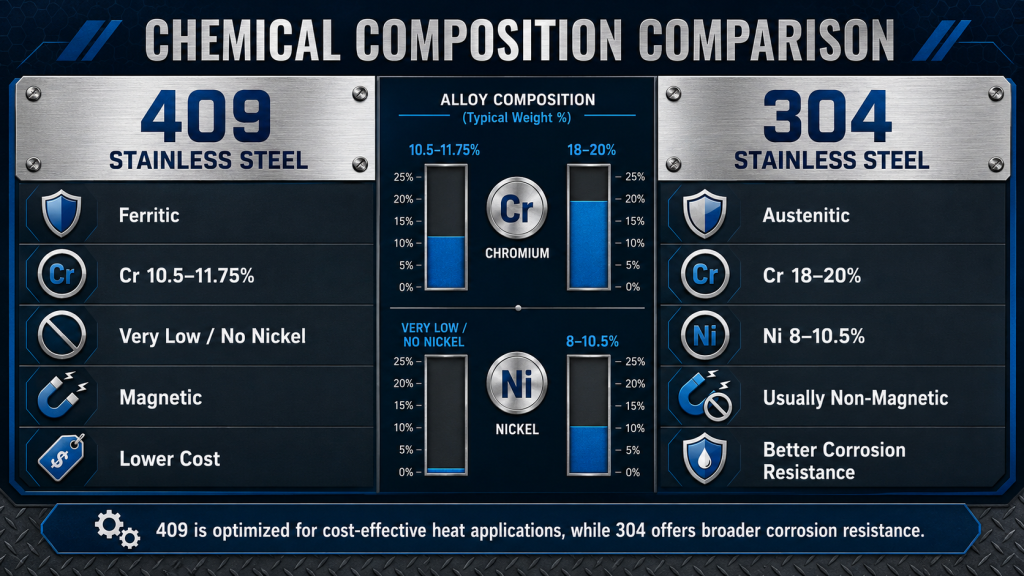
The biggest technical difference between 409 and 304 stainless steel is chemical composition. 409 has lower chromium and very low nickel content. 304 has higher chromium and nickel content, which improves corrosion resistance, ductility, toughness and surface stability.
| Element / Feature | 409 Stainless Steel | Нержавеющая сталь 304 |
|---|---|---|
| Chromium | About 10.5%–11.75% | About 18%–20% |
| Nickel | Very low or none | About 8%–10.5% |
| Carbon | Low | Low |
| Structure | Ferritic | Austenitic |
| Магнетизм | Magnetic | Usually non-magnetic or weakly magnetic after cold working |
| Primary Design Goal | Cost-effective heat and exhaust performance | Corrosion resistance, formability, hygiene and decorative performance |
Why Nickel Content Matters
Nickel is one of the key reasons 304 stainless steel costs more than 409. It improves corrosion resistance, toughness, formability and austenitic stability. Since 409 contains little to no nickel, it offers a lower-cost solution when high corrosion resistance is not the main requirement.
4. Corrosion Resistance Comparison
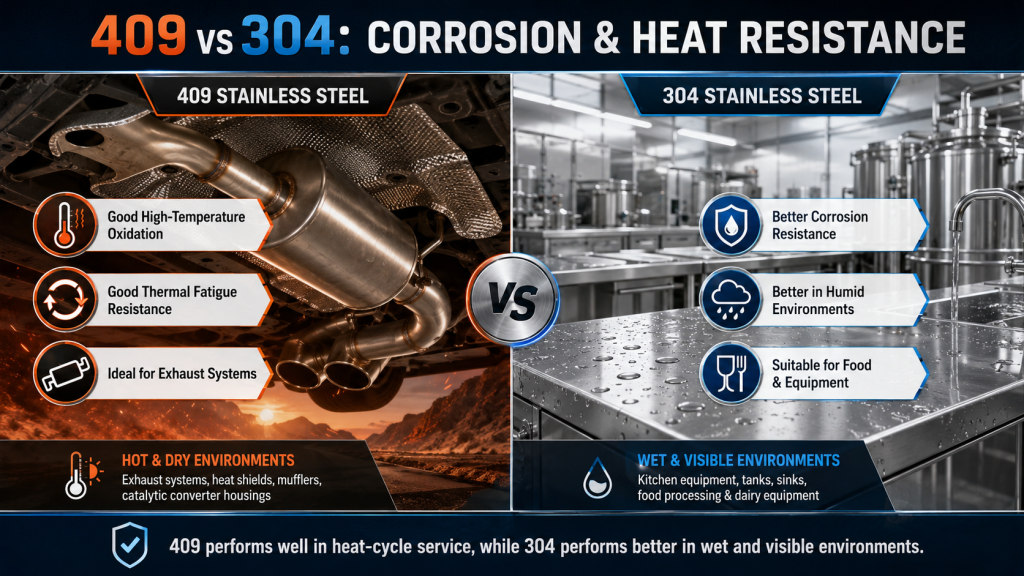
Corrosion resistance is where 304 stainless steel has a clear advantage. 304 performs better in humid environments, water contact, food processing, outdoor exposure and decorative applications. 409 provides moderate corrosion resistance, but it may develop surface rust, yellowing, brown oxidation marks or discoloration over time, especially in wet or salty environments.
This does not mean 409 is a poor material. It simply means 409 is designed for different priorities. In an exhaust system, the material must handle heat cycles and cost pressure. In a kitchen, tank or architectural panel, corrosion resistance and appearance are usually more important.
| Environment | Better Choice | Reason |
|---|---|---|
| Automotive exhaust system | 409 Stainless Steel | Good heat resistance, thermal fatigue resistance and lower cost |
| Kitchen equipment | Нержавеющая сталь 304 | Better corrosion resistance, hygiene and cleanability |
| Outdoor architecture | Нержавеющая сталь 304 | Better surface appearance and rust resistance |
| Humid environment | Нержавеющая сталь 304 | Lower risk of rust spots and staining |
| High-temperature dry environment | 409 Stainless Steel | Cost-effective for heat-related utility applications |
| Food processing | Нержавеющая сталь 304 | Better food-contact and cleaning performance |
| Coastal or chloride-rich environment | 316L or higher grade | 304 may still be limited in strong chloride exposure; 409 is not recommended |
5. Heat Resistance and Thermal Fatigue
Heat performance is where 409 stainless steel shows strong value. It is widely used in exhaust systems because it handles repeated heating and cooling cycles better than many low-cost materials. This makes it suitable for mufflers, tailpipes, exhaust pipes and catalytic converter shells.
304 also has strong oxidation resistance and good high-temperature capability, but it is more expensive and may not always be necessary for standard automotive exhaust applications. For premium exhaust systems or visible parts where corrosion resistance and appearance matter, 304 may still be selected.
| Heat Performance Factor | 409 Stainless Steel | Нержавеющая сталь 304 |
|---|---|---|
| Exhaust Heat Cycles | Excellent cost-performance balance | Good, but more expensive |
| Thermal Fatigue Resistance | Good | Good |
| High-Temperature Oxidation | Good for exhaust applications | Excellent in many environments |
| Dry Heat Applications | Very suitable when appearance is not critical | Suitable but may be over-specified |
| Premium Heat + Corrosion Applications | Limited | Better choice |
Practical Insight
- 409 is often the practical choice for standard exhaust systems.
- 304 is better when corrosion resistance and appearance are also important.
- For very severe high-temperature applications, heat-resistant grades such as 309S, 310S or nickel alloys may need evaluation.
- For coastal exhaust systems, road salt exposure and premium aftermarket parts, 304 or 316L may provide better lifecycle performance.
6. Surface Appearance and Finish Options
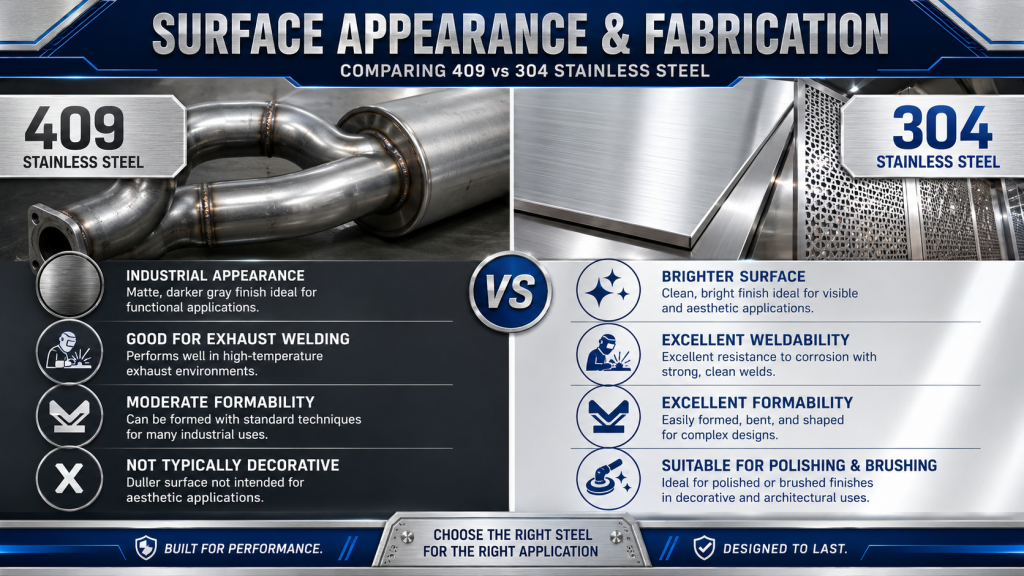
Surface appearance is another major difference. 409 stainless steel usually has a darker, more industrial look. It may discolor after high-temperature use. This is acceptable for exhaust parts hidden under vehicles, but not ideal for decorative panels or visible consumer products.
304 stainless steel has a brighter, smoother and more decorative appearance. It is widely available in finishes such as 2B, BA, No.4, hairline, brushed and mirror finish. That makes it more suitable for kitchen equipment, architectural panels, elevators, furniture and visible stainless steel products.
| Surface / Finish Factor | 409 Stainless Steel | Нержавеющая сталь 304 |
|---|---|---|
| Visual Appearance | Darker gray, industrial appearance | Brighter and more decorative |
| Surface Discoloration | More likely after heat exposure | Better appearance retention in normal environments |
| Полировка | Limited decorative value | Превосходно |
| Щетка | Possible but less common for decorative use | Very common |
| Mirror Finish | Not typical | Common in decorative applications |
| Best Surface Use | Hidden exhaust and industrial utility parts | Visible panels, kitchenware, architectural decoration |
Jude Steel supplies stainless steel sheet, coil and strip with various surface options. For decorative or visible applications, explore stainless steel sheet, stainless steel coil, brushing service and polishing service.
7. Weldability, Formability and Fabrication
Both 409 and 304 can be welded and formed, but 304 offers better overall fabrication performance. 304 has higher ductility, better deep drawing capability and better decorative finishing potential.
409 is suitable for exhaust welding and industrial utility fabrication. However, it is not the best choice for deep-drawn kitchen parts, visible panels or products requiring premium surface finish.
| Fabrication Factor | 409 Stainless Steel | Нержавеющая сталь 304 |
|---|---|---|
| Weldability | Good for exhaust systems | Excellent for general fabrication |
| Formability | Good | Превосходно |
| Ductility | Moderate | High |
| Deep Drawing | Moderate | Превосходно |
| Cold Forming | Moderate to good | Превосходно |
| Surface Finish Capability | Industrial grade | Decorative grade |
| Best Fabrication Use | Exhaust pipes, mufflers, heat shields | Kitchenware, tanks, panels, equipment and precision components |
8. Cost Comparison
409 stainless steel is usually cheaper than 304 because it contains little to no nickel. Nickel is a major cost driver in austenitic stainless steels. For applications where 304-level corrosion resistance is not required, 409 can reduce material cost significantly.
However, lower purchase price does not always mean lower total cost. If 409 is used in a humid, visible or food-contact application, corrosion, discoloration, cleaning difficulty or customer rejection may create higher long-term cost.
| Cost Factor | 409 Stainless Steel | Нержавеющая сталь 304 |
|---|---|---|
| Raw Material Cost | Lower | Higher |
| Nickel Cost Exposure | Very low | High |
| Fabrication Cost | Good for exhaust manufacturing | Good for general forming and welding |
| Surface Finishing Cost | Limited decorative use | Better value for polished and brushed products |
| Maintenance Risk | Higher in humid or visible environments | Lower in many general environments |
| Best Cost Scenario | Automotive exhaust and dry heat utility applications | Food, decoration, equipment and corrosion-sensitive applications |
9. Application Comparison
| Application | Better Choice | Reason |
|---|---|---|
| Standard automotive exhaust | 409 Stainless Steel | Cost-effective heat and thermal fatigue performance |
| Premium exhaust system | Нержавеющая сталь 304 | Better corrosion resistance and appearance |
| Kitchen equipment | Нержавеющая сталь 304 | Better hygiene, cleanability and corrosion resistance |
| Mufflers and tailpipes | 409 Stainless Steel | Common and economical exhaust-grade material |
| Food processing equipment | Нержавеющая сталь 304 | Suitable for food-contact and cleaning environments |
| Architectural decoration | Нержавеющая сталь 304 | Brighter surface and better long-term appearance |
| Industrial burners | 409 Stainless Steel | Suitable for dry high-temperature utility applications |
| Outdoor or humid equipment | 304 or 316L Stainless Steel | Better corrosion resistance than 409 |
10. 409 vs 304 Stainless Steel: Selection Guide
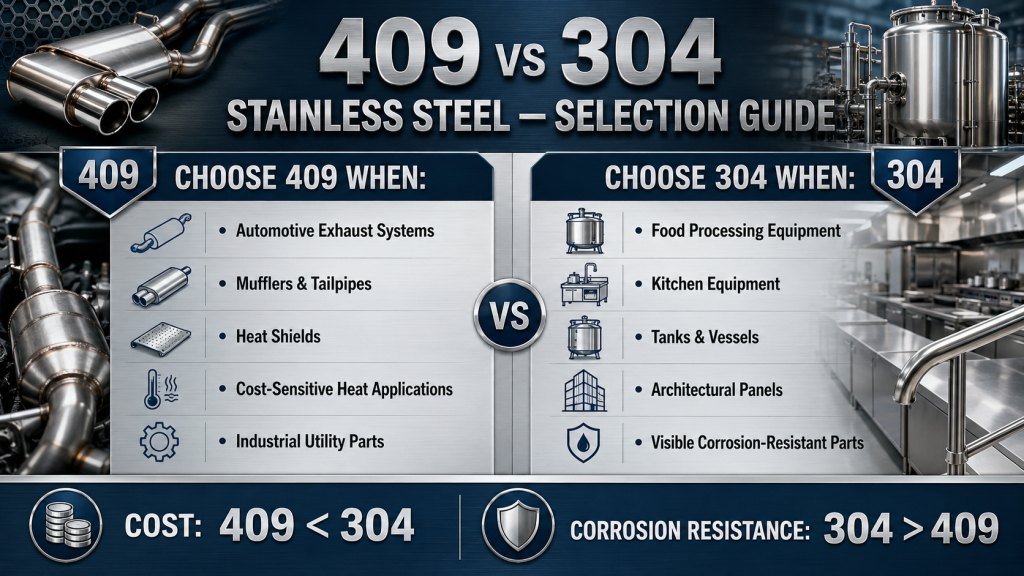
Choose 409 Stainless Steel If:
- The application is an automotive exhaust system
- Cost efficiency is the main priority
- The environment is hot but relatively dry
- Decorative appearance is not important
- Moderate corrosion resistance is acceptable
- Thermal fatigue resistance is important
- The product is a muffler, tailpipe, heat shield or catalytic converter shell
Choose 304 Stainless Steel If:
- Corrosion resistance is important
- The product will contact food or moisture
- Outdoor appearance matters
- Long-term durability is critical
- The surface must be polished, brushed or decorative
- Better formability or deep drawing is required
- The application is kitchen equipment, tank, vessel, panel or chemical pipeline
Consider Other Stainless Steel Grades If:
- 316L is needed for stronger chloride or coastal corrosion resistance
- 430 is needed for lower-cost decorative indoor applications
- 441 is needed for improved ferritic high-temperature exhaust performance
- 439 is needed for better weldability and exhaust system performance than basic ferritic grades
- 309S or 310S is needed for more severe high-temperature oxidation environments
- 2205 duplex is needed for higher strength and chloride resistance
11. Common Buyer Mistakes to Avoid
- Choosing 409 only because it is cheaper
- Using 409 in humid, outdoor or decorative applications without evaluation
- Using 304 for low-cost exhaust parts when 409 is sufficient
- Assuming all stainless steels have the same corrosion resistance
- Ignoring thermal cycling and exhaust temperature requirements
- Ignoring surface appearance requirements
- Comparing only raw material price and not lifecycle cost
- Not confirming grade, thickness, surface finish, welding process and service environment before purchase
Frequently Asked Questions
What is the main difference between 409 and 304 stainless steel?
409 stainless steel is a ferritic stainless steel with lower chromium and little to no nickel, mainly used for automotive exhaust and heat-related applications. 304 stainless steel is an austenitic stainless steel with higher chromium and nickel content, offering better corrosion resistance, formability, appearance and food-grade performance.
Is 409 stainless steel cheaper than 304 stainless steel?
Yes. 409 stainless steel is usually cheaper because it contains little or no nickel. 304 stainless steel costs more because it contains nickel and provides better corrosion resistance, ductility and surface performance.
Does 409 stainless steel rust?
409 stainless steel can develop surface rust, oxidation marks or discoloration over time, especially in humid, salty or wet environments. It is more suitable for exhaust and dry heat applications than decorative or wet environments.
Why is 409 used for exhaust systems?
409 is used for exhaust systems because it offers good high-temperature oxidation resistance, thermal fatigue resistance and sufficient corrosion resistance at lower cost. This makes it practical for mufflers, tailpipes and catalytic converter shells.
Is 304 better than 409 stainless steel?
304 is better for corrosion resistance, appearance, formability, welding and food-grade applications. 409 is better when the project requires lower cost and good heat performance in exhaust or dry high-temperature environments.
Can 409 stainless steel replace 304?
409 can replace 304 only in selected applications where corrosion resistance, appearance and hygiene are not critical. It should not replace 304 in food equipment, humid environments, architectural panels or decorative products without careful evaluation.
Which grade is better for kitchen equipment?
304 stainless steel is better for kitchen equipment because it offers better corrosion resistance, cleanability, hygiene performance and surface appearance than 409 stainless steel.
Заключение
409 and 304 stainless steel are designed for different priorities. 409 stainless steel focuses on heat resistance, thermal fatigue performance and cost efficiency, making it widely used in automotive exhaust systems, mufflers, catalytic converter shells and dry high-temperature applications.
304 stainless steel focuses on corrosion resistance, hygiene, formability, weldability and appearance. It is the better choice for food processing, kitchen equipment, tanks, architectural panels, chemical pipelines and visible stainless steel products.
Choose 409 stainless steel when the application is exhaust-related, cost-sensitive and not highly exposed to moisture or decorative requirements. Choose 304 stainless steel when corrosion resistance, appearance and long-term durability are more important. Jude Steel supplies stainless steel sheets, coils, strips and customized processing services for global buyers. Explore more at Judesteel.com, or visit our product pages for stainless steel sheet, stainless steel coil and stainless steel strip.
