
347 vs 347H Stainless Steel: Key Differences, Properties & Industrial Applications
As stabilized austenitic stainless steel grades, 347 and 347H stainless steel are widely adopted in high-temperature service, welding structures and anti-intergranular corrosion working conditions across power generation, petrochemical, boiler and heat exchanger industries. Many engineers and procurement professionals struggle to distinguish their performance boundaries and select the right grade for extreme operating environments.
Based on international ASTM and ASME standards, JUDE STEEL delivers an in-depth, data-backed comparison covering chemical composition, carbon content, mechanical strength, high-temperature creep resistance, weld performance and typical application scenarios. This guide helps you make precise material selection to ensure equipment safety, service life and overall project cost-effectiveness.
1. Basic Overview of 347 & 347H Stainless Steel
Both 347 and 347H are niobium-stabilized austenitic stainless steels. Niobium (Nb) is added to bind carbon elements inside the material, effectively preventing chromium carbide precipitation during welding and high-temperature exposure. This feature eliminates intergranular corrosion, which makes them superior alternatives to conventional 304 and 316 stainless steel for welded components operating at elevated temperatures.
The core distinction between the two grades lies in controlled carbon content and corresponding high-temperature mechanical properties. 347H is the high-carbon enhanced version of standard 347 stainless steel, specially optimized for long-term high-temperature continuous service.
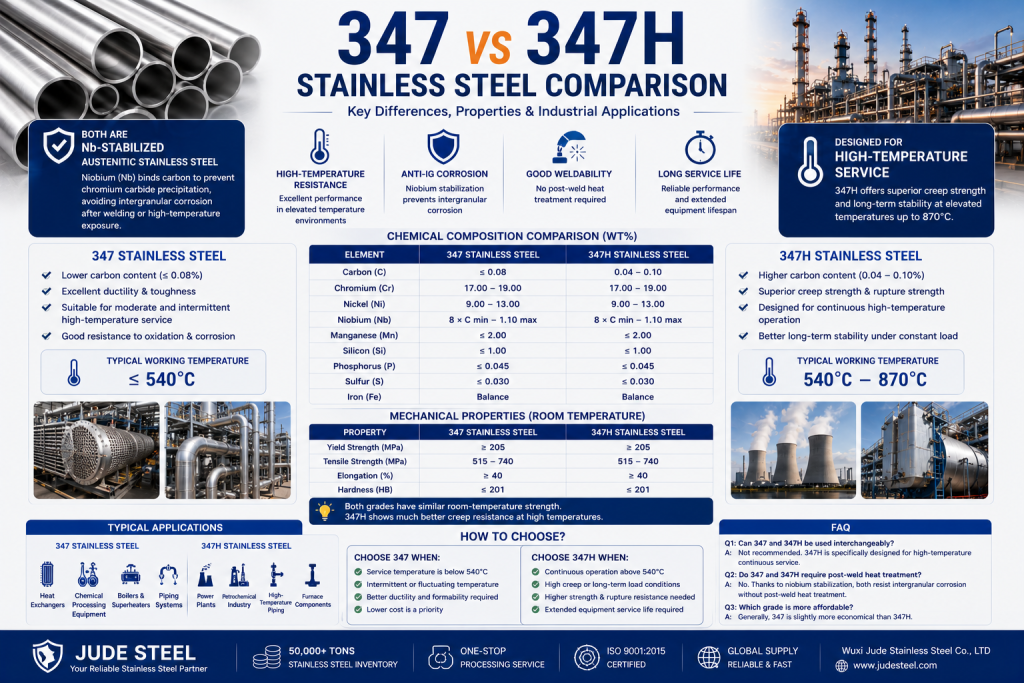
2. Chemical Composition Comparison
Chemical composition is the fundamental reason for their performance differences. The main variation focuses on carbon content, while niobium content follows matching stabilization design requirements.
| Element (wt%) | 347 Stainless Steel | 347H Stainless Steel |
|---|---|---|
| Carbon (C) | ≤ 0.08 | 0.04 – 0.10 |
| Chromium (Cr) | 17.00 – 19.00 | 17.00 – 19.00 |
| Nickel (Ni) | 9.00 – 13.00 | 9.00 – 13.00 |
| Niobium (Nb) | 8 × C min – 1.10 max | 8 × C min – 1.10 max |
| Manganese (Mn) | ≤ 2.00 | ≤ 2.00 |
| Silicon (Si) | ≤ 1.00 | ≤ 1.00 |
| Phosphorus & Sulfur | Standard austenitic limits | Standard austenitic limits |
Core Note: Higher carbon content in 347H improves high-temperature creep strength and lasting strength, while standard 347 with lower carbon delivers better ductility and stress relief performance under moderate temperature conditions.
3. Mechanical & High-Temperature Properties
Room-temperature mechanical indicators of 347 and 347H are close, while their performance diverges significantly under sustained high-temperature working environments.
3.1 Room Temperature Mechanical Properties
- Yield Strength (MPa): Both grades approx 205 min
- Tensile Strength (MPa): Both grades 515 – 740
- Elongation: Excellent ductility for cold forming and bending
3.2 High-Temperature Performance
This is the most critical difference between 347 and 347H:
- 347 Stainless Steel: Suitable for working temperature below 540°C. It maintains good toughness and anti-intergranular corrosion, ideal for intermittent high-temperature operation and general welded structures.
- 347H Stainless Steel: Designed for continuous service at 540°C to 870°C. The controlled higher carbon content greatly enhances creep resistance and rupture strength under long-term high temperature and constant load. It resists material deformation and fatigue failure in extreme thermal environments.
4. Weldability & Corrosion Resistance
4.1 Weld Performance
Thanks to niobium stabilization, both grades exhibit outstanding weldability. They do not require post-weld solution heat treatment, and welded joints remain highly resistant to intergranular corrosion. Both can be processed via common welding methods including GTAW, GMAW and SMAW.
4.2 Corrosion Resistance
347 and 347H share nearly identical corrosion resistance. They perform well in atmospheric environment, fresh water, weak acid and neutral chemical media. Their anti-rust and anti-corrosion capability is equivalent to 304 stainless steel. Neither grade is recommended for heavy chloride or strong corrosive service.
5. Typical Industrial Applications
Applications for 347 Stainless Steel
347 is the preferred choice for components exposed to moderate and intermittent high temperatures with strict requirements on welding quality and intergranular corrosion prevention:
- General industrial furnace parts and auxiliary piping
- Welded structural components for heat exchangers
- Petrochemical pipeline systems with medium temperature
- Equipment requiring cold forming and complex fabrication
Applications for 347H Stainless Steel
347H is engineered for continuous ultra-high temperature service and heavy-load thermal equipment, widely used in high-end energy and thermal industries:
- Power plant boiler superheaters, reheaters and furnace tubes
- High-temperature steam piping and pressure vessels
- Gas turbine components and high-temperature reaction vessels
- Refinery high-temperature furnace equipment and flue gas systems
6. Cost & Procurement Reference
In terms of raw material price, 347H stainless steel is slightly higher than standard 347 due to stricter smelting and carbon control standards. For projects running below 540°C, standard 347 brings better cost performance. For continuous high-temperature working conditions above 540°C, 347H effectively reduces downtime and replacement frequency, delivering lower total lifecycle cost.
JUDE STEEL supplies full-size 347 and 347H stainless steel plate, sheet, coil, pipe and profile with complete material certificates. All products comply with ASTM, ASME and EN standards for global industrial projects.
7. Frequently Asked Questions (FAQ)
Q1: What is the main difference between 347 and 347H stainless steel?
A1: The primary difference is carbon content. 347H has a higher controlled carbon range, which delivers far better high-temperature creep resistance and lasting strength for continuous high-temperature service. Standard 347 has lower carbon and better ductility for moderate temperature use.
Q2: Can 347 replace 347H for long-term service above 540°C?
A2: Not recommended. Standard 347 will face gradual creep deformation and strength attenuation under long-term temperature above 540°C. 347H is specially developed for this working condition to guarantee long-term operational safety.
Q3: Do 347 and 347H need post-weld heat treatment?
A3: Generally no. As niobium-stabilized grades, both effectively avoid intergranular corrosion after welding. Post-weld heat treatment is only required for special extreme service working conditions.
Q4: Are 347 and 347H resistant to chloride corrosion?
A4: Their chloride resistance is similar to 304 stainless steel. They are not suitable for marine environments or media with high chloride concentration. Choose 316L or duplex stainless steel for such scenarios.
Q5: How to order qualified 347 and 347H stainless steel from Jude Steel?
A5: You can submit your drawings, working temperature parameters and size requirements via judesteel.com. Our technical team will recommend the most suitable grade and provide formal quotation and material test reports within 24 hours.
Final Selection Guide
Choose 347 stainless steel if your equipment works under intermittent high temperature, below 540°C, or requires complex cold forming and welding processing. It balances reliable performance and competitive material cost.
Choose 347H stainless steel for equipment running continuously at 540°C to 870°C, such as power boilers, high-temperature steam pipes and industrial furnaces. Its superior high-temperature strength ensures stable long-term operation.
With strict quality control and full-range inventory, JUDE STEEL provides standard and customized 347 & 347H stainless steel products for global clients. Contact us to get professional material solutions and one-stop procurement service.
