
316L vs Titanium: Differences, Strength, Corrosion Resistance & Cost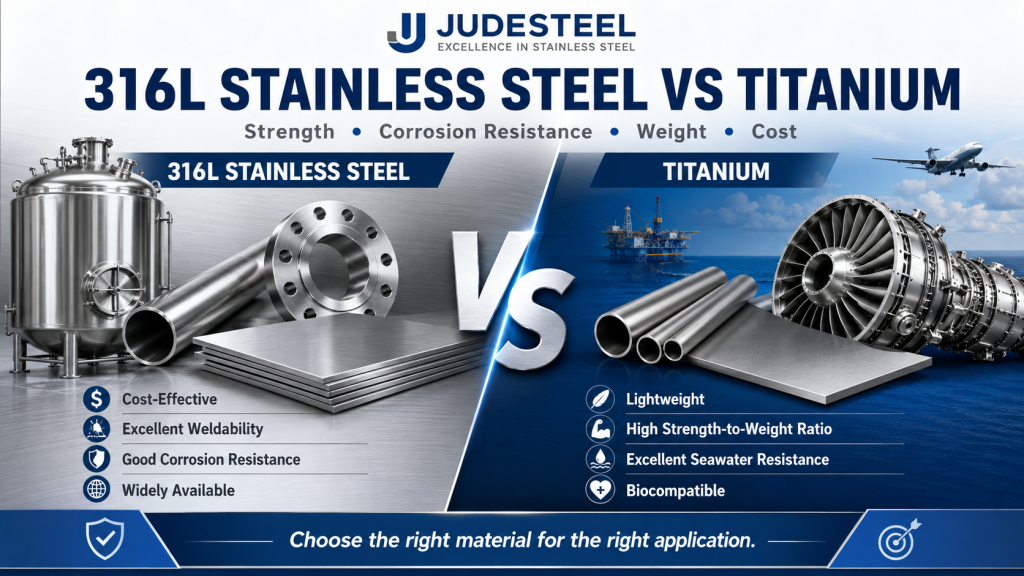
When comparing 316L vs titanium, the decision is not simply about which material is stronger or more corrosion resistant. It is about selecting the material that best matches the operating environment, weight requirement, corrosion risk, fabrication process, budget and expected service life.
316L stainless steel is one of the most widely used corrosion-resistant stainless steels. It offers a strong balance of corrosion resistance, weldability, availability, hygiene and cost efficiency. Titanium, on the other hand, is valued for its lightweight structure, excellent strength-to-weight ratio and outstanding resistance to seawater and chloride-rich environments.
This guide compares 316L stainless steel and titanium in terms of chemical composition, strength, weight, corrosion resistance, fabrication, cost and application selection. For more stainless steel grade information, visit the Jude Steel Stainless Steel Grade Center.
Fast Comparison: 316L Stainless Steel vs Titanium
| Feature | 316L Stainless Steel | Titanium |
|---|---|---|
| Material Type | Austenitic stainless steel | Lightweight reactive metal |
| Main Alloy System | Iron-chromium-nickel-molybdenum | Titanium-based alloy system |
| Main Advantage | Cost-effective corrosion resistance and weldability | High strength-to-weight ratio and excellent corrosion resistance |
| Density | Higher, approximately 8.0 g/cm³ | Lower, approximately 4.5 g/cm³ |
| Weight | Heavier | Much lighter |
| Устойчивость к коррозии | Good to excellent in many environments | Excellent in seawater and many chloride environments |
| Weldability | Excellent and widely understood | Good but requires strict shielding and process control |
| Machinability | Moderate | More difficult |
| Стоимость | Lower and widely available | Higher material and processing cost |
| Typical Applications | Food equipment, chemical tanks, marine hardware, medical equipment, piping | Aerospace, marine systems, medical implants, heat exchangers, chemical processing |
1. What Is 316L Stainless Steel?
316L stainless steel is a low-carbon version of 316 stainless steel. It belongs to the austenitic stainless steel family and contains chromium, nickel and molybdenum. The molybdenum content improves resistance to pitting and crevice corrosion compared with 304 stainless steel, especially in chloride-containing environments.
The “L” in 316L means low carbon. Lower carbon content helps reduce the risk of carbide precipitation during welding, making 316L a popular choice for welded tanks, pipes, vessels and fabrication projects.
Jude Steel supplies related stainless steel products including stainless steel sheet, stainless steel coil, stainless steel strip and stainless steel sheet metal.
Main Characteristics of 316L Stainless Steel
- Good resistance to corrosion in many industrial and marine environments
- Better chloride resistance than 304 stainless steel
- Excellent weldability due to low carbon content
- Good formability and fabrication performance
- Widely available in sheet, plate, coil, strip, pipe, bar and fittings
- Cost-effective compared with titanium
- Suitable for food, chemical, pharmaceutical, marine and medical applications
Typical 316L Stainless Steel Applications
- Food processing equipment
- Chemical tanks and piping
- Pharmaceutical equipment
- Marine hardware and fittings
- Medical instruments
- Heat exchangers in moderate environments
- Architectural components
- Welded pressure vessels and process equipment
2. What Is Titanium?
Titanium is a lightweight metal known for its high strength-to-weight ratio, strong corrosion resistance and excellent biocompatibility. It forms a very stable oxide film on its surface, which gives titanium outstanding resistance in seawater, chloride environments and many oxidizing chemical media.
Titanium is commonly used in aerospace, marine, chemical processing and medical applications. It is more expensive than 316L stainless steel, but its performance can justify the cost when weight reduction, seawater resistance or long service life is essential.
Main Characteristics of Titanium
- Much lighter than stainless steel
- Excellent strength-to-weight ratio
- Outstanding corrosion resistance in seawater and chloride environments
- Excellent biocompatibility
- Good performance in many chemical environments
- Higher material cost than 316L stainless steel
- Requires strict welding and fabrication control
Common Titanium Grades
| Titanium Grade | Type | Main Feature |
|---|---|---|
| Grade 1 | Commercially pure titanium | Excellent corrosion resistance and high ductility |
| Grade 2 | Commercially pure titanium | Common general-purpose titanium grade with good strength and corrosion resistance |
| Grade 5 / Ti-6Al-4V | Alpha-beta titanium alloy | High strength and widely used in aerospace and medical applications |
| Grade 7 | Palladium-enhanced titanium | Improved corrosion resistance in reducing acids and chemical environments |
3. Chemical Composition Comparison
316L stainless steel and titanium are fundamentally different material systems. 316L is an iron-based stainless steel alloyed with chromium, nickel and molybdenum. Titanium is a titanium-based metal or alloy system with much lower density and a different surface oxide behavior.
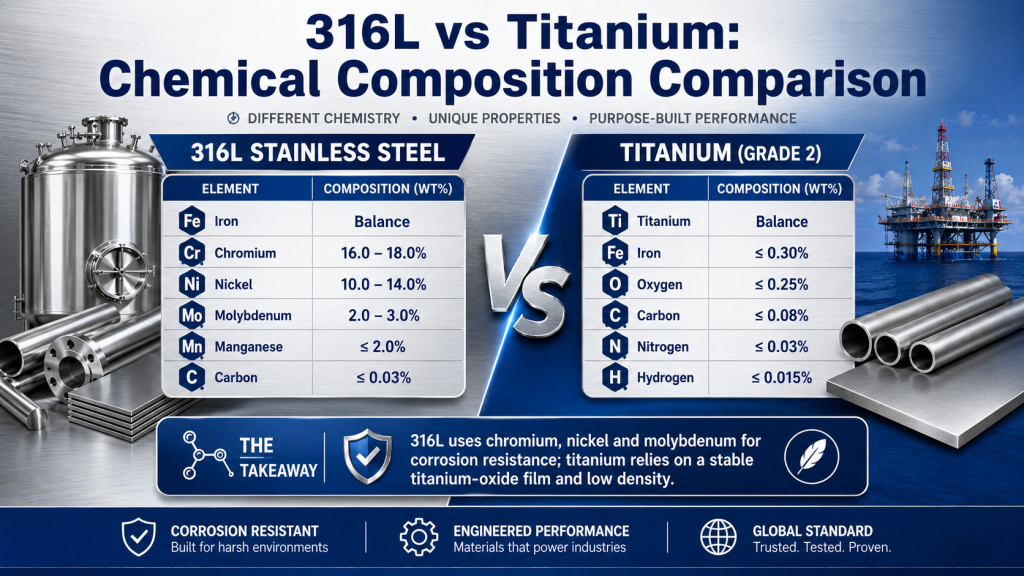
| Element / Feature | 316L Stainless Steel | Titanium |
|---|---|---|
| Base Element | Iron | Titanium |
| Chromium | Major alloying element for passive film formation | Not the main alloying element in commercially pure titanium |
| Nickel | Important element for austenitic structure and toughness | Usually not a major element in common titanium grades |
| Molybdenum | Improves pitting and crevice corrosion resistance | May appear in selected titanium alloys, not typical in pure titanium grades |
| Carbon | Low carbon level to improve weldability | Very low impurity-controlled content |
| Passive Film | Chromium oxide layer | Titanium oxide layer |
| Design Goal | Cost-effective corrosion resistance and fabrication | Lightweight performance, corrosion resistance and biocompatibility |
Why Composition Matters
The chromium-nickel-molybdenum system gives 316L stainless steel a strong balance of corrosion resistance, toughness and weldability. The titanium oxide film gives titanium exceptional stability in many seawater and chloride environments, while its low density gives it a major advantage when weight reduction is important.
4. Strength and Weight Comparison
Strength should not be compared by tensile strength alone. For many projects, the more important metric is strength-to-weight ratio. Titanium is much lighter than 316L stainless steel, so it can provide excellent performance where weight reduction is a design priority.
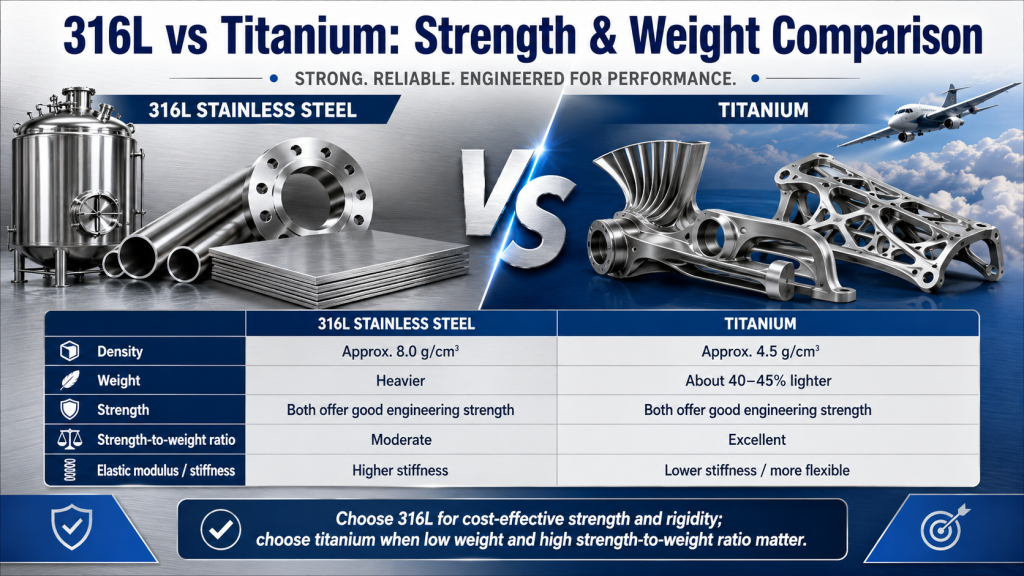
| Недвижимость | 316L Stainless Steel | Titanium |
|---|---|---|
| Density | Approximately 8.0 g/cm³ | Approximately 4.5 g/cm³ |
| Weight | Heavier | About 40%–45% lighter than stainless steel |
| Strength | Good strength for industrial applications | Good to very high depending on grade |
| Strength-to-Weight Ratio | Moderate | Превосходно |
| Elastic Modulus | Higher stiffness | Lower stiffness than steel, more flexible |
| Best Use | Cost-effective structures, tanks, piping and equipment | Aerospace, marine, medical and weight-sensitive components |
Practical Meaning
- 316L stainless steel is better when weight is not a major issue and cost efficiency matters.
- Titanium is better when lower weight improves performance, energy efficiency or handling.
- 316L may feel more rigid due to its higher stiffness.
- Titanium may need careful design due to lower elastic modulus compared with steel.
- For aerospace and high-performance marine systems, titanium can provide major lifecycle value.
5. Corrosion Resistance Comparison
Both 316L stainless steel and titanium resist corrosion, but titanium generally provides stronger performance in seawater, chloride-rich and many oxidizing environments. 316L stainless steel is excellent for many industrial and marine applications, but it can still suffer pitting or crevice corrosion in aggressive chloride conditions.
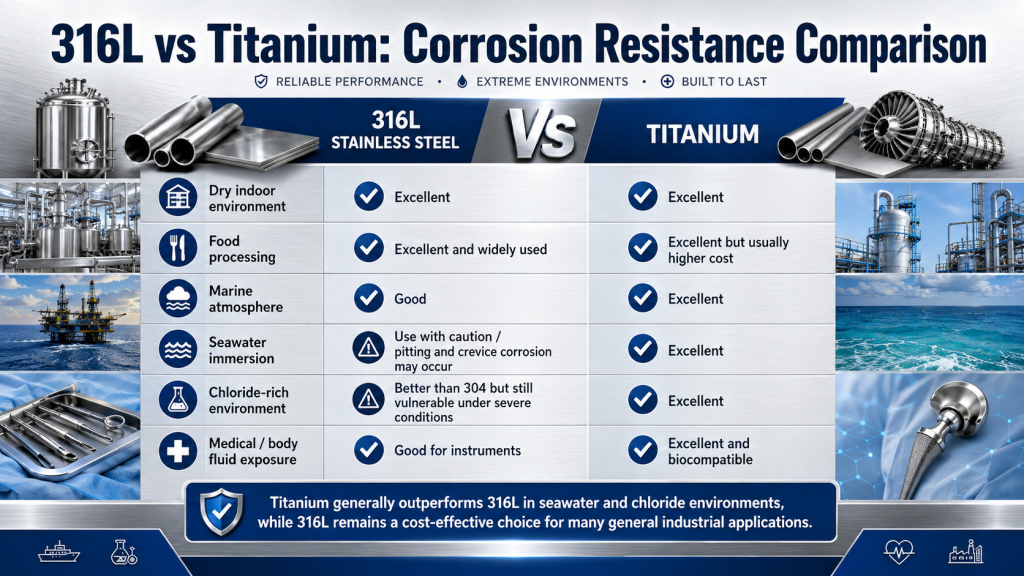
| Environment | 316L Stainless Steel | Titanium |
|---|---|---|
| Dry Indoor Environment | Превосходно | Excellent but often unnecessary |
| Food Processing | Excellent and widely used | Excellent but usually higher cost |
| Marine Atmosphere | Good with proper design and maintenance | Превосходно |
| Seawater Immersion | Use with caution; pitting and crevice corrosion may occur | Excellent in many seawater applications |
| Chloride-Rich Environment | Better than 304, but still vulnerable under severe conditions | Excellent in many chloride environments |
| Medical / Body Fluid Exposure | Used in instruments and some medical components | Excellent biocompatibility; widely used for implants |
| Strong Reducing Acids | Grade-dependent and may be limited | Grade-dependent; special titanium grades may be required |
6. Temperature Performance
316L stainless steel performs well in many moderate-temperature industrial applications. Titanium also has useful temperature performance, but its high-temperature oxidation behavior and strength retention depend strongly on grade and exposure conditions.
| Factor | 316L Stainless Steel | Titanium |
|---|---|---|
| Moderate Temperature Service | Good | Good depending on environment |
| High-Temperature Oxidation | Limited compared with heat-resistant stainless grades | Grade and temperature dependent |
| Теплопроводность | Lower than carbon steel, typical for stainless steel | Lower than many steels |
| Thermal Expansion | Higher than titanium | Lower thermal expansion than stainless steel |
| Best Use | Process equipment, tanks, piping and welded fabrication | Aerospace, heat exchangers and weight-sensitive systems |
For extreme high-temperature oxidation applications, other materials such as heat-resistant stainless steels, nickel alloys or specialized titanium alloys may need to be evaluated.
7. Fabrication, Welding and Machining
316L stainless steel is one of the most fabrication-friendly corrosion-resistant metals. It can be welded, cut, bent, polished, brushed and formed using widely available equipment and industrial processes. Jude Steel provides processing services such as laser cutting, bending, brushing and polishing.
Titanium can also be fabricated and welded, but it requires stricter process control. During welding, titanium must be protected from oxygen, nitrogen and hydrogen contamination at high temperature. Poor shielding can reduce weld quality and long-term performance.
| Processing Factor | 316L Stainless Steel | Titanium |
|---|---|---|
| Cutting | Widely available and economical | Possible but requires suitable tools and parameters |
| Welding | Excellent, especially because of low carbon content | Good but requires strict inert gas shielding |
| Bending / Forming | Good formability | Possible, but springback and tooling control are important |
| Machining | Moderate | More difficult due to heat and tool wear concerns |
| Surface Finishing | Excellent finish options: 2B, BA, No.4, HL, mirror | Specialized finishing may be required |
| Fabrication Cost | Lower | Higher |
8. Cost Comparison
Cost is one of the clearest differences between 316L stainless steel and titanium. 316L is widely available and produced at large industrial scale, making it more economical for most projects. Titanium is more expensive because raw material production, melting, rolling, machining and welding require more complex control.
| Cost Factor | 316L Stainless Steel | Titanium |
|---|---|---|
| Raw Material Cost | Moderate | High |
| Availability | Превосходно | More limited |
| Machining Cost | Lower | Higher |
| Welding Cost | Lower and widely understood | Higher due to shielding and quality control |
| Lifecycle Value | Excellent when corrosion exposure is moderate | Excellent when low weight or severe corrosion resistance prevents failure |
| Best Cost Scenario | Large-scale tanks, piping, equipment and general fabrication | Marine, aerospace, medical and weight-sensitive systems |
9. Typical 316L Stainless Steel Applications
- Food processing equipment
- Pharmaceutical tanks and piping
- Chemical storage and process equipment
- Marine hardware and fittings
- Heat exchangers in moderate environments
- Medical instruments
- Architectural panels and decorative structures
- Water treatment equipment
- Welded pressure vessels and industrial fabrication
10. Typical Titanium Applications
- Aerospace components
- Marine heat exchangers
- Seawater piping and pump components
- Medical implants and surgical devices
- Chemical processing equipment
- High-performance sports and racing components
- Desalination systems
- Offshore equipment
- Weight-sensitive industrial structures
11. 316L vs Titanium: Quick Selection Guide
| Project Requirement | Recommended Material | Reason |
|---|---|---|
| Best cost efficiency | 316L Stainless Steel | Lower material and fabrication cost |
| Low weight requirement | Titanium | Much lower density and excellent strength-to-weight ratio |
| Food and pharmaceutical equipment | 316L Stainless Steel | Widely accepted, hygienic, weldable and economical |
| Seawater immersion | Titanium | Excellent resistance to seawater corrosion |
| General marine atmosphere | 316L or Titanium | 316L may work with proper design; titanium offers longer corrosion life |
| Medical implants | Titanium | Excellent biocompatibility and low weight |
| Large welded tanks and piping | 316L Stainless Steel | Excellent weldability and availability |
| Aerospace components | Titanium | High strength-to-weight ratio and performance advantage |
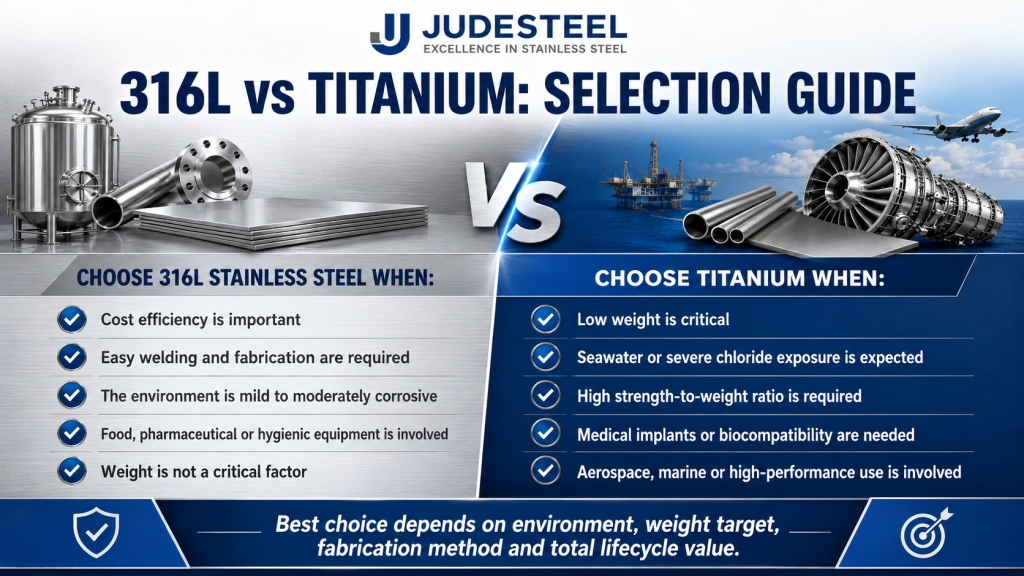
12. Which Material Should You Choose?
Choose 316L Stainless Steel If:
- Cost efficiency is important
- The project requires easy welding and fabrication
- The environment is mild to moderately corrosive
- Food, pharmaceutical or hygienic performance is required
- The project uses tanks, pipes, vessels, panels or general equipment
- Material availability and fast delivery matter
- Weight reduction is not a major design priority
Choose Titanium If:
- Low weight is critical
- Seawater immersion or severe chloride exposure is expected
- High strength-to-weight ratio is required
- Medical biocompatibility is important
- The application is aerospace, marine or high-performance industrial equipment
- Long corrosion life justifies higher initial cost
- Failure risk or replacement cost is very high
Consider Other Materials If:
- 316L is not corrosion resistant enough but titanium is too expensive
- Duplex stainless steel may offer better strength and chloride resistance
- Super duplex stainless steel may be suitable for severe offshore service
- Nickel alloys may be needed for high-temperature chemical corrosion
- Heat-resistant stainless steels may be more suitable for elevated-temperature oxidation
13. Common Buyer Mistakes to Avoid
- Choosing titanium only because it is “better” without considering cost
- Using 316L stainless steel in severe seawater immersion without corrosion evaluation
- Comparing strength without considering density and weight
- Ignoring welding and fabrication difficulty for titanium
- Assuming titanium is resistant to every chemical environment
- Choosing material based only on price per kilogram
- Ignoring maintenance, replacement and lifecycle cost
- Not considering crevice corrosion risk in marine design
The correct material should be selected according to environment, mechanical load, weight target, fabrication method, corrosion risk and total lifecycle value.
Frequently Asked Questions
What is the main difference between 316L stainless steel and titanium?
316L stainless steel is an iron-based austenitic stainless steel containing chromium, nickel and molybdenum. Titanium is a lightweight titanium-based metal known for excellent strength-to-weight ratio, seawater corrosion resistance and biocompatibility.
Is titanium stronger than 316L stainless steel?
Titanium offers a better strength-to-weight ratio, meaning it provides strong performance at much lower weight. 316L stainless steel can still provide excellent strength for tanks, piping, vessels and general industrial equipment at lower cost.
Which is more corrosion resistant, 316L stainless steel or titanium?
Titanium generally offers superior corrosion resistance in seawater and chloride-rich environments. 316L stainless steel provides good corrosion resistance in many industrial, food, pharmaceutical and marine applications, but it can suffer pitting or crevice corrosion under severe chloride exposure.
Why is titanium more expensive than 316L stainless steel?
Titanium is more expensive because extraction, melting, rolling, machining and welding require more complex technology and process control. It is also less widely produced than 316L stainless steel.
Can 316L stainless steel replace titanium?
316L stainless steel can replace titanium in many moderate environments where weight reduction and extreme corrosion resistance are not critical. Titanium should be used when low weight, seawater resistance, chloride resistance or biocompatibility is essential.
Is 316L stainless steel suitable for marine applications?
316L stainless steel is suitable for many marine atmosphere and splash-zone applications, but it may not be ideal for long-term seawater immersion or severe crevice conditions. Titanium performs better in many seawater immersion applications.
Which material is better for medical applications?
Both materials are used in medical fields. 316L stainless steel is widely used for instruments and selected devices, while titanium is preferred for many implants because of its low weight, corrosion resistance and biocompatibility.
Заключение
316L stainless steel and titanium are both highly valuable corrosion-resistant materials, but they solve different engineering problems. 316L stainless steel provides excellent cost-effective corrosion resistance, weldability, availability and fabrication flexibility. It is widely used in food processing, chemical equipment, pharmaceutical systems, marine hardware, medical instruments and general industrial fabrication.
Titanium provides a much better strength-to-weight ratio and superior corrosion resistance in seawater and many chloride environments. It is the stronger choice for aerospace, marine heat exchangers, medical implants, offshore systems and weight-sensitive equipment where performance and service life justify the higher cost.
The best choice depends on the balance between performance, cost, weight, corrosion resistance and fabrication requirements. Choose 316L stainless steel for economical durability in general industrial environments. Choose titanium when lightweight performance, seawater resistance or high-value reliability is essential. Jude Steel supplies stainless steel sheets, coils, strips and customized processing services for global buyers. Explore more at Judesteel.com, or visit our product pages for stainless steel sheet, stainless steel coil and stainless steel strip.
