
316L vs 317L Stainless Steel: Which Grade Is Better for Your Application?
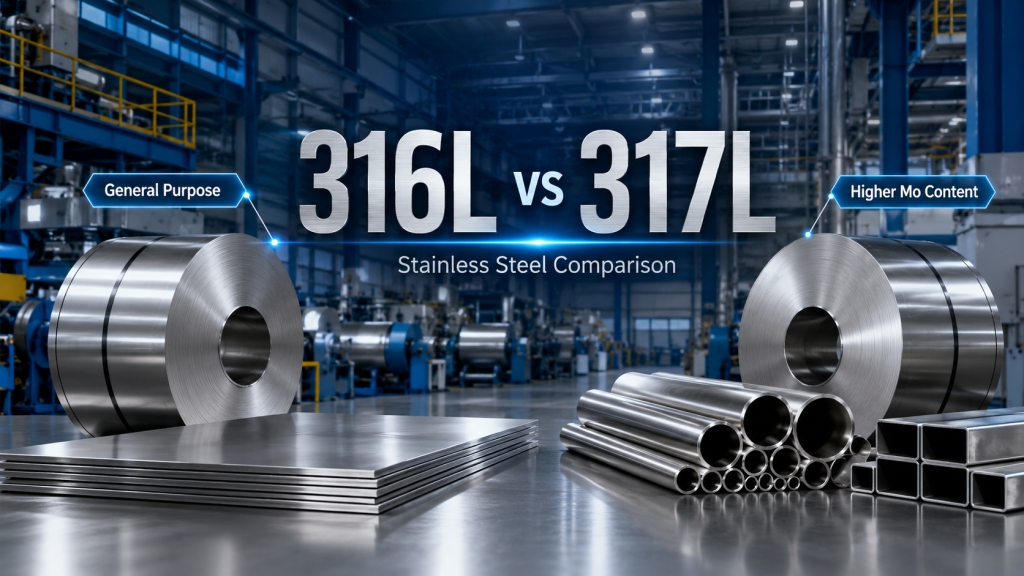
Comparison of 316L and 317L molybdenum-bearing austenitic stainless steels for chemical, pharmaceutical, food-processing and industrial equipment.
316L and 317L are low-carbon, molybdenum-bearing austenitic stainless steels designed for corrosive industrial environments. Both grades offer excellent weldability, good formability and stronger resistance to pitting and crevice corrosion than conventional 304L stainless steel.
Although the two grades have similar manufacturing characteristics, their chemical compositions are not identical. 317L contains higher levels of chromium, nickel and molybdenum than 316L. The increased alloy content generally provides a higher resistance to localized corrosion and chemical attack, especially in acidic chloride environments.
The higher alloy content also increases the purchase price and can reduce product availability. For many food-processing, pharmaceutical, architectural and general industrial applications, 316L remains the more economical and widely available solution. For aggressive chemical-processing, fertilizer, pulp-and-paper, scrubber and flue-gas-desulfurization systems, 317L may provide a valuable additional corrosion margin.
This guide compares 316L vs 317L stainless steel by chemical composition, molybdenum content, PREN, corrosion resistance, mechanical properties, welding, forming, machining, typical applications, cost and purchasing requirements.
Quick Answer: Should You Choose 316L or 317L?
Choose 316L when you require a widely available and cost-effective stainless steel for food equipment, pharmaceutical systems, tanks, piping, heat exchangers, coastal structures or general chemical processing.
Choose 317L when the process contains stronger acids, higher chloride concentrations or aggressive industrial chemicals and the additional chromium, nickel and molybdenum can extend equipment service life.
317L offers higher corrosion resistance than 316L, but it is not automatically suitable for every seawater, hydrochloric-acid or high-temperature chloride application. Temperature, chemical concentration, deposits, crevices, welding quality and cleaning procedures must also be evaluated.
316L vs 317L Stainless Steel at a Glance
| Comparison Item | 316L Stainless Steel | 317L Stainless Steel |
|---|---|---|
| Stainless steel family | Low-carbon austenitic stainless steel | Low-carbon austenitic stainless steel |
| UNS designation | S31603 | S31703 |
| Common EN designation | 1.4404 | 1.4438 |
| Chromium under ASTM A240 | 16.0–18.0% | 18.0–20.0% |
| Nickel under ASTM A240 | 10.0–14.0% | 11.0–15.0% |
| Molybdenum under ASTM A240 | 2.0–3.0% | 3.0–4.0% |
| Maximum carbon | 0.03% | 0.03% |
| Localized corrosion resistance | Excellent for many general industrial environments | Generally better in acidic chloride and chemical environments |
| Weldability | Превосходно | Excellent with a suitable procedure and filler metal |
| Heat-treatment hardening | Not hardenable by conventional heat treatment | Not hardenable by conventional heat treatment |
| Magnetic behavior | Essentially non-magnetic when annealed | Essentially non-magnetic when annealed |
| Availability | Very widely available | More specialized and less widely stocked |
| Relative material cost | Lower | Higher because of increased nickel and molybdenum |
| Typical industries | Food, pharmaceutical, architectural, marine and general chemical processing | Chemical processing, pulp and paper, fertilizers, scrubbers, FGD and power generation |
What Is 316L Stainless Steel?
316L stainless steel
is the low-carbon version of Type 316. It is an austenitic stainless steel containing chromium, nickel and molybdenum. Molybdenum improves resistance to pitting and crevice corrosion compared with non-molybdenum grades such as
304L stainless steel
.
The “L” designation indicates a restricted carbon content. Under ASTM A240, the maximum carbon content is 0.03%. Lower carbon reduces chromium-carbide precipitation and helps preserve intergranular corrosion resistance in welded components.
Typical advantages of 316L include:
- Excellent availability in sheet, plate, coil and strip
- Good resistance to many chloride-containing environments
- Excellent weldability and fabrication performance
- Good formability and deep-drawing capability
- Good hygiene and cleanability
- Good toughness at low and cryogenic temperatures
- Broad recognition in international industrial specifications
- Lower material cost than 317L and many higher-alloy grades
Common applications include food-processing machinery, pharmaceutical tanks, sanitary piping, pressure vessels, process tanks, heat exchangers, valves, pumps, marine hardware and architectural components.
What Is 317L Stainless Steel?
317L stainless steel
is a low-carbon austenitic chromium-nickel-molybdenum stainless steel. Compared with 316L, it contains higher chromium, nickel and molybdenum levels.
The increased molybdenum content is particularly important because molybdenum strengthens resistance to localized attack, including pitting and crevice corrosion. Higher chromium supports passive-film formation, while nickel stabilizes the austenitic structure and contributes to toughness and chemical resistance.
Typical advantages of 317L include:
- Improved general corrosion resistance compared with 316L in many chemical environments
- Higher resistance to chloride-induced pitting and crevice corrosion
- Improved performance in selected sulfuric-acid and acidic chloride services
- Good weldability because of its low carbon content
- Good formability for tanks, vessels and process equipment
- Higher ASTM minimum tensile and yield strength than 316L plate
- Suitability for pulp-and-paper, scrubber, FGD and chemical-processing systems
317L provides a useful improvement over 316L, but it does not offer the same corrosion-resistance level as highly alloyed grades such as 904L, duplex 2205, super duplex 2507 or 6% molybdenum stainless steel. Severe seawater, hydrochloric-acid and hot concentrated chloride applications require separate engineering evaluation.
Chemical Composition of 316L vs 317L
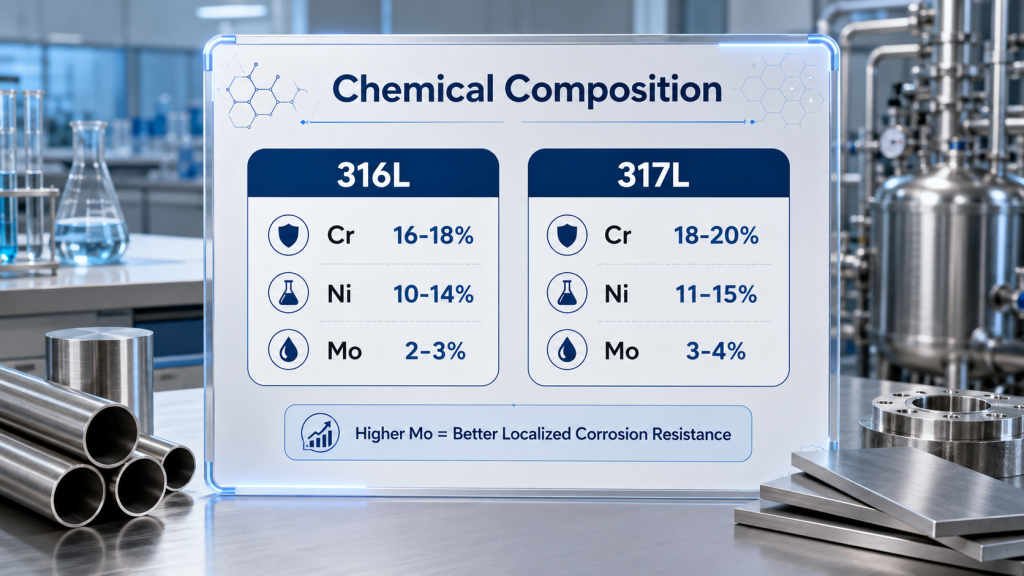
317L contains higher chromium, nickel and molybdenum limits than 316L under ASTM A240.
| Элемент | 316L ASTM A240 | 317L ASTM A240 | Practical Effect |
|---|---|---|---|
| Carbon | 0.03% maximum | 0.03% maximum | Low carbon reduces sensitization risk after welding and thermal processing. |
| Chromium | 16.0–18.0% | 18.0–20.0% | Chromium supports formation and repair of the protective passive oxide film. |
| Nickel | 10.0–14.0% | 11.0–15.0% | Nickel stabilizes the austenitic structure and supports toughness and chemical resistance. |
| Molybdenum | 2.0–3.0% | 3.0–4.0% | Molybdenum improves resistance to pitting, crevice corrosion and selected reducing acids. |
| Manganese | 2.0% maximum | 2.0% maximum | Manganese supports steelmaking and deoxidation. |
| Silicon | 0.75% maximum | 0.75% maximum | Silicon acts primarily as a deoxidizer. |
| Phosphorus | 0.045% maximum | 0.045% maximum | Phosphorus is controlled to protect toughness and fabrication performance. |
| Sulfur | 0.03% maximum | 0.03% maximum | Sulfur is controlled because inclusions can affect corrosion and forming performance. |
| Nitrogen | 0.10% maximum | 0.10% maximum | Nitrogen can contribute to strength and localized corrosion resistance. |
Why Does the Additional Molybdenum Matter?
Under ASTM A240, 316L contains 2.0–3.0% molybdenum, while 317L contains 3.0–4.0%. This is the most important compositional difference for many corrosion applications.
Molybdenum improves the stability of the passive film in chloride-bearing and acidic environments. It can reduce the rate at which localized corrosion develops after the surface film has been damaged.
Higher molybdenum and nickel content also increase raw-material cost. The actual price difference between 316L and 317L changes with alloy-market conditions, order quantity, product form and mill availability.
PREN Comparison
The Pitting Resistance Equivalent Number, commonly called PREN, is a calculated indicator used to compare the expected localized corrosion resistance of stainless steel grades.
PREN = %Cr + 3.3 × %Mo + 16 × %N
Because 317L contains higher chromium and molybdenum, its calculated PREN is normally higher than that of conventional 316L. This indicates a higher expected resistance to chloride-induced pitting.
PREN is useful for initial alloy screening, but it is not a corrosion guarantee. Two products with similar PREN values may perform differently because of surface finish, inclusions, welding oxide, fabrication contamination, temperature, pH and crevice geometry.
For critical chloride applications, request the actual mill test certificate and calculate PREN from the certified heat chemistry rather than relying only on the nominal grade name.
Corrosion Resistance Comparison
Both grades rely on a chromium-rich passive film for corrosion protection. Molybdenum improves the resistance of this film to localized breakdown in chloride-bearing and acidic environments.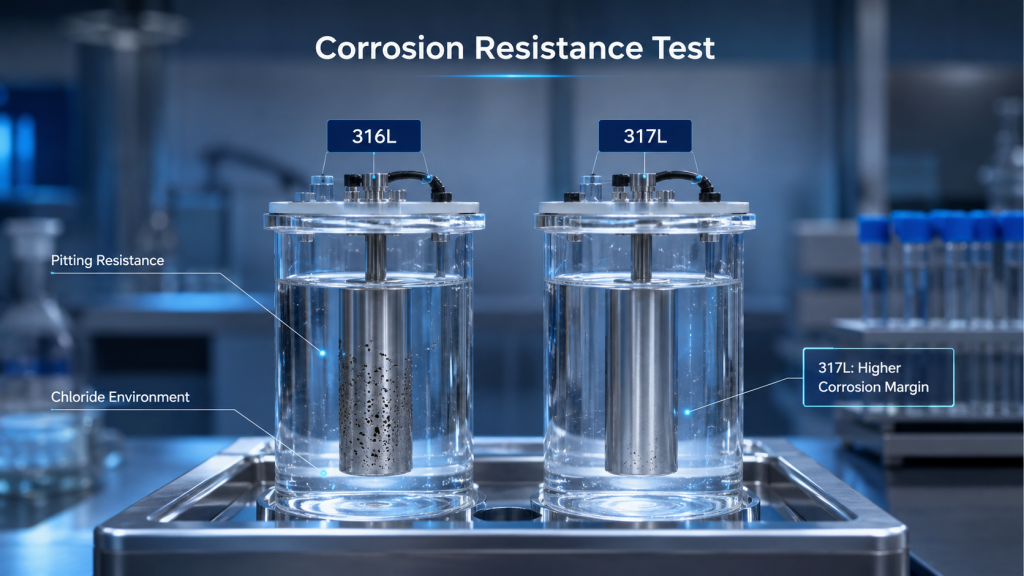 Corrosion performance should be evaluated using the actual chemical concentration, temperature, surface condition and fabrication quality.
Pitting Corrosion
Pitting is a localized form of corrosion that creates small but potentially deep cavities. Chloride ions can initiate pitting when the passive film becomes unstable.
Because 317L contains more chromium and molybdenum, it generally provides higher pitting resistance than 316L. The improvement can be important in equipment exposed to acidic chlorides, chemical deposits or contaminated process liquids.
Crevice Corrosion
Crevice corrosion occurs in shielded areas containing stagnant liquid, such as under gaskets, deposits, washers, flange faces and threaded connections.
317L normally provides a greater crevice-corrosion margin than 316L, but neither grade is immune. Poorly designed crevices can create conditions substantially more aggressive than those on an open and freely washed surface.
General Chemical Corrosion
317L can offer improved resistance in selected sulfuric-acid, acidic chloride, phosphoric-acid, pulp-liquor, fertilizer and chemical-processing environments.
Chemical concentration and temperature can dramatically change corrosion behavior. A material that performs well in a dilute solution may corrode rapidly when the concentration or operating temperature increases.
Intergranular Corrosion
Both grades limit carbon to 0.03% maximum under ASTM A240. The reduced carbon content lowers the risk of chromium-carbide precipitation during welding and helps maintain corrosion resistance in the heat-affected zone.
Low carbon does not eliminate every welding-related problem. Heat tint, incomplete shielding, embedded iron, rough weld profiles and unremoved oxide can still reduce local corrosion resistance.
Marine and Seawater Environments
316L is frequently called marine-grade stainless steel, but this commercial description has limitations. It performs well in many coastal, atmospheric and splash-zone applications, yet warm or stagnant seawater can cause pitting and crevice corrosion.
317L offers an improvement over 316L but should not automatically be considered a long-term seawater alloy. Continuously immersed equipment, tight crevices and warm natural seawater may require duplex or more highly alloyed materials.
Stress Corrosion Cracking
Both 316L and 317L are austenitic stainless steels and remain susceptible to chloride stress corrosion cracking under certain combinations of tensile stress, chloride concentration and elevated temperature.
The additional molybdenum in 317L improves localized corrosion resistance but does not eliminate chloride stress corrosion cracking. Duplex stainless steel may provide a better solution when this failure mode controls material selection.
Механические свойства
| Недвижимость | 316L ASTM A240 | 317L ASTM A240 |
|---|---|---|
| Minimum tensile strength | 485 MPa | 515 MPa |
| Minimum 0.2% yield strength | 170 MPa | 205 MPa |
| Minimum elongation | 40% | 40% |
| Maximum hardness | 95 HRB | 95 HRB |
| Crystal structure | Austenitic | Austenitic |
| Heat-treat hardenable | No | No |
| Strengthening method | Cold working | Cold working |
Under ASTM A240 plate requirements, 317L has higher minimum tensile and yield strength than 316L. Actual mechanical properties depend on product thickness, rolling condition, heat treatment and the applicable product standard.
Both grades retain good ductility and toughness. They cannot be hardened by conventional quenching and tempering, but their strength can increase substantially through cold rolling, drawing or another cold-working process.
Magnetic Properties
Annealed 316L and 317L are generally considered non-magnetic or only weakly magnetic. Cold working and welding can create small amounts of magnetic phases and produce a measurable magnetic response.
When magnetic permeability is a critical design requirement, specify a maximum permitted value and verify it on the finished component.
Welding and Fabrication
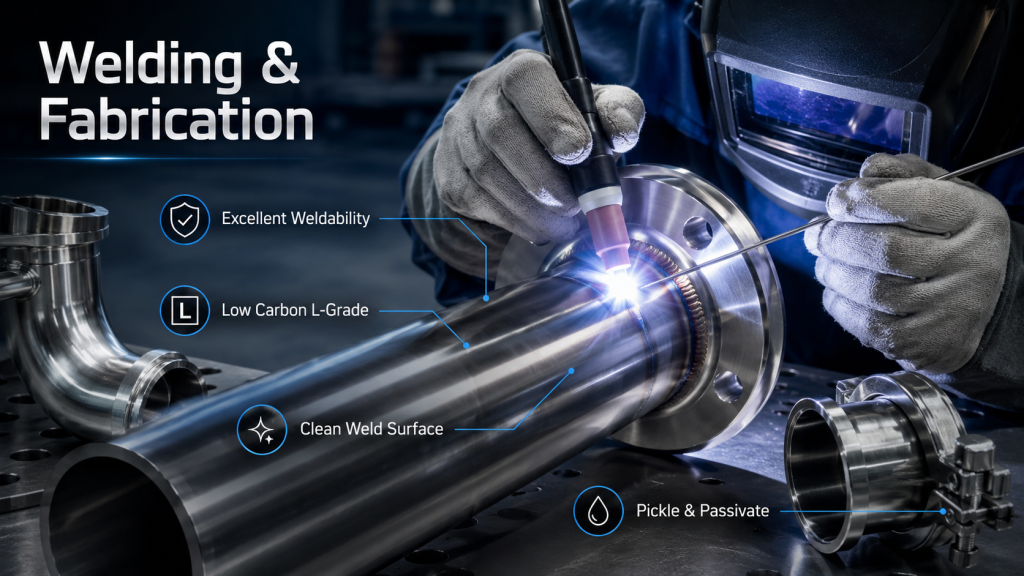
Correct shielding, filler-metal selection, oxide removal and passivation help preserve corrosion resistance after welding.
Weldability
Both 316L and 317L have excellent weldability using common stainless steel welding processes, including GTAW, GMAW, SMAW, FCAW and submerged-arc welding when a qualified procedure is used.
316L is commonly welded with matching or suitably over-alloyed filler metal. For 317L equipment, a matching 317L-type filler may be selected when the weld metal must maintain corrosion resistance similar to the base material.
Filler-metal selection should consider the corrosive medium, dilution, joint design, heat input, hot-cracking resistance and the applicable pressure-vessel or piping code.
Heat Tint and Post-Weld Cleaning
Heat tint is a visible oxide formed next to a stainless steel weld. The metal directly below this oxide can become depleted in chromium and less resistant to localized corrosion.
Depending on the operating environment, heat tint may need to be removed by mechanical cleaning, pickling or another qualified process. Passivation can then support formation of a clean and uniform protective surface.
Forming
Both grades offer good forming performance. 316L is more widely used for deep-drawn and heavily fabricated products because of its broad availability and extensive manufacturing experience.
317L also has good formability, but its higher strength and alloy content can require greater forming force. Springback, bend allowance and tooling should be verified through production trials.
Machining
Both materials can work harden during machining. Rigid equipment, sharp cutting tools, positive cutting geometry, adequate feed and effective cooling help reduce tool wear.
The tool should remain engaged with the workpiece. Rubbing or repeated shallow passes can harden the surface and make subsequent machining more difficult.
Application Comparison
| Application | Recommended Starting Choice | Selection Reason |
|---|---|---|
| Food-processing equipment | 316L | Widely accepted, cleanable, weldable and generally cost-effective |
| Pharmaceutical tanks and piping | 316L | Broad availability, sanitary-finish options and extensive industry experience |
| General chemical storage tank | 316L or 317L | Selection depends on chemical concentration, contaminants and temperature |
| Acidic chloride process vessel | 317L | Higher chromium and molybdenum provide a greater localized-corrosion margin |
| Pulp-and-paper equipment | 317L | Improved resistance in selected pulp-liquor and chemical environments |
| Flue-gas-desulfurization scrubber | 317L or a higher-alloy grade | Additional molybdenum improves resistance, but severe zones may require higher alloys |
| Fertilizer-processing equipment | 317L | Often selected for additional resistance to aggressive process chemicals |
| Coastal architectural hardware | 316L | Common and economical for many coastal applications with proper maintenance |
| Continuously immersed seawater equipment | Detailed engineering evaluation | Neither grade is universally reliable in warm natural seawater and tight crevices |
| Heat exchanger | 316L or 317L | Fluid chemistry, chloride level, temperature and crevice design determine selection |
| Power-generation condenser | 317L in selected services | Higher alloy content may improve performance in aggressive cooling environments |
| General architectural sheet | 316L | 317L may add unnecessary cost unless the environment is unusually aggressive |
Price, Availability and Lead Time
316L is one of the most widely traded stainless steel grades in the global market. It is normally easier to source in sheet, plate, coil, strip, bar, tube and pipe.
317L is a more specialized grade with lower production volume. Uncommon thicknesses, widths, finishes or product forms may require mill production instead of immediate warehouse supply.
The price difference is influenced by:
- Nickel and molybdenum market prices
- Order quantity and minimum order requirements
- Sheet, plate, coil or strip product form
- Cold-rolled or hot-rolled production route
- Thickness and dimensional tolerances
- Surface finish
- Slitting, cutting, polishing and fabrication requirements
- Mill origin and certification requirements
- Freight, packaging and destination port
The higher purchase cost of 317L can be justified when it extends equipment life, reduces shutdown frequency or prevents leakage. It may not be economically justified when 316L already provides an adequate corrosion margin.
Which Grade Should You Choose?
Choose 316L When:
- The environment is moderately corrosive.
- General chloride resistance is required.
- The project involves food or pharmaceutical equipment.
- Worldwide availability and shorter lead time are important.
- The application requires extensive forming or fabrication.
- Lower initial material cost is an important consideration.
- Existing service experience confirms acceptable equipment life.
Choose 317L When:
- The process contains acidic chlorides or stronger chemicals.
- 316L has experienced premature pitting or crevice corrosion.
- Additional molybdenum can provide a useful corrosion margin.
- The application involves pulp and paper, fertilizers, scrubbers or FGD systems.
- Higher ASTM minimum strength is useful.
- The additional material cost is justified by longer service life.
- The project specification or corrosion engineer requires 317L.
When Is a Higher-Alloy Grade Required?
Neither 316L nor 317L should be selected automatically for hot concentrated chlorides, continuously immersed natural seawater, strongly reducing acids, severe crevices or highly contaminated process streams.
Depending on the environment, materials such as
duplex 2205
,
super duplex 2507
or another high-alloy stainless steel may provide a more reliable solution.
When corrosion failure would create major safety, environmental or production consequences, conduct laboratory testing or field coupon testing with the actual process liquid and representative welded samples.
316L and 317L Purchasing Checklist
A complete request for quotation should provide enough information for the supplier to match the grade, dimensions, surface finish, certification and processing requirements.
- Grade:
Specify 316L/S31603 or 317L/S31703. - Applicable standard:
Identify ASTM A240, ASME SA240, EN 10088-2, JIS G4304, JIS G4305 or another required standard. - Product form:
Specify sheet, plate, coil, strip, pipe, tube, bar or fabricated component. - Dimensions:
Provide thickness, width, length, coil weight and dimensional tolerances. - Surface finish:
Specify No.1, 2D, 2B, BA, No.4, hairline, brushed, polished or another required finish. - Edge condition:
Choose mill edge, slit edge, deburred edge or rounded edge. - Corrosive environment:
Provide chemical composition, concentration, temperature, pH, chloride level and possible contaminants. - Fabrication requirements:
Identify cutting, slitting, bending, rolling, welding, polishing or machining requirements. - Material certificate:
Request an EN 10204 3.1 certificate or another required mill test certificate. - Inspection:
Define PMI, chemical analysis, mechanical testing, dimensional inspection, ultrasonic testing or third-party inspection. - Corrosion testing:
Specify ASTM G48, intergranular corrosion testing or project-specific testing when required. - Quantity and destination:
Provide total weight, packing requirements, delivery schedule and destination port.
Available Product Forms and Processing Services
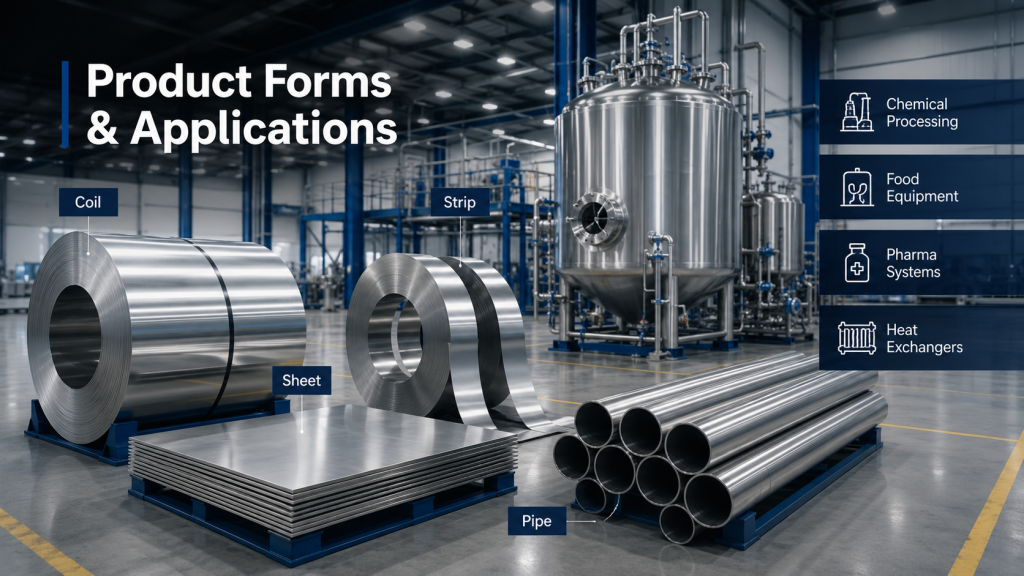 JUDE supplies stainless steel sheet, plate, coil and precision strip with customized processing and inspection.
JUDE supplies 316L and 317L stainless steel products for chemical processing, food equipment, pharmaceutical systems, heat exchangers, tanks and industrial fabrication.
Stainless steel sheet and plate
Рулон нержавеющей стали
Precision stainless steel strip- Cold-rolled and hot-rolled products
- Custom slitting and cut-to-length processing
- Laser, plasma and waterjet cutting
- Bending, rolling and customized fabrication
- No.1, 2B, BA, No.4, brushed and polished finishes
- Mill test certificates and material traceability
- Dimensional and surface inspection
- Third-party inspection when specified
JUDE’s
stainless steel strip-processing service
includes uncoiling, precision slitting, leveling, rewinding and customized packaging.
Buyers can also review available
inspection reports
before placing an order.
Final Conclusion
316L and 317L are both low-carbon, molybdenum-bearing austenitic stainless steels with excellent weldability, formability and corrosion resistance.
316L is the preferred general-purpose choice because it is widely available, economical and suitable for many food-processing, pharmaceutical, chemical, architectural and moderately chloride-bearing environments.
317L contains more chromium, nickel and molybdenum. It generally offers improved resistance to pitting, crevice corrosion and selected acidic chemical environments, making it useful for chemical plants, pulp-and-paper equipment, fertilizer systems, scrubbers, FGD equipment and demanding process vessels.
The correct material should be selected according to the actual chemical concentration, temperature, chloride level, crevice conditions, welding quality, expected service life and total lifecycle cost. 317L should not be selected only because it has a higher grade number, and 316L should not be selected only because it is less expensive.
Frequently Asked Questions
Is 317L better than 316L?
317L generally provides better localized and chemical corrosion resistance because it contains more chromium, nickel and molybdenum. However, 316L is more widely available and usually more economical. The better grade depends on the operating environment.
What is the main difference between 316L and 317L?
Under ASTM A240, 316L contains 16–18% chromium, 10–14% nickel and 2–3% molybdenum. 317L contains 18–20% chromium, 11–15% nickel and 3–4% molybdenum.
Which grade has better pitting resistance?
317L generally has better pitting resistance because of its higher chromium and molybdenum content. Actual performance also depends on temperature, chloride concentration, surface finish, welding and crevice conditions.
Can 317L replace 316L?
317L can often be considered as a corrosion-resistant upgrade from 316L, but the substitution must satisfy the applicable design standard, mechanical requirements, welding procedure, availability and project approval process.
Can 316L replace 317L?
316L should not replace 317L without an engineering review. If 317L was selected because of aggressive chlorides, acids or process chemicals, reducing the alloy content may shorten service life.
Is 317L suitable for seawater?
317L offers better localized corrosion resistance than 316L, but it is not universally reliable in warm, stagnant or biologically active natural seawater. Crevices and continuously immersed critical equipment may require a higher-alloy grade.
Which grade is better for sulfuric acid?
317L can outperform 316L in selected sulfuric-acid conditions, but performance depends strongly on acid concentration, temperature, aeration and contaminants. Application-specific corrosion data should be reviewed.
Are 316L and 317L magnetic?
Both grades are essentially non-magnetic in the annealed condition. Cold working and welding can introduce a slight magnetic response.
Can 316L and 317L be hardened by heat treatment?
No. These austenitic grades cannot be hardened by conventional quenching and tempering. Their strength can be increased through cold working.
Which grade is easier to source?
316L is normally easier to source because it is produced and stocked in much larger volumes. 317L may require a longer lead time for uncommon dimensions and finishes.
Why is 317L more expensive than 316L?
317L contains higher levels of nickel and molybdenum. Its lower production volume and more specialized availability can also increase price and lead time.
What information should I provide when requesting a quotation?
Provide the grade, standard, thickness, width, length, quantity, surface finish, edge condition, processing requirements, inspection documents, destination port and intended application.
Request a 316L or 317L Stainless Steel Quotation
Send JUDE your required grade, specification, dimensions, quantity, surface finish, processing requirements, inspection documents and destination port.
For chemical-processing applications, include the process-fluid composition, operating temperature, chloride concentration and service conditions so the material requirement can be reviewed more accurately.
