
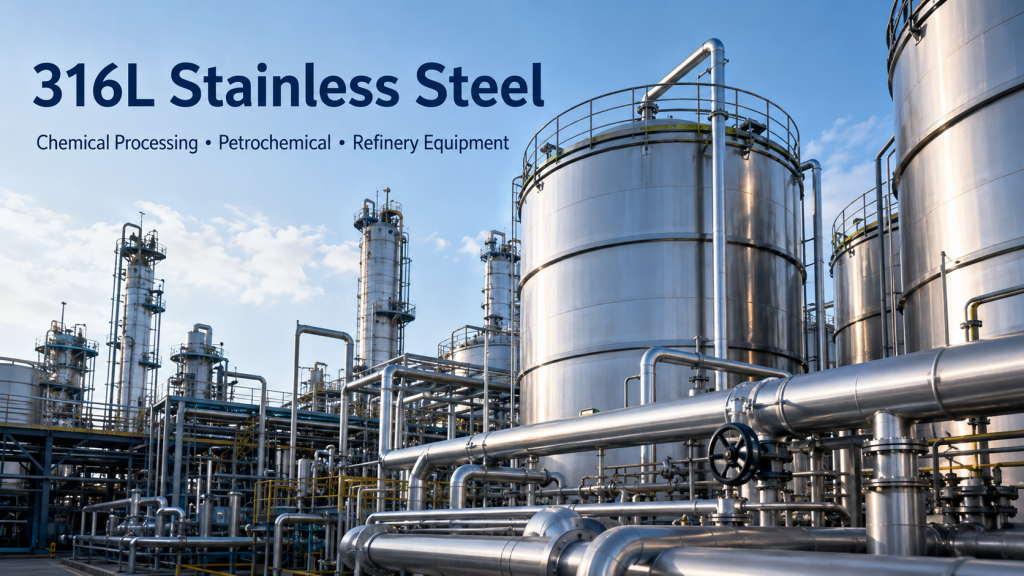
316L stainless steel is one of the most important molybdenum-alloyed austenitic stainless steels used in chemical and petrochemical processing equipment.
Its low carbon content also makes it particularly useful for welded tanks, piping, vessels and fabricated process equipment where resistance to intergranular corrosion after welding is important.
However, 316L is not a universal chemical or refinery alloy.
The correct material selection must be based on the actual process fluid, concentration, temperature, chloride content, pressure, contaminants, welding condition and equipment design.
Quick Answer: What Chemical and Petrochemical Equipment Uses 316L?
Where process conditions are compatible with Type 316L, potential applications include:
- chemical storage tanks;
- mixing and blending vessels;
- process vessels and reactor shells;
- process piping and pipe spools;
- heat exchanger components;
- condensers;
- flanges;
- valves;
- selected pump components;
- tank containers;
- petrochemical equipment;
- selected refinery equipment after a process-specific corrosion review.
316L should not automatically be specified for concentrated hydrochloric acid, warm high-chloride environments, severe sour service, aggressive refinery overhead condensate or other highly corrosive process conditions.
What Is 316L Stainless Steel?
316L is a low-carbon molybdenum-alloyed austenitic stainless steel.
Common international designations include:
- ASTM: Type 316L;
- UNS: S31603;
- EN: 1.4404;
- EN name: X2CrNiMo17-12-2;
- JIS: SUS316L.
For JUDE material information, see
316L Stainless Steel
.
Why Does Molybdenum Matter?
The main alloying distinction between the common 304L and 316L families is the molybdenum addition in 316L.
Molybdenum improves resistance to localized corrosion such as pitting and crevice corrosion in many chloride-containing environments.
This makes 316L worth evaluating where 304L does not provide sufficient corrosion margin.
Important:
Molybdenum improves corrosion resistance, but it does not make 316L immune to chlorides, acids, seawater or stress-corrosion cracking.
Why Is the Low Carbon Level Important?
The lower carbon level reduces the tendency for chromium carbide precipitation during welding.
This is particularly valuable in:
- large tanks;
- welded process vessels;
- pipe spools;
- heat-exchanger fabrication;
- large fabricated chemical equipment.
Low carbon reduces sensitization risk but does not remove the need for qualified welding procedures and proper post-weld surface treatment.
316L Standards and Grade Identification
| Product | Класс | Reference Standard | Buyer Note |
|---|---|---|---|
| Plate / Sheet / Strip | Type 316L / UNS S31603 | ASTM A240/A240M-26 | Use with the required dimensional and project specifications. |
| General Flat-Product Requirements | Stainless flat products | ASTM A480/A480M-25b | General requirements used with applicable product specifications. |
| EN Flat Product | 1.4404 / X2CrNiMo17-12-2 | EN 10088-2:2024 | State the exact EN designation. |
| JIS Hot Rolled | SUS316L | JIS G 4304:2021 | For applicable hot-rolled flat products. |
| JIS Cold Rolled | SUS316L | JIS G 4305:2021 | For applicable cold-rolled flat products. |
| ASTM Process Pipe | TP316L | ASTM A312/A312M-25 | Finished pipe specification; do not use as the raw plate specification. |
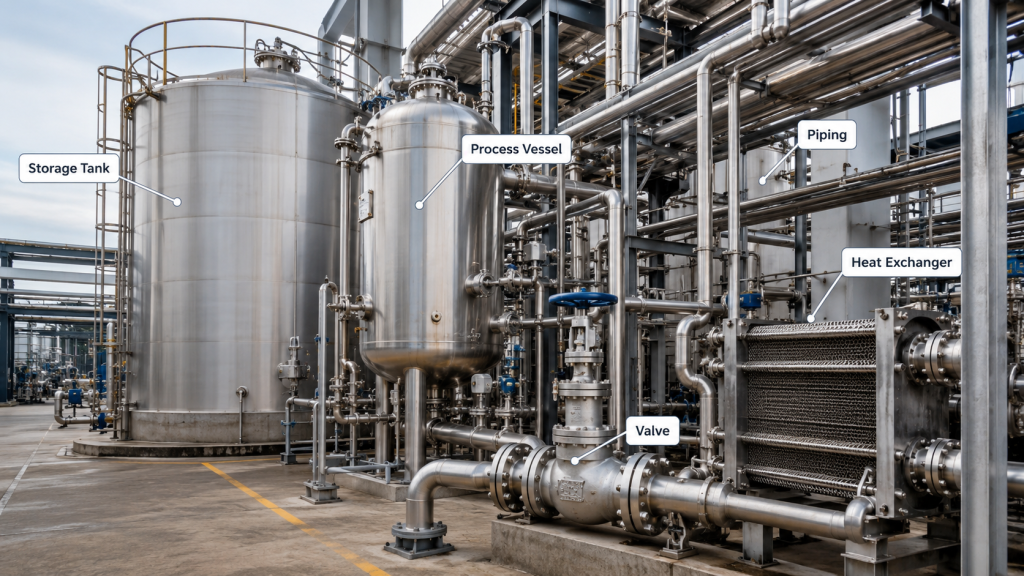
Which Chemical and Petrochemical Equipment Uses 316L?
| Equipment | Potential 316L Role | Main Selection Check |
|---|---|---|
| Storage Tank | Widely considered for compatible chemicals | Fluid chemistry, temperature and chlorides |
| Mixing Vessel | Common process-equipment candidate | Process and cleaning chemicals |
| Process Vessel | Application dependent | Pressure, temperature and corrosion mechanism |
| Process Piping | Common for compatible corrosive streams | Fluid, temperature, pressure and piping code |
| Heat Exchanger | Common but highly service dependent | Process side and cooling side |
| Flange / Valve | Established application family | Fluid chemistry and pressure class |
316L Chemical Storage Tanks
Chemical storage tanks are one of the most important applications for 316L flat products.
Potential fabricated parts include:
- shell courses;
- bottom plates;
- roofs;
- nozzles;
- internal partitions;
- access covers.
Before specifying 316L, the tank designer should confirm the chemical concentration, temperature, chloride content, expected contamination and cleaning procedure.
316L Process Vessels and Reactor Shells
316L can be fabricated into atmospheric or pressure-containing process vessels when permitted by the design code and project material specification.
Material review should include:
- feed chemistry;
- reaction products;
- impurities;
- temperature;
- pressure;
- startup and shutdown conditions;
- cleaning chemistry.
316L Process Piping and Pipe Spools
TP316L is widely used in compatible process piping systems.
For finished ASTM stainless steel pipe, ASTM A312/A312M is a common specification.
Typical purchasing information includes:
- NPS / OD;
- wall thickness or schedule;
- welded or seamless construction;
- pipe standard;
- end preparation;
- testing requirements;
- process medium.
316L Heat Exchangers and Condensers
316L is widely evaluated for heat exchangers because the Mo-bearing alloy provides greater localized-corrosion resistance than 304L.
However, both sides of the exchanger must be reviewed.
Important parameters include:
- process fluid;
- cooling water;
- chloride concentration;
- temperature;
- flow velocity;
- crevices;
- deposits;
- shutdown conditions.
316L Flanges and Valves
Flanges and valves are established 316L application categories.
Depending on the component, the required material may be supplied as:
- plate;
- bar;
- forging;
- casting;
- machined stock.
The correct product specification must match the manufacturing route.
316L in Petrochemical Equipment
316L is widely used in the chemical and petrochemical industries, but the specific process stream must control the final grade decision.
Potential applications include:
- process vessels;
- storage systems;
- transfer piping;
- heat exchangers;
- valves;
- flanges;
- tank-container systems.
316L in Selected Refinery Applications
316L can be used in selected refinery environments where the corrosion mechanism falls within its capabilities.
Refinery metallurgy can be affected by:
- sulfur compounds;
- naphthenic acids;
- chlorides;
- acidic condensates;
- wet hydrogen sulfide;
- high temperature;
- shutdown corrosion.
Refinery selection rule:
Never replace the project-specified refinery material with 316L solely because it has higher corrosion resistance than 304L.
316L in Chloride-Containing Environments
The molybdenum content of 316L improves resistance to pitting and crevice corrosion compared with 304L.
However, risk increases with:
- higher chloride concentration;
- higher temperature;
- lower pH;
- crevices;
- deposits;
- stagnant conditions.
Chloride Stress-Corrosion Cracking
316L is still a conventional austenitic stainless steel and can suffer chloride-induced stress-corrosion cracking under sufficiently aggressive conditions.
This is especially important when heat, tensile stress and chloride concentration act together.
Is 316L Resistant to Hydrochloric Acid?
316L should not be generically described as hydrochloric-acid resistant.
Hydrochloric acid can destroy the passive film that protects stainless steel.
Material suitability depends strongly on:
- acid concentration;
- temperature;
- impurities;
- aeration;
- process conditions.
More highly alloyed stainless steels or nickel alloys are frequently required.
316L in Sulfuric Acid
Sulfuric-acid resistance cannot be summarized by a single statement.
The corrosion rate can vary dramatically with:
- acid concentration;
- temperature;
- oxygen;
- metal ions;
- other contaminants.
A corrosion chart, laboratory test or project metallurgy specification should be used for final material selection.
316L and H₂S / Sour Service
Sour-service suitability must be evaluated from the complete environment rather than the stainless steel grade name alone.
Relevant parameters include:
- H₂S partial pressure;
- pH;
- chloride concentration;
- CO₂;
- temperature;
- stress;
- applicable NACE / ISO requirements.
316L and Elevated Temperature
The low carbon content of 316L is beneficial for welded fabrication, but it does not make 316L the preferred material for every prolonged high-temperature refinery application.
When high-temperature stability, oxidation, carburization or sulfidation becomes the controlling issue, stabilized or heat-resistant stainless steels may be more appropriate.
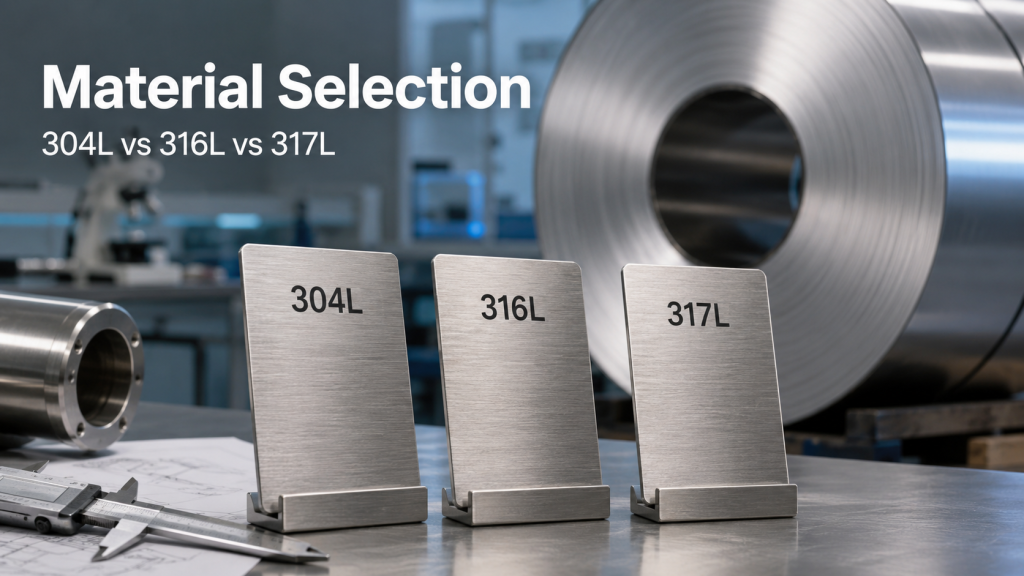
304L vs 316L vs 317L for Process Equipment
| Material | General Position | Typical Selection Reason |
|---|---|---|
| 304L | General Cr-Ni low-carbon process stainless steel | Compatible mild-to-medium chemical service |
| 316L | Mo-bearing Cr-Ni low-carbon stainless steel | Greater localized-corrosion margin and chloride resistance |
| 317L | Higher-Mo austenitic stainless steel | Evaluate when 316L corrosion margin is insufficient |
| Duplex / Higher Alloy | Higher strength or higher alloying | More demanding chloride, SCC or chemical environments |
See JUDE’s
304L Stainless Steel
and
317L Stainless Steel
pages for comparison.
316L Sheet, Plate, Coil or Strip?
316L Plate
Plate is commonly used for:
- large tanks;
- process vessels;
- reactor shells;
- pressure equipment;
- large fabricated components.
See JUDE’s
Stainless Steel Sheet and Plate
.
316L Coil
Stainless Steel Coil
can be suitable for continuous production, thinner-gauge tanks, fabricated components and downstream forming.
316L Strip
Stainless Steel Strip
is suitable for narrow-width formed parts, clamps and specialized fabricated components.
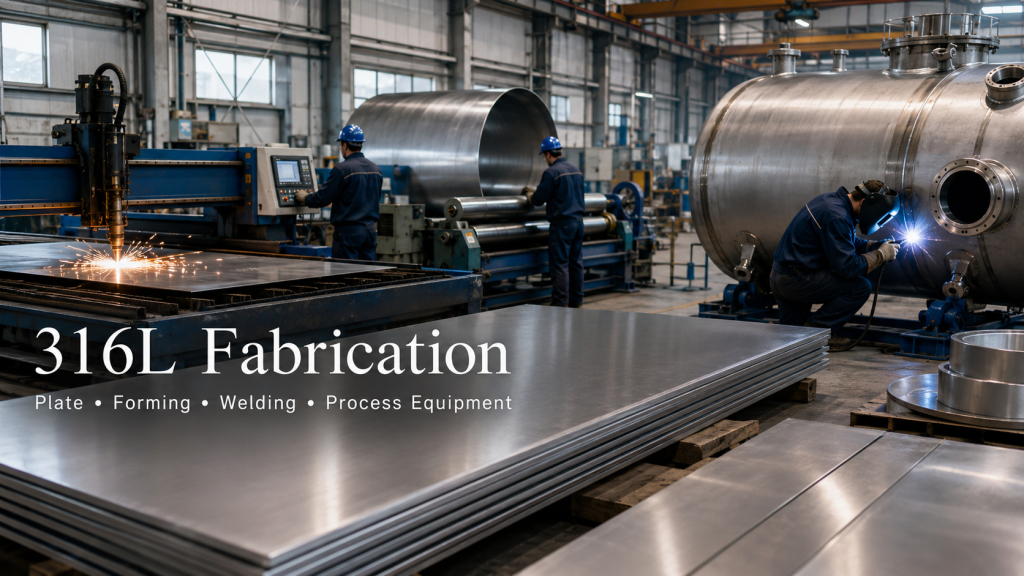
Fabrication and Welding of 316L
316L is widely used in welded chemical equipment.
Fabricators should still control:
- heat input;
- filler metal;
- joint design;
- shielding;
- interpass temperature;
- heat tint;
- surface contamination.
Weld oxide and iron contamination can reduce the corrosion performance of the final component.
Depending on the specification, post-fabrication treatment may include:
- mechanical cleaning;
- pickling;
- passivation;
- final rinsing;
- visual inspection.
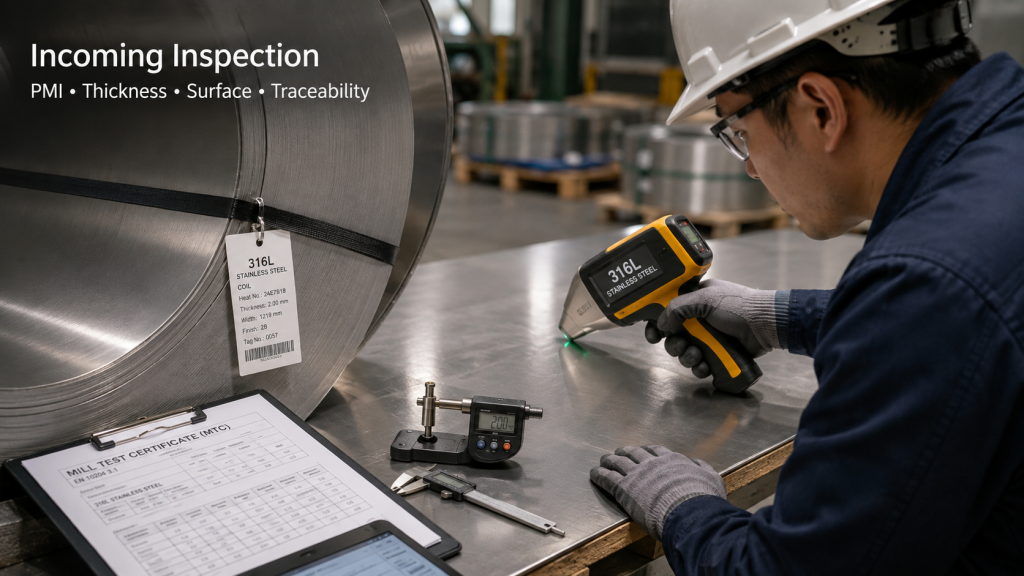
Incoming Inspection of 316L
- Confirm Type 316L / UNS S31603 or the specified EN/JIS grade.
- Verify the governing product standard.
- Review the MTC.
- Match heat and plate/coil numbers.
- Verify thickness.
- Verify width and length.
- Inspect surface condition.
- Check flatness and tolerance.
- Perform PMI when the project requires it.
- Verify Mo-bearing alloy identity where required.
- Review additional corrosion tests when specified.
- Verify project documentation.
See JUDE’s
Inspection Reports
for available material-verification documentation.
Common 316L Purchasing Mistakes
Mistake 1: Ordering only “316L.”
State the governing standard, product form, dimensions and project specification.
Mistake 2: Assuming 316L is immune to chlorides.
Mo improves localized-corrosion resistance but does not eliminate pitting, crevice corrosion or chloride SCC.
Mistake 3: Calling 316L hydrochloric-acid resistant.
Hydrochloric acid can rapidly attack conventional stainless steels depending on concentration and temperature.
Mistake 4: Assuming all refinery equipment should use 316L.
Refineries contain multiple distinct corrosion mechanisms.
Mistake 5: Ignoring the cooling-water side of a heat exchanger.
Cooling water may determine the required alloy rather than the process fluid.
Mistake 6: Confusing ASTM A240 and ASTM A312.
A240 covers flat products; A312 covers finished austenitic stainless steel pipe.
Mistake 7: Ignoring weld cleaning.
Heat tint and carbon-steel contamination can reduce corrosion performance.
JUDE 316L Stainless Steel Supply Options
JUDE lists 316L across its stainless steel flat-product range.
316L Stainless Steel
Stainless Steel Sheet / Plate
Рулон нержавеющей стали
Полоса из нержавеющей стали
Обработка полос
316L Chemical / Petrochemical RFQ Checklist
- Final equipment: tank, vessel, pipe, exchanger, valve or another component.
- Industry: chemical, petrochemical, refinery or other.
- Process fluid.
- Concentration.
- Normal operating temperature.
- Maximum design temperature.
- Pressure.
- Chloride concentration.
- pH.
- H₂S / sulfur / acid contaminants if applicable.
- Grade: 316L / S31603 / 1.4404 / SUS316L.
- Product standard.
- Product form: plate, sheet, coil or strip.
- Thickness.
- Width and length.
- Surface finish.
- Dimensional tolerances.
- Welding process.
- Post-weld cleaning requirement.
- PMI requirement.
- MTC / EN 10204 requirement.
- Corrosion test requirement.
- Quantity.
- Destination and Incoterm.
Frequently Asked Questions
Why is 316L used in chemical processing?
316L combines molybdenum-enhanced localized-corrosion resistance with low-carbon weldability, making it suitable for many tanks, vessels, piping and process components when the process chemistry is compatible.
Is 316L better than 304L for chemical equipment?
316L generally provides a greater resistance margin to pitting and crevice corrosion because of its molybdenum addition, but the correct grade still depends on the actual process environment.
Can 316L be used for chemical storage tanks?
Yes, for many compatible chemicals. The concentration, temperature, chlorides and cleaning chemistry should be reviewed before final selection.
Can 316L be used in refineries?
Yes, in selected refinery services. It is not a universal refinery material, and the specific corrosion mechanism must be evaluated.
Is 316L resistant to hydrochloric acid?
Not as a general rule. Hydrochloric acid can destroy the stainless steel passive film, and conventional stainless grades have limited suitability depending on concentration and temperature.
Can 316L handle seawater?
316L may be used in some chloride-containing environments, but sustained seawater exposure, warm seawater and crevice conditions can require a more highly alloyed or duplex stainless steel.
Can 316L suffer chloride stress-corrosion cracking?
Yes. 316L is an austenitic stainless steel and can suffer chloride-induced stress-corrosion cracking when chloride, tensile stress and temperature combine unfavorably.
Is 316L suitable for heat exchangers?
Often yes, but both the process side and cooling side must be evaluated. Cooling-water chloride content may control the alloy selection.
When should 317L be considered instead of 316L?
317L can be evaluated when a higher molybdenum content and additional corrosion margin are required beyond conventional 316L.
What information should I provide for a 316L quotation?
Provide the final equipment, process fluid, concentration, temperature, chloride level, pressure, project specification, grade, dimensions, welding and inspection requirements, quantity and destination.
Заключение
316L stainless steel is one of the most important standard materials used in chemical and petrochemical process equipment.
Its combination of molybdenum-enhanced localized-corrosion resistance and low-carbon welded performance makes it suitable for many chemical tanks, process vessels, piping systems, heat exchangers, flanges and valves.
The correct selection sequence is:
Process Fluid → Concentration → Temperature → Chlorides → Contaminants → Corrosion Mechanism → Grade → Product Standard → Fabrication → Inspection.
316L provides more corrosion margin than 304L in many environments, but it is not a universal solution for seawater, hydrochloric acid, chloride SCC, sour service or refinery corrosion.
When the service environment exceeds the capability of 316L, 317L, duplex stainless steels, higher-alloy austenitic grades or nickel alloys should be evaluated.
Request 316L Stainless Steel for Chemical and Petrochemical Equipment
Send JUDE your equipment drawing, process fluid, concentration, operating and design temperature, chloride content, pressure, required material standard, dimensions, welding process, inspection requirements and annual demand.
For refinery or sour-service projects, also include the project metallurgy specification and known H₂S, sulfur, acid and chloride conditions.
