
316 vs 321 Stainless Steel: Complete Technical Comparison Guide
Selecting the correct stainless steel grade is essential for ensuring long-term durability, corrosion resistance, and operational reliability in industrial applications. Among the most commonly compared austenitic stainless steels are 316 stainless steel and 321 stainless steel. While both grades offer excellent performance, they are designed for different operating environments and temperature conditions.
This comprehensive guide explains the differences between 316 and 321 stainless steel in terms of chemical composition, mechanical properties, corrosion resistance, heat resistance, welding performance, applications, and lifecycle cost.
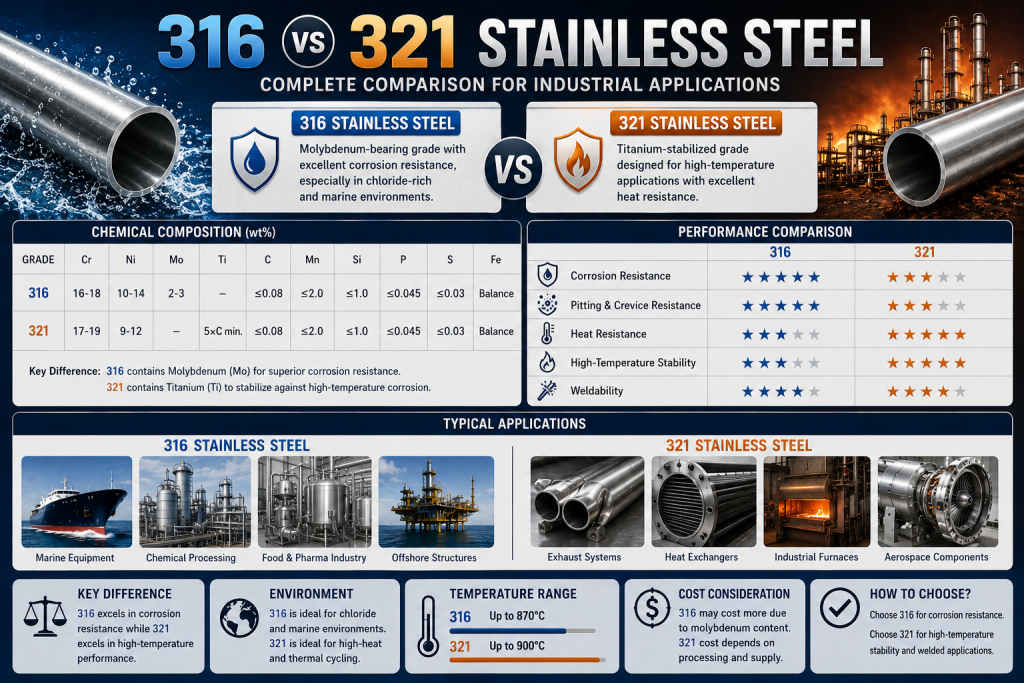
1. What Is 316 Stainless Steel?
316 stainless steel is a molybdenum-bearing austenitic stainless steel known for its excellent corrosion resistance, especially in chloride-rich and marine environments.
Its typical composition includes:
- 16–18% Chromium (Cr)
- 10–14% Nickel (Ni)
- 2–3% Molybdenum (Mo)
The addition of molybdenum significantly improves resistance to pitting and crevice corrosion compared with standard 304 stainless steel.
2. What Is 321 Stainless Steel?
321 stainless steel is a titanium-stabilized austenitic stainless steel specifically developed for high-temperature applications.
Its composition is similar to 304 stainless steel but includes titanium additions to prevent chromium carbide precipitation during welding and high-temperature exposure.
- 17–19% Chromium (Cr)
- 9–12% Nickel (Ni)
- Titanium stabilization
321 stainless steel is widely used in environments involving continuous high heat and thermal cycling.
3. Chemical Composition Comparison
| Элемент | 316 Stainless Steel | 321 Stainless Steel |
|---|---|---|
| Chromium | 16–18% | 17–19% |
| Nickel | 10–14% | 9–12% |
| Molybdenum | 2–3% | None |
| Titanium | None | Present |
| Main Advantage | Corrosion resistance | High-temperature stability |
The presence of molybdenum in 316 improves corrosion resistance, while titanium in 321 enhances high-temperature performance.
4. Corrosion Resistance Comparison
316 Stainless Steel
- Excellent resistance to chlorides and seawater
- Superior pitting and crevice corrosion resistance
- Preferred for marine and chemical environments
321 Stainless Steel
- Good general corrosion resistance
- Performs well at elevated temperatures
- Less resistant to chloride attack than 316
For corrosive environments involving saltwater or chemicals, 316 is generally the better choice.
5. Heat Resistance and High-Temperature Performance
Heat resistance is where 321 stainless steel demonstrates a clear advantage.
321 Stainless Steel Advantages
- Excellent oxidation resistance at high temperatures
- Resists intergranular corrosion after welding
- Suitable for continuous service up to approximately 900°C
316 Stainless Steel Limitations
- Good heat resistance but less stable at prolonged high temperatures
- More susceptible to carbide precipitation
321 is widely preferred for exhaust systems, heat exchangers, and aerospace components exposed to thermal cycling.
6. Mechanical Properties
| Недвижимость | 316 Stainless Steel | 321 Stainless Steel |
|---|---|---|
| Прочность на разрыв | High | High |
| Ductility | Превосходно | Превосходно |
| High-Temperature Stability | Moderate | Превосходно |
| Thermal Fatigue Resistance | Good | Superior |
Both grades offer strong mechanical performance, but 321 performs better under repeated heating and cooling cycles.
7. Welding and Fabrication
316 Stainless Steel
- Excellent weldability
- Easy fabrication and forming
- 316L grade minimizes carbide precipitation
321 Stainless Steel
- Designed specifically for welded high-temperature service
- Titanium stabilizes the structure during welding
- Excellent resistance to weld decay
For high-temperature welded structures, 321 is often preferred due to its enhanced thermal stability.
8. Typical Applications
Applications of 316 Stainless Steel
- Marine equipment
- Chemical processing systems
- Food and pharmaceutical industries
- Offshore structures
Applications of 321 Stainless Steel
- Aircraft exhaust systems
- Heat exchangers
- Industrial furnaces
- Thermal processing equipment
Application environment and operating temperature are the primary selection factors.
9. Cost Comparison
In general:
- 316 stainless steel may cost more due to molybdenum content
- 321 stainless steel pricing depends on titanium stabilization and processing requirements
Lifecycle cost should always consider maintenance, corrosion risk, and operating conditions—not just initial material price.
10. Which One Should You Choose?
- Choose 316 Stainless Steel if:
- Corrosion resistance is the top priority
- The environment contains chlorides or seawater
- Chemical resistance is required
- Choose 321 Stainless Steel if:
- The application involves continuous high temperatures
- Thermal cycling is frequent
- Weld stability at elevated temperatures is critical
Frequently Asked Questions (FAQ)
Is 321 stainless steel better than 316?
Not necessarily. 321 is better for high-temperature applications, while 316 is better for corrosion resistance.
Can 321 stainless steel rust?
Like all stainless steels, it can corrode under certain conditions, but it offers good general corrosion resistance.
Why does 321 contain titanium?
Titanium stabilizes the material and prevents carbide precipitation during welding and heat exposure.
Which stainless steel is better for marine environments?
316 stainless steel is generally preferred due to its molybdenum-enhanced chloride resistance.
Is 321 stainless steel suitable for exhaust systems?
Yes. Its excellent high-temperature stability makes it widely used in exhaust and thermal processing systems.
Conclusion: Both 316 and 321 stainless steel are high-performance austenitic grades designed for different industrial priorities. 316 excels in corrosion resistance and marine applications, while 321 provides superior thermal stability and weld performance at elevated temperatures. Selecting the right material depends on environmental exposure, operating temperature, and long-term performance requirements.
