
304L, 316L, 321 and 316Ti for Chemical Equipment Repairs in Dzerzhinsk and Kstovo
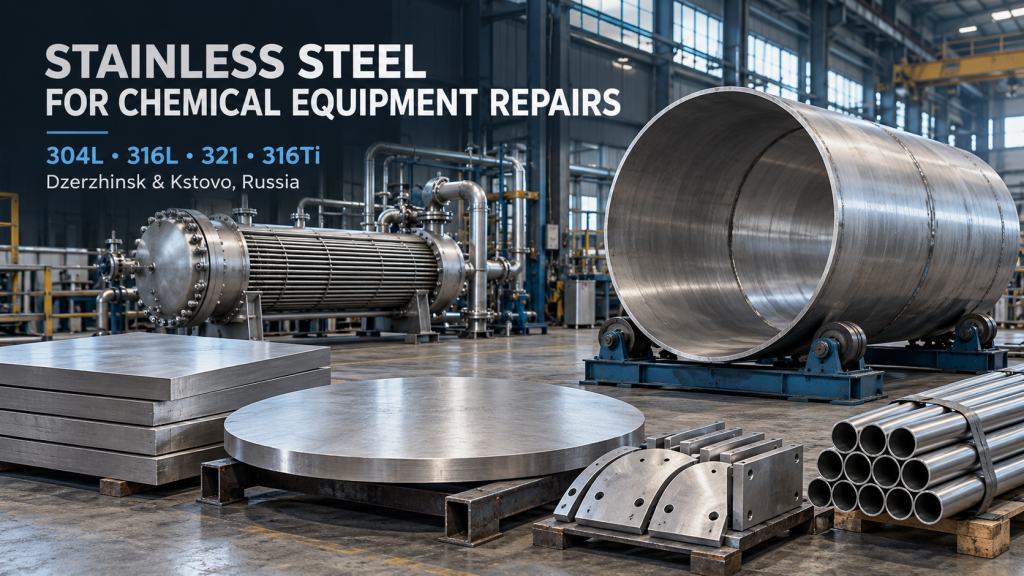 304L, 316L, 321 and 316Ti stainless steel can be specified
for replacement vessel sections, mixing-equipment internals,
head blanks, process piping and selected heat-exchanger
components. The correct purchase depends on the
approved repair design, the existing material and the reason
the original component needs replacement.
For equipment builders and maintenance contractors serving
Dzerzhinsk and Kstovo in Russia’s Nizhny Novgorod
Oblast, a repair order often combines large plate
blanks with small, urgent replacement pieces. Each item needs
its own material identity and acceptance requirements before
the supplier cuts or reserves stock.
This guide explains how to turn that mixed requirement into a
reviewable material order. It describes potential applications
and procurement decisions; it does not identify the metallurgy
of any named plant or represent a completed JUDE project.
Start with the repair scope and the failed component
Separate pressure-retaining items from process-contact internals
and external covers. A shell insert, a mixing baffle and a
removable guard may look like similar cut plates, but their
design duties and release requirements differ.
Collect the equipment drawing, material record or equipment
passport, inspection findings and current process conditions.
Where corrosion caused the damage, have the responsible engineer
review the mechanism before approving a repeat order in the
same grade. A thickness measurement on a worn component does
not establish the required replacement thickness.
| Component to manufacture | Material to specify | Decision needed before purchase |
|---|---|---|
| Vessel shell section or engineered shell insert | 304L or 316L plate for approved compatible service; 321 or 316Ti where the repair specification requires a stabilized grade. | Confirm starting thickness, developed dimensions, forming allowance, weld preparation and traceability. |
| Replacement dished head | A plate blank in the approved vessel grade, with the forming route agreed. | The head manufacturer must approve blank diameter and starting thickness against the required finished geometry and minimum thickness. |
| Mixing baffle, partition or distributor plate | Sheet, plate or cut blanks in the grade assigned to that internal component. | Check fluid exposure, attachment details, erosion, vibration and clearances; the shell grade does not automatically apply to every internal. |
| Wetted pipe section or spool | Pipe to the approved piping specification, with grade, manufacturing route and dimensions identified. | Define wall thickness, ends, fittings, welds and testing separately from the raw pipe supply. |
| Heat-exchanger baffle or replacement tube | Plate for baffles; purpose-specified tubing for heat-transfer tubes. | Review both fluids, tube dimensions, wall basis and tube-to-tubesheet joint requirements. Tubesheets require a separate material and manufacturing review. |
| Inspection cover or maintenance panel | Sheet or plate to the released component drawing. | Identify whether it seals a pressure boundary, contacts the process or only provides external access. |
JUDE’s
stainless steel sheet and plate range
is a starting point for flat-product enquiries. Finished heads,
complete spools, tube bundles and installation services should
be identified separately and confirmed in the quotation.
Compare the four grades without treating them as equivalents
| Класс | UNS / common EN reference | Material-selection role |
|---|---|---|
| 304L | S30403 / 1.4307 | Low-carbon chromium-nickel steel for compatible welded service. Low carbon helps limit sensitization; it does not provide molybdenum-enhanced pitting resistance. |
| 316L | S31603 / 1.4404 | Low-carbon, molybdenum-bearing steel with improved localized-corrosion resistance over 304L in many environments. Suitability still depends on the actual exposure. |
| 321 | S32100 / 1.4541 | Titanium-stabilized chromium-nickel steel used where the approved design requires resistance to sensitization during thermal exposure. It is not a molybdenum-alloyed substitute for 316L. |
| 316Ti | S31635 / 1.4571 | Titanium-stabilized, molybdenum-bearing steel for specified process duties, including selected elevated-temperature applications. |
These EN references identify commonly associated grades, not
automatic equivalence between complete specifications. For
example, EN 1.4306 is another low-carbon chromium-nickel grade
associated with 304L, but its requirements differ from 1.4307.
Preserve the exact grade, standard, edition and delivery
condition on the approved order.
Manufacturer references include Outokumpu’s
Core grades
and
Supra grades
.
Use the contractual specification and material certificate
for acceptance; a producer’s typical composition is not a
guaranteed analysis for every supplied heat.
Resolve material substitutions before the shutdown deadline
Replacing 316Ti with 316L
The grades can have comparable performance in many aqueous
environments, but this does not authorize an automatic change
on a repair drawing. Check elevated-temperature strength
requirements, exposure history, forming, welding and the
original material specification. The
British Stainless Steel Association’s comparison
explains why temperature and fabrication can affect
substitution decisions.
Replacing a molybdenum-bearing grade with 321
Titanium stabilization addresses a different metallurgical
issue from molybdenum alloying. An available 321 plate is
not an equivalent replacement for 316L or 316Ti merely
because all are austenitic stainless steels. Review the
corrosive medium and the approved design before changing
the alloy family.
Matching a legacy Russian material callout
Keep the original designation and any GOST or TU requirement
from the equipment documents. Request a written comparison
covering composition, mechanical properties, product form,
heat treatment and testing. A commercial cross-reference
table alone cannot release an alternative material for a
pressure-boundary repair.
Also preserve suffixes: 321 and 321H are distinct designations.
Where creep or stress-rupture performance governs, the engineer
must select a suitable grade and code basis. JUDE’s
321 chemical and refinery application guide
provides additional background.
Use a product standard for each purchased form
A grade name does not define the full purchase specification.
Under an ASTM-based project, the following standards address
different product forms:
- Plate, sheet and strip:
ASTM A240/A240M
covers stainless flat products for pressure vessels and
general applications. - Process pipe:
ASTM A312/A312M
covers relevant seamless, welded and heavily cold-worked
austenitic stainless steel pipe. - Seamless heat-exchanger tubing:
ASTM A213/A213M
covers specified seamless boiler, superheater and
heat-exchanger tubes. - Welded heat-exchanger tubing:
ASTM A249/A249M
covers specified welded austenitic boiler, superheater,
heat-exchanger and condenser tubes.
Confirm that the ordered grade, dimensions, manufacturing route
and condition are covered by the chosen edition. These references
are not a declaration that every grade is available in every
form. ASTM requirements should not be inserted into an EN-,
GOST- or TU-based repair specification without approval.
For tube replacement, state whether the wall requirement is
minimum, average or nominal under the applicable specification.
An outside diameter and an informal wall value alone can leave
suppliers quoting different products. A raw-material standard
also does not approve the finished vessel, head or repair.
Set three acceptance points for the material package
1. Before stock is allocated
Review the proposed grade, product standard, condition and
certificate requirements. Record deviations before ordering.
Confirm process chemistry, operating and design temperatures,
pressure or vacuum duty, and cleaning or shutdown exposure
with the responsible engineer.
None of these four grades is a universal choice for hot chlorides,
aggressive acids or every refinery stream. For an exchanger,
evaluate both the process side and the cooling or heating side.
2. Before blanks are cut or formed
Approve the cutting drawing and revision, forming allowance,
plate orientation where specified, edge preparation and marking
locations. For shell inserts, the drawing must distinguish
supplied blank dimensions from finished fit-up dimensions.
Specify the weld preparation through the fabricator’s approved
procedure. JUDE’s
bevel and edge-chamfering service
can be discussed against that drawing; the supplier’s general
capability listing does not set the required weld geometry.
Link every cut piece to its parent material record. Handheld
XRF can help identify alloying elements, but it cannot verify
the carbon limit needed to establish an L grade. If carbon
verification is required, specify a suitable validated method.
Thermo Fisher’s material-verification guidance
explains this limitation.
3. Before shipment and workshop release
Reconcile part numbers, quantities, dimensions, identification
and documents. Define responsibility for removal of heat tint,
contamination control and any specified surface treatment after
fabrication. Passivation does not compensate for the wrong
alloy or an unacceptable weld.
Where EN 10204 type 3.1 is ordered, require the appropriate
manufacturer’s inspection certificate with specific inspection
results. It is not automatically a third-party inspection
certificate. Agree any additional inspection, test coverage
and acceptance criteria before production.
For deliveries to Dzerzhinsk or Kstovo, identify the actual
receiving address, unloading arrangements and which repair
assemblies must arrive first. Ask for a packing list grouped
by equipment tag so urgent pieces can be found without
sorting the entire shipment.
Prepare an RFQ that separates material supply from fabrication
Send the released drawings and the repair material schedule
together. If the scope is still preliminary, mark it accordingly
and identify what remains subject to engineering approval.
Subject: RFQ - Stainless repair materials - Dzerzhinsk / Kstovo Project / equipment tag: Service fluids, contaminants and cleaning conditions: Operating / design temperature and pressure or vacuum: Repair drawing and revision: Original material designation and standard: Approved replacement grade: Product standard, edition and delivery condition: For each item: - Component name and part number - Plate / head blank / internal blank / pipe / tube - Dimensions, wall basis and tolerances - Quantity and required processing - Supplied surface condition and protection - Identification, inspection and certificate requirements For head blanks: - Former-approved diameter and starting thickness For tubular items: - Manufacturing route, OD, wall basis, length and ends - Required testing and tube-to-tubesheet details, if applicable Commercial requirements: - Named destination and requested delivery term - Required-on-site date and permissible split deliveries - Separate prices for material, processing, inspection and packing - Written list of proposed deviations or unavailable items
Compare quotations against the same delivered scope. A low
plate price can exclude cutting, marking or documentation
needed for workshop release. Confirm lead time against the
proposed material and processing route before accepting
a shutdown delivery commitment.
Frequently asked questions
Can a repair package include more than one stainless grade?
Yes, when each grade is approved for its own component.
Separate the line items and maintain identification through
cutting, packing and assembly. If different grades will be
welded together, the joint and welding procedure need an
appropriate technical review.
Can commercial stock be reserved before the final repair
drawing is issued?
A reservation may be discussed, but record which dimensions
and material requirements are confirmed. Agree cancellation
terms and keep irreversible cutting or forming subject to
drawing release. A provisional stock reservation is not
technical acceptance of the repair.
Should a quotation for a head blank include the completed
dished head?
Only if forming and finished-head acceptance are expressly
included. Otherwise, the quoted item is the starting plate
or cut blank. Ask who owns forming calculations, post-forming
measurements, any required heat treatment and the finished
component documentation.
What should I request when the original material certificate
is missing?
Ask the equipment owner or responsible engineer to establish
an identification and acceptance plan using available drawings,
equipment records and appropriate testing. A supplier should
not assign a replacement grade solely from appearance,
a magnet check or an informal description of the old part.
Request a quotation for your approved repair materials
Send JUDE Steel your component schedule, drawings, material
callouts, quantities and delivery destination. Identify
whether the enquiry covers flat stock, processed blanks
or separately specified tubular products so the available
supply scope can be confirmed.
Send a chemical-equipment repair RFQ
Email:
support@jiscojude.com
Request written confirmation of availability, processing
capability, documentation, lead time and any proposed
material substitutions.
