
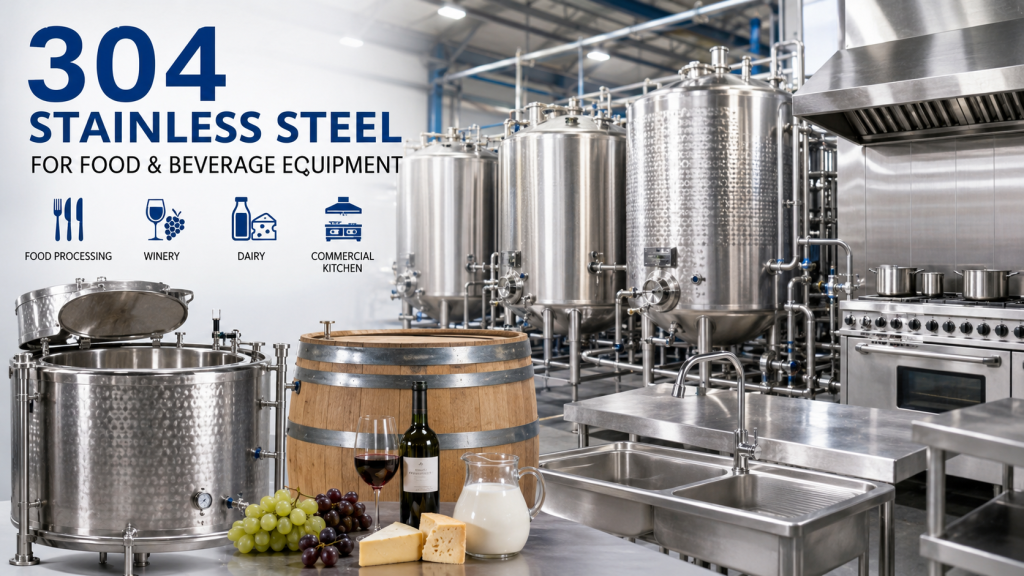
Which Food & Beverage Equipment Uses 304 Stainless Steel? A Sourcing Guide for Manufacturers
304 stainless steel is one of the most widely used raw materials for food-processing machinery, beverage equipment, winery tanks and commercial-kitchen products.
However, a wine-tank manufacturer, a dairy-equipment fabricator and a commercial-kitchen sink producer do not purchase the same 304 raw material simply because the finished products all use stainless steel.
They may require different sheet thicknesses, coil widths, surface finishes, sanitary tubing specifications, forming properties and hygienic requirements.
The practical purchasing question is therefore:
which food and beverage products are commonly manufactured from 304 stainless steel, and what raw-material form should be specified for each product?
This guide connects finished equipment with 304 sheet, plate, coil, strip and sanitary tubing requirements for food, beverage, winery, dairy and commercial-kitchen manufacturers.
Quick Answer: Which Products Are Commonly Made From 304 Stainless Steel?
Depending on the food product, cleaning process, chloride exposure and equipment standard, 304 stainless steel may be used to manufacture:
- food storage tanks
- mixing tanks and vessels
- wine fermentation tanks
- wine storage tanks
- beer and beverage tanks
- milk storage tanks
- selected dairy-processing equipment
- ingredient hoppers
- food chutes
- food-processing tables
- commercial sinks
- restaurant preparation tables
- kitchen worktops
- commercial kitchen cabinets
- kitchen exhaust hoods
- shelving
- food containers
- conveyor components
- sanitary tubing and transfer lines
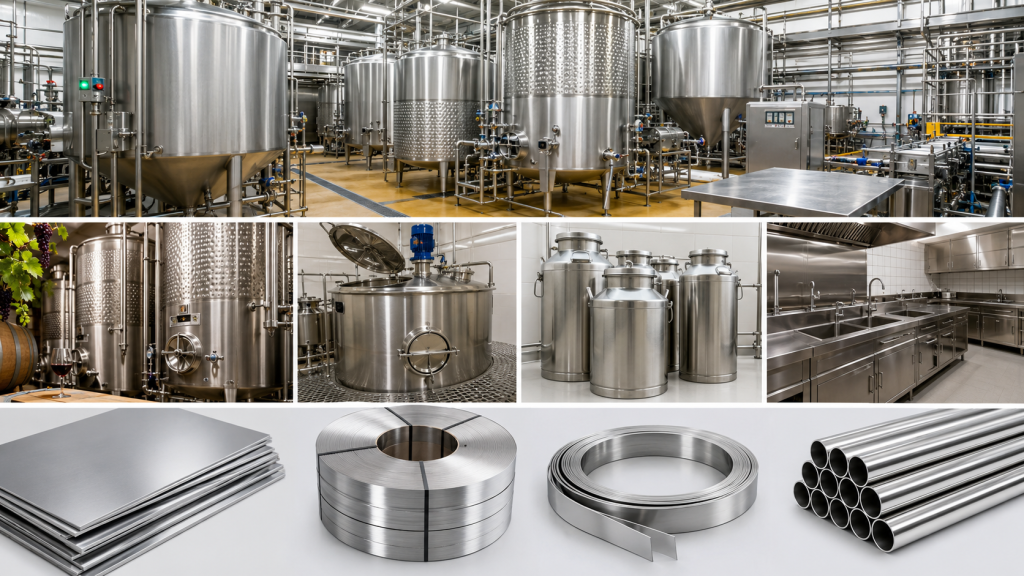
304 should not be treated as a universal material for every food environment. Salt, brine, chlorides, aggressive acidic products, cleaning chemicals and coastal exposure may justify 316L or another more corrosion-resistant grade.
What Does “Food-Grade 304” Actually Mean?
The term “food-grade 304 stainless steel” is widely used commercially, but it is not a separate ASTM alloy designation.
Type 304 / UNS S30400 defines the stainless steel grade. Hygienic suitability of the finished food-contact equipment also depends on:
- surface condition
- surface roughness
- weld quality
- crevice control
- drainability
- cleanability
- fabrication contamination
- cleaning chemicals
- equipment design
- the applicable food or dairy equipment standard
For this reason, buying ASTM A240 Type 304 sheet does not by itself certify the finished tank, table or food-processing machine as hygienic equipment.
3-A Sanitary Standards address hygienic equipment design, materials, fabrication and cleanability for dairy and food-processing systems.
The raw material is therefore only one part of sanitary equipment compliance.
304 Grade Designations and Product Standards
| System / Product | Designation | Procurement Note |
|---|---|---|
| Common grade | Type 304 | Commercial grade designation |
| UNS | S30400 | Principal UNS designation for Type 304 |
| EN | 1.4301 / X5CrNi18-10 | Common European designation |
| JIS | SUS304 | Common Japanese designation; order to the applicable JIS product standard |
| Plate / sheet / strip | ASTM A240/A240M S30400 | Flat stainless steel products |
| General-service tubing | ASTM A269/A269M TP304 | General corrosion-resistant tubing; not automatically a sanitary-food tubing specification |
| Sanitary food / dairy tubing | ASTM A270/A270M TP304 | Sanitary tubing intended for dairy and food-industry service with specified surface-finish options |
The key purchasing point is that the finished product determines the correct standard.
A commercial-kitchen sink manufacturer may purchase ASTM A240 sheet, while a dairy-processing line may require ASTM A270 sanitary tubing.
The current scope of ASTM A240 can be reviewed through
ASTM International.
ASTM A240 UNS S30400 Chemical Composition
The following values are specification limits for ASTM A240 Type 304 / UNS S30400 flat products. They should not be described as a producer’s typical chemistry.
| Элемент | ASTM A240 S30400, wt.% |
|---|---|
| Carbon (C) | 0.080 max. |
| Manganese (Mn) | 2.00 max. |
| Silicon (Si) | 0.75 max. |
| Phosphorus (P) | 0.045 max. |
| Sulfur (S) | 0.030 max. |
| Chromium (Cr) | 18.0–20.0 |
| Nickel (Ni) | 8.0–10.5 |
| Nitrogen (N) | 0.10 max. |
Descriptions such as “18/8 stainless steel” are useful shorthand for the alloy family, but the actual purchase specification and mill test certificate should be used to verify the supplied material.
For basic material information, see the
JUDE Steel Type 304 material page.
Which Food & Beverage Products Use 304 Stainless Steel?
1. Food Processing Tanks and Mixing Vessels
304 sheet and plate are widely used to fabricate general-purpose food-processing tanks and mixing vessels where the product chemistry and sanitation procedure are compatible with the alloy.
Potential components include:
- tank shells
- tank bottoms
- formed heads
- mixing-vessel walls
- lids and covers
- support brackets
- non-pressure food-contact fabrications
A fabricator may purchase cold-rolled sheet for thinner formed components or hot-rolled plate for larger and heavier fabricated vessels.
JUDE Steel supplies
304 stainless steel sheet and plate
in both cold-rolled and hot-rolled product ranges.
2. Winery Fermentation and Storage Tanks
Stainless steel is widely used for wine fermentation and storage because it is durable, cleanable and does not require the same internal treatment as many conventional tank materials.
304 and 304L are common starting points for winery tanks in appropriate service conditions.
Possible components include:
- fermentation-tank shells
- wine-storage tanks
- tank lids
- formed bottoms
- manway components
- external jackets and structural parts
Wine itself is only one part of the corrosion environment.
The buyer should also consider:
- cleaning chemicals
- chloride concentration in process or cleaning water
- sulfur-containing winery chemicals
- temperature
- weld condition
- surface finish
Where the corrosion environment becomes more aggressive, 316L may provide a greater corrosion margin.
3. Dairy Tanks and Processing Equipment
304 and 304L stainless steels are widely used in dairy-processing equipment, but hygienic design is particularly important in milk and dairy production.
Possible components include:
- milk storage tanks
- mixing vessels
- ingredient tanks
- equipment covers
- frames and external panels
- selected product-contact fabrications
The material grade should be evaluated together with the cleaning system.
Frequent chemical cleaning, chloride-containing water or more aggressive dairy-processing conditions may justify 316L for selected wetted components.
For welded vessels where resistance to sensitization is important, buyers may also specify 304L rather than standard 304.
4. Hoppers, Chutes and Food-Contact Fabrications
Food-processing lines use large numbers of sheet-metal components that guide, hold or transfer ingredients.
304 sheet may be formed into:
- ingredient hoppers
- powder hoppers
- food chutes
- collection trays
- equipment guards
- machine covers
- processing enclosures
For these products, sheet flatness, thickness tolerance, surface quality and forming performance may be more important to the fabricator than simply specifying the alloy grade.
5. Commercial Kitchen Sinks and Work Tables
Commercial kitchens are one of the largest application areas for cold-rolled 304 stainless steel sheet.
Typical products include:
- single- and multi-bowl sinks
- preparation sinks
- work tables
- food-preparation counters
- worktops
- dish tables
Sink manufacturing often requires good deep-drawing or forming performance, while tables and counters may prioritize flatness, appearance and fabrication consistency.
The sheet specification should therefore identify the final manufacturing process rather than simply requesting “food-grade 304.”
6. Kitchen Hoods, Cabinets and Shelving
304 stainless steel is also widely used in commercial-kitchen products where cleanability, durability and appearance are important.
Applications include:
- ventilation hoods
- backsplashes
- wall panels
- kitchen cabinets
- shelving
- equipment covers
- restaurant service counters
For visible commercial-kitchen products, No.4 brushed sheet is frequently specified for appearance and ease of maintenance.
However, the term “No.4 finish” alone should not be interpreted as a universal hygienic-surface specification for direct food-contact equipment.
7. Food Conveyors and Processing Components
304 stainless sheet and strip may also be used for selected components in food-processing conveyor and machinery systems.
Examples include:
- side panels
- guides
- trays
- guards
- support components
- formed strip parts
JUDE Steel supplies
stainless steel strip
with slitting and edge-processing options for manufacturers requiring controlled-width material.
8. Sanitary Tubing and Product Transfer Lines
Food and dairy pipelines require more careful specification than ordinary industrial tubing.
ASTM A270/A270M is specifically intended for sanitary tubing used in the dairy and food industry and provides options for special surface finishes and maximum surface roughness.
Typical applications may include:
- milk transfer lines
- beverage lines
- liquid-food transfer piping
- clean-in-place system tubing
- winery product-transfer lines
The buyer should identify:
- grade
- OD
- wall thickness
- internal finish
- external finish
- maximum Ra where required
- weld condition
- inspection and certification
A general ASTM A269 tube should not automatically be substituted where the equipment specification explicitly requires ASTM A270 sanitary tubing.
Equipment-to-Raw-Material Procurement Matrix
| Finished Product | Typical 304 Raw Material | Important Buying Requirement |
|---|---|---|
| Food storage tank | Sheet / plate | Thickness, surface, welding requirement |
| Mixing vessel | Sheet / plate | Formability, finish, welded condition |
| Wine fermentation tank | Sheet / plate / coil | Surface, weldability, cleaning environment |
| Milk storage tank | Sheet / plate | Hygienic finish, weld condition, cleaning chemistry |
| Ingredient hopper | Cold-rolled sheet | Formability, thickness tolerance, surface |
| Commercial sink | Cold-rolled sheet / coil | Deep drawing, thickness, finish |
| Kitchen work table | Cold-rolled sheet | Flatness, surface finish, gauge |
| Kitchen hood | Sheet / coil | Appearance, brushing direction, flatness |
| Food conveyor component | Sheet / strip | Width, edge condition, forming requirement |
| Food / dairy sanitary line | Sanitary tube | ASTM A270, OD, wall, internal finish, Ra |
2B, No.4 and Sanitary Surface Finish Are Not the Same Thing
Surface terminology is one of the most common sources of confusion in food-equipment purchasing.
2B Finish
2B is a common cold-rolled mill finish with a smooth, relatively uniform appearance.
It is widely used as a starting surface for fabricated stainless steel products.
However, “2B” alone does not define the hygienic design of a finished food-contact vessel or sanitary tube.
No.4 Finish
No.4 is a mechanically polished or brushed appearance widely used on commercial-kitchen surfaces, appliances, work tables and architectural stainless products.
Its appearance can be suitable for visible kitchen equipment, but No.4 should not automatically be treated as a specific sanitary roughness requirement.
Sanitary Surface Requirement
A sanitary-equipment specification may define a maximum surface roughness, polishing method or electropolished condition.
ASTM A270 sanitary tubing, for example, allows purchasers to specify different surface finishes and maximum roughness-average requirements.
The purchasing document should therefore identify the actual required finish or Ra rather than relying on the general phrase “food grade finish.”
When Should a Buyer Specify 304L Instead?
304L / UNS S30403 is the lower-carbon version of 304.
Its lower carbon content reduces the risk of chromium-carbide precipitation associated with welding and thermal exposure.
304L may therefore be preferred for:
- extensively welded storage tanks
- welded sanitary vessels
- large fabricated tanks
- welded piping components
- equipment where post-weld solution treatment is impractical
This does not mean that every welded food product must use 304L.
The correct choice depends on section thickness, welding procedure, corrosion environment, equipment standard and customer specification.
For a more detailed explanation, see
304 vs 304L Stainless Steel: Composition & Applications.
When a mill test certificate shows dual certification such as 304/304L, buyers should verify that the supplied heat actually satisfies the requirements of both grades rather than assuming dual certification from the product description alone.
When May 304 Not Be Enough?
304 is widely suitable for general food and kitchen service, but some environments require greater corrosion resistance.
A buyer should evaluate 316L or another grade when the equipment is exposed to:
- high salt or brine
- seafood-processing environments
- high chloride concentration
- aggressive acidic products
- chloride-containing cleaning chemicals
- frequent harsh chemical sanitation
- coastal or marine exposure
- service conditions where pitting or crevice corrosion becomes a design concern
Material upgrades should be based on the real environment rather than the assumption that 316L is automatically necessary for every dairy, winery or food-processing application.
304 vs 316L for Food, Winery and Dairy Equipment
| Selection Factor | 304 | 316L |
|---|---|---|
| General food-processing equipment | Widely used | Often unnecessary unless corrosion conditions justify it |
| Commercial kitchen equipment | Common choice | Used where higher chloride resistance is required |
| General winery tanks | Common starting point | May be selected for more aggressive cleaning or corrosion conditions |
| Dairy equipment | Common in suitable service | Often evaluated where cleaning chemistry or chlorides are more demanding |
| Salt / brine service | Higher pitting risk | Generally better chloride resistance |
| Material cost | Usually lower | Usually higher |
This comparison is a material-screening guide only.
The food product, chloride concentration, cleaning chemicals, temperature, hygienic design and service life should determine the final grade.
What Should a 304 Stainless Steel RFQ Include?
An inquiry stating only “304 food-grade stainless steel” normally leaves too many variables undefined.
A professional RFQ should identify:
- Finished product: tank, sink, work table, winery vessel, dairy equipment, hopper, hood or sanitary line
- Grade: Type 304 / UNS S30400, or 304L where required
- Standard: ASTM A240, ASTM A270, EN, JIS or project specification
- Product form: sheet, plate, coil, strip or sanitary tubing
- Thickness: including tolerance requirement
- Width and length: or coil dimensions
- Surface finish: 2B, No.4 or project-specific sanitary finish
- Surface roughness: specify maximum Ra when required
- Edge condition: mill edge, slit edge, deburred edge or cut blank
- Quantity: pieces, sheets, coils or total weight
- Forming process: deep drawing, bending, stamping or rolling
- Welding requirement: where relevant
- Cleaning environment: especially for direct food-contact equipment
- Certification: mill test certificate or customer-specific documentation
- Processing: cutting, slitting, polishing or blank preparation
- Destination: country, port and delivery requirement
Example 304 Stainless Steel Sheet RFQ
Material: Type 304 Stainless Steel
UNS: S30400
Specification: ASTM A240/A240M
Product: Cold-Rolled Sheet
Application: Commercial Kitchen Preparation Table
Thickness: 1.20 mm
Width: 1219 mm
Length: 2438 mm
Surface: No.4 brushed finish
Brushing Direction: Along the 2438 mm length
Quantity: 600 sheets
Protection: PVC film required on visible side
Certificate: Mill Test Certificate required
Destination: Los Angeles, California, USA
A winery-tank or dairy-equipment RFQ should add the applicable hygienic, weld and surface requirements instead of copying a commercial-kitchen sheet specification.
Inspection and Documentation
Incoming inspection should match the actual equipment requirement.
Depending on the purchase specification, buyers may verify:
- heat number
- mill test certificate
- grade and chemical composition
- thickness
- width and length
- flatness
- surface finish
- polishing direction
- surface defects
- edge quality
- surface roughness where specified
- protective film
- traceability
For food-contact equipment, final hygienic acceptance also depends on fabrication, weld finishing, cleaning and equipment design rather than raw-material inspection alone.
JUDE Steel’s company and third-party certifications can be reviewed on the
Certification page.
How JUDE Steel Supports Food Equipment Manufacturers
JUDE Steel supplies Type 304 stainless steel in sheet, plate, coil and strip form for international manufacturers.
Published product ranges include:
JUDE Steel also provides processing services that can support equipment manufacturers requiring cut blanks, slit material or fabricated flat-product preparation.
Available capabilities can be reviewed on the
Services & Capabilities page.
For drawing-based sheet parts, buyers can also review JUDE Steel’s
laser-cutting capability.
Specific availability of 304 grade, thickness, surface, finish direction, protective film and processing should be confirmed for each order rather than assumed from the general product range.
Frequently Asked Questions
Is ASTM A240 enough when buying 304 sheet for food equipment?
ASTM A240 defines the stainless steel flat-product specification, but a food-equipment RFQ should also identify thickness, dimensions, surface finish, roughness where required, fabrication requirements and any applicable hygienic equipment standard.
Does dairy piping require ASTM A270?
ASTM A270 is specifically intended for sanitary stainless steel tubing used in the dairy and food industry. If a project specification calls for sanitary tubing, ordinary ASTM A269 general-service tubing should not automatically be substituted.
Is 2B automatically a sanitary food-contact finish?
No. 2B is a common cold-rolled mill finish. Hygienic suitability of the finished equipment also depends on surface roughness, weld finishing, crevice control, cleanability and the applicable equipment standard.
Is No.4 finish automatically food grade?
No. No.4 is a widely used brushed finish for commercial-kitchen and visible stainless steel products, but the term alone does not define a universal food-contact roughness or sanitary requirement.
Should a welded food tank use 304 or 304L?
Both may be used depending on the design and specification. 304L has lower carbon and is often preferred for extensively welded equipment where resistance to sensitization is important. The project standard should determine the final choice.
Can 304 be used for wine tanks?
304 and 304L are widely used for wine-storage and fermentation equipment in suitable conditions. Cleaning chemicals, chlorides, sulfur-containing process chemicals, temperature and weld condition should still be considered when selecting the final grade.
When should a winery or dairy plant consider 316L?
316L may provide a better corrosion margin when chloride exposure, salt, aggressive cleaning chemicals or other process conditions create a greater pitting or crevice-corrosion risk than 304 can economically tolerate.
What should a commercial-kitchen manufacturer include in a 304 sheet inquiry?
Provide the grade, standard, thickness, sheet or coil dimensions, surface finish, brushing direction, PVC-film requirement, forming process, quantity and destination.
What should a food-tank manufacturer include in an RFQ?
In addition to grade and dimensions, provide the final product, welding requirement, food or beverage medium, cleaning process, surface-finish or roughness requirement, certification and any applicable hygienic equipment specification.
Request a 304 Stainless Steel Quote
Manufacturing food-processing equipment, winery tanks, dairy equipment or commercial-kitchen products?
Send JUDE Steel your:
Grade + Standard + Product Form + Thickness + Width + Surface Finish + Quantity + Finished Equipment + Destination
For food-contact and sanitary equipment, also include:
Surface Roughness + Welding Requirement + Cleaning Environment + Hygienic Standard + Drawing
Technical note:
This guide is intended for preliminary material selection and procurement. Final food-contact suitability depends on the stainless steel grade, product chemistry, cleaning environment, hygienic design, surface condition, fabrication, welding and the applicable regulatory or equipment standard.
