
304, 304L and 316L for Altai Krai Dairy Equipment: Sheet, Coil or Cut Blanks?
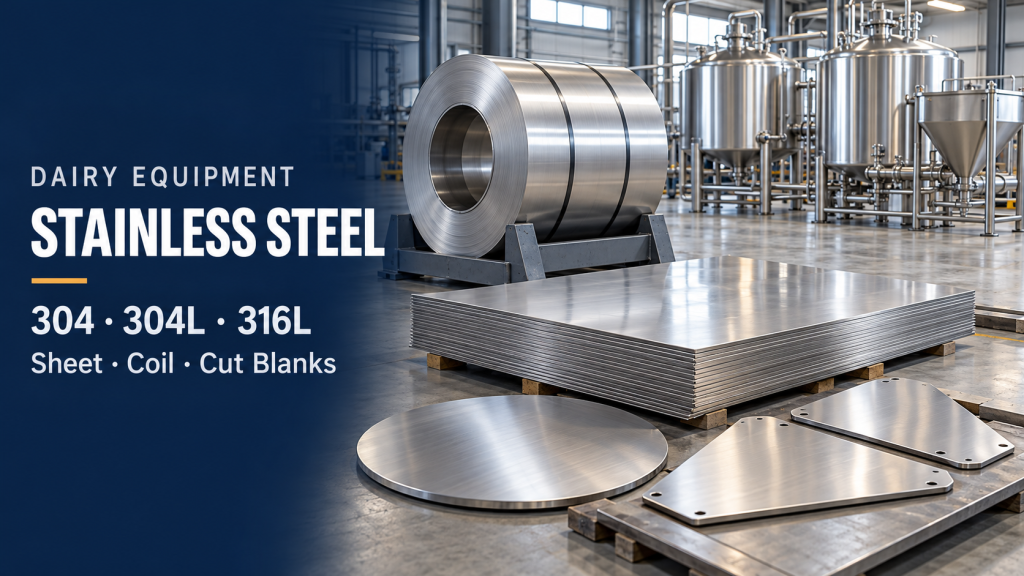 304, 304L and 316L stainless steel can be purchased as sheet, coil or cut blanks for manufacturing dairy tanks, blending vessels, ingredient hoppers, conveyor contact plates and cleaning equipment. Once the grade is approved for the application, the purchase format determines which cutting, handling and inspection operations remain with the equipment builder.
For projects in Altai Krai, Russia, this is a practical supply-chain decision. The public catalogue of MOLLCOM in Barnaul includes dairy storage vessels, cheese and curd equipment, and cleaning stations. These equipment categories illustrate the regional manufacturing context; the purchasing guidance below is a general framework for equipment builders.
A useful quotation should therefore answer two questions: what material is being delivered, and how much work is still required before that material becomes an acceptable production component?
Which Equipment Components Create the Material Order?
Start with the manufactured part rather than combining every requirement into a single tonnage. The following applications are candidates for these stainless grades where the equipment design and service conditions permit them.
| Equipment manufactured | Sheet, plate or blank requirements | Purchase-format decision |
|---|---|---|
| Milk holding and balance tanks | Shell panels, bottom blanks, covers and flat internals | Compare available sheet sizes with approved shell developments and workshop handling capacity. |
| Dairy, beverage and ingredient blending vessels | Vessel-wall blanks, baffles, lids and addition panels | Separate large shell pieces from small repeated internals before choosing full sheets or cut parts. |
| Powder and ingredient hoppers | Cone segments, folded side panels, lids and discharge chutes | Use the approved flat patterns to assess nesting, bend allowances and repeated-batch demand. |
| Product-transfer and conveyor assemblies | Contact plates, guides and removable transfer panels | Evaluate cut blanks where hole positions, edges, finish direction and piece counts are already defined. |
| CIP reservoirs and parts-washing units | Tank panels, wash-chamber sheet, trays and selected internal parts | Keep different approved grades and contact-face requirements separate when combining the order. |
Tubing, fittings, agitator shafts and complete machines require separate specifications. A sheet or blank order does not establish their supply scope.
Approve 304, 304L or 316L Before Comparing Prices
- 304 — UNS S30400; commonly associated with EN 1.4301: a candidate for compatible-service tanks, formed hoppers and contact panels. The grade supports many forming and welding applications, subject to the fabrication procedure and operating conditions.
- 304L — UNS S30403; commonly associated with EN 1.4307: a lower-carbon option often selected for welded food-equipment components. Lower carbon reduces susceptibility to sensitization and associated intergranular corrosion; it does not provide a substantial upgrade in chloride-pitting resistance over 304.
- 316L — UNS S31603; commonly associated with EN 1.4404: a low-carbon, molybdenum-bearing option where additional resistance to localized corrosion is needed. Suitability still depends on the actual product, cleaning chemicals and exposure conditions.
These grade references do not establish automatic equivalence between complete ASTM and EN requirements. Outokumpu’s Core grade information and Supra grade information provide useful identification and alloy-family references.
For a cleaning-related material review, use JUDE’s 304, 304L and 316L dairy-equipment CIP guide. Do not choose a different grade merely to use a more convenient stock size.
Compare Sheet, Coil and Cut Blanks at the Same Delivery Stage
Sheet and plate for varied dimensions or project batches
Discrete sheets allow the workshop to allocate material across different components and drawing revisions. They can suit equipment projects where shell panels, hopper sections and small internals have different shapes or production schedules.
Compare stock width and length with the approved cutting layout. An oversized sheet may reduce joining in one component while leaving less usable material elsewhere. Review JUDE’s stainless steel sheet options and request the actual size, finish and availability for each grade.
Coil for recurring demand with a defined processing route
Coil becomes a purchasing option when repeat demand and processing capability justify it. The buyer or an agreed processor needs to handle the coil, level and cut it as required, and protect the contact surface through those operations.
Confirm inside and outside diameter, maximum coil mass, usable width, edge condition and the required condition after processing. Allocate responsibility for the remaining coil when a production batch uses only part of it. JUDE’s stainless steel coil range provides a product starting point; suitability depends on the order and downstream equipment.
Cut blanks for a released drawing and a clear quantity
Cut blanks can reduce the cutting work remaining at the equipment factory. Define whether the quotation includes only the outline or also holes, edge preparation, deburring, surface protection and identification.
Ask for a drawing review through JUDE’s laser-cutting service. The workshop should approve developed dimensions and allowances before cutting. A cut circle is still an input to head forming, and a flat hopper pattern still requires its specified forming and finishing operations.
Calculate Cost per Accepted Blank
Choose a common comparison stage, such as an inspected blank ready for forming. Include every cost needed to reach that stage:
Estimated cost per accepted blank =
(Delivered purchase cost + remaining processing + inspection and handling − recoverable scrap value) ÷ accepted blank quantity.
Keep the currency, delivery terms, grade, thickness, finish and drawing revision consistent. Count processing already included in the purchase price only once. Use agreed estimates before ordering and actual results when reviewing production performance.
Illustrative nesting calculation: for one grade and thickness, a 75% geometric area yield requires approximately 1.33 m² of purchased sheet for each 1 m² of net blank area, because 1 ÷ 0.75 = 1.33. This is arithmetic, not a promised production yield. Kerf, edge trimming, permitted part orientation, defects and additional rejects must be reflected in the actual estimate.
For blanks priced per piece, ask whether material loss is already included and who retains the remnants. Apply a scrap credit only where it will actually be recovered by the party whose costs are being compared.
Define Material and Surface Acceptance Before Cutting
For an ASTM-based flat-product order, specify the applicable edition of ASTM A240/A240M and the relevant ASTM A480/A480M general requirements. Identify the unit system and required delivery condition. Where the approved Russian drawing uses a GOST or TU reference, retain that requirement and obtain approval for any alternative.
Separate incoming thickness and flatness requirements from finished component tolerances. Forming, welding and polishing can change the part; starting thickness and allowances must come from the approved manufacturing and design requirements.
Identify the product-contact face, supplied finish, any specified roughness limit and the inspection stage. A 2B or No. 4 finish label alone does not define a complete hygienic acceptance specification. Confirm who performs final weld finishing, cleaning and any specified surface treatment; polishing scope should be quoted against the actual part.
Pack the Order Around the Assembly Schedule
For a project containing tank shells, hoppers, contact plates and cleaning-unit parts, request a packing list by assembly and part number. Preserve the link between each item, its grade, material certificate and heat identification after cutting.
Agree surface protection, separation between parts, permissible identification locations and handling requirements. Give the exact destination in Altai Krai and the required sequence of deliveries so the quotation can address the real receiving and assembly plan.
Frequently Asked Questions
What if I have only the finished-part drawing?
Identify who will develop and approve the flat pattern. Bend allowances, forming allowances and trimming provisions depend on the intended fabrication route. Do not treat an unapproved outline extracted from a finished drawing as a released cutting file.
Should protective film and packaging be included in the invoiced steel weight?
Agree the commercial weight basis before ordering. The quotation should distinguish net steel weight, gross shipment weight and separately charged packaging or processing. Use the same basis when comparing offers.
Can a drawing revision be applied after the blanks are cut?
Only after reviewing the affected pieces. A change may be achievable by further processing, or it may require replacement material. Define the drawing release point and change-approval process before work starts.
Request a 304, 304L or 316L Material Package
Preparing dairy, beverage or blending equipment for an Altai Krai project? Send JUDE Steel your material list and approved drawings, and identify whether you want sheet, coil, cut blanks or a comparison of these options.
- Parts: assembly names, part numbers, drawing revisions and quantities.
- Material: approved grade, product standard, edition and delivery condition.
- Dimensions: thickness, sheet or blank sizes, tolerances and coil handling limits where applicable.
- Surface: contact face, finish, protection and required inspection.
- Processing: cutting, holes, edge work, polishing and identification.
- Documentation: material certificates, traceability and additional agreed tests.
- Delivery: named destination, required date, delivery term and batch schedule.
Use our material quotation form or email support@jiscojude.com with the subject Altai Krai Dairy Equipment Material RFQ. Request separate confirmation of material availability, processing capability, minimum order, lead time and any proposed deviations.
